The Meiji Restoration in five minutes
The Meiji Restoration was the political revolution of 1868 in which samurai from several Japanese domains ended the 265-year-old Tokugawa shogunate and set up a government in the name of the teenage Emperor Meiji. Over the next two decades the new leaders replaced a patchwork of feudal domains with a centralised state, a conscript army, railways, schools and, in 1889, a written constitution.
It belongs to the larger story told in Qing China, Japan and the West (1793–1912): how the industrial powers pushed into East Asia. Japan and China faced similar pressure. What set Japan apart was that a small group of leaders chose to rebuild the state itself, quickly, while the danger was still at the door.
Historians usually date the Restoration itself to 1868. The story, though, starts with the American fleet in 1853 and runs on to the constitution of 1889.
Causes: pressure from outside, strain inside
Two centuries of limited contact
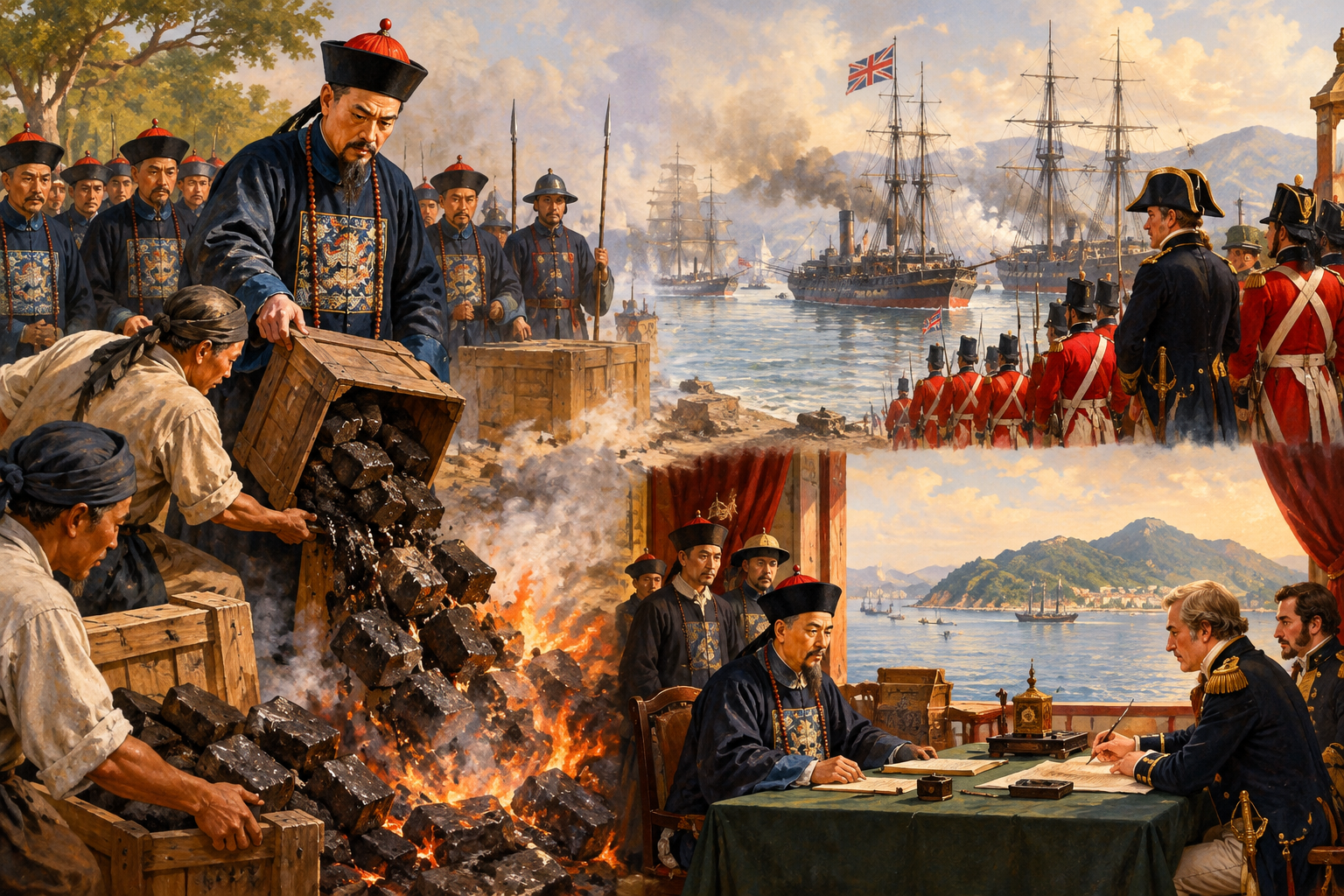
From the 1630s the Tokugawa shoguns allowed only a few channels to the outside world: Dutch and Chinese traders at Nagasaki, plus relations with Korea and the Ryukyu Kingdom. Peace lasted for generations. But Japan's rulers watched closely when Britain defeated Qing China in the First Opium War (1839–1842). The news showed them what steam warships and modern guns could do to a much larger country.
The black ships and the unequal treaties
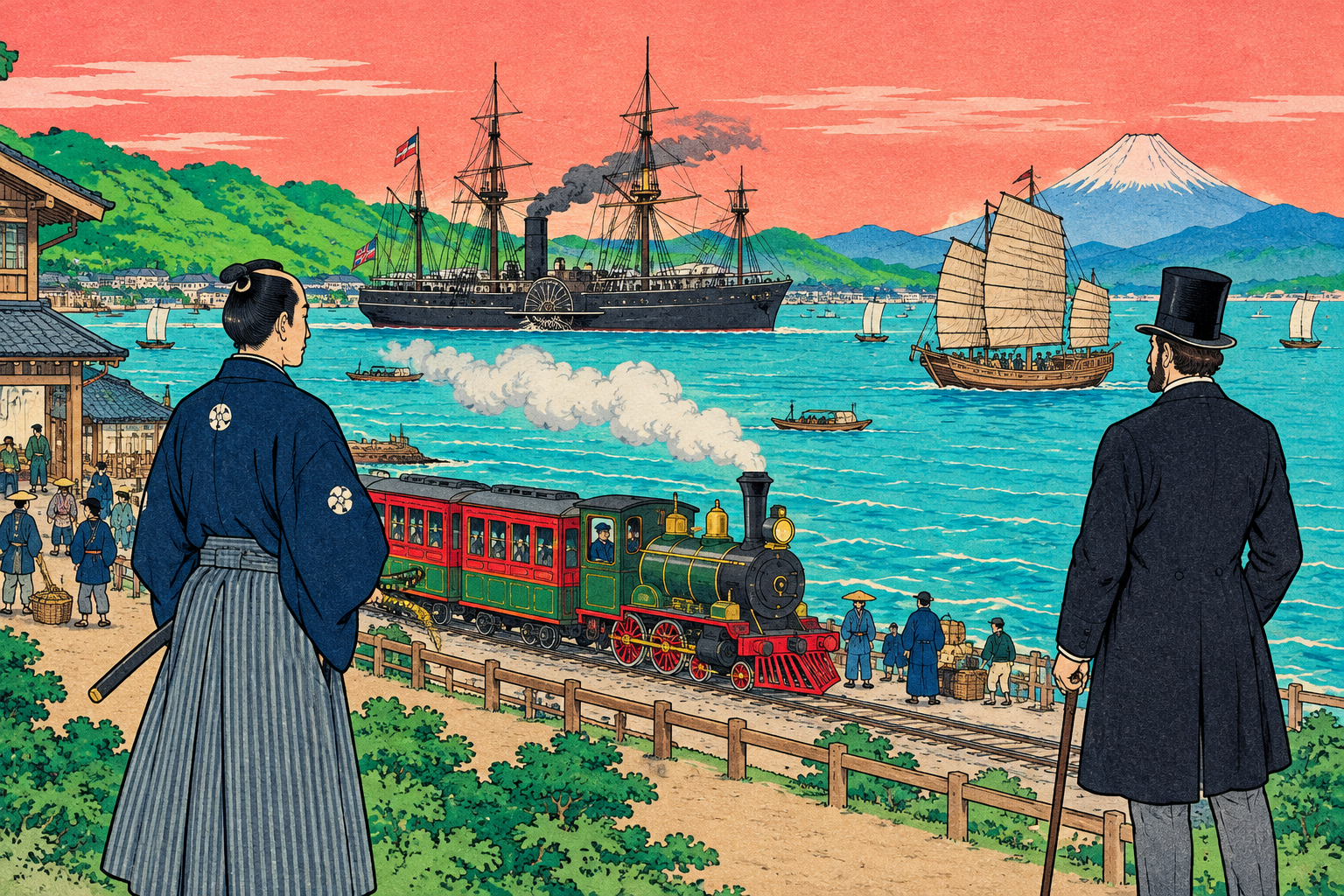
In July 1853 Commodore Matthew Perry brought US Navy steamships into Edo Bay and delivered a letter asking for trade and for ports where American ships could take on supplies. He returned in 1854, and the Convention of Kanagawa opened two ports to American ships. The full story is in Commodore Perry and the Opening of Japan (1853).
In 1858 the shogunate signed a Treaty of Amity and Commerce with the United States, followed by similar treaties with the Netherlands, Russia, Britain and France, together called the Ansei Treaties. They opened more ports and set low import duties that Japan could not change on its own. They also let foreign residents be tried by their own consuls, a right known as extraterritoriality. Japanese leaders came to call these unequal treaties, and ending them became a national goal for the next half century.
A shogunate losing its grip
The treaties were signed without the emperor's approval, and the criticism was fierce. The senior official Ii Naosuke punished his opponents, then was assassinated by samurai outside Edo Castle in 1860. The shogunate looked weaker with every year. Powerful domains such as Satsuma in southern Kyushu and Chōshū in western Honshu wanted a bigger say. Their rallying cry was sonnō jōi, "revere the emperor, expel the barbarians."
The slogan met reality quickly. In 1862 samurai from Satsuma killed a British merchant near Yokohama, and in 1863 British warships bombarded Kagoshima, Satsuma's main town. In the same year Chōshū fired on foreign ships at Shimonoseki, and in 1864 a combined fleet of British, French, Dutch and American ships destroyed its shore batteries. Both domains drew the same conclusion: expelling foreigners was impossible, so Japan had to learn Western methods and build comparable strength.
What happened, 1866–1869
Satsuma and Chōshū had been rivals. In 1866 they formed a secret alliance, helped along by Sakamoto Ryōma, a samurai from Tosa. In November 1867 the last shogun, Tokugawa Yoshinobu, offered to return political authority to the emperor, hoping to keep a leading place in whatever council followed. On 3 January 1868 the court, steered by Satsuma, Chōshū and allied nobles, announced the "restoration of imperial rule." The shogunate was abolished, and Yoshinobu was told to give up his rank and lands.
Fighting began at Toba–Fushimi near Kyoto in late January 1868. The smaller imperial force won. Edo Castle then surrendered without a battle in April, after talks between Saigō Takamori for the new side and Katsu Kaishū for the shogunate. Resistance continued in the north and ended in 1869 at Hakodate on Hokkaido. This conflict is called the Boshin War, after the year name in the old calendar.
In April 1868 the new government issued the Charter Oath, five short articles that promised public discussion of policy and said knowledge should be sought "throughout the world." Later that year the era was named Meiji. Edo was renamed Tokyo, and the emperor moved there in 1869.
Building a new state, 1869–1889
The leaders of the new government were mostly young samurai from Satsuma, Chōshū, Tosa and Hizen. They worked under three slogans: "rich country, strong army," "increase production and promote industry," and "civilisation and enlightenment." The main steps were these.
- 1869: the daimyo returned their domain registers, handing their lands and people to the emperor.
- 1871: the domains were abolished and replaced by prefectures run by officials the government appointed. Feudal Japan ended as an administrative system.
- 1871–1873: the Iwakura Mission, led by senior ministers, toured the United States and Europe to study institutions and to try, without success, to open talks on the treaties.
- 1872: the first railway opened between Shimbashi in Tokyo and Yokohama. The government also set up a national school system and ran model factories such as the Tomioka silk mill.
- 1873: a conscription law created an army of commoners, and land tax reform replaced rice payments with a cash tax based on land value.
- 1877: the Satsuma Rebellion, led by Saigō Takamori and angry former samurai, was crushed by the conscript army.
- 1889: the Meiji Constitution was promulgated on 11 February, and the first Diet met in 1890.
The changes had real costs. Samurai lost their status and their stipends, and the cash land tax sparked peasant protests. Many former samurai found the new order bitter, which helped fuel the rebellions of the 1870s.
Why it matters in world history
Japan and Qing China received the same shock from the same powers, yet they went in different directions. China's Self-Strengthening Movement, from the 1860s, bought weapons and built arsenals and shipyards, but the imperial system stayed in place. Japan dissolved its old order and rebuilt the state from the centre. The Meiji leaders also had advantages: a small, homogeneous country, a samurai class used to administration, a literate population and a competitive Western world that never united against Japan.
The results showed quickly. Japan won the Sino-Japanese War of 1894–1895, a war that grew out of a crisis in Korea; see The Donghak Peasant Revolution (1894). It signed an alliance with Britain in 1902 and defeated Russia in 1904–1905. Treaty revision moved step by step: Britain agreed in 1894 to end extraterritoriality, which took effect in 1899, and Japan regained full control of its tariffs in 1911.
The same state also became an imperial power, taking Taiwan in 1895 and annexing Korea in 1910. The Meiji Restoration is often called a revolution from above, because samurai elites led it instead of peasants or merchants. It showed that a non-Western country could industrialise and compete with the Western powers, and it also showed how that power could be turned outward.
What exams ask
- When: know 1853 (Perry), 1858 (the Ansei Treaties), 1867 (return of power), 1868 (Restoration and Boshin War), 1871 (prefectures), 1873 (conscription and land tax) and 1889 (constitution).
- Causes: outside pressure (Perry, unequal treaties), a weakening shogunate, and ambitious domains such as Satsuma and Chōshū.
- Compare: an AP-style question asks you to compare Japan's response to Western pressure with China's. Use the contrast between state-building and limited self-strengthening, and name the Meiji reforms as evidence.
- Significance: Japan avoided colonisation, ended the unequal treaties, and became an imperial power by 1895.
Read next
- Commodore Perry and the Opening of Japan (1853): the arrival that started the crisis, told in detail.
- The First Opium War (1839–1842): the Chinese defeat that warned Japan's leaders what was coming.
- The Donghak Peasant Revolution (1894): the Korean uprising that led into the first war Japan fought as a modern power.
- Qing China, Japan and the West (1793–1912): the hub that puts all of these in one timeline.