In five minutes
The 1911 Revolution, also known as the Xinhai Revolution, was the uprising that toppled the Qing dynasty and ended China's imperial system. It began with a revolt in Wuchang on 10 October 1911, and within months the last Qing emperor had abdicated and a republic had been declared. The name comes from the traditional Chinese calendar, in which 1911 is called xinhai.
To understand why it happened, you need the longer story. Before 1911 the Qing court had lost wars to foreign powers, owed heavy payments to them and watched parts of its territory fall under foreign influence. The court tried to reform itself, but the changes came too slowly for many people. For the wider background, see our hub Qing China, Japan and the West (1793–1912).
Causes: a court losing its grip
The roots go back further than 1911. Britain's victory in the First Opium War (1839–1842) ended with the Treaty of Nanking, which opened several ports to trade and handed Hong Kong island to Britain. Japan's victory in the Sino-Japanese War of 1894–1895 cost China the island of Taiwan. In 1898 the Hundred Days' Reform, a burst of modernising reform, was ended by a court coup led by the Empress Dowager Cixi. Each defeat and each failed reform made it harder for the court to claim it could protect the country.
Three pressures pushed the Qing toward collapse. The first was reform that came late and unsettled many people. In 1905 the court abolished the civil service examinations, which had chosen officials through Confucian learning for more than a thousand years. The aim was to build modern schools and a new officer class. But the change also closed the old career path for many scholars, and reform was expensive: new schools and armies needed money that the treasury did not have.
The second pressure was debt and foreign control. After the Boxer uprising, the Peking Protocol of 1901 required China to pay a large indemnity to foreign states. The money came from higher taxes and loans, and foreign powers still held railway and mining rights in several regions. Many people felt the country's wealth was slipping into foreign hands piece by piece.
The third pressure was the railway crisis of 1911. In May the government announced that major railway lines would be taken under state control, and it agreed to a foreign loan backed by railway rights. In Sichuan, where local shareholders had put up much of the money for the lines, anger grew into a broad protest movement known as the Railway Protection Movement. The court sent troops from central China to deal with it, and some of those troops were pulled away from the Wuhan area, which weakened the defence of Wuchang. Historians often see this crisis as the link between reform and revolt.
Revolutionaries had been organising for years. Sun Yat-sen and his allies founded the Revolutionary Alliance, known in Chinese as Tongmenghui, in Tokyo on 20 August 1905. Its programme rested on the Three Principles of the People: nationalism, democracy and people's livelihood. Its members were spread across China and overseas, so organising a coordinated rising was never simple.
Earlier attempts had failed. A rising planned in Guangzhou in 1895 was discovered and crushed before it could begin. In April 1911 another Guangzhou rising, the Huanghuagang Uprising, was defeated within about a day, and many of its fighters were killed. Each failure taught the organisers that they needed support inside the army, and the New Army, the modern units trained along Western lines, was where to look.
What happened in the 1911 Revolution
The uprising started almost by accident. In early October 1911, revolutionaries were making bombs in Hankou's Russian concession when one exploded. Russian police arrested several people and seized membership registers that listed revolutionaries in the New Army. The plot was exposed, and the organisers had to act sooner than planned.
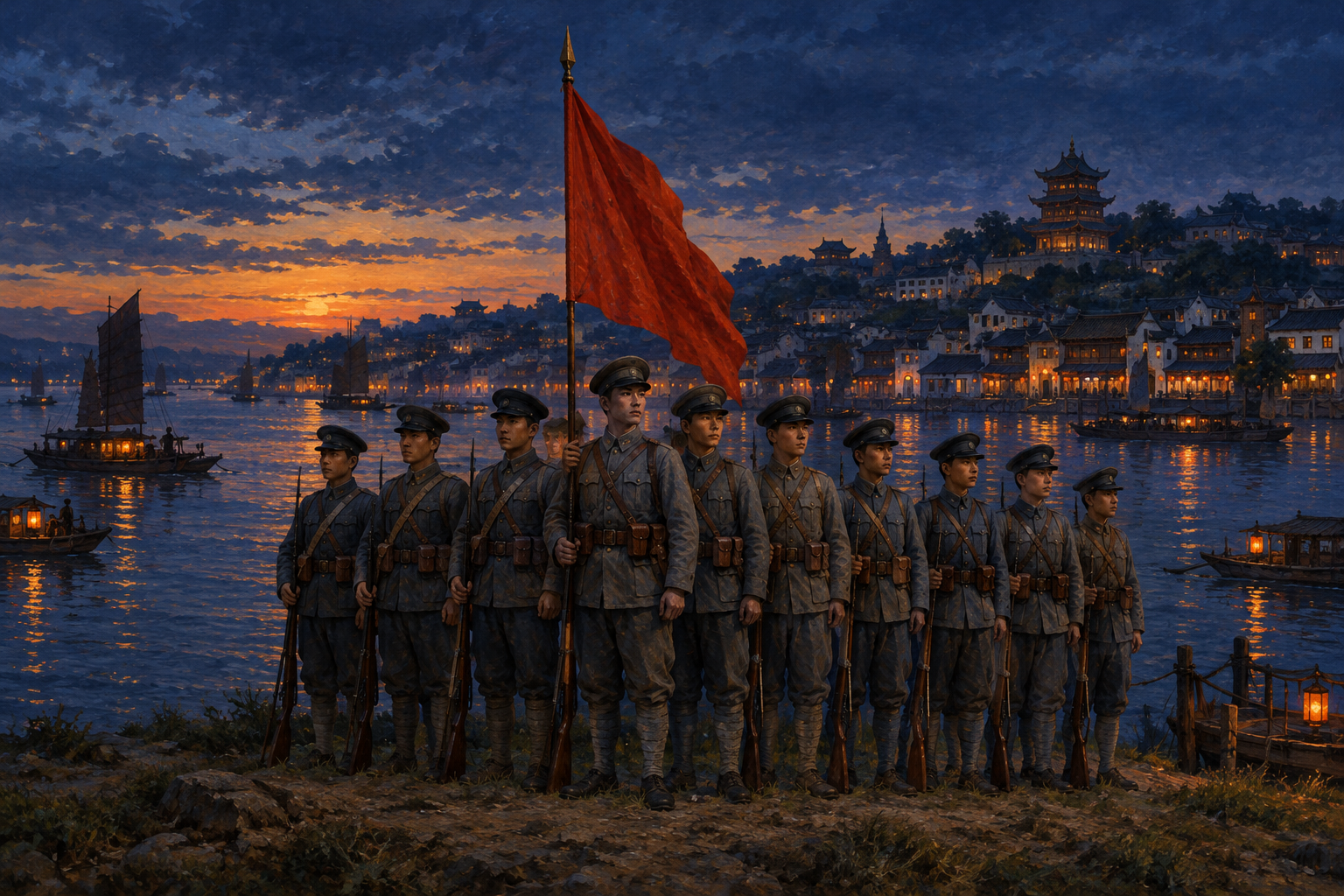
On 10 October 1911, New Army soldiers in Wuchang rose up and attacked the residence of the Qing viceroy. The city fell to the rebels quickly. Hanyang and Hankou, the neighbouring cities across the rivers, were taken on 11 and 12 October. Sun Yat-sen was abroad at the time and read about the uprising in a newspaper the next morning.
The rebels in Wuchang needed a figurehead. They chose Li Yuanhong, an army officer, as their military governor, giving the new movement a leader on the spot. Many provinces did not fight at all. Local officials, army officers and gentry leaders often decided that the Qing was finished, declared their own independence or simply stopped taking orders from Beijing.
News of the revolt spread fast. Within about two months, roughly a dozen provinces had broken away from Qing rule. The court no longer had a force that could crush the movement everywhere at once. It turned to Yuan Shikai, a capable general who had been dismissed from office earlier. On 1 November 1911 he was appointed prime minister and began talks with the revolutionaries, and those talks were central to what came next.
Consequences: from empire to republic
The Republic of China was declared at Nanjing on 1 January 1912, with Sun Yat-sen as provisional president. About six weeks later, on 12 February, the six-year-old Xuantong Emperor, known as Puyi, abdicated. The imperial system that had ruled China since the Qin unification in 221 BCE was over. Sun then handed the presidency to Yuan Shikai, who was sworn in on 10 March 1912.
The new republic had no strong army and no stable tax base, and many historians argue that this weakness shaped what followed. Political rivals soon clashed. Song Jiaoren, the leading figure behind the Nationalist Party (Kuomintang), which had won the most seats in the first parliamentary elections, was assassinated in Shanghai in March 1913. Sun and others took up arms against Yuan that summer in what is called the Second Revolution, but Yuan's forces defeated the rising within a few months.
Yuan tried to restore the monarchy in 1915, but the plan met strong opposition and he dropped it in 1916. He died that June. Regional military leaders, known as warlords, then competed for power across much of the country. The revolution had ended the empire, but building a stable national state took far longer.
Why does it matter? It ended a political order that had lasted for more than two thousand years. It also made the idea of a republic a central political question for the decades that followed. Historians still debate how much daily life, especially in the countryside, changed after 1912, which shows how much the outcome depended on who held power.
What exams ask
Exam questions usually test three things: causes, key people and results. For causes, expect the abolition of the civil service examinations, the railway crisis and the foreign indemnity. For people, know the difference between Sun Yat-sen, who led the revolutionary movement, and Yuan Shikai, who took over the presidency. For results, remember the republic's founding date and the abdication. AP-style questions often ask you to explain significance: the revolution ended imperial rule, but it did not create a stable state. The strongest answers link cause to outcome, showing that reform came too late to hold the court together and the railway crisis opened the door for the uprising.
A common mistake is to treat 1912 as the start of stable democracy. The republic was founded, but its early years were unstable, and the warlord period that followed shows how far the country was from a settled state.
Read next
- The Scramble for Concessions in China shows the foreign pressure that shaped late Qing reform.
- Sun Yat-sen and the Three Principles of the People explains the ideas and leadership behind the revolutionary movement.
- The First Opium War (1839–1842) goes back to the conflict that first exposed the Qing's military weakness.