In five minutes
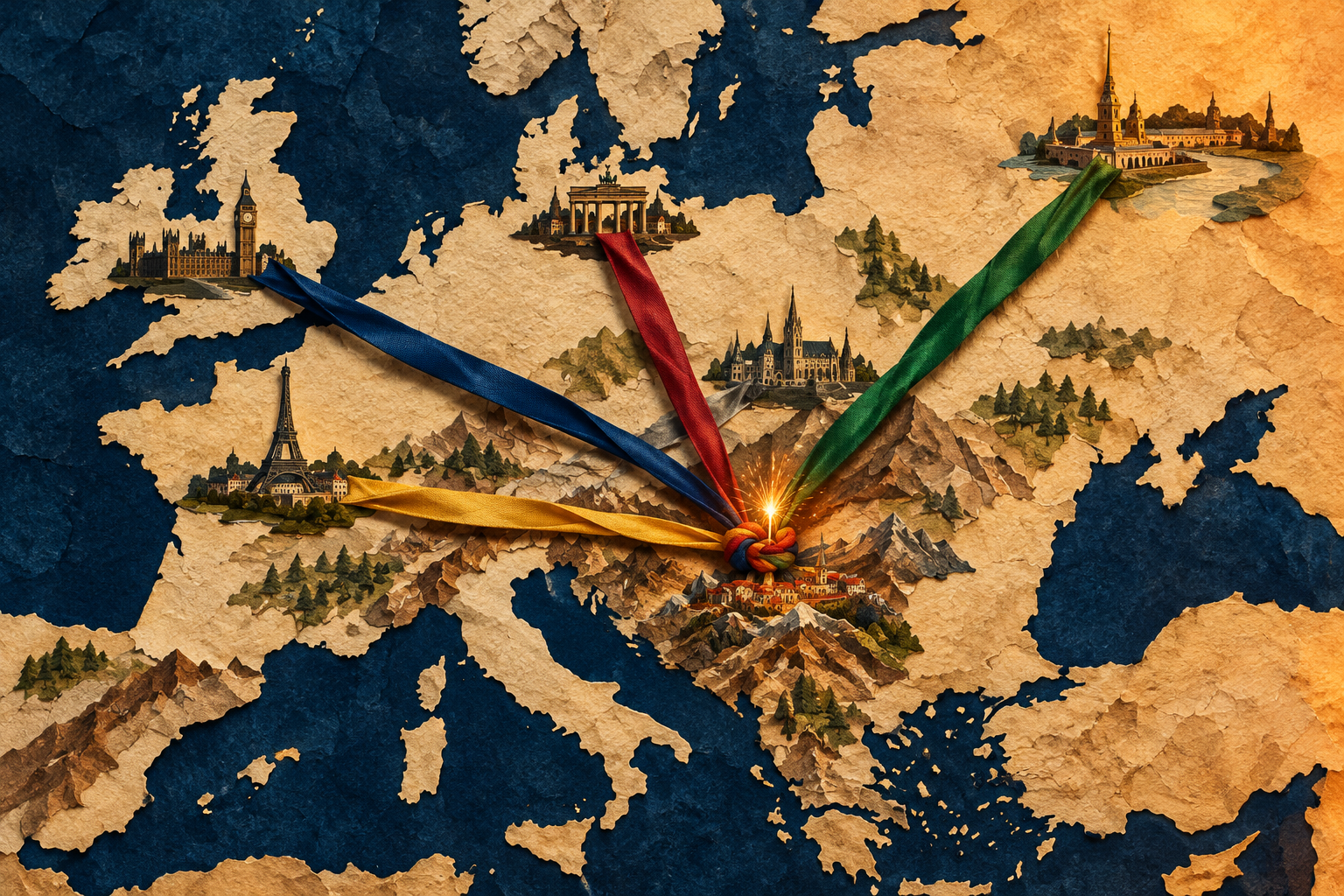
The short answer: WW1 (World War I) began because a murder in Sarajevo set off a crisis that Europe's alliances, armies and rivalries could not contain. On 28 June 1914, Gavrilo Princip, a young Bosnian Serb nationalist, shot Archduke Franz Ferdinand of Austria-Hungary and his wife, Sophie. Within about five weeks, five of Europe's six great powers were at war with one another.
The killing was the spark, but the fuel had been gathering for decades. Rival alliances, a race to build bigger armies and navies, competition for colonies and clashing nationalisms all raised the stakes. Once Austria-Hungary moved against Serbia, these links turned a regional quarrel into a continental war within days, and then into a world war as the fighting spread overseas.
If you want the full course of the war rather than only its causes, the World War I hub covers it from start to finish.
The four long-term causes of WW1
Historians and teachers often group the underlying causes under four headings: militarism, alliances, imperialism and nationalism. Each one raised the stakes on its own. Together, they made a local crisis dangerous.
Militarism: big armies and fixed timetables
By 1914, the major powers had large standing armies, and many relied on conscription, so they could call up millions of men within days. Their general staffs had drawn up detailed plans for mobilising and moving troops by rail. Germany's Schlieffen Plan, for example, depended on defeating France quickly by marching through Belgium before turning east against Russia. Once such plans were in place, many leaders believed that waiting could cost them their advantage, which pushed them towards fast decisions.
Land forces were not the only race. Britain and Germany competed to build ever larger battleships. Britain launched HMS Dreadnought in 1906, and that ship set a new standard which rival navies had to match. Each side read the other's new ships as a threat, which made both feel less secure.
Alliances: two blocs and a chain of obligations
Germany and Austria-Hungary signed a defensive alliance in 1879, and Italy joined them in 1882, forming the Triple Alliance. France and Russia signed a military alliance in 1894. Britain had kept clear of formal commitments on the Continent, but it signed agreements with France in 1904 and with Russia in 1907. These links produced the Triple Entente.
An alliance promised support to a partner that was attacked. A quarrel between two countries could therefore draw in their friends, one after another. Italy, though a member of the Triple Alliance, stayed neutral in 1914 and joined the Allies in 1915. That gap shows that alliances were not automatic.
Imperialism: a race for colonies
The European powers competed for colonies in Africa, Asia and the Pacific. Colonies were tied to prestige, trade and naval bases, so losing a contest could look like a national humiliation. That competition produced repeated crises. In 1905 and 1906, Germany challenged France over Morocco, and in 1911 Germany sent a gunboat to the port of Agadir, starting a second Moroccan crisis. Each showdown made the rivals more suspicious of each other and gave military planners more reason to prepare for war.
Nationalism: unfinished borders and rival peoples
Nationalism pulled countries in different directions. After the Franco-Prussian War of 1870–71, Germany took Alsace-Lorraine from France, and many French people wanted it back. In the Balkans, Serbia hoped to draw other South Slav peoples under its leadership. Austria-Hungary, however, was a multi-ethnic empire and feared that a strong Serbia would encourage its own minorities to break away.
The tension deepened in 1908, when Austria-Hungary annexed Bosnia and Herzegovina, which it had administered since 1878. This angered Serbia and Russia. The Balkan Wars of 1912 and 1913 then left Serbia larger and more confident, and Vienna saw that as a growing threat.
The spark: Sarajevo and the July crisis
Franz Ferdinand, heir to the Habsburg throne, visited Sarajevo on 28 June 1914. That date was Vidovdan, the Serbian feast that marks the Battle of Kosovo in 1389, so it carried symbolic weight for many Serbs. Earlier that morning, another conspirator threw a bomb at the motorcade, but it missed the archduke's car. Later, when the driver took a wrong turn and stopped, Princip stepped up and fired. Both the archduke and Sophie died that day.
Vienna used the killing as a pretext to press Serbia. Germany had already promised its support, a pledge often called the 'blank cheque'. On 23 July, Austria-Hungary sent Serbia an ultimatum with ten demands and 48 hours to reply. Serbia accepted most of the demands but not all of them. On 28 July, Austria-Hungary declared war on Serbia.
The next step was mobilisation. Russia began mobilising its army to support Serbia, and Germany demanded that Russia stop. Once large armies were on the move, it became hard to stop them, and each government felt pressure to act before its rivals did. The July crisis was therefore a race against time as much as a diplomatic dispute.
From one war to a world war
Germany declared war on Russia on 1 August and on France on 3 August. German war plans required a quick march through neutral Belgium. On 4 August, German troops crossed into Belgium. Britain had guaranteed Belgian neutrality under a treaty signed in 1839, and it declared war on Germany that same day.
British entry brought in the Empire, its navy and its colonies, so the war became global in reach. By the end of 1914, the Ottoman Empire had joined the Central Powers, and fighting spread to the Middle East, Africa and the Pacific. What began as a dispute between Austria-Hungary and Serbia had become a war across the world.
What the war changed
The fighting lasted until the armistice of 11 November 1918. By then, the tsarist government in Russia had fallen in 1917, and the German, Austro-Hungarian and Ottoman empires had lost power or broken apart. The Treaty of Versailles in 1919 placed responsibility for the war on Germany and required it to pay reparations. Its terms became a major grievance in Germany during the 1920s.
The war also left millions dead and reshaped the map of Europe and the Middle East. Understanding the causes helps explain why the peace settlement, and the new states that emerged from it, were so contested.
What exams ask
Exam questions often ask you to separate long-term causes from short-term triggers. A strong AP-style answer explains how militarism, alliances, imperialism and nationalism made the system fragile, then shows how the Sarajevo killing and the July ultimatums turned a regional war into a general one. Be ready to order the key dates from 1879 to August 1914, and to explain why Britain's entry changed the scale of the war.
When you write, avoid saying that one country simply caused the war. Stronger answers show how several decisions, taken under pressure, linked together.
Read next
Choose the page that matches your next question:
- The MAIN Causes of WWI: a fuller walk through each of the four causes, with examples for each.
- What Is Militarism? How It Led to WWI: how armies, conscription and war plans shaped the July crisis.
- Triple Alliance vs Triple Entente: a side-by-side look at which countries stood where in 1914.