In five minutes: the Cambodian–Vietnamese War
The Cambodian–Vietnamese War began with Vietnam’s invasion of Cambodia in December 1978. Vietnamese troops and Cambodian forces opposed to Pol Pot’s government took Phnom Penh on 7 January 1979, ending the Khmer Rouge’s rule there. The invasion removed a regime responsible for mass death and persecution, but it also placed Cambodia under Vietnamese military influence for nearly a decade. The Cambodian–Vietnamese War was therefore both a military intervention that toppled the Khmer Rouge government and a long conflict over who would govern Cambodia and whether foreign troops should stay.
The names can be confusing. “Vietnamese invasion of Cambodia” often means the opening campaign of late 1978 and early 1979. “Cambodian–Vietnamese War” usually refers to the wider conflict that continued through the 1980s. Vietnam called its forces volunteers and said it was helping Cambodian allies; many governments and the United Nations treated their presence as a foreign occupation. These descriptions reflect a genuine political dispute, not just a difference in wording.
Why did Vietnam invade Cambodia?
The immediate cause was an escalating border war. After the Khmer Rouge took power in 1975, armed clashes began along the Cambodian–Vietnamese frontier. The Cambodian regime, called Democratic Kampuchea, pursued a radical and violent programme inside Cambodia while its forces attacked Vietnamese border communities. The Extraordinary Chambers in the Courts of Cambodia records early clashes in 1975 and describes the Khmer Rouge’s persecution, purges, forced labour and attacks on Vietnamese people. By 1977 and 1978, border fighting and hostility had intensified.
Hanoi had reasons to fear that the fighting could widen. The Khmer Rouge government was closely supported by China, while Vietnam had formed a treaty relationship with the Soviet Union. Relations between China and Vietnam were deteriorating. Vietnamese leaders also faced a humanitarian and security problem: border attacks drove people from their homes, and a hostile Cambodian government could continue to threaten Vietnam’s southwestern provinces.
These conditions explain why war seemed likely; they do not settle whether the invasion was justified. Vietnam described its intervention as a response to Khmer Rouge aggression and as assistance to Cambodian opponents of the regime. Critics focused on the violation of Cambodia’s sovereignty and the long military presence that followed. Both the immediate security crisis and the larger regional rivalry matter if we want to understand the decision.
How did the invasion unfold?
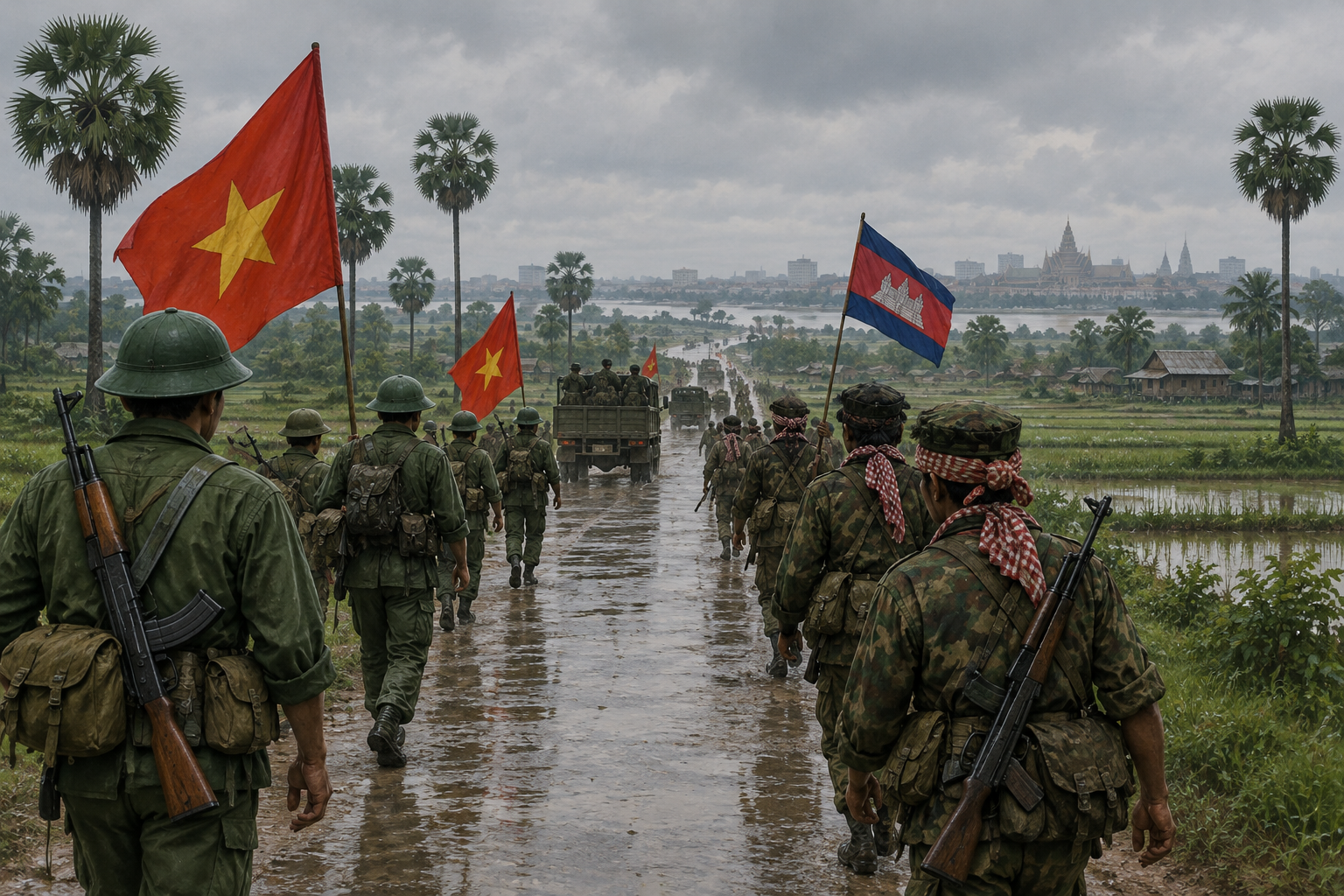
On 25 December 1978, Vietnam began a full-scale offensive with support from Cambodian opponents of the Khmer Rouge. One of these groups was the Kampuchean National United Front for National Salvation, formed by Cambodians who had defected or opposed the regime. Vietnamese forces advanced rapidly, and Khmer Rouge troops and senior leaders retreated westward. The Khmer Rouge’s control over the state collapsed in a matter of weeks.
On 7 January 1979, Vietnamese forces and their Cambodian allies entered Phnom Penh. Pol Pot and other senior Khmer Rouge leaders had fled. The new authorities established the People’s Republic of Kampuchea, led by Cambodian communists who had broken with Pol Pot. Reconstruction began in a country devastated by forced labour, hunger, imprisonment, executions and the collapse of ordinary institutions. The new government could reopen schools and services, but it depended heavily on Vietnamese military support.
The speed of the government’s collapse is important. The invasion did not create the Khmer Rouge’s internal failures; the regime had already destroyed lives and weakened the country through its own policies. But the military victory did not immediately create peace or broad political agreement. Khmer Rouge forces survived, regrouped near the Thai border and continued fighting alongside other resistance factions. The war shifted from a quick campaign against the regime to a prolonged struggle over Cambodia’s future.
Why did the conflict last until 1989?
Vietnam remained militarily involved to support the new government and prevent the Khmer Rouge from returning to power. Resistance forces continued to fight, and the Cambodian conflict became entangled with competition among China, the Soviet Union, the United States, Thailand and the Association of Southeast Asian Nations. China opposed Vietnam’s intervention and launched a brief invasion of northern Vietnam in February 1979. The two conflicts were connected, but they were not the same war: the Sino-Vietnamese War was fought across Vietnam’s northern border, while Vietnamese forces remained in Cambodia.
The international response reflected this divide. In 1979, the United Nations General Assembly called for foreign forces to leave Cambodia and for Cambodians to choose their government without outside interference. In practice, governments disagreed over which Cambodian representatives should be treated as legitimate. Diplomatic recognition, the Khmer Rouge’s continuing armed resistance and the presence of Vietnamese troops all complicated efforts to settle the conflict.
Vietnam began partial withdrawals in the 1980s. It announced the complete withdrawal of its forces in September 1989, although the announcement was not independently verified at the time. The end of the military presence did not end Cambodia’s conflict at once. Negotiations continued, and the Paris Peace Agreements of October 1991 set out a framework for a political settlement and a United Nations transition. The long gap between the fall of Phnom Penh and the peace agreement shows why a military victory is not the same as a durable political settlement.
What should you remember for an exam?
Keep three stages separate. First, Khmer Rouge rule and escalating border violence created the immediate crisis. Second, Vietnam’s invasion in December 1978 toppled the regime in January 1979 and brought a new Cambodian government to power. Third, the continued Vietnamese presence and armed resistance turned the outcome into a regional and international dispute that lasted through the 1980s.
A strong answer explains both causes and consequences. Mention Vietnam’s security concerns and Cambodian border attacks, then explain how China’s support for the Khmer Rouge and the wider Cold War rivalry shaped the conflict. Finally, distinguish the end of Pol Pot’s government from the end of the Cambodian–Vietnamese War and from the 1991 peace settlement. These were different turning points.
One useful question is: “How could an intervention that ended Khmer Rouge rule also create a prolonged dispute?” Answer it by considering the contrast between the immediate result—removing the government in Phnom Penh—and the longer questions of sovereignty, military occupation, resistance and international recognition. This framing avoids treating the event as either a simple rescue or a simple act of expansion.
FAQ
When did Vietnam invade Cambodia? Vietnam launched its full-scale invasion on 25 December 1978. Vietnamese forces entered Phnom Penh on 7 January 1979, and Pol Pot’s government lost control of the capital. Vietnamese forces remained in Cambodia until Vietnam announced their complete withdrawal in September 1989.
Why did Vietnam invade Cambodia? The immediate context was escalating border warfare, including attacks by Khmer Rouge forces on Vietnamese communities. Vietnam also supported Cambodian opponents of Pol Pot. Regional competition—especially China’s support for the Khmer Rouge and Vietnam’s ties to the Soviet Union—shaped the wider conflict.
Did the invasion end the Cambodian–Vietnamese War? No. It ended Khmer Rouge rule in Phnom Penh, but armed resistance continued and Vietnam kept troops in Cambodia. Vietnam announced a full withdrawal in 1989; negotiations continued until the 1991 Paris Peace Agreements.
Was the 1979 China–Vietnam War the same conflict? No. China’s brief invasion of northern Vietnam in February 1979 was a separate war. It was connected to Vietnam’s intervention in Cambodia, but it took place on Vietnam’s northern border, not in Cambodia.
What happened to Cambodia after the invasion? The People’s Republic of Kampuchea took power with Vietnamese support. The country began rebuilding after years of Khmer Rouge rule, while resistance groups and international disputes continued. A political agreement followed in 1991, and the United Nations later helped oversee Cambodia’s transition.
Read next
This article is part of our Vietnam: Indochina Wars and the Vietnam War topic. Start with the wider Vietnam War overview to place the later regional conflicts in context.
Read about the Sino-Vietnamese War to see how the Cambodian intervention and China’s 1979 attack on Vietnam were connected. Our guide to Vietnam’s reunification explains the state that made the decision to intervene. For the earlier war and its logistics, see the Ho Chi Minh Trail.