In five minutes: what was the Sino-Vietnamese War?
The Sino-Vietnamese War was a large-scale Chinese invasion of northern Vietnam from 17 February to 16 March 1979. Chinese forces crossed the border, fought toward several provincial centers and towns, then withdrew. Vietnam stayed in Cambodia, and China did not occupy Vietnamese territory permanently. Beijing described the operation as a punitive action that had achieved its purpose. Hanoi presented the withdrawal as proof that Vietnam had resisted the invasion. The governments judged the outcome by different aims.
The war grew from several disputes that had become entangled. China and Vietnam argued over their border and over the treatment and departure of ethnic Chinese residents in Vietnam. Their governments also supported opposing sides in the widening conflict in Cambodia. Vietnam’s closer relationship with the Soviet Union added a Cold War dimension. The invasion was a campaign to impose costs and send a political message, rather than a successful attempt to conquer Vietnam or replace its government.
- When: 17 February to 16 March 1979; China announced withdrawal on 5 March.
- Where: Northern Vietnam, along the border with China.
- Who: China and Vietnam.
- Regional flashpoint: Vietnam’s invasion of Cambodia and the removal of China’s Khmer Rouge ally.
- Initial Chinese force: Estimates range from about 150,000 to 220,000 troops.
- Outcome: Chinese forces withdrew; both governments claimed success.
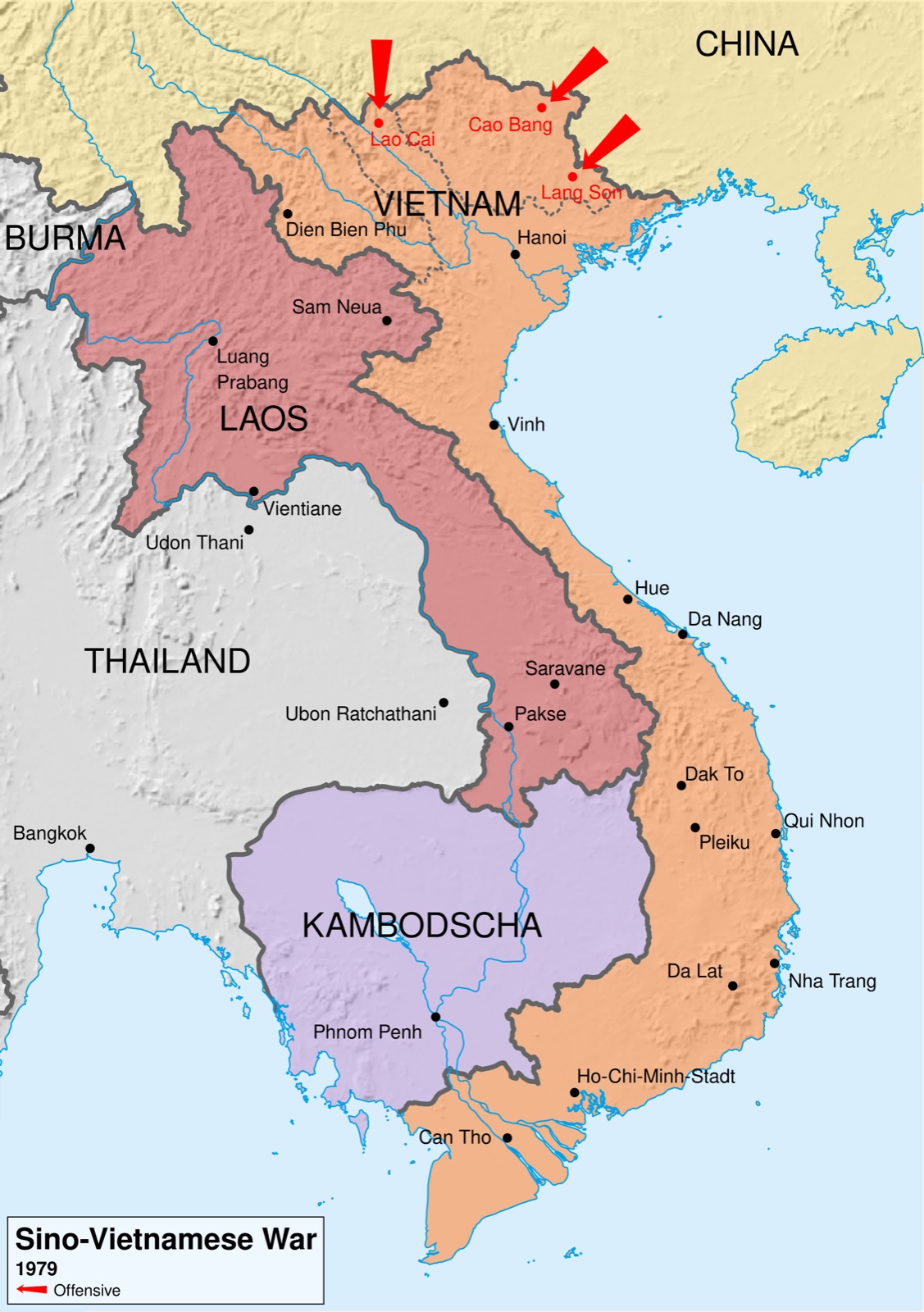
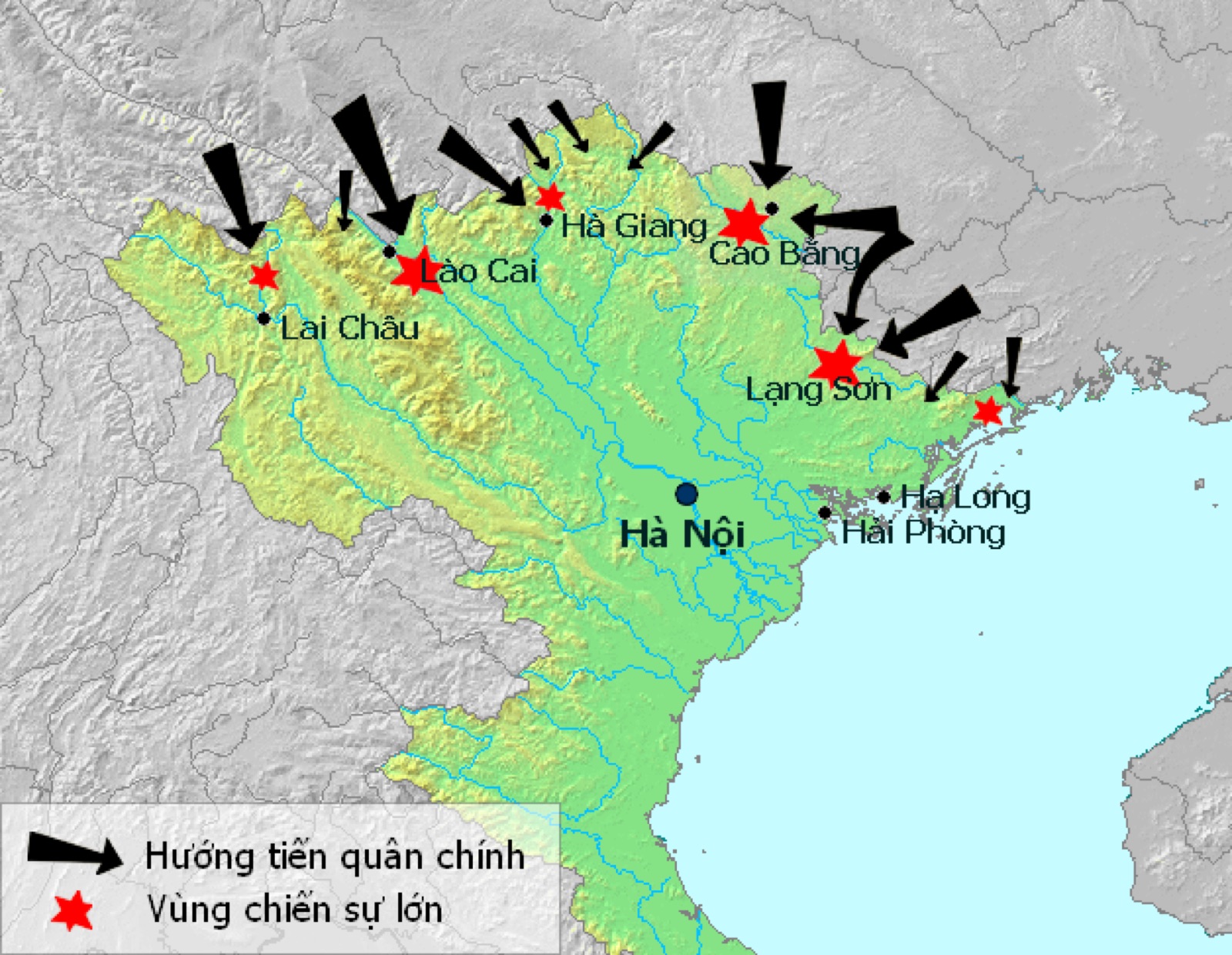
The campaign began along several parts of the frontier, including routes toward Cao Bằng, Lào Cai and Lạng Sơn. Vietnamese regular forces, local troops and militia resisted. China announced its withdrawal on 5 March, but its forces did not complete the withdrawal until 16 March.
The maps show why the campaign was not a single march toward Hanoi. For the wider context of Vietnam’s earlier war, read The Vietnam War Explained. Vietnam’s Invasion of Cambodia follows the regional crisis that became a central flashpoint.
Why did China attack Vietnam?
There was no single cause. The border had been a source of friction for years, with disputes over territory and accusations about incidents along the frontier. Relations also worsened over the movement and treatment of ethnic Chinese residents in Vietnam. These problems helped build distrust, while the conflict in Cambodia and the rivalry between China and the Soviet Union shaped the timing and political setting of the campaign.
The most immediate regional flashpoint was Cambodia. Vietnam and the Khmer Rouge had fought along the Cambodian border. On 25 December 1978, Vietnam began a full-scale invasion of Cambodia. Vietnamese forces removed the Khmer Rouge from power and supported a government aligned with Hanoi. China had backed the Khmer Rouge government, so it viewed Vietnam’s intervention as a major blow to its ally and as evidence that Vietnam was expanding its influence in the region.
Vietnam described its action as a response to Khmer Rouge attacks and a security necessity. Cambodia’s people had suffered under Khmer Rouge rule, and the invasion and conflict that followed brought further hardship. The border war cannot be understood only as a contest between Beijing and Hanoi; Cambodian civilians were also caught in the events that helped trigger it.
The Soviet connection added another layer. Vietnam and the Soviet Union signed a Treaty of Friendship and Cooperation on 3 November 1978. China and the Soviet Union were bitter rivals, and Beijing saw Vietnam’s closer relationship with Moscow as relevant to the balance of power in Southeast Asia. The treaty did not mean that the Soviet Union would automatically enter a war on Vietnam’s behalf, and Moscow did not intervene militarily in the border campaign. Chinese leaders still had to consider how the Soviet Union might respond.
During his visit to the United States in January 1979, Chinese leader Deng Xiaoping told President Jimmy Carter that China intended to act against Vietnam in response to its invasion of Cambodia. The warning came only weeks before the attack. China called its operation a limited punitive action, intended to teach Vietnam a lesson. That was Beijing’s stated justification; Chinese forces nevertheless crossed into Vietnamese territory. The border conflict, the Cambodian war, the Soviet-Vietnam relationship and China’s regional aims overlapped.
How the campaign unfolded
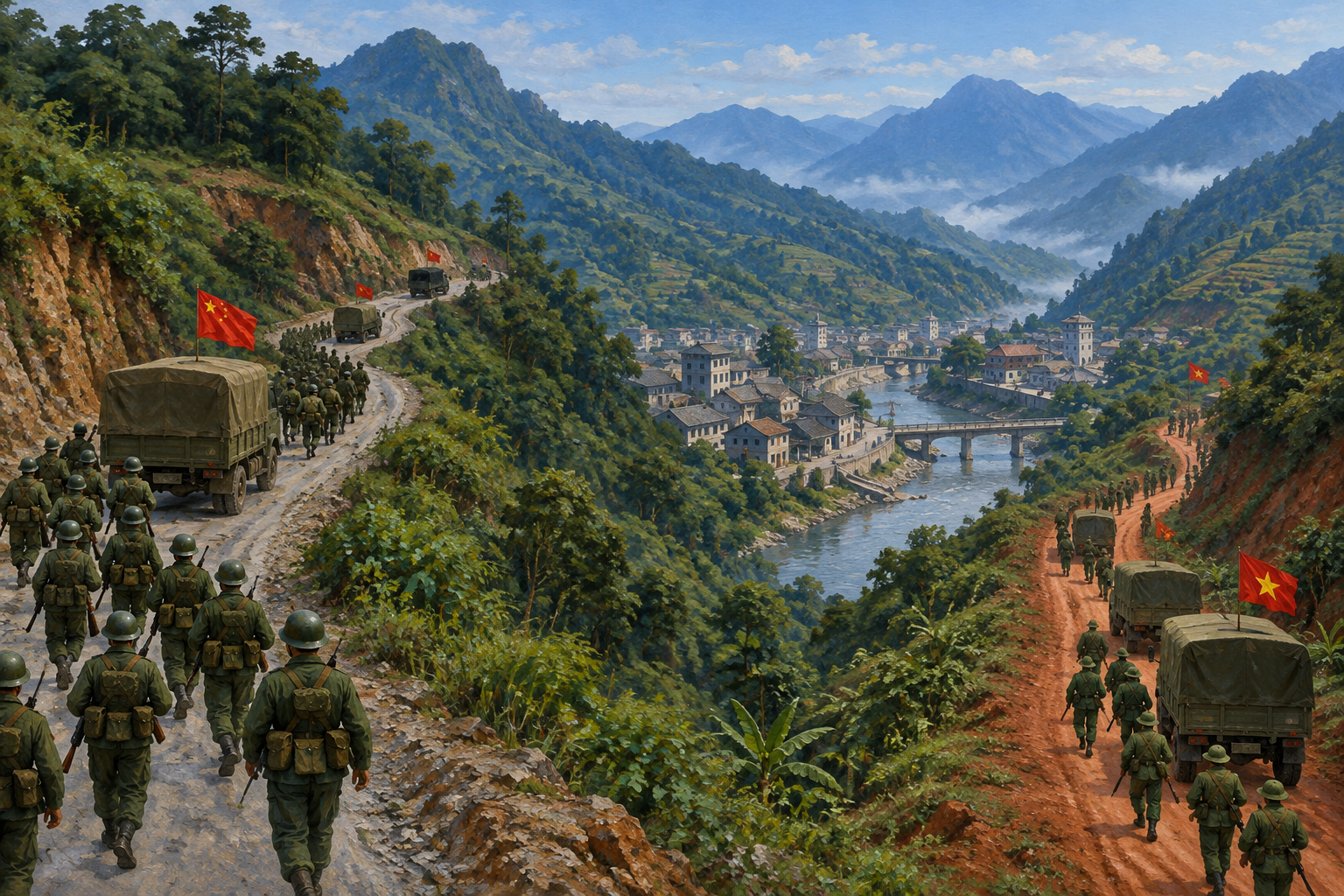
On 17 February, Chinese forces crossed the border from Guangxi in the east and Yunnan in the west. Published estimates of the initial force range from about 150,000 to 220,000 troops. Attacks spread across a broad part of the northern frontier instead of following one road toward the capital. Chinese units advanced toward border towns, transport routes and provincial centers, including areas around Lạng Sơn, Lào Cai and Cao Bằng.
The campaign map shows several approaches through a region of mountains, valleys and limited roads. Units moving along separate routes had to coordinate and supply themselves over difficult ground. A town’s importance could come from its position on a road or route through the hills, not simply from its size. Maps show the direction of an advance, but they cannot show the pressure of combat on local people or the practical difficulties faced by individual units.
The People’s Liberation Army had greater numbers and artillery, but its advance met resistance. Mountain ridges, narrow roads and defended settlements made movement and coordination difficult. Vietnam’s experienced regular forces were not all stationed in the north; many were deployed in Cambodia. Local forces and militia took part in the defense, and Vietnamese units moved toward threatened areas. The Chinese advance faced forces with different levels of training and equipment, rather than one uniform defensive line.
Fighting around Lạng Sơn became especially intense in the later phase. The city stood on an important route through the eastern border region. Chinese forces captured it after repeated fighting, giving Beijing a concrete battlefield result to point to. But taking Lạng Sơn did not bring down Vietnam’s government or end its military capacity. Hanoi did not withdraw from Cambodia. The campaign damaged communities and infrastructure caught in its path, while both sides suffered military losses.
On 5 March, China announced that its forces would withdraw and said the punitive operation had achieved its purpose. The announcement did not mean every Chinese unit had already crossed back over the border. The withdrawal took time, and combat and destruction continued during the pullback. By 16 March, Chinese forces had returned across the border. Keeping the announcement date separate from the completion date is essential to understanding the campaign’s final phase.
Who won the Sino-Vietnamese War?
China could point to captured towns, damage inflicted on northern Vietnam and its demonstration that it was willing to use force. Beijing said it had completed a limited operation and brought its troops home. By the narrow standard of showing that China could mount an invasion and impose costs, the campaign had visible results. But China did not force Vietnam out of Cambodia, destroy Vietnam’s armed forces or secure lasting control of Vietnamese territory.
Vietnam could point to the survival of its government, its continued presence in Cambodia and the withdrawal of Chinese forces. Hanoi described the outcome as successful resistance to an invasion. Yet Vietnam had not prevented the attack or the damage to northern towns and infrastructure. The losses experienced by soldiers and residents remain part of the outcome, whichever government’s account of victory one accepts.
So who won? The answer depends on what counts as success. China inflicted damage and demonstrated that it could launch a large operation. Vietnam denied China the broader result of compelling a change in Hanoi’s regional policy. Neither side achieved everything it wanted, and both used the end of the campaign to support a political and diplomatic narrative. A sound exam answer explains the competing measures of success instead of simply naming one victor.
It also helps to distinguish battlefield results from political results. Capturing a city is a concrete military achievement, but it does not automatically change another government’s policy. A withdrawal, in turn, does not prove that the opposing side achieved every aim. The campaign damaged Vietnam’s northern border region, while Vietnam’s continued presence in Cambodia showed that China had not forced Hanoi to reverse its course. These facts explain why both governments could claim success while pointing to different outcomes.
Why did tension continue after the withdrawal?
The withdrawal ended the main invasion, not the hostility. Border tension persisted, and the two countries experienced further clashes in later years. Vietnam continued its costly involvement in Cambodia, while China maintained pressure along the northern frontier. Those later events belong to the longer history of Sino-Vietnamese conflict; they should not be treated as if the February and March campaign continued unchanged for years.
The physical effects of a short campaign could last far longer than the fighting. Damage to homes and transport facilities affected communities after the troops had left. The photograph below shows a building in Lạng Sơn photographed in 2019, with damage attributed to the 1979 war. A campaign can end on a calendar date while its material traces remain visible.

China and Vietnam normalized diplomatic relations in 1991, after years of tension and clashes. Normalization did not mean that competing interests or memories of the conflict disappeared. It marked a decision to restore formal relations and manage disagreements through other channels.
The war matters beyond its short duration because it connects the histories of Vietnam, Cambodia, China and the Soviet Union. Looking only at the border invasion obscures how the fighting in Cambodia shaped regional relationships and how Cold War rivalries influenced them. State strategies cannot fully describe people’s experience. For residents of the border region, destruction and displacement were not abstractions in a contest among major powers.
What exams ask
For world history and AP-style questions, connect the Sino-Vietnamese War to the Third Indochina War and the Sino-Soviet split. A concise chain of causes is: relations between China and Vietnam deteriorated; Vietnam invaded Cambodia and removed China’s Khmer Rouge ally; Vietnam’s treaty with the Soviet Union heightened Chinese concern; China invaded in a stated punitive campaign; Vietnamese forces resisted; and Chinese forces withdrew without forcing Vietnam out of Cambodia.
Keep the dates distinct. The Soviet-Vietnamese Treaty of Friendship and Cooperation was signed on 3 November 1978. Vietnam’s full-scale invasion of Cambodia began on 25 December 1978. China’s invasion of Vietnam began on 17 February 1979. China announced withdrawal on 5 March, and the withdrawal was complete by 16 March.
If asked which side won, explain the different measures of success. China captured important border towns and inflicted major damage. Vietnam survived the invasion, remained in Cambodia and saw Chinese forces withdraw. Related themes include Vietnam’s reunification and Đổi Mới.
Read next
The Vietnam War Explained puts the conflict in the context of Vietnam’s earlier wars and the postwar period. Vietnam’s Invasion of Cambodia follows the regional crisis that became the immediate flashpoint. Reunification in 1976 explains the state Vietnam sought to defend, while Đổi Mới covers its later economic reforms.