In five minutes
The National Liberation Front of South Vietnam, usually shortened to the National Liberation Front or NLF, was a communist-led movement established in 1960 to challenge the government in Saigon. Its political work and armed struggle were connected: the front sought support, organized local networks, and fielded forces in the countryside. In American and South Vietnamese usage, many of its members and forces were called the Viet Cong. The Vietnam War overview places the NLF within the wider conflict.
The terms overlap, but they are not perfect synonyms. The NLF was the public political organization and coalition; “Viet Cong” became a broad label for the communist-led movement and its people, especially its armed forces. The name could also be used as a hostile shorthand. The formal armed forces associated with the front were commonly called the People’s Liberation Armed Forces. These distinctions help explain why accounts of the war often seem to use different names for the same side.
The movement combined local roots with direction and support from the communist leadership in Hanoi. The NLF had southern members, grievances, and political work of its own, yet it was not simply an independent local alliance. Nor was it merely a name invented to conceal an entirely northern operation. The tension between those two descriptions was central to how the war was understood, both in Vietnam and abroad.
In 1969, the NLF joined with allied groups in creating the Provisional Revolutionary Government of the Republic of South Vietnam, giving the revolutionary side a diplomatic presence. The NLF and its allies took part in the political struggle that continued alongside military operations. After the war ended in 1975, the south was brought under communist rule and Vietnam was formally reunified in 1976.
Why the movement emerged and how it worked
Vietnam was divided after the 1954 Geneva settlement, with a temporary line near the seventeenth parallel separating the communist-led Democratic Republic of Vietnam in the north from the Republic of Vietnam in the south. The planned nationwide elections did not take place. The southern government, led by Ngo Dinh Diem, faced armed opposition as well as discontent over political repression, land and social policy, and the question of national reunification. These conditions did not make all opponents communists, but they gave revolutionary organizers openings to build support.
In December 1960, organizers announced the National Front for the Liberation of South Vietnam. Its name presented the struggle as a broad southern movement for liberation, rather than as a northern invasion. The front brought together communist organizers and allied groups, and its program promised political and social change. The language of a united front could appeal to people opposed to Diem for different reasons, including people who did not identify primarily as communists.
At the same time, the movement belonged to a wider communist project. The Workers’ Party of Vietnam led from Hanoi, and its leaders sought reunification under communist rule. Southern revolutionary activity had real local participants and causes, while Hanoi’s party leadership shaped strategy and provided crucial support. It is more accurate to describe the NLF as southern and communist, tied to a nationwide leadership, than to choose only one of those features.
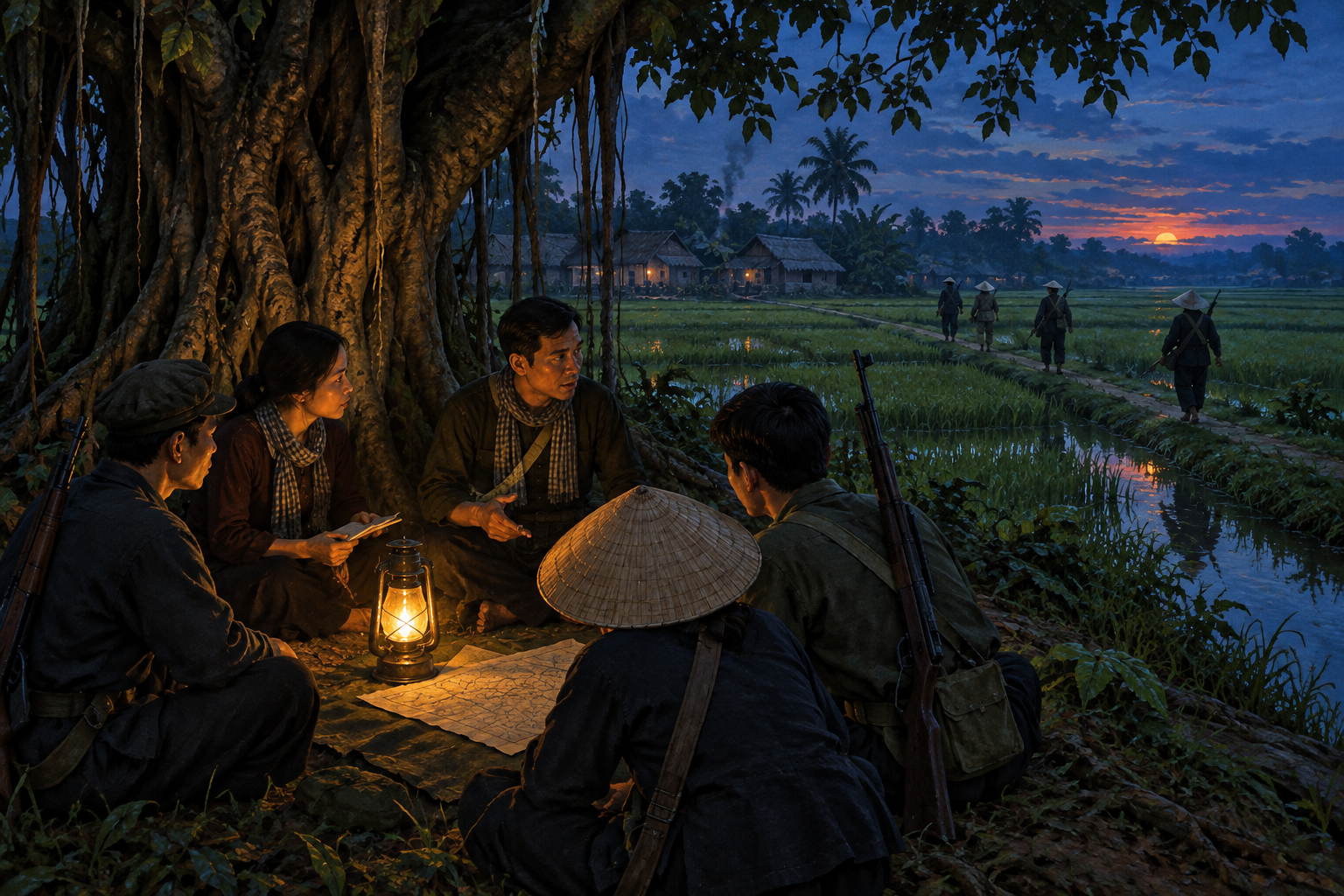
The NLF worked through more than battlefield operations. Its organizers built networks in villages and towns, spread political messages, recruited members, and sought to influence local administration. Some supporters were committed communists; others could be drawn by opposition to the Saigon government, promises of reform, nationalism, family or community ties, or coercion. The balance varied by place and time. It is misleading to describe every supporter as either a willing ideologue or a passive victim.
The armed struggle was likewise not one simple kind of warfare. Guerrillas used local knowledge, small-unit tactics, and clandestine networks. Political organization and military action could reinforce one another: influence in an area might help gather supplies and intelligence, while attacks could weaken government authority. These methods also brought violence to civilians, who faced danger from multiple armed sides and could be pressured to provide information, food, shelter, or allegiance.
The South Vietnamese government and its American allies treated the NLF as an insurgency directed by Hanoi. That interpretation pointed to real connections, but it also served a political purpose: it framed the conflict as aggression from outside and made the southern opposition appear less locally grounded. The NLF, by contrast, stressed its southern identity and claimed to represent people seeking independence and reunification. Neither side’s public framing alone captures the whole picture.
What “Viet Cong” means
“Viet Cong” is a shortened form of a Vietnamese phrase usually rendered as “Vietnamese communist.” During the war, South Vietnamese and American officials used the term for communist-led opponents in the south, including political cadres and armed forces. It was not the NLF’s formal name for itself. The front emphasized its national liberation identity, while the opposing governments’ terminology stressed its communist character and connection to Hanoi.
In everyday English, “Viet Cong” often became a catch-all for the NLF, its guerrillas, local organizers, and sometimes communist forces more generally. That broad usage is understandable, but it can blur important differences. A political cadre who worked in a village, an armed guerrilla, a member of a local allied organization, and a North Vietnamese army soldier did not have identical roles, even when they fought on the same side.
The label also shaped how Americans imagined the enemy. A single name made a complicated insurgency easier to discuss, but it could make the southern movement seem like one uniform force. In reality, the organization involved political networks, local supporters, armed units, and relationships with northern leadership. A careful reader should ask who used the term, which people or institutions they meant, and what the label leaves out.
Understanding the NLF and the Viet Cong helps answer a basic question about the Vietnam War: who was fighting whom? The answer was not just two national armies. The war included an insurgency within South Vietnam, a southern political front, the government in Saigon, North Vietnamese forces, and outside powers. Those actors overlapped and cooperated, but they were not interchangeable. “National Liberation Front” foregrounds a claim to broad southern legitimacy; “Viet Cong” foregrounds communism and became a common opposing label.
The NLF during the wider war
As the conflict escalated, the NLF became a major political and military adversary of South Vietnam and the United States. Its forces took part in the 1968 Tet Offensive, a coordinated campaign that struck cities and other targets across South Vietnam. The offensive caused heavy fighting and losses. Although communist forces did not hold the cities they attacked, the scale of the campaign challenged claims that the Saigon government and its allies were close to securing the country.
Tet also changed the movement’s place in the war. The fighting weakened the NLF’s southern military networks, while North Vietnamese forces became increasingly important in later combat. This shift matters because the popular image of the war often treats the Viet Cong as the only communist opponent. By the later years, the conflict involved large conventional forces from the north as well as southern revolutionary forces and political organizations.
In June 1969, the NLF and allied groups announced the Provisional Revolutionary Government of the Republic of South Vietnam. The new body gave the revolutionary side an official political representative in international diplomacy and negotiations. It was distinct from the North Vietnamese government, though both pursued communist victory and reunification. The change illustrates how armed movements can develop political institutions to claim legitimacy and negotiate on behalf of a population or territory.
Exam focus: the National Liberation Front
For AP-style questions, connect the NLF to the causes and character of the Vietnam War: it was a southern political front with local members and grievances, and it was also tied to the communist leadership in Hanoi. Keep the main actors distinct. The NLF was announced in 1960, the Provisional Revolutionary Government followed in 1969, communist forces prevailed in 1975, and Vietnam was formally reunified in 1976. Do not treat the NLF, North Vietnamese army, and South Vietnamese government as interchangeable.
Read next
- The Vietnam War Explained gives the broader timeline and shows how the NLF fit into the conflict.
- South Vietnam explains the state and government the NLF fought against.
- The Tet Offensive explores the 1968 campaign and its political impact.
- Saigon and Southern Vietnam adds the region’s longer background.
FAQ
What does Viet Cong mean? It is a shortened form of a Vietnamese phrase meaning “Vietnamese communist.” During the war, it became a broad label for communist-led political cadres and armed forces in South Vietnam, often including people associated with the NLF.
Was the Viet Cong the same as the NLF? The terms overlap but are not exact equivalents. The NLF was the political front; “Viet Cong” was a broad label used for its members and forces, and sometimes for communist opponents more generally.
When was the National Liberation Front formed? The NLF was announced in December 1960. It presented itself as a southern front against the Saigon government and for political change and reunification.
Was the NLF controlled by North Vietnam? It had southern members and local political roots, while also being linked to the communist party leadership in Hanoi. Both its southern character and its place in a nationwide communist strategy matter.
What happened to the NLF after the war? After communist victory in 1975 and Vietnam’s formal reunification in 1976, the NLF’s role as a separate wartime front ended as the new state consolidated power.