Alliances did not start World War I on their own. The spark was the assassination of Archduke Franz Ferdinand in Sarajevo in June 1914. But the treaties linking the great powers turned a regional quarrel into a war across most of Europe within about five weeks. This guide explains how those alliances worked, why they were meant to keep the peace, and why they failed. For the wider story, start with our World War I hub.
In five minutes
Before 1914, the great powers of Europe had signed a network of agreements promising military help to their partners. The idea was deterrence. If a country knew its friends would respond to an attack, it would be less likely to start one. In practice, the network meant that a quarrel between two countries could quickly pull in their partners' partners. The main agreements were:
- Germany and Austria-Hungary (1879): a Dual Alliance. Each promised to help the other if it was attacked by Russia.
- Italy joins (1882): the Triple Alliance with Germany and Austria-Hungary. Italy's commitment was weaker in practice, because it also had its own secret understanding with France.
- France and Russia (1892–1894): a military agreement to support each other if either was attacked by Germany, or by a power backed by Germany.
- Britain and France (1904): the Entente Cordiale. It settled colonial disputes. It was not a defence treaty, although military talks followed later.
- Britain and Russia (1907): an agreement settling disputes in Asia. Together with the 1904 deal, it formed the Triple Entente, a loose grouping of understandings rather than a single treaty.
Britain never signed a written treaty obliging it to send an army to the continent. That detail mattered in August 1914.
How did alliances lead to WWI?
Think of the alliances as tripwires. Each country's safety depended on its friends, so a crisis in one place could spread to others. Each bloc was built in response to a fear. France had lost to Prussia in 1870–1871 and feared isolation. Germany, after unification in 1871, feared being encircled by France and Russia. Britain wanted to protect its empire and to prevent one power from dominating the continent. Each agreement was a defensive answer to someone else's fear, and that is part of the problem.
Three features made the system especially dangerous.
The blocs were rigid. Leaders feared that abandoning a partner would leave them isolated, so they backed partners even in risky disputes. In July 1914, Germany's promise of support, often called the blank cheque, encouraged Austria-Hungary to take a hard line against Serbia.
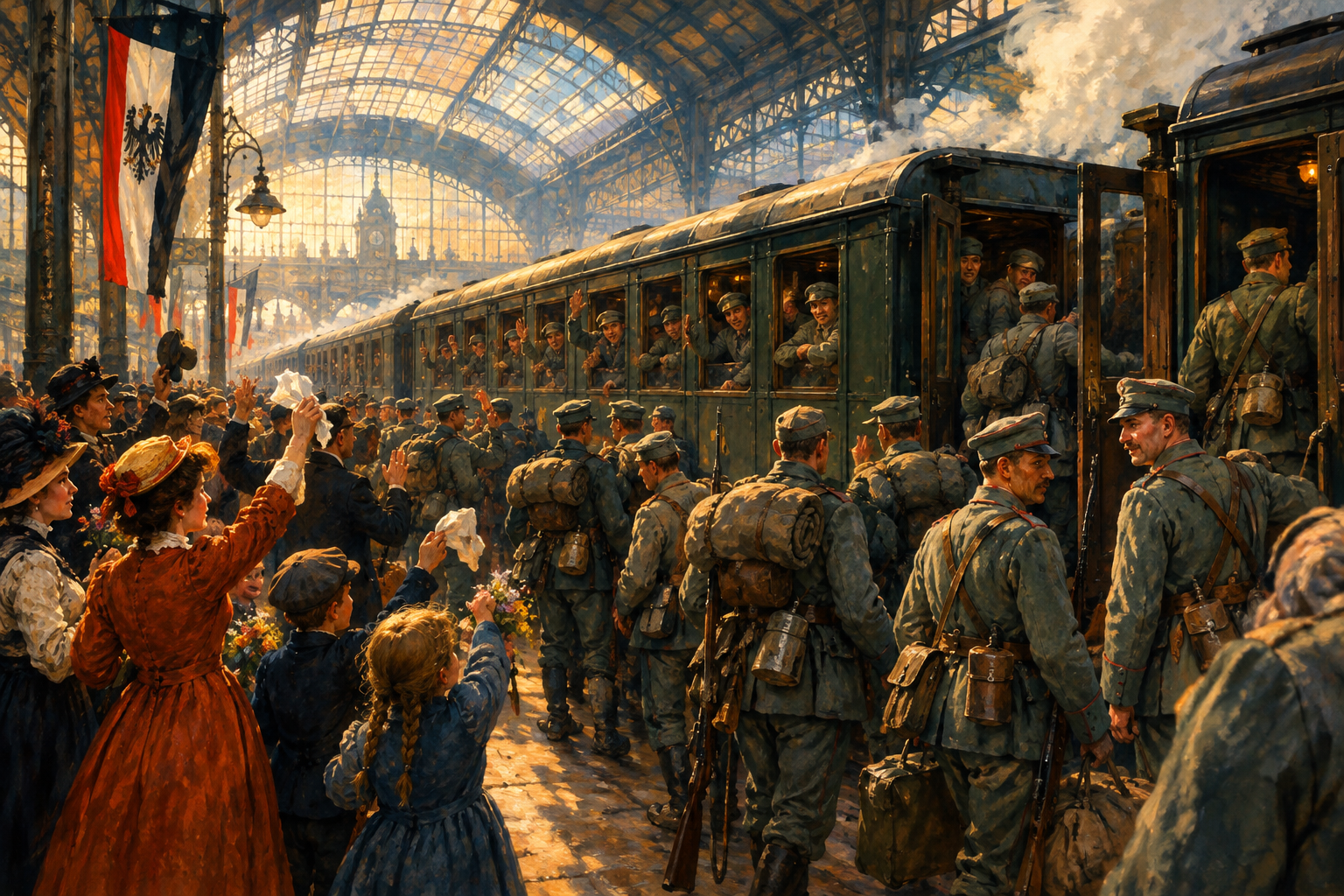
The war plans ran on timetables. Mobilisation depended on railways and tight schedules. Once armies began to move, it was hard to stop them without looking weak or losing ground. Germany's Schlieffen Plan aimed to defeat France quickly by marching through Belgium, then turn east against Russia. Russia's mobilisation, ordered to protect Serbia, was seen in Berlin as a threat that demanded a fast response.
Neutrality was costly. A country that stayed out could lose its partners' trust, while a country that joined could find itself fighting for a quarrel it had not started. Italy shows the first case. It belonged to the Triple Alliance on paper but stayed out in 1914, arguing that the alliance was defensive and that Austria-Hungary had started the war.
The Balkans were the weakest point. The Balkan Wars of 1912 and 1913 left Serbia larger and more confident, which alarmed Austria-Hungary, whose empire included many South Slavs. Russia saw itself as a protector of Slavic states and had its own interests in the Balkans and the Black Sea straits. Each power read the other's moves as threats and counted on its partners to back it.
What happened in July 1914?
On 28 June 1914, Archduke Franz Ferdinand, heir to the Austro-Hungarian throne, and his wife Sophie were shot dead in Sarajevo by a young Bosnian Serb nationalist. Vienna blamed the Serbian government and wanted to curb Serbian influence in the Balkans. On 23 July, Austria-Hungary sent Serbia an ultimatum with ten demands. The demands were severe and hard for any government to accept in full.
Serbia accepted most of the demands but not all of them. Austria-Hungary declared war on Serbia on 28 July. Russia, which saw itself as Serbia's protector, ordered mobilisation. Germany, backing its ally, declared war on Russia on 1 August and on France on 3 August. German troops then entered Belgium on 4 August. Britain had guaranteed Belgian neutrality under a treaty of 1839, so it declared war on Germany that same day.
In the space of a few days, a dispute between Austria-Hungary and Serbia had become a war between the great powers. The bloc system had done its work: each partner's decision made the next one more likely.
What were the consequences?
The war that began as a Balkan crisis became a world war. The Ottoman Empire joined the Central Powers in late 1914. Italy switched sides in 1915, after the secret Treaty of London promised it territory from the Allies. The United States entered in April 1917. Roughly nine million soldiers died, and many millions of civilians suffered death, hunger or displacement.
The fighting also changed in character. Industrial production, conscription and propaganda were used on a far larger scale than in earlier wars, and long trench lines made decisive victories hard to win. By 1918, the German, Austro-Hungarian and Russian empires had collapsed, and the Ottoman Empire was broken apart by 1922. The alliance system that was meant to keep the peace did not survive the war.
What exams ask
Exam questions often ask why a local dispute became a world war. A strong answer does three things. It names the main alliances and their dates. It traces the July 1914 crisis from Austria-Hungary and Serbia to Russia, Germany, France and Britain. And it explains why the alliances made backing down costly. Historians usually place alliances alongside militarism, imperialism and nationalism, which textbooks often group as the main causes. The best way to use alliances in an answer is as the mechanism that spread the crisis, rather than as a root cause on their own.
Good answers show how each decision made the next one more likely, rather than listing treaty dates from memory.
Read next
Each of these pages takes one of the other causes further:
- What Is Militarism? How It Led to WWI: how the arms race and military planning raised the stakes.
- How Imperialism Caused WWI: how colonial rivalry added to the tension between the great powers.
- Triple Alliance vs Triple Entente: a side-by-side look at the two blocs and their members.