
In five minutes
In April 1288, at the Battle of Bạch Đằng, the Đại Việt army led by Trần Hưng Đạo trapped a Yuan naval fleet on the Bạch Đằng River and destroyed most of it. The Yuan were the dynasty founded by Kublai Khan. This was the third time they had tried to conquer the Trần state in what is now northern Vietnam, and the victory brought that invasion to an end.
The battle itself ran from sunrise to sunset on 9 April, but the preparation began in March. To understand it you need three things: the Trần dynasty, which ruled Đại Việt from 1225 until 1400; the Yuan invasions that came before the river fight; and the stakes, wooden poles driven into the riverbed that turned the tide into a weapon. The stakes are the heart of this story.
Background: Đại Việt before the Trần
Đại Việt (大越) was an independent state centred on the Red River delta in the north of present-day Vietnam. Its rulers had long defended the coast and river routes against Chinese armies. The most famous earlier victory on the same river came in 938, when a commander named Ngô Quyền used stakes in the water to defeat a southern Chinese fleet. Later writers often compare the two battles.
The Lý dynasty ruled from 1009. Its founder moved the capital in 1010 to Thăng Long, on the site of present-day Hanoi. The Lý line weakened in the 1220s, and around 1225 a Trần prince, Trần Cảnh, later known as Emperor Thái Tông, came to the throne. The powerful official Trần Thủ Độ was the key figure behind that transfer of power.
The Trần kept the throne until 1400, when Hồ Quý Ly deposed the young emperor and founded the Hồ dynasty. For the full sweep of these dynasties, the hub article Vietnam's Dynasties and French Rule (1428–1945) places this period in context.
Who were the Yuan?
The Yuan dynasty was the Mongol-ruled state that Kublai Khan built in China. He renamed the dynasty Great Yuan in 1271, and his armies pushed well beyond their borders. The first of two large expeditions against Japan set out in November 1274, and the second in the summer of 1281. Japanese history calls these campaigns the 元寇. The attacks on Vietnam belong to the same expansion, so the same court stands behind both the Trần wars and the Japanese invasions.
The Yuan court expected rulers in the south to accept its authority and send tribute. The Trần did not give that submission in full, and the Yuan answered with armies. Each campaign needed food, horses and ships, so the logistics of the war mattered as much as the battles.
Three invasions in about thirty years
The first Yuan invasion of Đại Việt, in 1258, was led by Uriyangkhadai, a son of the general Subutai, with a force that came from Yunnan. The Yuan took the capital, Thăng Long, and the Trần court was thrown into crisis.
The second invasion, in 1285, was led by Prince Toghan, a son of Kublai Khan. The Yuan army took Thăng Long again in early 1285, while Trần Hưng Đạo commanded the Đại Việt forces. The Yuan withdrew from the capital in June 1285.
The third invasion began in the autumn and winter of 1287. The Yuan fleet sailed from Qinzhou in December 1287. Toghan led the land army, while Omar commanded the naval expedition. The map below shows the wider Mongol expeditions into Vietnam, including this final push.

The Yuan armies depended on supplies carried by river and along narrow roads, and the Trần forces repeatedly struck those lines. In late January 1288, Trần Hưng Đạo and Trần Khánh Dư, with about 30 warships, attacked a Yuan supply fleet under Zhang Wenhu near Vân Đồn island and forced it back towards Hainan. By early 1288 food shortages were pressing on the invaders, and they began to pull back.
The commanders
Trần Hưng Đạo, known by his personal name Trần Quốc Tuấn, was a prince of the Trần royal house. He commanded the Đại Việt forces in the campaigns of 1285 and 1288, and the stakes trap at Bạch Đằng is credited to his planning. Trần Khánh Dư fought alongside him in the Vân Đồn engagement.
On the Yuan side, Toghan led the land forces. He was a son of Kublai Khan and had already commanded in the 1285 invasion. The naval expedition was led by Omar, who had also been involved in earlier Yuan operations against Đại Việt. Omar was taken prisoner after the battle.
How the tide shaped the battle
The Bạch Đằng is a tidal river, and that is the key to the whole battle. The water level rises and falls twice a day, so a channel that is open at high tide can become a shallow, muddy stretch at low tide. A ship that cannot turn or back away in shallow water is easy to stop, and a ship held fast on a wooden stake is easy to destroy.
This is why timing mattered as much as weapons. The attackers needed to know when the tide would turn, where the channels ran and where the reefs and hidden coves lay. The stakes were placed so that they stayed hidden under high water and were exposed as the water fell. The Yuan fleet entered the river at the moment that suited the trap, not the moment that suited its own safety.
The stakes in the Bạch Đằng river
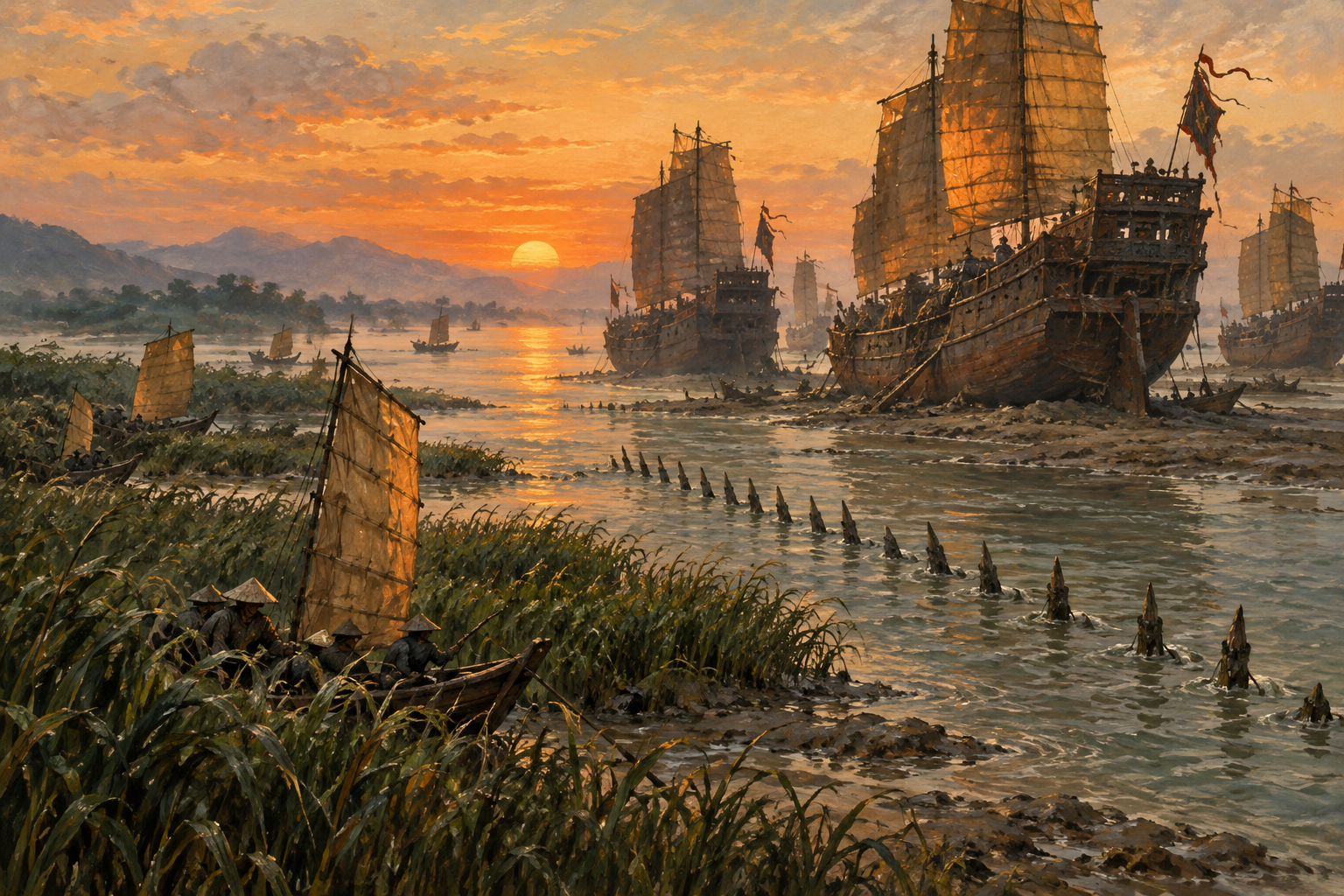
Before setting anything in the water, Trần Hưng Đạo studied the tides and the river channels. Iron-tipped wooden stakes were driven into the riverbed of the Chanh, Kênh and Rút channels. At high tide the stakes lay hidden under the water. At low tide they stood exposed.
The trap had two parts. Đại Việt boats waited in hidden coves behind a reef called Ghềnh Cốc. The Yuan fleet entered the river on the high tide and sailed into the trap. When the tide fell, the Yuan ships were stranded on the exposed stakes, and the waiting Đại Việt boats came out to attack them. One account says the fighting ran from sunrise to sunset.
The historian Lê Văn Lan has described the timing as a night setup at high tide, followed by an early-morning attack. The falling water in the morning left the Yuan boats with no route back to the open sea. The trap was not a single surprise but a planned sequence that depended on reading the water correctly.
The stakes are not only a story. In November 2019, excavators at Liên Khê commune in Thủy Nguyên district, Hải Phòng, uncovered wooden stakes near the Đá Bạc river dyke. They stood about 3 to 4 metres tall and were about 30 centimetres in diameter. By the end of November the excavation covered 950 square metres and had yielded 27 stakes. Carbon-14 dating places the wood between 1270 and 1430, a range that includes 1288.
Lê Văn Lan has argued that the finds point to a planned system of traps along the river, rather than one isolated engagement.

The battle on 9 April 1288
By March 1288 the Yuan were in retreat. Trần Hưng Đạo had begun preparing the battlefield that month, placing stakes and hiding boats behind reefs and creeks along the banks. On 5 March Toghan left Thăng Long for the fortified Yuan base at Vạn Kiếp, and on 30 March he ordered a withdrawal towards China. The retreat was to take the Yuan back through the Bạch Đằng River.
The Yuan fleet entered the Bạch Đằng in the early morning of 9 April 1288, on the high tide, under the command of Omar. The ships pressed deeper into the channel, and the falling water closed the trap. Omar was captured. Another Yuan admiral, Fan Yi, jumped into the river and was killed by Đại Việt forces.
The battle was won by planning as much as by force. The commanders read the tide, placed the stakes and cut off the escape route, and the plan worked. A large fleet forced to fight in the wrong place and at the wrong time can become helpless, however many ships it has.
Forces and losses
No firm count of the armies has survived, so the figures below are ranges from secondary accounts. The Yuan naval force is put at about 500 warships and 70 transports, with about 18,000 soldiers. Estimates for the whole Yuan army range from about 94,000 to about 170,000 men, and the larger figure covers the entire 1287 to 1288 campaign. The Đại Việt side is given as about 50,000 men.
Losses are equally uncertain. One account gives about 80,000 Yuan killed or captured in the battle, while another puts the Yuan dead across the whole 1287 to 1288 campaign at about 90,000, most of them killed or drowned. The Đại Việt dead at the battle are given as about 4,000 to 4,500. Whatever the exact figures, the Yuan fleet was largely lost and the land army retreated.
What came after
Omar was drowned in 1289, when the ship carrying him was deliberately sunk at sea. Kublai Khan reportedly banished Toghan to Yangzhou.
Kublai Khan died in 1294, and Temür Khan succeeded him. No new Yuan invasion of Đại Việt followed, and the Trần state kept its independence until 1400.
The Trần line ended in 1400, when Hồ Quý Ly deposed the young emperor Thiếu Đế, his maternal grandson, and founded the Hồ dynasty. The 1288 victory meant that the dynasty's last hundred years were lived without a Yuan army at the border.
Why the battle matters
The victory at Bạch Đằng ended the Yuan campaigns against Đại Việt. It also made Trần Hưng Đạo the central commander in Vietnamese memory of the thirteenth century, and his reputation rests on this battle.
The method, a trap that used the tide and stakes, shows how a smaller force can fight a larger navy on its own terms. The battle also shows continuity. The same river had seen a stake trap in 938, and that link is one reason the battle is taught as part of a longer Vietnamese tradition of resisting northern powers, rather than as a single event.
What exam questions ask
If this topic appears in an exam, expect questions on why a smaller army could beat a larger invading force. Name the stakes, the tide and the river terrain, and connect them to the supply problems that pushed the Yuan out. A comparison question may ask what the 1288 battle shares with the 938 victory of Ngô Quyền on the same river: the terrain, the reliance on stakes, and the use of timing.
Also be ready to explain the Japan link. The Yuan attacked Japan in 1274 and 1281, which Japanese history calls the 元寇. The Vietnamese campaigns and the Japanese invasions were part of the same expansion by the same Yuan court, so a strong answer places them together.
Read next
For the wider frame of this period, start with Vietnam's Dynasties and French Rule (1428–1945), the hub that links every article on the topic. For the longer story of the country, read The History of Vietnam: Dynasties, Empire and War. For what followed the Trần, read The Lê Dynasty and the Trịnh–Nguyễn Split. For how writing and culture changed alongside these dynasties, read Chữ Nôm and Quốc Ngữ: Why Vietnam Stopped Writing in Chinese Characters.