In five minutes
Nationalism did not start the First World War on its own, but it helped turn the 1914 assassination in Sarajevo into a continental war. Nationalism is the belief that a people who share a language, history or identity should govern themselves. Before 1914 that belief led leaders and crowds to treat every diplomatic move as a question of honor, so backing down felt like a loss of face. For the wider picture, see our World War I overview.
How nationalism built up before 1914
Nationalism took three main forms in Europe, and each one shaped the crisis in its own way.
- New nation-states. Italy was unified during the 1860s and early 1870s, and Germany became a single empire in 1871 after its victory over France. Both wanted to be taken seriously as great powers.
- Peoples inside empires. Austria-Hungary, the Russian Empire and the Ottoman Empire ruled many languages and ethnic groups. Czechs, Poles, Croats, Serbs and others pressed for more autonomy, and the rulers feared losing control.
- Pride in great-power status. France never forgot the loss of Alsace-Lorraine to Germany in 1871. Britain and Germany raced to build bigger battleships, and naval strength became a measure of national worth.
These forms did not automatically lead to war. Most people wanted security, jobs and recognition, not a fight. The danger came when nationalist claims met fear, prestige and war plans.
The Balkans: where the fuse was lit
The Balkans were the most dangerous place for nationalist rivalry. In 1908 Austria-Hungary formally annexed Bosnia and Herzegovina, which it had administered since 1878. Many of its people were Serbs, and Serbian nationalists wanted them to join a Serbian-led union of South Slavs. Russia saw itself as the protector of Slavic peoples and backed Serbia. Austria-Hungary feared that a stronger Serbia would encourage unrest among its own South Slav subjects.
The Balkan Wars of 1912 and 1913 raised the temperature. First, a league of Balkan states, including Serbia, drove the Ottoman Empire out of most of its European lands. The allies then fell out over the spoils. Serbia came out of the wars with much more territory, including much of Macedonia. Austria-Hungary blocked Serbia's access to the Adriatic Sea by backing the creation of an independent Albania. Both sides finished the wars more suspicious of each other.
Secret nationalist groups added to the danger. The Black Hand, formed in 1911 by officers linked to the Serbian army, called itself Unification or Death. It worked for the union of South Slavs and was willing to use violence. Some of its members helped arrange the weapons used in the Sarajevo plot.
From Sarajevo to war in July 1914
On 28 June 1914, Archduke Franz Ferdinand, heir to the Austro-Hungarian throne, visited Sarajevo with his wife, Sophie. The date was Vidovdan, a Serbian feast day that commemorates the Battle of Kosovo in 1389, so it carried deep national meaning for many Serbs. Gavrilo Princip, a 19-year-old Bosnian Serb linked to the Young Bosnia movement, shot both of them. Both died.
The killing was a crime, not yet a war, but it forced the great powers to respond. Austria-Hungary's leaders wanted to punish Serbia and first secured Germany's support. In early July, Kaiser Wilhelm II gave what became known as a “blank cheque”, an unconditional promise of backing for whatever Vienna chose to do.
Once Vienna decided to act, the crisis moved quickly. Each capital believed that a retreat would cost it prestige, and that its rivals were testing its resolve.
- 23 July: Austria-Hungary delivered an ultimatum to Serbia with ten demands and a 48-hour deadline.
- 25 July: Serbia accepted most demands but not all. Austria-Hungary broke off diplomatic relations.
- 28 July: Austria-Hungary declared war on Serbia.
- 29–30 July: Russia began mobilizing to support Serbia, first partially and then generally.
- 1 August: Germany declared war on Russia. Two days later it declared war on France.
- 4 August: German troops entered Belgium, and Britain declared war on Germany.
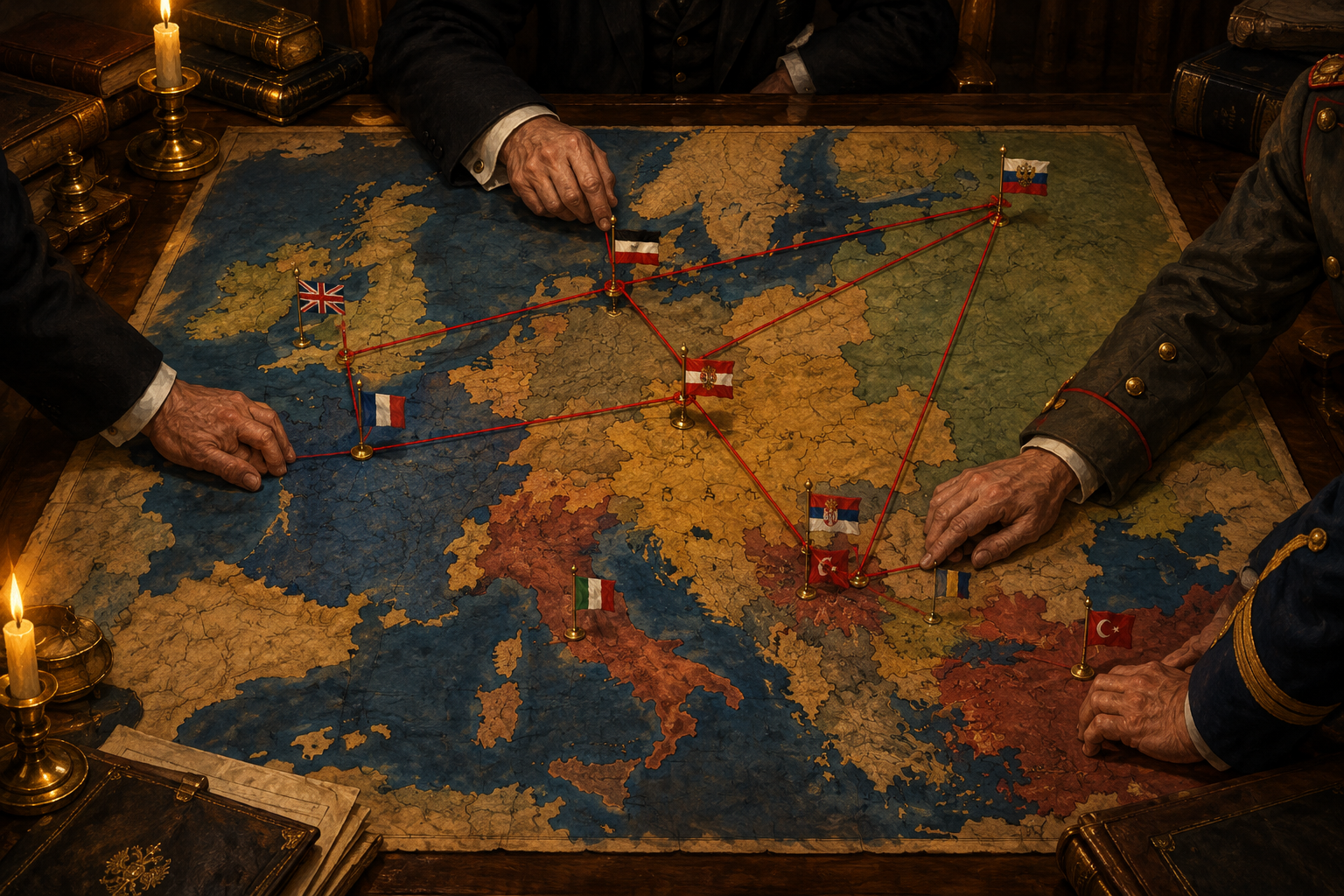
Nationalism gave these moves their emotional weight. Serbia could not accept demands that looked like a loss of sovereignty. Russia could not abandon Serbia without losing face among Slavic peoples. France was bound to Russia by alliance and still remembered 1871. Germany judged that a quick war was its best chance. For how these commitments fitted together, see Triple Alliance vs Triple Entente.
Why diplomacy could not stop it
Diplomacy still offered exits. Serbia's reply made real concessions, and Britain proposed a four-power conference to settle the dispute. But each option was weighed in terms of prestige. In Vienna, leaders believed that a weak answer would encourage nationalist unrest across the empire. In Saint Petersburg, leaders believed that dropping Serbia would damage Russia's standing among Slavs. In Berlin, military voices argued for fighting before Russia's army grew stronger. Nationalist pride turned every concession into a risk, and every risk into a reason to hold firm.
Four ways nationalism pushed Europe toward war
- Prestige at home. Leaders feared looking weak. A government that backed down could lose public support or its position.
- Protecting kin abroad. Russia's ties to Slavic peoples, especially Serbs, made it hard to stay out of a Balkan quarrel.
- Pressure inside empires. Austria-Hungary worried that a victory for Serbian nationalism would inspire its South Slav and other subjects, so it treated Serbia as a threat to the whole state.
- Public mood. Newspapers in several countries stirred anger against rivals. In late July and early August 1914, crowds in several European capitals gathered to celebrate the declarations of war.
Nationalism was not the only cause
Nationalism worked alongside other forces. Alliances decided who would stand beside whom. Militarism made war plans and mobilization timetables seem urgent; see What Is Militarism? How It Led to WWI. Imperial rivalry, most visibly in the Moroccan crises of 1905 and 1911, had already strained relations between the great powers, as explained in How Imperialism Caused WWI. Nationalism's special contribution was to make each of these pressures feel personal and national, and therefore impossible to back away from.
What followed
Fighting ended with the armistice of 11 November 1918. By then the Russian Empire had fallen, the German and Austro-Hungarian empires had collapsed, and the Ottoman Empire was breaking up. The peace settlements redrew the map along national lines, creating states such as Czechoslovakia and the Kingdom of Serbs, Croats and Slovenes. Those new borders left many minorities on the wrong side, and the tensions they produced lasted well beyond 1918.
What exams ask
History exams often ask you to assess how far nationalism contributed to the war. A strong answer names specific events, such as the Balkan Wars or the Sarajevo assassination, and explains the mechanism each one shows: prestige, protection of kin, or pressure inside empires. It then weighs nationalism against alliances, militarism and imperial rivalry and states a clear judgment. For AP-style essays, pair each cause with a result, such as how the July crisis turned a regional conflict into a world war.
Read next
- How Imperialism Caused WWI: how colonial rivalry added another layer of distrust between the great powers.
- Triple Alliance vs Triple Entente: the two alliance blocs that turned a Balkan crisis into a European war.
- What Is Militarism? How It Led to WWI: why armies and war plans shaped the choices of July 1914.