Latin American independence in five minutes
Between 1791 and 1826 nearly all of Latin America broke free of European rule. France lost Saint-Domingue, its richest colony, which became Haiti. Spain lost an empire that stretched from California to Cape Horn. Portugal lost Brazil. These Latin American revolutions belong to the wider age of Atlantic revolutions described in our World History 1700–1918 hub, next to the American and French Revolutions that inspired them.
The story has two starts. In Haiti, enslaved Africans rose against a slave society in 1791 and declared independence in 1804. On the Spanish mainland the spark came from Europe: Napoleon invaded Spain in 1808 and removed its king, and from 1810 councils led by creoles took power in the colonial capitals. Simón Bolívar then freed the north of South America and José de San Martín the south. Mexico broke away in 1821 and Brazil in 1822. When the last Spanish garrison, at Callao in Peru, surrendered in January 1826, only Cuba and Puerto Rico were still Spanish.
The order of independence
- 1804, Haiti (from France): the first independent state in Latin America, and the first founded by a successful slave revolt.
- 1811, Paraguay: breaks away from both Spain and Buenos Aires.
- 1816, Argentina (the United Provinces of the Río de la Plata): declared at the Congress of Tucumán on 9 July.
- 1818, Chile: proclaimed in February, secured at the Battle of Maipú in April.
- 1819–1822, Gran Colombia: Venezuela, New Granada and Ecuador united under Bolívar.
- 1821, Mexico, Central America and Peru: Peru was proclaimed free in 1821, but the war there was only won in 1824.
- 1822, Brazil (from Portugal): declared by Prince Pedro on 7 September.
- 1825, Bolivia: named after Bolívar.
What caused the Latin American revolutions?
The causes fall into three groups: old grievances, new ideas and one sudden trigger.
Creoles against peninsulares
Colonial society was a ladder ranked by birth and race. At the top were peninsulares, Spaniards born in Europe, who held the highest posts in church and government. Below them were creoles (criollos), people of European descent born in the Americas. Many were rich landowners and merchants, but they were often passed over for the top jobs. Further down came mestizos of mixed descent, Indigenous peoples, free people of colour and the enslaved. On the mainland, independence was led mostly by creoles who wanted the power their wealth and education seemed to promise.
The Bourbon reforms and trade
From the 1760s Spain's Bourbon kings tried to run the empire more tightly and for more profit. They raised taxes, sent officials out from Spain and expelled the Jesuits in 1767. Creoles felt treated as colonial subjects rather than partners in a shared monarchy. Trade rules that favoured Spain annoyed merchants, who knew Britain could sell them cheaper goods, legally or by smuggling.
Ideas and examples
Educated creoles read Enlightenment writers on natural rights and the sovereignty of the people. The United States showed that colonies could beat a European power and found a republic. The French Revolution supplied the language of liberty and equality. Yet some examples frightened creoles too. The great Andean rising led by Túpac Amaru II in 1780–1781 and the Haitian Revolution showed what happened when those at the bottom rose up. Many creoles wanted self-rule without a social revolution, and that caution shaped the movements.
The trigger: Napoleon in Spain, 1808
In 1808 Napoleon occupied Spain, pushed King Charles IV and his son Ferdinand VII to give up the crown, and made his brother Joseph king. With no legitimate king, who held power in the colonies? From 1810 creoles in Caracas, Buenos Aires, Bogotá and Santiago formed juntas, at first claiming to rule in the captive Ferdinand's name. Self-government, once tasted, was hard to give back. When Ferdinand returned in 1814 he scrapped the liberal Constitution of Cádiz of 1812 and sent armies to restore full control, which pushed many moderates toward complete independence.
What happened: the main revolutions
Haiti, 1791–1804
Saint-Domingue grew much of the world's sugar and coffee on plantations worked by roughly half a million enslaved people. In August 1791 the enslaved of the Northern Plain rose in revolt. Toussaint Louverture, a formerly enslaved man, became the revolution's leading general. After France abolished slavery in 1794 he fought for the Republic, drove out Spanish and British forces and by 1801 ruled the colony under his own constitution. Napoleon sent a large army under General Leclerc to restore French control. Toussaint was seized in 1802 and died in a French prison in 1803, but his lieutenant Jean-Jacques Dessalines fought on. Yellow fever and fierce resistance wrecked the French army, and after the Battle of Vertières in November 1803, Haiti declared independence on 1 January 1804.
Mexico, 1810–1821
On 16 September 1810 Father Miguel Hidalgo rang the church bell in Dolores and called his parishioners to rise, the event remembered as the Grito de Dolores. His army of mostly Indigenous and mestizo villagers grew fast and turned on Spaniards, which scared many creoles into backing the royalists. Hidalgo was executed in 1811, and the priest José María Morelos, who called for independence and an end to racial castes, in 1815. Independence finally came from the conservative side. A liberal revolt in Spain in 1820 alarmed Mexico's elite, and the royalist officer Agustín de Iturbide joined the rebel Vicente Guerrero under the Plan of Iguala of February 1821, which promised independence, the Catholic faith and union of Mexicans and Spaniards. Their army entered Mexico City that September.
The north: Bolívar and Gran Colombia
Venezuela declared independence on 5 July 1811, but the republic collapsed in 1812 and a second attempt fell in 1814. Simón Bolívar, a wealthy creole from Caracas, went into exile and in his Letter from Jamaica of 1815 argued that Spanish America would win. In 1816 Haiti's president Alexandre Pétion gave him ships and weapons, asking him to free the enslaved in return. Bolívar crossed the Andes, won the Battle of Boyacá on 7 August 1819 and entered Bogotá. He founded the Republic of Colombia, now called Gran Colombia, won Venezuela at Carabobo in June 1821, and his general Antonio José de Sucre took Quito after the Battle of Pichincha in 1822.
The south: San Martín, Chile and Peru
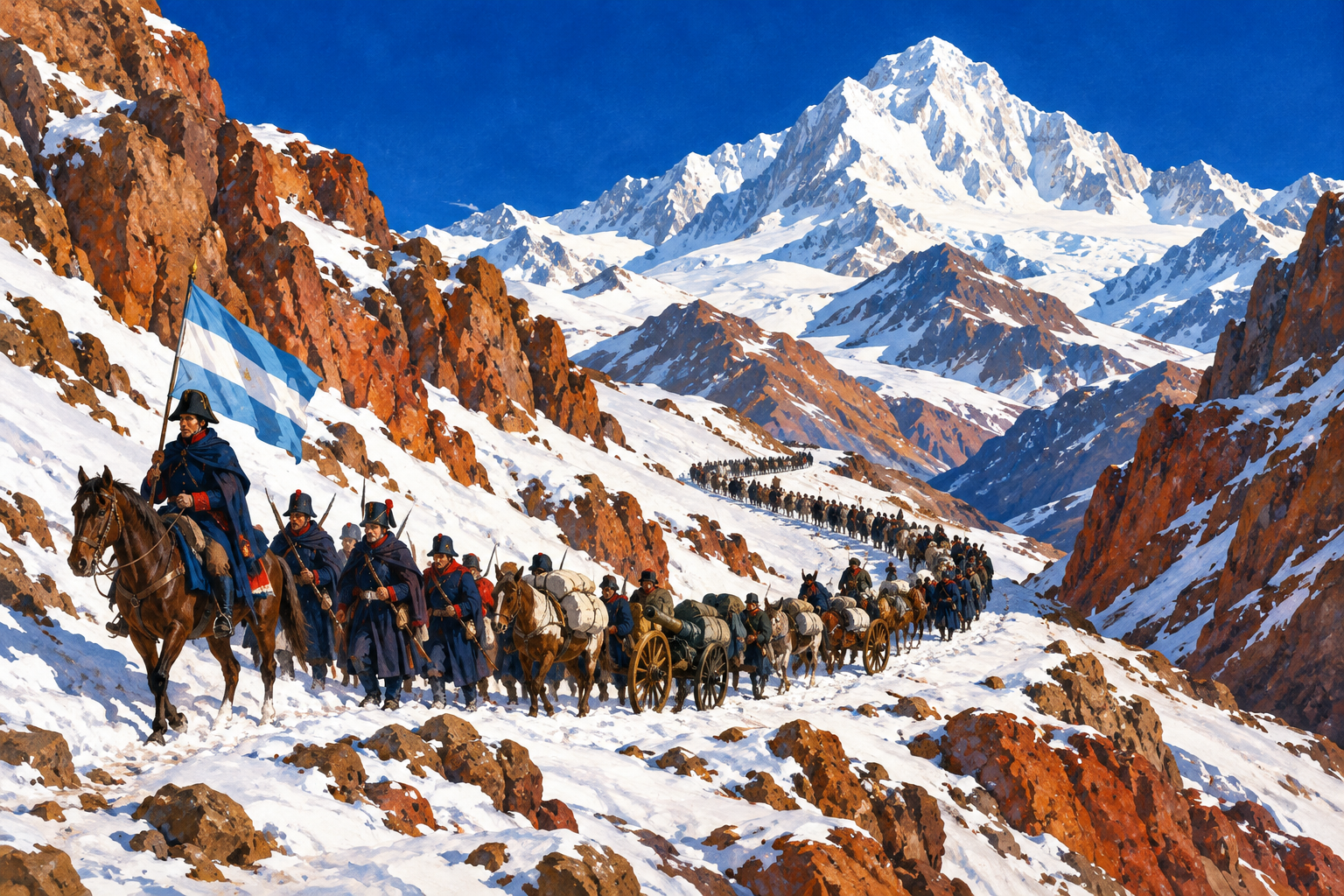
Buenos Aires had governed itself since its May Revolution of 1810. José de San Martín, an officer born in the region who had fought for Spain in Europe, believed independence was never safe while royalist Peru stood. In early 1817 his Army of the Andes, with the Chilean leader Bernardo O'Higgins, crossed passes higher than the Alps and won at Chacabuco. Chile proclaimed independence in 1818. In 1820 a fleet under Lord Cochrane carried San Martín's army to Peru, and he proclaimed independence in Lima on 28 July 1821, though royalist armies still held the highlands.
The endgame: Guayaquil to Ayacucho
In July 1822 Bolívar and San Martín met privately at Guayaquil. No full record of their talk survives, but afterwards San Martín stepped aside and left the war to Bolívar. On 9 December 1824 Sucre defeated the last major royalist army at Ayacucho. Upper Peru became Bolivia in 1825, and the fortress of Callao gave up in January 1826.
Brazil: independence with a crown
Brazil's path was quieter. Fleeing Napoleon, the Portuguese royal family moved to Rio de Janeiro in 1808, and in 1815 Brazil became a kingdom equal to Portugal. When King João VI went home in 1821, the Lisbon parliament tried to reduce Brazil to a colony again. His son Pedro stayed and declared independence on 7 September 1822, becoming Emperor Pedro I. Brazil kept its monarchy and its slave system, with far less bloodshed than Spanish America.
Consequences
- A new map, but no unity. Bolívar called the Congress of Panama in 1826 to join the new republics, but it achieved little. Gran Colombia split into Venezuela, Colombia and Ecuador around 1830, and the Federation of Central America broke up by about 1840.
- Creole power, not social revolution. Creole landowners replaced Spanish officials, while most Indigenous people and the poor gained little. Power often passed to caudillos, strongmen with private armies.
- A slow end to slavery. Chile abolished it in 1823, Mexico in 1829, Venezuela and Peru in 1854, and Brazil only in 1888.
- Haiti punished. In 1825 France recognised Haiti only in return for an indemnity of 150 million francs, later reduced, which burdened the country for generations.
- New outside powers. Britain backed the new states and came to dominate their trade. The United States issued the Monroe Doctrine in December 1823, warning Europe against new colonies or intervention in the Americas.
- Spain's last colonies. Cuba and Puerto Rico stayed Spanish until 1898.
What exams ask
AP World History and similar courses treat these events as part of the Atlantic revolutions. Expect questions like these:
- Causes: explain how Enlightenment ideas, creole resentment and Napoleon's invasion of Spain combined.
- Comparison: Haiti was a revolution of the enslaved that ended slavery; most Spanish American revolutions were led by creole elites who kept the social order largely in place; Brazil became independent as a monarchy.
- Continuity and change: independence changed who ruled, but large estates, racial hierarchy and reliance on exporting raw materials mostly continued.
- Documents: the Haitian Declaration of Independence (1804), Bolívar's Letter from Jamaica (1815) and the Plan of Iguala (1821).
Read next
- World History 1700–1918: the era hub that sets these revolutions beside the American and French Revolutions and the industrial age.
- Ideas That Shaped the 19th Century: liberalism and nationalism, the ideas creole leaders borrowed and argued over.
- The Russian Empire (1721–1917): Russia led the conservative Holy Alliance, and fears of European intervention plus Russian claims on the Pacific coast helped prompt the Monroe Doctrine.