In five minutes
The Napoleonic Wars were a series of conflicts from 1803 to 1815 in which Napoleon's France fought, again and again, against rivals that kept forming new alliances. Britain, Austria, Prussia and Russia were the main opponents, and the fighting ran from Spain to Russia and across the seas. The wars are part of the wider Napoleonic Era, and the settlement that followed shaped Europe for much of the nineteenth century.
Put simply, the wars kept asking one question: could Napoleon's France dominate Europe, or would the great powers stop it? For a long time the answer seemed to be yes. Then the army that had conquered much of the continent failed in Russia, and its rivals finally won. Understanding that turn explains most of what happened between 1803 and 1815.
The cast is easier to follow if you hold on to a few names. Napoleon led France. Horatio Nelson commanded the British fleet at Trafalgar, and Arthur Wellesley, later the Duke of Wellington, led British forces in the Iberian Peninsula and at Waterloo. On the other side, Tsar Alexander I ruled Russia, while Emperor Francis of Austria and King Frederick William III of Prussia ruled states that joined and left the coalitions as their fortunes changed.
Causes of the Napoleonic Wars
The French Revolution had already set France against the monarchies of Europe in the 1790s. In 1799 Napoleon Bonaparte seized power in a coup and became First Consul. A short peace in 1802 did not last. In May 1803 Britain declared war on France again, and the conflict spread from there.
Two rivalries drove it. The first was on land. Napoleon steadily extended French influence through annexations, client states and alliances, and rulers in Vienna, Berlin and St Petersburg saw a threat to their own survival. The second was at sea and in trade. Britain had the strongest navy in the world, so Napoleon tried to hurt it economically by closing European ports to British goods. This policy, known as the Continental System, was set out in late 1806 and caused friction for years. Each side's pressure provoked a response from the other.
Alliances were fragile. A defeat could push a power out of the fight, and a new treaty could bring it back in. Austria was beaten at Ulm and Austerlitz in 1805 and defeated again at Wagram in 1809, yet it even sent troops to support Napoleon during the Russian campaign of 1812. The wars look tangled on a map because the same states fought, made peace and fought again, and their aims rarely stayed the same for long.
The major battles
Napoleon crowned himself emperor in Paris in December 1804. The next year brought the decisive naval battle of the wars. At Trafalgar, on 21 October 1805, the Royal Navy defeated the combined French and Spanish fleets off the coast of Spain. Admiral Nelson was killed, and British command of the sea stayed secure for the rest of the war. Napoleon never managed to invade Britain.
The army Napoleon had gathered on the French coast for an invasion had already marched east in August 1805. Trafalgar ended any realistic hope of crossing the Channel later. The sea war did not stop, however. Britain kept up its blockades, and its wealth helped fund subsidies to allies on the continent.
On land, his victories were just as dramatic. At Austerlitz on 2 December 1805, his army defeated the combined Austrian and Russian forces and broke the Third Coalition. The following year, at Jena and Auerstedt on 14 October 1806, French forces crushed the Prussian army in a single day. French troops then occupied Berlin, and the Treaties of Tilsit in 1807 left Prussia smaller and Russia an uneasy partner.
Cavalry mattered as well. Mounted troops scouted, screened armies and chased broken enemies. At Waterloo, French cavalry charged repeatedly against British infantry squares, though many of those squares held.
The Peninsular War ran from 1808 to 1814. A revolt in Madrid on 2 May 1808 became a long, grinding struggle against French rule in Spain. British forces under Wellington fought alongside Spanish and Portuguese troops, and the war drained French resources for years.
The turning point: Russia in 1812
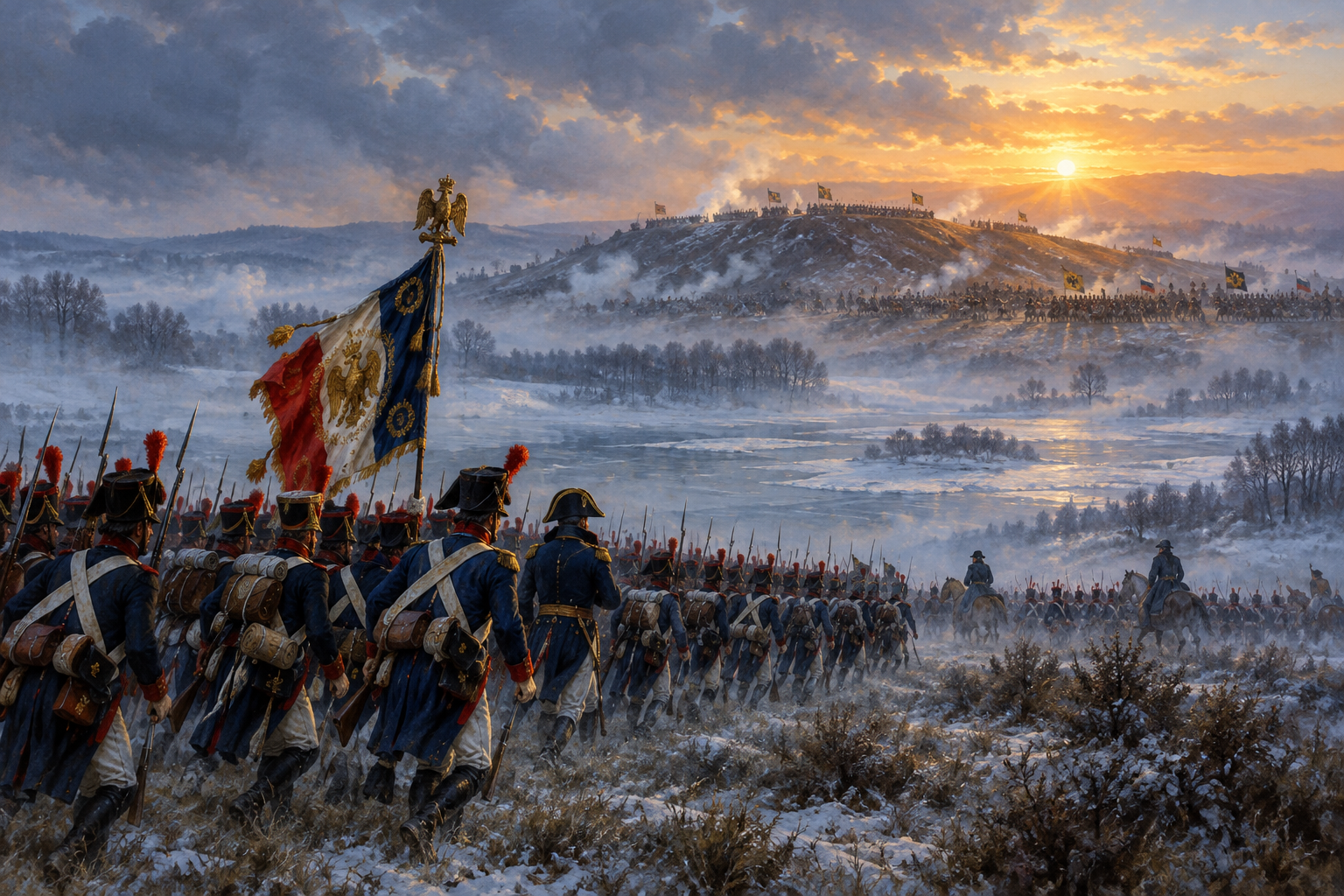
Napoleon's invasion of Russia in June 1812 was the great gamble of the wars. He led a huge army across the border, and a large share of its soldiers came from allied and conquered states rather than France. Russian forces avoided a decisive battle for much of the summer, pulling back and stretching French supply lines. The bloody battle of Borodino in September was costly to both sides. The French entered Moscow on 14 September, but much of the city burned, and no peace offer came. Napoleon waited there for over a month before he ordered the retreat.
The retreat began in October. Hunger, disease and the Russian winter destroyed much of the army. Estimates of French losses vary widely, so it is safer to speak of hundreds of thousands of men dead, captured or missing. The catastrophe changed the balance of power. Prussia and Austria turned against Napoleon, and a new coalition formed.
The crossing of the River Berezina in late November was one of the worst episodes of the retreat. The French built bridges under fire, and the army lost many more men while crossing. By December, what was left of the Grande Armée was a fraction of the force that had marched east in June.
The Battle of Leipzig, fought from 16 to 19 October 1813, was one of the largest battles in European history before 1914. It forced the French back toward the Rhine.
When did the Napoleonic Wars end?
The wars ended in 1815. The final major fighting was the Waterloo campaign, and the decisive battle took place near Brussels on 18 June 1815, where British and Prussian armies defeated Napoleon. Wellington held a position on the ridge of Mont-Saint-Jean, and Prussian troops under Marshal Blücher arrived in the late afternoon to help break the French attack. The formal end came with the Treaty of Paris, signed on 20 November 1815.
Napoleon had already abdicated once, in April 1814, and had been sent to the Mediterranean island of Elba. He left Elba in February 1815 and landed in southern France on 1 March. The Hundred Days that followed ended after Waterloo, and he was exiled to the South Atlantic island of Saint Helena, where he died in 1821.
The peace was shaped at the Congress of Vienna, which met in 1814 and 1815. Its aim was to restore order by balancing power among the great states and to stop any one power from dominating Europe again. France was kept within narrower borders than Napoleon had created. Two figures stood out in the negotiations. Klemens von Metternich, the Austrian foreign minister, led much of the organising work, while Talleyrand represented the restored French monarchy and worked to limit the losses France faced.
The wars left lasting marks. Britain gained naval supremacy and a global role that lasted through the nineteenth century. In Spain and Prussia, resistance to French rule helped fuel new national feeling. Death tolls are very uncertain, but estimates of soldiers and civilians killed often run into the millions.
For ordinary people, the wars meant conscription, requisitions and occupation. Young men were called into the armies, towns and farms supplied passing troops, and disease and hunger killed large numbers, sometimes more than the battles themselves.
What exams ask
In AP European History and most school courses, the Napoleonic Wars are usually taught as a bridge between the French Revolution and the age of nationalism. Students are commonly asked why the coalitions kept forming, what the Continental System was meant to do, and how the Congress of Vienna tried to build a stable Europe through the Concert of Europe.
A strong answer links cause, event and result: Napoleon's expansion caused the coalitions, the Russian campaign shifted the balance, and the Vienna settlement ended an era of conquest by one state.
Read next
To see the bigger picture, start with the Napoleonic Era, which covers the empire, the wars and the Congress of Vienna together. Then try these:
- Napoleonic Wars Timeline: a year-by-year view if you want more dates in order.
- The Battle of Waterloo (1815): how the last great battle unfolded and why it mattered.
- Who Was Napoleon Bonaparte?: the life behind the emperor, from Corsica to power.
- Pride and Prejudice: a novel set in England while the wars rage abroad. The war mostly stays in the background, through militia officers and news that reaches a country village.