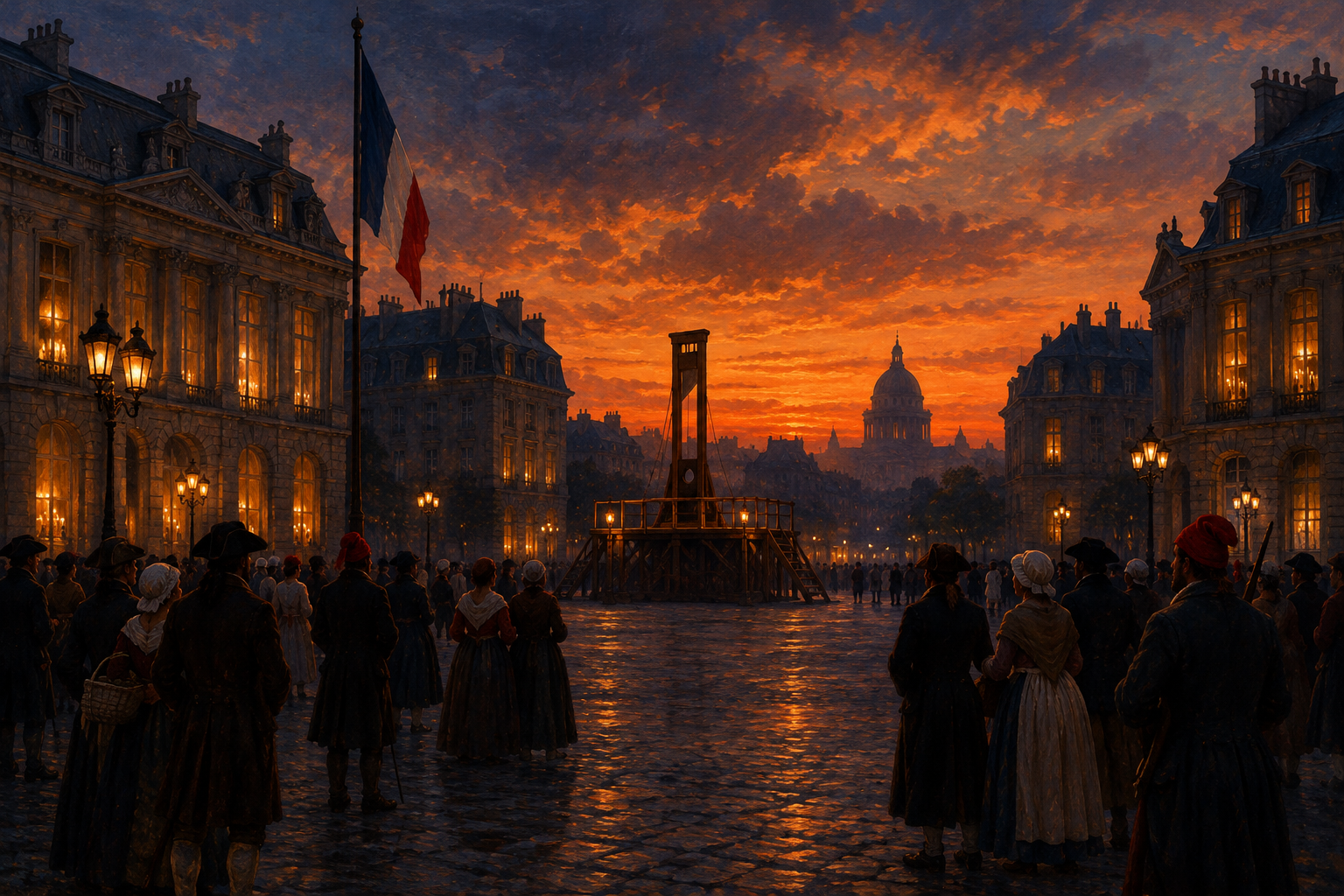
In five minutes: what was the Reign of Terror?
The Reign of Terror was the most radical stage of the French Revolution, running from September 1793 to July 1794. For about ten months, the government ruled through emergency courts, mass arrests and executions. Its leaders argued that these measures were needed to save the new republic from enemies at home and abroad.
Historians still debate how much of the violence was necessary and how much came from fear, ambition and rivalry between revolutionary factions. Most agree on the outline, though. A revolution that began by demanding liberty and rights ended up turning on many of its own supporters before its leaders themselves fell.
For the wider story, read the French Revolution explained, which covers the whole decade from 1789 to 1799 and shows where the Terror fits.
Causes: why the Terror began
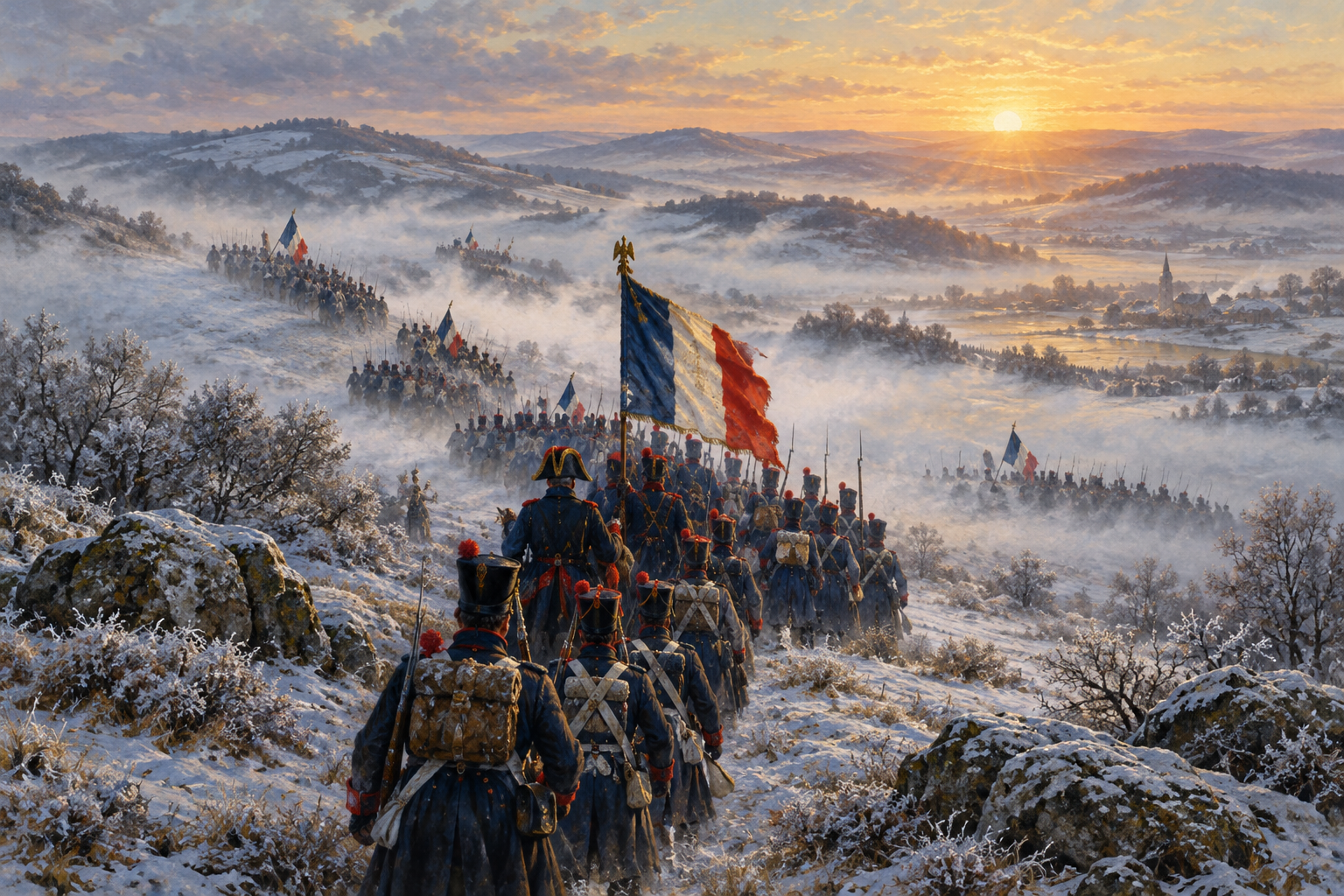
By the summer of 1793, the Revolution was under pressure from almost every direction. Austria, Prussia, Britain and other European powers had joined the war against France. The king, Louis XVI, had been executed in January 1793, which hardened the hostility of the monarchies around France.
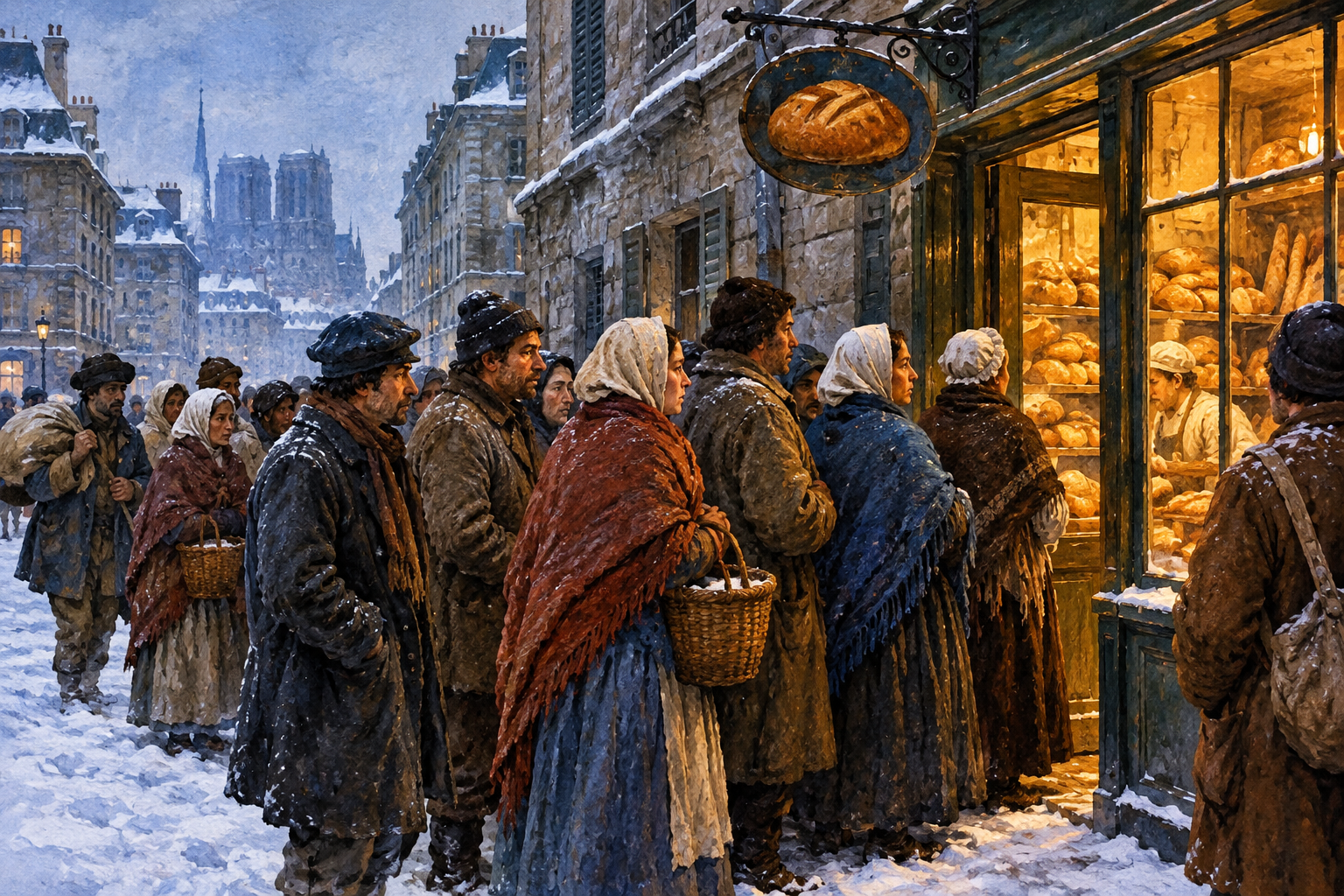
Revolt spread inside the country as well. In the Vendée, in western France, peasants rose against the republic's religious policies and the military levies that came with the war. Cities such as Lyon and Marseille turned against the Convention in Paris. Bread was expensive and often hard to find, and the working people of Paris, known as the sans-culottes, pressed for firm action against food hoarders and suspected traitors.
Politics made the crisis worse. The Jacobins, a radical club whose leading members included Maximilien Robespierre, had been in conflict with the Girondins, moderate deputies who had pushed for the war but were seen as too cautious about the Revolution's enemies. In early June 1793, the Jacobins used the pressure of the Paris crowds to have the Girondin deputies removed from the Convention, and several of their leaders were later executed. Each faction began to see its rivals as traitors. Every defeat or revolt seemed to prove that enemies were everywhere.
In early September 1793, pressure from the Paris crowds pushed the National Convention to adopt terror as official government policy. What had been an emergency response to war and revolt became a system of fear that reached into everyday life.
What happened: courts, committees and fear
The engine of the Terror was the Committee of Public Safety, a small group within the National Convention. It came to direct the war effort, the army, the food supply and much of the justice system. Robespierre was one of its most influential members, and his speeches did much to shape the policy of the period.
Justice ran through the Revolutionary Tribunal in Paris, which had been set up in March 1793 and gained wider powers as the year went on. Local surveillance committees in each district compiled lists of suspects. The Law of Suspects, passed on 17 September 1793, gave the authorities a legal basis to arrest anyone judged hostile to the Revolution. The definition was broad. Nobles, former officials and priests who refused to swear the oath could be arrested, but so could ordinary people whose loyalty was merely questioned.
Economic controls were part of the same effort. The General Maximum, introduced in late September 1793, set ceilings on many prices and limited wages. The aim was to keep bread and basic goods affordable for the poor. Enforcement was harsh, and merchants who broke the rules could face prosecution.
The government also tried to reshape daily life. A new revolutionary calendar counted the years from 1792, and the state pushed a campaign against the Catholic Church, closing many churches and promoting a civic cult of Reason, later of the Supreme Being. Robespierre's Festival of the Supreme Being, held in June 1794, was an attempt to create a civic religion to replace the old one. Many ordinary people did not share the enthusiasm.
Outside Paris, repression was often harsher still. In Lyon, which had rebelled against the Convention, the city was besieged and punished with mass executions. In Nantes, representatives sent by the Convention ordered prisoners drowned in the Loire. These representatives, known as representatives on mission, held wide powers and often acted with a great deal of independence from Paris.
The victims included Marie Antoinette, executed in October 1793, and the leaders of the Girondins, who went to the guillotine later that same month. The government then turned on its own. The Hébertists, a radical group around the journalist Jacques-René Hébert, were executed in March 1794, and Danton and his allies followed in April. Each purge sent a message that no one was safe, not even the most committed revolutionaries.
The Law of 22 Prairial, passed on 10 June 1794, changed the courtroom itself. Suspects lost their right to a public trial and to legal help, and juries could only acquit or condemn. The law is often seen as the start of the Great Terror, a period of sharply rising executions in the following weeks.
Official figures record about 17,000 people executed, with perhaps another 10,000 who died in prison or without trial. At least 300,000 people were arrested. Historians treat these figures as estimates, and totals depend on whether regional repression and deaths in custody are counted, so use them as a sense of scale rather than exact counts.
Consequences: how the Terror ended
By July 1794 many deputies in the Convention feared that they would be next. Robespierre gave a speech that seemed to threaten further purges, and colleagues who believed their names were on his lists began to plan against him.
On 9 Thermidor in the revolutionary calendar, which corresponds to 27 July 1794, the Convention turned against him, and he was arrested. He was executed the next day, 10 Thermidor, or 28 July 1794, together with about twenty of his closest allies. This coup, known as the Thermidorian coup, ended the most intense phase of the Terror.
The fall did not bring calm straight away. The period that followed, known as the Thermidorian Reaction, saw many prisoners released, the powers of the Revolutionary Tribunal curbed and the General Maximum abolished. It also brought reprisals against former Jacobins, and the emergency government was dismantled gradually over the following year. A military shift helped as well: the French victory at Fleurus in June 1794 eased the pressure on the frontiers and weakened the case for emergency controls at home.
The Terror left lasting marks. The Revolution's ideals of equality and citizenship survived, but so did the memory of how emergency powers could be used against opponents. Later politicians, historians and writers have returned to the Terror again and again when they ask how far a state may go to defend itself.
What exams ask
Exam questions usually ask why the Terror happened, how it worked and why it ended. A strong answer uses three layers. The first is the emergency: foreign war and internal revolts. The second is politics: the struggle between factions, from the Jacobins and Girondins to Robespierre and his rivals. The third is the institutions that made fear systematic, such as the Committee of Public Safety, the Revolutionary Tribunal, the Law of Suspects and the Law of 22 Prairial.
For significance, connect the Terror to the larger change it helped set in motion. It showed how a state could centralise power in a crisis, and it became a reference point in later debates about emergency rule. Avoid treating the Terror as a simple list of victims. Explain why it happened as well as what it did.
Read next
Read Who Was Robespierre? for the man at the centre of the Terror.
Jacobins vs Girondins explains the rival groups whose conflict pushed the Revolution toward the Terror.
Who Was Louis XVI? covers the king whose execution in January 1793 came just before the Terror began.