The American Revolution in five minutes
The American Revolution was a political and military break between Great Britain and thirteen of its colonies on the Atlantic coast of North America, from New Hampshire in the north to Georgia in the south. It began as an argument about taxes after 1763, became a shooting war in April 1775, produced the Declaration of Independence on 4 July 1776 and ended with the Treaty of Paris in 1783, when Britain recognised the United States as independent.
Historians usually date the revolution from the Stamp Act crisis of 1765 to the peace of 1783. The war itself, called the Revolutionary War or the War of Independence, ran from 1775 to 1783, although the last major battle was fought at Yorktown in 1781.
Three things make it a turning point. It was the first time colonies in the Americas won independence from a European empire. It wrote ideas from the Enlightenment, such as natural rights and government by consent, into founding documents. And it pushed France deep into debt, which helped set the stage for the French Revolution in 1789. In our overview of world history from 1700 to 1918, it opens the age of revolutions.
Causes: from imperial victory to “no taxation without representation”
The road to revolution started with a British win. In the Seven Years' War (1756–1763), known in North America as the French and Indian War (fighting there began in 1754), Britain drove France out of Canada and the lands east of the Mississippi. Victory left Britain with a huge debt and a much larger empire to guard. Ministers in London decided that the colonists, who had gained most from the war, should help pay for their own defence.
A series of new laws followed:
- Proclamation of 1763: banned settlement west of the Appalachian Mountains, angering colonists who wanted new land.
- Sugar Act (1764): tightened duties and customs enforcement on molasses and other imports.
- Stamp Act (1765): the first direct tax on the colonies, charged on newspapers, legal documents and playing cards. Riots, boycotts and the Stamp Act Congress forced its repeal in 1766, but Parliament also passed the Declaratory Act, claiming full power to make laws for the colonies.
- Townshend Acts (1767): duties on imported glass, paint, paper, lead and tea. Boycotts led to their repeal in 1770, except for the tax on tea.
- Tea Act (1773): let the East India Company sell cheap tea in America while keeping the tea tax.
The sums involved were small. The principle was not. Colonists elected their own assemblies but sent no members to Parliament, so they argued that Parliament had no right to tax them. The slogan “no taxation without representation” summed this up. British leaders replied that Parliament spoke for every subject of the empire, whether they voted or not. Neither side would give way.
The tension turned violent in Boston. On 5 March 1770 British soldiers fired into a crowd and killed five people, an event patriots called the Boston Massacre. On 16 December 1773 colonists, some disguised as Mohawk people, boarded three ships and dumped more than 300 chests of East India Company tea into Boston Harbor. This was the Boston Tea Party.
From protest to war, 1774–1776
Parliament answered the Tea Party with the Coercive Acts of 1774, which colonists called the Intolerable Acts. They closed the port of Boston until the tea was paid for and cut back self-government in Massachusetts. Instead of isolating Boston, the laws united the colonies behind it. In September 1774 delegates from twelve colonies met in Philadelphia as the First Continental Congress and agreed to boycott British goods.
On 19 April 1775 British troops marched out of Boston to seize militia weapons stored at Concord. Local militia met them at Lexington and Concord, and the first shots of the war were fired. In May the Second Continental Congress gathered, and in June it named George Washington of Virginia commander of the new Continental Army. On 17 June 1775, at the Battle of Bunker Hill, the British took the high ground above Boston but suffered heavy losses.
Even then, many colonists still hoped to make peace with King George III. That changed in 1776. In January, Thomas Paine's pamphlet Common Sense argued in plain language that it made no sense for an island to rule a continent, and that the colonies did not need a king at all. It sold widely. On 2 July Congress voted for independence, and on 4 July 1776 it adopted the Declaration of Independence, drafted mainly by Thomas Jefferson. Drawing on John Locke and other Enlightenment writers, it stated that people have rights to “life, liberty and the pursuit of happiness,” that governments get their power from the consent of the governed, and that people may replace a government that destroys those rights.
The War of Independence, 1775–1783
On paper Britain should have won. It had the world's strongest navy, a trained army and German auxiliaries hired from states such as Hesse-Kassel, often called Hessians. The Americans had little money, short-term soldiers and a Congress with no power to tax. But Britain had to fight across an ocean, hold a vast territory and win over a divided population: Patriots backed independence, Loyalists stayed loyal to the Crown, and many people simply tried to stay out of the fighting.
Washington lost New York in 1776 but kept his army alive, and his surprise attack across the Delaware River at Trenton on 26 December 1776 restored morale. The turning point came in October 1777, when British General John Burgoyne surrendered his whole army at Saratoga in New York. Saratoga convinced France that the Americans could win. In February 1778 France signed a treaty of alliance with the United States, bringing money, troops and a navy. Spain entered the war against Britain as France's ally in 1779, and the Dutch Republic was drawn in at the end of 1780. That same year Russia's Catherine the Great led a League of Armed Neutrality to protect neutral shipping, leaving Britain more isolated.
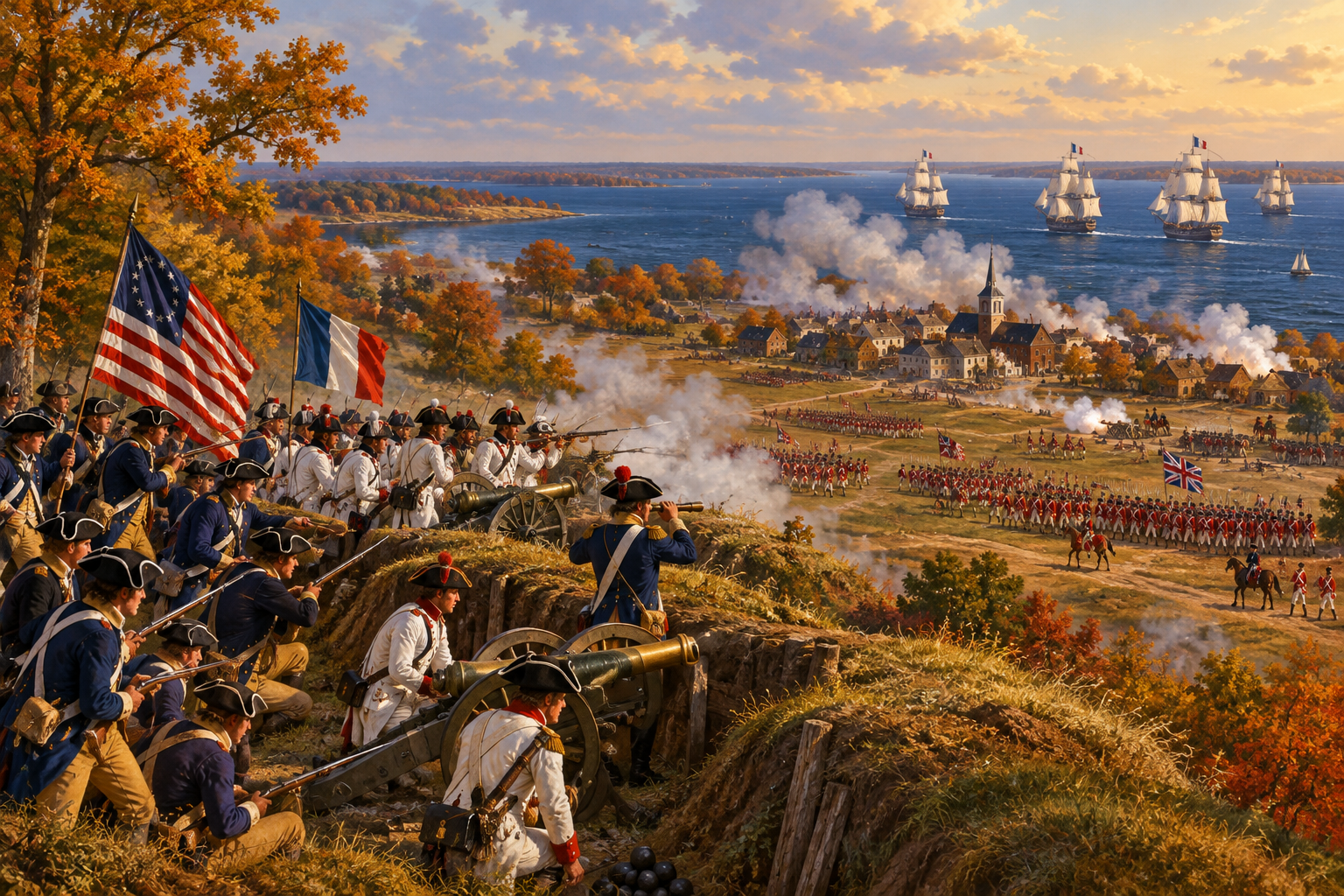
The Continental Army survived a hard winter at Valley Forge in 1777–1778, where the Prussian officer Baron von Steuben drilled it into a sharper fighting force. The British then shifted to the South, taking Savannah and Charleston. In 1781 General Charles Cornwallis marched into Virginia and dug in at Yorktown. A French fleet under Admiral de Grasse blocked help from the sea, while American and French armies under Washington and the Comte de Rochambeau besieged him by land. Cornwallis surrendered on 19 October 1781.
Yorktown did not end the war at once, but it ended Britain's will to keep fighting in America. Peace talks in Paris produced the Treaty of Paris, signed on 3 September 1783. Britain recognised the independence of the United States and handed over the land between the Appalachians and the Mississippi River.
Consequences: a new nation and an example for the world
Independence did not settle how Americans would govern themselves. The first national framework, the Articles of Confederation (in force from 1781), created a weak central government that could not raise taxes. After years of debt and unrest, delegates met in Philadelphia and wrote the United States Constitution in 1787. It set up a federal system with separate legislative, executive and judicial branches and took effect after ratification in 1788. George Washington became the first president in 1789, and the Bill of Rights followed in 1791.
The revolution's promises were not shared equally. Slavery continued in the new republic, even though the Declaration said that all men are created equal. Some enslaved people won their freedom by joining the British, who offered it to escape Patriot owners, or by serving in the Continental Army, and several northern states began to end slavery. Many Native American nations had sided with Britain to hold back settlers; they lost their main protector and faced rapid westward expansion. Tens of thousands of Loyalists left for Canada, Britain and the Caribbean.
Abroad, the revolution had two big effects. France's war spending deepened a debt crisis that forced Louis XVI to call the Estates-General in 1789, the opening act of the French Revolution. And the example of colonists declaring independence and writing their own constitution inspired later movements, from Haiti to Spanish America.
What exams ask
AP and other history exams usually test the American Revolution through causes and significance rather than battle details. Be ready to:
- Explain how debt from the Seven Years' War led to new taxes after 1763, and why colonists objected on principle rather than over the amounts.
- Put the key steps in order: Stamp Act (1765), Boston Massacre (1770), Boston Tea Party (1773), Coercive Acts (1774), Lexington and Concord (1775), Declaration of Independence (1776), Saratoga (1777), French alliance (1778), Yorktown (1781), Treaty of Paris (1783).
- Connect the Declaration of Independence to Enlightenment ideas such as natural rights, the social contract and consent of the governed.
- Explain why Saratoga is called the turning point: it brought France into the war.
- Judge how revolutionary it really was: it changed who governed, but kept slavery and pushed Native Americans aside.
- Link the American Revolution to the French Revolution through shared ideas and French debt.
Read next
- The Enlightenment Explained: Ideas, Thinkers and Legacy: where the ideas behind the Declaration, from Locke's natural rights to Montesquieu's separation of powers, came from.
- The French Revolution Explained (1789–1799): how the next great revolution began, partly because France had paid for America's war.
- World History 1700–1918: Revolutions, Industry, Empire and War: the big picture of the age of revolutions and where this topic fits in it.