In five minutes: Otto von Bismarck
Otto von Bismarck (1815–1898) was the Prussian statesman who united Germany. As minister president of Prussia he won three short wars, against Denmark in 1864, Austria in 1866 and France in 1870–71, and in January 1871 the German Empire was proclaimed under the Prussian king. As the empire's first chancellor he then spent almost twenty years trying to keep the new balance of power from breaking. He is remembered as the "Iron Chancellor", a name that comes from his 1862 claim that the great questions of the day would be settled by iron and blood, not by speeches.
His career is the centre of the German unification story in our 19th-century Europe cluster. This page follows him from a landowner's son to a chancellor who made, and later lost, control of Europe.
Early life and rise
Bismarck was born on 1 April 1815 at Schönhausen in Prussia, into a Junker family, the landowning nobility east of the Elbe. He studied law at Göttingen and Berlin, worked briefly as a civil servant, then managed family estates. In 1847 he entered the Prussian United Diet and married Johanna von Puttkamer.
He quickly stood out as a conservative who defended the king's power. During the revolutions of 1848 he opposed the liberals, and he had no sympathy for the Frankfurt Parliament that tried to build a German state from below. In 1851 Prussia sent him to the Federal Diet in Frankfurt, where Austria presided. There he learned that Vienna would never treat Berlin as an equal. He later served as envoy in St Petersburg (1859) and Paris (1862), which gave him a close look at the Russian and French leaders he would one day face.
Causes: why Prussia turned to him
In the 1850s Germany was not one country but the German Confederation, a loose league of about three dozen states led by Austria. Liberals had tried to unify it by parliament in 1848–49, but the Prussian king refused the crown they offered. Two questions stayed open: who would lead a united Germany, Austria or Prussia, and whether Austria's many non-German lands would be part of it.
Prussia also faced a crisis at home. King Wilhelm I wanted a larger, better-trained army, but the liberal majority in the Prussian parliament, which controlled the budget, refused to pay. The deadlock, called the constitutional conflict, became so deep that the king considered abdicating. In September 1862 his war minister, Albrecht von Roon, urged him to call Bismarck. Bismarck became minister president and foreign minister. He argued that the constitution had a gap when parliament and crown could not agree, and he governed for several years without a legally approved budget. Soon afterwards he gave the speech behind his nickname; the full story is in "Blood and Iron": Bismarck's Speech and Policy.
What happened: three wars, one empire
1864: Denmark
Prussia and Austria fought Denmark together over Schleswig and Holstein, duchies tied to the Danish crown but with many German speakers. Denmark lost, and the two winners took joint control. Bismarck had created a shared problem that he could use as a lever against Austria later.
1866: Austria
The quarrel over the duchies led to the Austro-Prussian War. Bismarck prepared the ground by allying with Italy and securing the goodwill of Napoleon III of France. The decisive battle was Königgrätz (also called Sadowa) on 3 July 1866, where the Prussian armies, directed by the chief of staff Helmuth von Moltke, defeated Austria and Saxony. Then Bismarck did something unexpected: he argued for a mild peace. Austria lost no territory to Prussia, because he wanted a future partner, not a permanent enemy. Austria left German affairs, Prussia annexed Hanover, Hesse-Kassel, Nassau and Frankfurt, and in 1867 the North German Confederation was formed under Prussian leadership.
1870–71: France
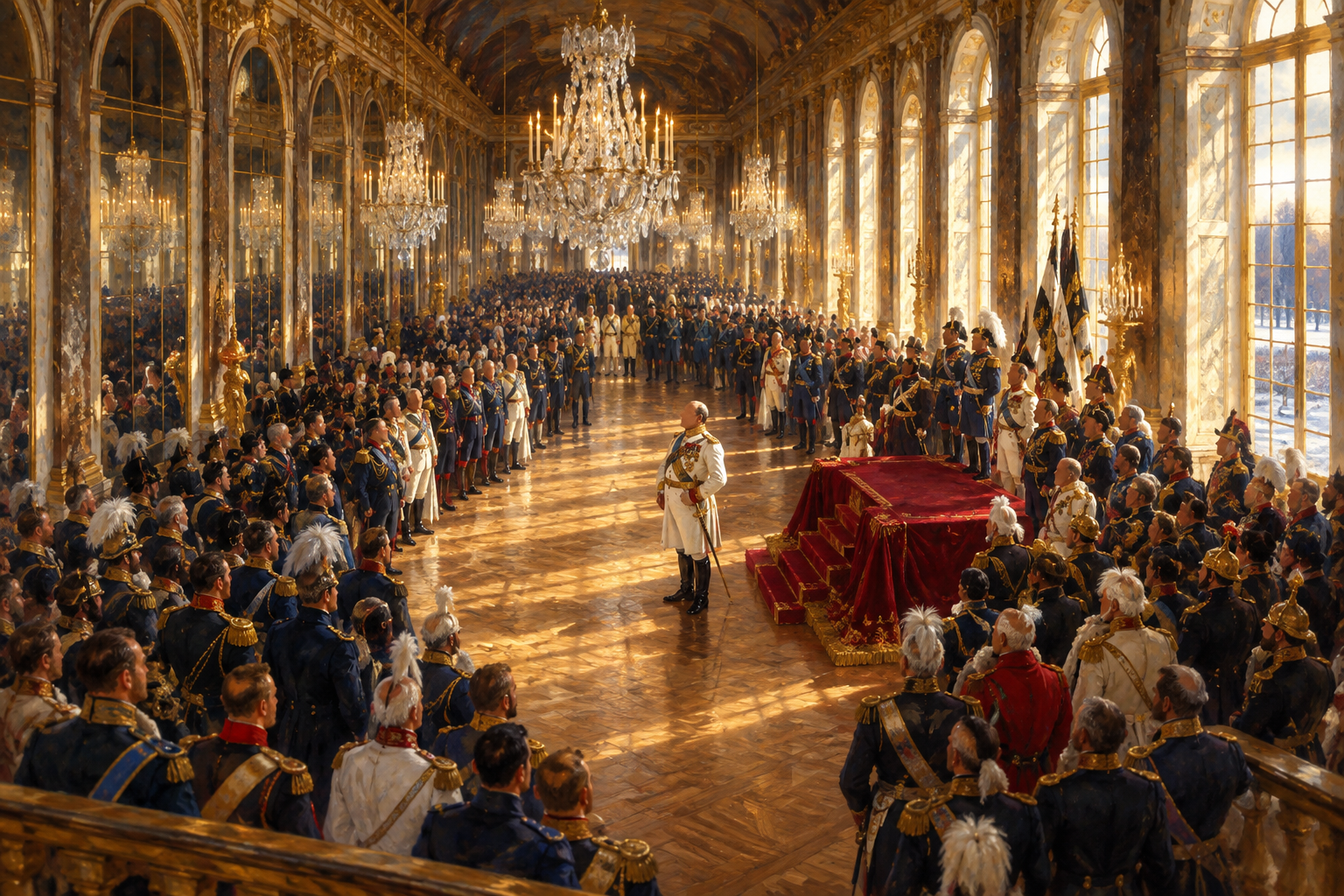
The last step was to draw in the southern states, such as Bavaria and Württemberg. A shared enemy would help. When a Hohenzollern prince was proposed for the vacant Spanish throne, France protested. At the spa town of Ems, Wilhelm I politely refused a French demand for a permanent promise on the matter. Bismarck then shortened the telegram that reported this meeting, the Ems Dispatch of 13 July 1870, so that it sounded like a mutual snub. France declared war on 19 July. German armies advanced fast, and at Sedan on 1–2 September 1870 Napoleon III was captured. On 18 January 1871, in the Hall of Mirrors at Versailles, Wilhelm I was proclaimed German Emperor. The Treaty of Frankfurt in May gave Alsace and part of Lorraine to Germany, a loss France resented for decades. The Dreyfus Affair, in which an officer from an Alsatian family was accused of spying for Germany, grew in this atmosphere; see The Dreyfus Affair.
The chancellor of a new empire (1871–1890)
The new empire was a federation of kingdoms, duchies and free cities, dominated by Prussia. It had an emperor, a Federal Council of the states and a Reichstag elected by all adult men. Bismarck, as imperial chancellor, answered to the emperor, not to parliament. To understand where its core came from, read Prussia: From Kingdom to Germany's Core.
At home he fought two struggles. The first was the Kulturkampf, the "culture struggle" of the 1870s. Bismarck feared that Catholics owed loyalty to the Pope and to the Catholic Centre Party, so laws such as the May Laws of 1873 put schools and clergy under state control. It backfired: Catholics united behind the Centre Party, and from the late 1870s he softened the policy. The second struggle was against socialists. After two attempts on the emperor's life in 1878, the Anti-Socialist Laws banned socialist organisations and newspapers, although socialists could still stand for the Reichstag.
At the same time he tried to win workers over. Health insurance began in 1883, accident insurance in 1884, and old-age and disability insurance in 1889. They were among the first national social insurance systems in the world. Historians often describe the mix as carrot and stick. In 1879 he also moved to protective tariffs, which helped farmers and heavy industry.
The Bismarckian alliance system
After 1871 Bismarck repeatedly called Germany a "satisfied" power. His aims were to keep France isolated, avoid war on two fronts, and stop Austria-Hungary and Russia from fighting each other in the Balkans. His main tools were:
- 1873: the League of Three Emperors (Germany, Austria-Hungary, Russia).
- 1878: the Congress of Berlin, where he chaired talks after the Russo-Turkish War as an "honest broker".
- 1879: the Dual Alliance with Austria-Hungary.
- 1882: the Triple Alliance with Austria-Hungary and Italy.
- 1887: the Reinsurance Treaty with Russia, a secret promise of neutrality in certain wars.
Bismarck was lukewarm about colonies, but in 1884–85 Germany claimed territories in Africa, including Togo, Cameroon, South West Africa and East Africa, and Berlin hosted a conference on Africa's partition.
Consequences: the fall in 1890
Wilhelm I died in March 1888. His son Friedrich III, already ill, reigned for only 99 days, and Wilhelm II, aged 29, took the throne in June. The young emperor wanted to rule personally and disagreed with Bismarck over the Anti-Socialist Laws and labour policy. Under pressure, Bismarck resigned on 18 March 1890. The Reinsurance Treaty with Russia was not renewed, and in the 1890s Russia moved closer to France. Bismarck retired to Friedrichsruh, where he died on 30 July 1898.
Why he matters
Bismarck created a powerful, unified Germany and a diplomatic order that kept great-power war away for two decades. Critics point out that he ruled through crisis and pressure, treated Catholics, socialists and Polish and French-speaking minorities as enemies of the state, and built a system that depended on one man's skill. After he left, the alliances hardened into the two blocs of 1914.
What exams ask
- Unification: know the order Denmark (1864), Austria (1866), France (1870–71), and the role of Königgrätz, the Ems Dispatch, Sedan and Versailles.
- Significance (AP-style): link nationalism, realpolitik and the shift of power in Europe after 1871.
- Domestic policy: Kulturkampf, Anti-Socialist Laws and social insurance, and the idea of carrot and stick.
- Diplomacy: the Bismarckian system and why it failed to outlast him.
Read next
- "Blood and Iron": Bismarck's Speech and Policy: the 1862 speech behind his nickname, in context.
- Prussia: From Kingdom to Germany's Core: the state that Bismarck led and used.
- The Dreyfus Affair: how French–German bitterness after 1871 shaped French politics.
- 19th-Century Europe: Revolutions, Nationalism and Unification: the big picture.