In five minutes
Prussia was a German state that rose from a small Baltic duchy and the sandy territory of Brandenburg to become a kingdom in 1701 and, by 1871, the leading power in Germany. It grew through three things: a large, disciplined army, an efficient civil service and a series of rulers who were willing to take risks. After 1871 the Prussian king was also German emperor, and Prussia made up most of the new empire. It lost its leading role after the First World War and was abolished in 1947.
This page is part of the hub 19th-Century Europe: Revolutions, Nationalism and Unification, where Prussia's story meets the wider rise of nationalism.
From Teutonic Knights to a duchy
The name comes from the Prussians, a Baltic people whose lands lay on the south-eastern shore of the Baltic Sea. In the thirteenth century the Teutonic Order, a crusading order of knights, conquered the region and ruled it as a religious state. In 1525 the Order's Grand Master, Albert of Brandenburg-Ansbach, adopted the Lutheran faith and turned the lands into a secular Duchy of Prussia under the overlordship of the Polish king.
The duchy and Brandenburg were still separate states. Brandenburg, with Berlin, was a poor territory ruled by the Hohenzollern family, whose head was one of the electors who chose the Holy Roman Emperor. In 1618 the Brandenburg line inherited the duchy, and the two came under one ruler without becoming one state. Historians call this union Brandenburg-Prussia. Its lands were scattered between the Rhine and the Baltic, which made them hard to defend.
Brandenburg-Prussia and the army state
The Thirty Years' War (1618–1648) devastated Brandenburg. Frederick William, known as the Great Elector (ruled 1640–1688), drew a lesson from it: a state of scattered lands needed its own standing army. He built one, created taxes and officials to pay for it, and in the Treaty of Wehlau in 1657 won full sovereignty over the Duchy of Prussia. In 1685 his Edict of Potsdam invited French Protestants, the Huguenots, who were fleeing persecution, and many skilled settlers came to Berlin.
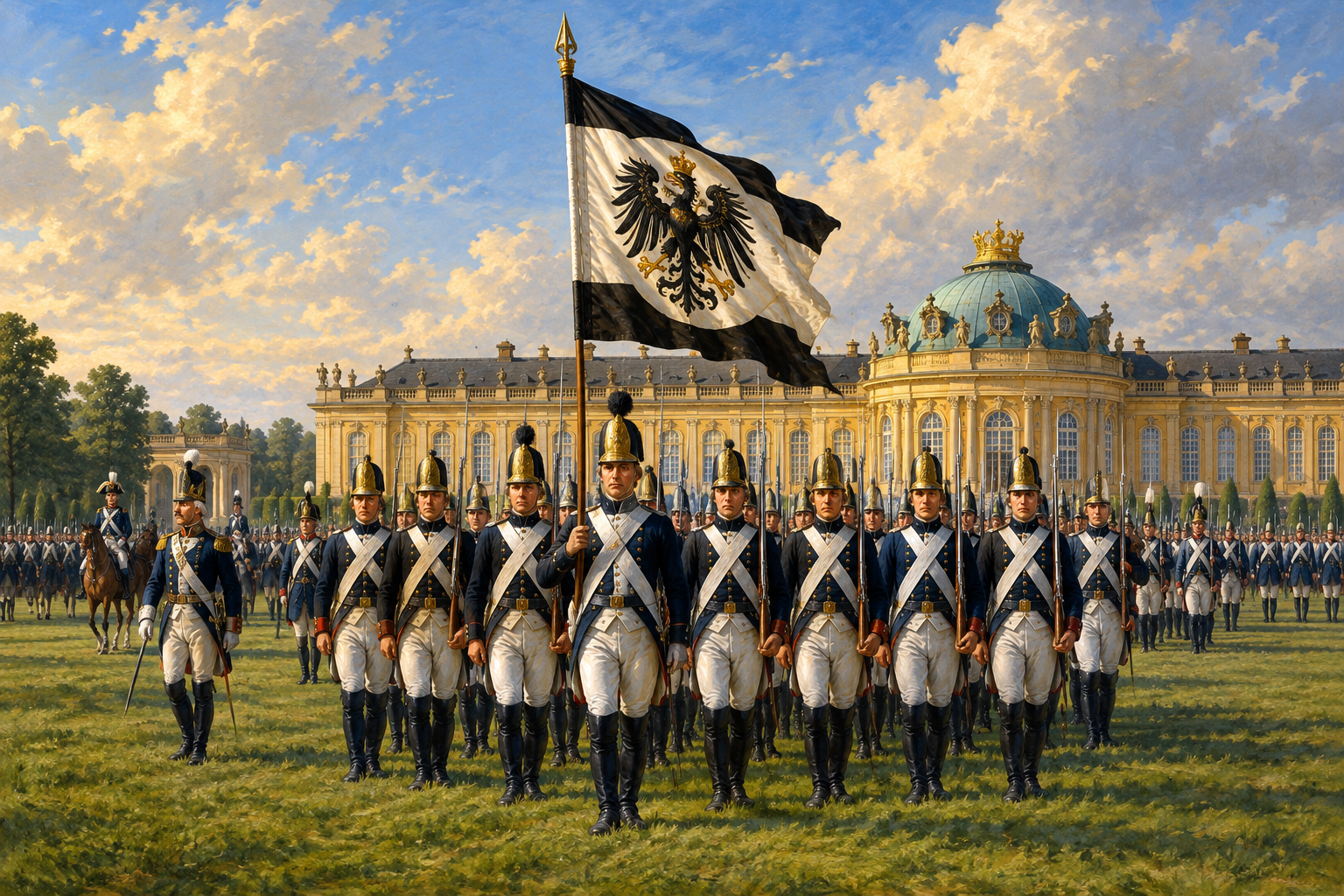
His son Frederick III turned this strength into a title. In return for backing the emperor in the War of the Spanish Succession, he was allowed to crown himself king on 18 January 1701 in Königsberg. He took the title King in Prussia, because Prussia lay outside the Holy Roman Empire while Brandenburg lay inside it. His son Frederick William I, the Soldier King (ruled 1713–1740), made the army the heart of the state. He raised it to about 80,000 men, a huge force for a small kingdom, and built a frugal, orderly bureaucracy. He rarely used the army, and left his son a full treasury.
Frederick the Great and the Seven Years' War
Frederick II, called Frederick the Great (ruled 1740–1786), put that army to use. Within months of taking the throne, in December 1740, he invaded Silesia, a rich Habsburg province. Maria Theresa of Austria fought to win it back, first in the War of the Austrian Succession and then in the Seven Years' War (1756–1763). In the second war Prussia faced Austria, France and Russia at once and came close to collapse. It held on, and the Treaty of Hubertusburg in 1763 left Silesia in Prussian hands.
In 1772 Frederick joined Russia and Austria in the First Partition of Poland. Prussia gained most of Polish Royal Prussia, which joined Brandenburg and East Prussia by land, and Frederick now styled himself King of Prussia. He is remembered as an 'enlightened' ruler who corresponded with Voltaire, tolerated several religions and described himself as the state's first servant. His reign made Prussia one of Europe's five great powers, alongside Britain, France, Austria and Russia. At home, however, nobles kept strong control over the serfs on their estates, and that would matter later.
Defeat and reform, 1806–1815
On 14 October 1806 Napoleon crushed the Prussian army at the twin battles of Jena and Auerstedt. In the Treaty of Tilsit in 1807 Prussia lost roughly half of its territory, had to pay heavy sums to France and had its army capped. Many Prussians concluded that the old order had failed.
A group of reformers set out to rebuild the state: Baron vom Stein, Karl August von Hardenberg, Gerhard von Scharnhorst, August von Gneisenau and Wilhelm von Humboldt. The October Edict of 1807 ended hereditary serfdom, so that peasants were free in person and nobles' land could be bought and sold. Full effect came on Martinmas (11 November) 1810. Peasants did not simply receive their fields: later rules often made them give up land or pay to hold it. Scharnhorst and Gneisenau opened officer posts to talent rather than birth alone and reshaped the army. Humboldt helped found the University of Berlin in 1810.
The new Prussia joined the wars against Napoleon in 1813. Prussian forces fought at Leipzig in October 1813, and Gebhard von Blücher's army helped win at Waterloo in 1815. At the Congress of Vienna Prussia gained the Rhineland, Westphalia and part of Saxony. This shifted its weight westward, towards the coal and iron of the Ruhr region that later powered its industry.
Prussia and German unification
After 1815 Prussia and Austria were the two biggest states in the German Confederation. In 1834 Prussia led the Zollverein, a customs union of German states that excluded Austria and tied northern and central Germany together economically. During the revolutions of 1848 the Frankfurt Parliament offered the imperial crown to King Frederick William IV, who refused it in April 1849 because it came from an elected assembly rather than from other princes. A Prussian constitution followed in 1850, with a voting system that gave the wealthiest taxpayers the most weight.
The decisive figure was Otto von Bismarck, who became Prussian minister-president in 1862. Read more in Otto von Bismarck: The Iron Chancellor and Bismarck Quotes and What They Reveal. Three wars followed. Prussia fought Denmark in 1864, beat Austria at Königgrätz on 3 July 1866 (see The Austro-Prussian War (1866)), and defeated France in 1870–1871. The North German Confederation of 1867 came first. Then, on 18 January 1871, King Wilhelm I of Prussia was proclaimed German Emperor in the Hall of Mirrors at Versailles. This was a 'small German' solution: a Germany led by Prussia, without Austria.
The end of Prussia
In the German Empire the Prussian king was also emperor, and Prussia held most of the empire's land and people. Prussia kept its unequal three-class voting system until 1918. After defeat in the First World War, Wilhelm II abdicated in November 1918 and Prussia became a free state in the Weimar Republic. For years it was governed by democratic parties and was one of the republic's steadier pillars. On 20 July 1932 Chancellor Franz von Papen removed the Prussian government by emergency decree, a blow to democracy in Germany. After 1933 the Nazis took over what was left of Prussian self-government.
The Allied Control Council formally abolished Prussia in Law No. 46 of 25 February 1947, calling it a bearer of militarism and reaction. After 1945 East Prussia was divided between the Soviet Union and Poland, and Königsberg became Kaliningrad. Today the old Prussian lands lie in Germany, Poland, Russia and Lithuania.
What exams ask
- Explain how the army, the civil service and rulers such as the Great Elector, Frederick William I and Frederick the Great turned a scattered, poor territory into a great power.
- Describe the Stein–Hardenberg reforms (1807 onward): the end of hereditary serfdom, army reform and education, and why defeat in 1806 triggered them.
- Explain why the Zollverein of 1834 and the wars of 1864, 1866 and 1870–1871 made Prussia, not Austria, the centre of German unification.
- Compare the 'small German' solution with a Germany that would have included Austria.
- Assess the idea that Prussia 'was an army with a state' with evidence of both military power and administrative reform.
Read next
- 19th-Century Europe: Revolutions, Nationalism and Unification: the hub that places Prussia among the other national movements.
- The Austro-Prussian War (1866): the seven-week war that settled who would lead Germany.
- Otto von Bismarck: The Iron Chancellor: the statesman who turned Prussian power into a German empire.
- Bismarck Quotes and What They Reveal: his own words, set in context.