In five minutes: the triangular trades
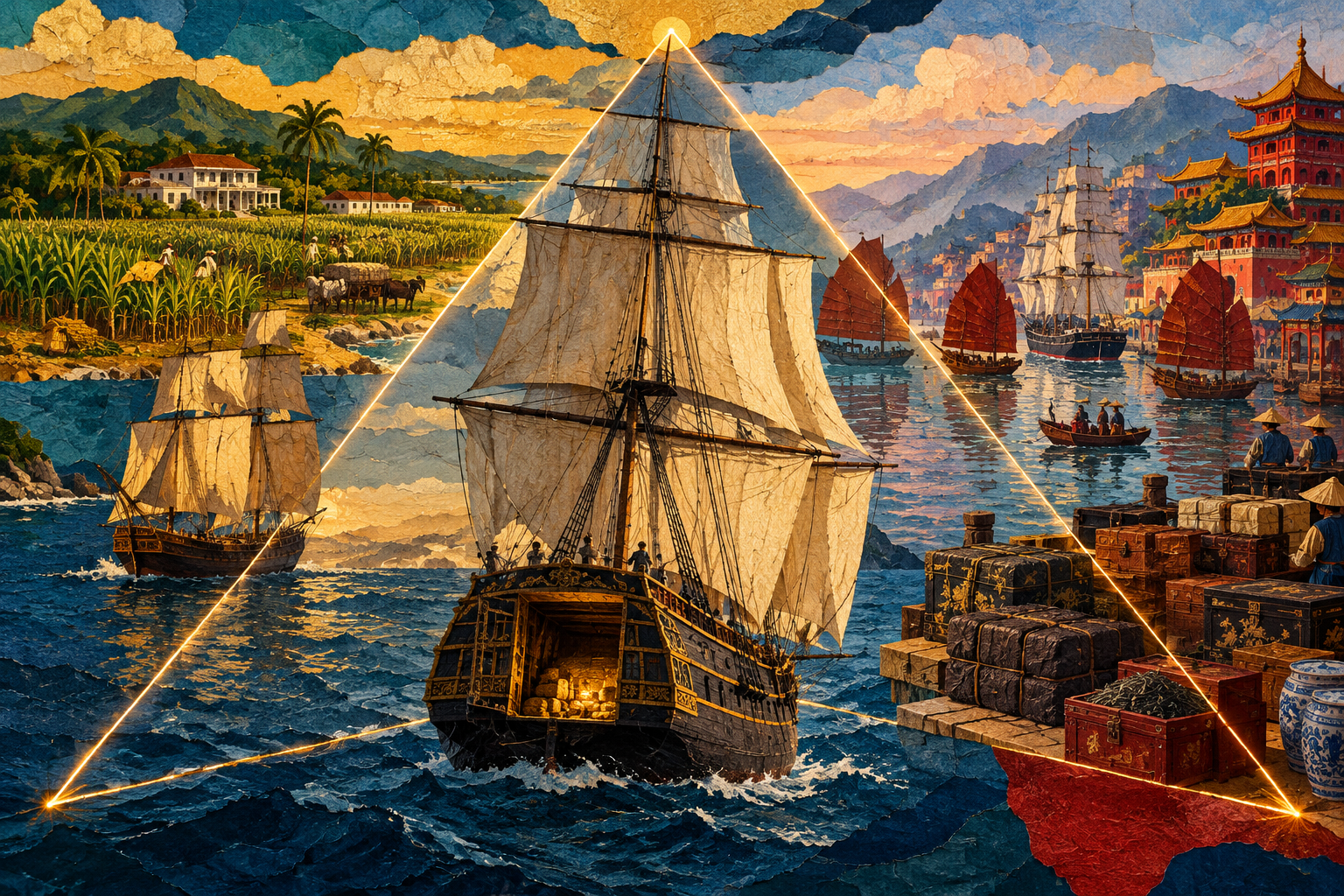
“Triangular trade” is a label for trade in which goods, people or money travel round three points instead of back and forth between two. Historians use it for two very different systems. The first is the Atlantic triangular trade, which ran from the 1500s to the 1860s. It joined Europe, Africa and the Americas and depended on the forced shipment of millions of enslaved Africans. The second is the Asian triangular trade between Britain, India and China, which took shape in the late 1700s and led to the First Opium War.
Both began with a European craving: sugar in the first case, tea in the second. Both turned human lives and addiction into profit, and both belong to the wider story of imperialism. A quick way to keep them apart: the Atlantic triangle is goods, people, crops; the Asian triangle is cotton and opium, silver, tea.
The Atlantic triangle: goods, people, crops
The Atlantic system is usually explained as three legs that make one loop. For a closer look at the British version, see The Atlantic Triangular Trade.
Leg 1: Europe to Africa
Ships left ports such as Liverpool, Bristol, Nantes and Lisbon loaded with cotton cloth, iron bars, guns, alcohol and cowrie shells. On the coasts of West and Central Africa, captains traded these goods for captives. The people who seized and sold those captives were mostly African rulers, states and merchants who profited from the trade. Europeans usually stayed at coastal forts and trading posts.
Leg 2: Africa to the Americas, the Middle Passage
Enslaved people were packed into the holds of ships and carried across the Atlantic. This crossing is called the Middle Passage because it is the middle side of the triangle. It lasted from several weeks to a few months, and disease, hunger and violence killed many on board. According to the Slave Voyages database, about 12.5 million people were forced onto ships between the 1500s and the 1860s, and about 10.7 million landed alive in the Americas. Roughly 1.8 million died at sea.
Leg 3: the Americas to Europe
On plantations in Brazil, the Caribbean and the southern part of North America, enslaved workers grew sugar, tobacco, cotton and coffee. Ships carried these crops, and rum made from sugar, back to Europe. The money from selling them paid for the next round of cloth and guns. Historians still argue about how much this wealth helped to drive the Industrial Revolution, but it clearly enriched port cities such as Liverpool and Nantes, and the banks and insurers that served them.
Not every voyage was a perfect triangle
The triangle is a model for understanding the system, not a description of every ship. Most captives were carried in Portuguese and Brazilian ships, and much of that trade ran straight between Angola and Brazil with no European leg at all. Many British ships also returned from the Caribbean with mixed cargoes or in ballast. Still, the picture is useful because it shows how three things were tied together: European factories and merchants, African slave-trading networks, and American plantations.
The Asian triangle: opium, silver and tea
The problem: tea and silver
In the 1700s tea became Britain's everyday drink, and almost all of it came from China. In 1757 the Qing government limited European trade to the port of Canton and made foreign merchants deal through licensed Chinese firms called the Hong. China wanted little that Britain made, such as woollen cloth, and asked to be paid in silver. Every cargo of tea therefore drained silver out of Britain.
The solution: Indian opium
Britain found something that Chinese buyers would pay for: opium. From 1773 the East India Company held a monopoly on opium made in Bengal and sold it at auction in Calcutta. Private “country traders” bought it and shipped it to the Chinese coast. Importing opium was illegal in China, so this was smuggling. The traders handed the silver they earned at Canton to the Company, which gave them bills payable in London and used the silver to buy tea.
This created the triangle. British manufactured goods, especially cotton cloth, went to India. Indian opium and raw cotton went to China. Chinese tea went to Britain, paid for with silver that opium sales had brought in. Opium imports grew from a few thousand chests a year around 1800 to about 40,000 chests by the late 1830s. Addiction spread, and silver began to flow out of China, which pushed up its price and made taxes harder for farmers to pay.
Lin Zexu and the Opium War
In 1839 the Daoguang Emperor sent the official Lin Zexu to Canton to stop the trade. At Humen he destroyed more than 20,000 chests of opium taken from foreign merchants. Britain treated this as the seizure of its subjects' property and sent a fleet. In the First Opium War (1839–1842) Qing forces could not match British steamships and guns. The Treaty of Nanjing in 1842 gave Hong Kong Island to Britain, opened five ports (Canton, Xiamen, Fuzhou, Ningbo and Shanghai), ended the Hong monopoly and required China to pay an indemnity of 21 million silver dollars. The treaty did not mention opium, and the trade carried on.
Comparing the two triangles
- The commodity that started it: sugar (Atlantic); tea (Asian).
- What was traded as a product: enslaved human beings (Atlantic); a drug (Asian).
- Who held the power: European states and traders working with African and colonial partners (Atlantic); the British East India Company and the British state (Asian).
- How it ended: abolition laws and rebellion (Atlantic); war, then treaties that opened China to foreign trade (Asian).
How the triangles ended
The Atlantic trade was attacked from several directions: enslaved people's own resistance, including the Haitian Revolution that began in 1791, and a growing abolition movement. Britain banned the slave trade in its empire in 1807 and the United States banned the import of enslaved people in 1808. Britain abolished slavery itself in most of its colonies in 1833, with the law taking effect in 1834. Illegal voyages continued for decades, and slavery lasted in the Americas until the United States ended it in 1865 and Brazil in 1888. For the whole story, read The Abolition of the Slave Trade and Slavery.
The Asian triangle ended differently. After the Second Opium War (1856–1860), opium was in effect legalised in China, and Indian opium flowed in until the early twentieth century. Meanwhile Britain's control of India grew into the Raj; see The British Raj (1858–1947) for that side of the story.
What exams ask
- Define it: the term “triangular trade” on its own usually means the Atlantic system. Read the question for clues such as Africa, the Middle Passage or plantations.
- Atlantic significance: mercantilism, the plantation economy, the Middle Passage, the demographic effect on Africa and the growth of port cities.
- Asian significance: the causes of the Opium War, unequal treaties, the loss of Chinese sovereignty over its ports and the founding of British Hong Kong.
- Comparison questions: a good answer names the goods on every side of each triangle and says who gained and who paid.
Read next
- The Atlantic Triangular Trade: a deeper look at the ships, routes and ports of the Atlantic system.
- The Abolition of the Slave Trade and Slavery: how the Atlantic system was finally outlawed.
- The British Raj (1858–1947): what happened in India after the Company's rule ended.