In five minutes
The Trail of Tears was the forced removal of the Cherokee Nation from its homeland in Georgia, Tennessee, North Carolina and Alabama to Indian Territory, in present-day Oklahoma. The main march took place in 1838–1839. About 16,000 Cherokee were driven west, and an estimated 4,000 died of disease, cold, hunger and exhaustion, both in the holding camps and on the road. The name is also used for the removals of the Choctaw, Muscogee (Creek), Chickasaw and Seminole peoples, which together uprooted tens of thousands of people from the American Southeast in the 1830s.
Three things explain it. White settlers wanted the land, and Georgia wanted to control it. A federal law, the Indian Removal Act of 1830, gave the president the power to exchange eastern land for land in the West. And a treaty signed by a small Cherokee faction gave the government a legal cover that most of the Cherokee Nation rejected. This article is part of 19th-Century America: Expansion, Civil War and the Gilded Age.
Causes: land, gold and a law
By the 1820s the Cherokee had lived in the southern Appalachians for centuries, and they were among the most visible examples of a Native nation adapting to the new United States on its own terms. In 1821 Sequoyah completed a writing system for the Cherokee language. In 1827 the nation adopted a written constitution modelled partly on the American one, with a capital at New Echota, in Georgia. In 1828 it began printing a bilingual newspaper, the Cherokee Phoenix. The Cherokee argued that they were a sovereign nation with treaties with the United States, and that their land could not simply be taken.
Georgia disagreed. The state claimed that the land inside its borders belonged to it and that the federal government had promised long ago to remove the Cherokee. Pressure grew after gold was found near Dahlonega, in northern Georgia, in 1829. Georgia then extended its laws over Cherokee territory, declared Cherokee laws void, and later held a lottery to give away Cherokee land to white citizens.
Andrew Jackson, who became president in 1829, supported removal. He and his allies described it as a way to protect Native people from conflict with settlers by placing them far from them. In practice it opened millions of acres to cotton farming and settlement. On May 28, 1830, Jackson signed the Indian Removal Act. On paper it only authorised the president to negotiate land exchanges with eastern nations for territory west of the Mississippi River. In practice it became the legal base for pressuring one nation after another into leaving. It fits within the wider push for land described in Manifest Destiny.
The courts and the Treaty of New Echota
The Cherokee took their case to the Supreme Court. In Cherokee Nation v. Georgia (1831), Chief Justice John Marshall declined to rule on the merits, saying the Cherokee were a “domestic dependent nation” and not a foreign state that could sue in that court. In Worcester v. Georgia (1832), the Court held that Georgia's laws had no force inside Cherokee territory, because dealings with Native nations belonged to the federal government. But neither Jackson nor Georgia acted on the ruling, and the pressure on the Cherokee continued.
The Cherokee themselves were divided. Principal Chief John Ross led the majority, who wanted to stay and to keep fighting through petitions and courts. A smaller group, the Treaty Party, led by Major Ridge, John Ridge and Elias Boudinot, concluded that removal could not be stopped and that it was better to negotiate the best terms possible. On December 29, 1835, Treaty Party leaders signed the Treaty of New Echota with US commissioners. It gave up all Cherokee land east of the Mississippi in return for $5 million and land in the West. The treaty had not been approved by the Cherokee National Council, and Ross collected a petition against it with about 16,000 signatures. The US Senate still ratified it in May 1836, by a margin of a single vote. The Cherokee were given two years to leave, until May 23, 1838.
What happened in 1838–1839
Only a small number of Cherokee left voluntarily. When the deadline passed, the army moved in. General Winfield Scott arrived in May 1838 with about 7,000 regular soldiers, state militia and volunteers. Families were taken from their homes and fields, often with little time to gather belongings, and held in stockades and forts. Settlers looted or moved into the empty houses almost at once. Crowded, poorly supplied camps spread disease through the summer, and many people died before the march had started.
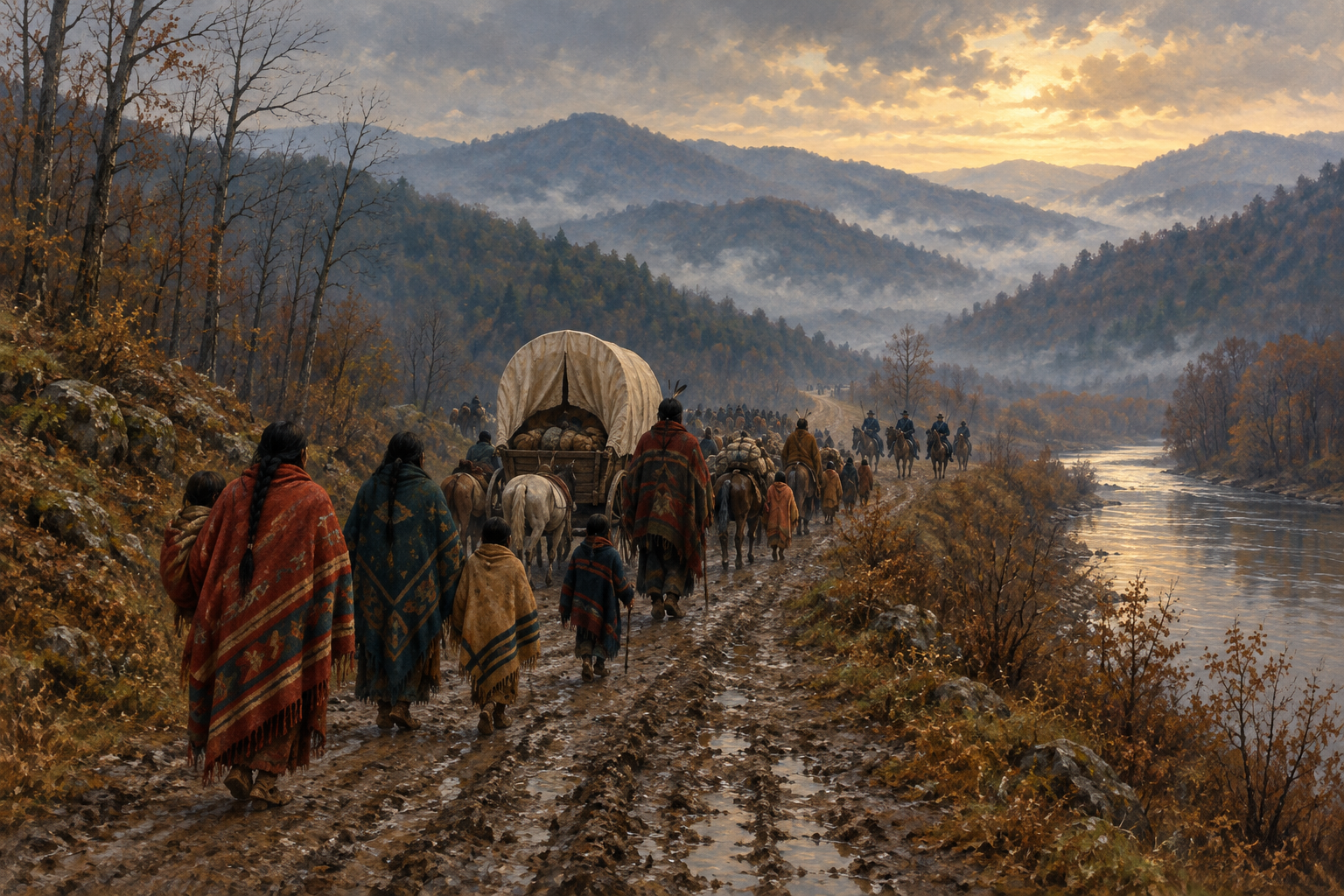
Ross convinced Scott to let the Cherokee organise the journey themselves, to wait out the worst of the summer heat. The people were divided into detachments of roughly 1,000 each, led by Cherokee conductors, and most set out between the late summer and autumn of 1838. Some travelled by river, but most went overland, covering about 1,000 miles through Tennessee, Kentucky, Illinois, Missouri and Arkansas. They crossed the Ohio and Mississippi rivers by ferry. Winter caught many of them on the road, and floating ice delayed crossings of the Mississippi, leaving families waiting for days in the open. Many walked without shoes or with poor clothing. Ross's wife, Quatie, died on the journey, in February 1839. The last groups arrived in Indian Territory in March 1839.
Nobody counted the dead at the time. Modern historians estimate that about 4,000 Cherokee died during the removal and its camps, roughly a quarter of the nation. Historians treat that figure as an estimate and not as an exact count.
Consequences
The Cherokee who arrived in the West had lost their homes, farms, mills, schools and much of their property, and they had to start over. Tensions between the groups were severe. On June 22, 1839, Major Ridge, John Ridge and Elias Boudinot were killed by men who held them responsible for the treaty. The Cherokee then re-established their government and built a new capital at Tahlequah, along with schools and a newspaper. A small number of Cherokee who avoided removal or returned stayed in the mountains of North Carolina and became the Eastern Band of Cherokee Indians.
The Cherokee were not alone. The Choctaw were removed first, from 1831 to 1833, and the Muscogee (Creek) followed in 1836–1837. The Chickasaw left in 1837–1838, and the Seminole were removed after long and costly wars in Florida. Across the Southeast, removal meant the end of most Native nations' presence east of the Mississippi. Today the Trail of Tears is remembered as a central example of how federal power and settler expansion overrode treaties. In 1987 Congress created the Trail of Tears National Historic Trail to mark the routes. The Cherokee Nation remains one of the largest federally recognised tribes in the United States.
What exams ask
On the AP US History exam and similar tests, the Trail of Tears usually appears in questions about Jacksonian democracy, federal and state power and westward expansion. Be ready to explain the following points.
- Indian Removal Act (1830): authorised the president to exchange land with eastern nations for land west of the Mississippi. It was the legal basis for removal.
- Worcester v. Georgia (1832): the Court ruled for the Cherokee, but Jackson and Georgia did not enforce the decision. This is a standard example of the limits of the courts when the executive does not act.
- Treaty of New Echota (1835): signed by a minority faction and ratified by one vote, which is why it was and remains contested.
- The Five Southeastern nations: Cherokee, Choctaw, Muscogee (Creek), Chickasaw and Seminole.
- Significance: removal opened land for cotton and slavery's expansion, and shows how the idea of a growing nation could be used to justify taking Native land. It is also a strong example for essays on the limits of democracy in the Age of Jackson.
Read next
- Manifest Destiny: the belief that the nation was meant to spread across the continent, which gave removal its wider political setting.
- The American West and the Frontier: what happened to the land and the people in the territories Native nations were moved into and beyond.
- Who Was Abraham Lincoln?: the president who led the country through the next great crisis, after the expansion that began in Jackson's time.