In five minutes: what the theory of evolution says
The theory of evolution is the idea that all living things descend from shared ancestors, and that species change over many generations. Charles Darwin's explanation for how this happens is called natural selection. It rests on three observations that anyone can check:
- Individuals in the same species differ from one another in size, colour, beak shape and countless other details.
- Some of those differences are passed from parents to offspring.
- More young are born than can survive, so they compete for food, space and mates.
Put these together and a pattern follows. Individuals whose inherited traits suit their surroundings tend to leave more offspring, so those traits become more common in the next generation. Repeat that over thousands of generations and a population can change enough to become a new species.
Two points are easy to miss. First, there is no goal or blueprint: natural selection only sorts the variation that already exists. Second, the unit that changes is the population, not the individual. This page sits inside our hub on the ideas that shaped the 19th century, alongside liberalism, socialism and nationalism.
Before Darwin: ideas that prepared the ground
Darwin did not invent the theory from nothing. Several earlier ideas made it possible.
Deep time. The geologist Charles Lyell argued in Principles of Geology (1830–33) that slow processes such as erosion and sediment, working for a very long time, could shape the whole landscape. Darwin read it on his voyage, and it gave him the long stretches of time he needed for gradual change in living things.
Changing species. The French naturalist Jean-Baptiste Lamarck proposed in 1809 that species change in response to their environment, and that traits an animal develops by use could be passed on. The second part was later rejected, but the bigger claim, that species are not fixed, kept the question open.
Competition for survival. Thomas Malthus, in his Essay on the Principle of Population (1798), argued that human numbers grow faster than food supplies. Darwin read it in 1838 and later said it helped him see that the same pressure must act on plants and animals, favouring some individuals over others.
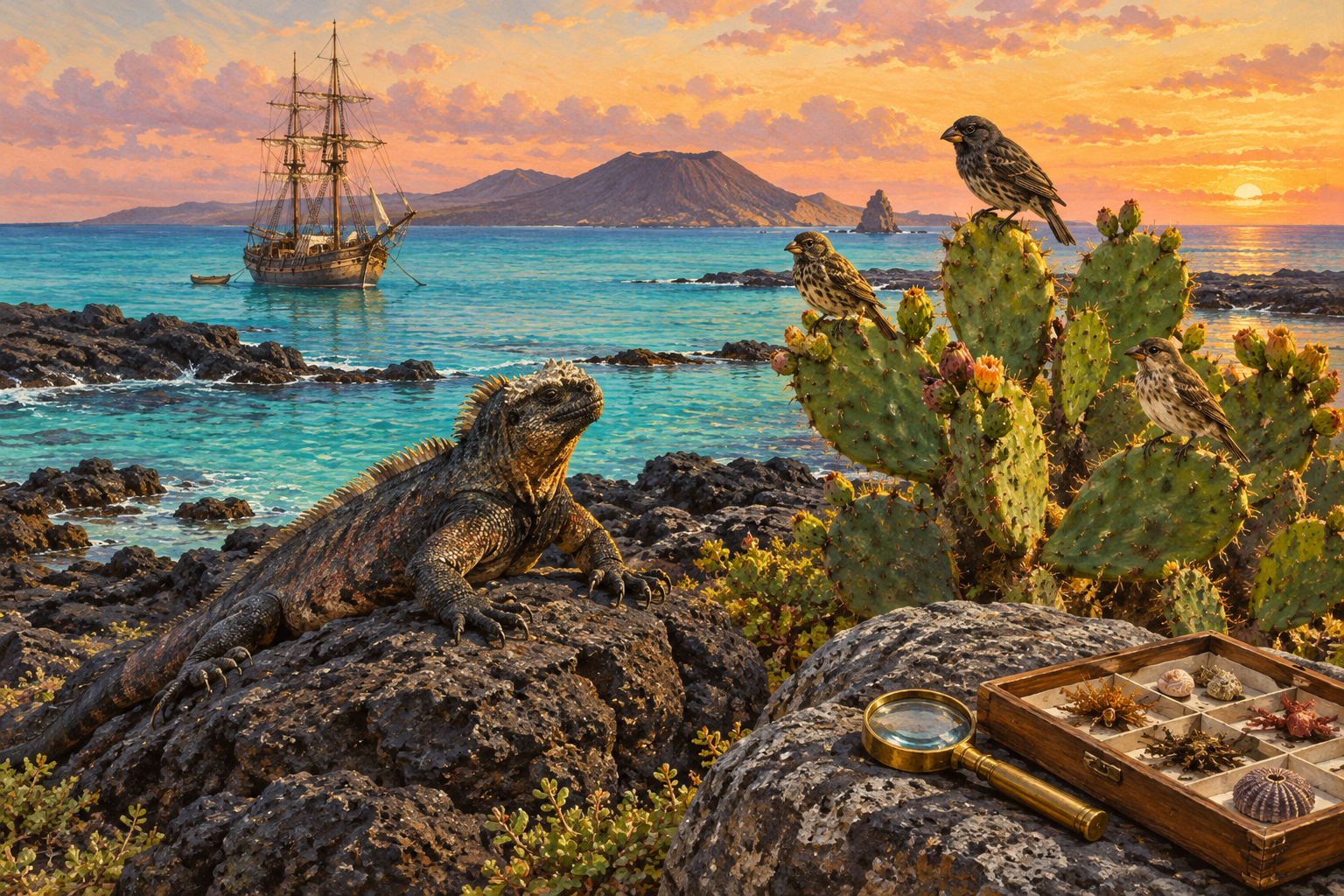
Darwin's own evidence. From 1831 to 1836 Darwin sailed around the world on HMS Beagle as the ship's naturalist. He collected fossils and specimens in South America and on the Galápagos Islands and noticed that related animals differed from place to place. Back in England he began private notebooks on how species change in 1837, but it took more than twenty years to turn them into a finished argument.
How natural selection works
Imagine a bird living on an island where its main food is hard seeds. Beak thickness varies from bird to bird, and thick beaks tend to run in families. In a drought, soft seeds disappear. Birds with thicker beaks can crack the remaining hard seeds, so they feed more chicks. In the next generation, thick beaks are more common. Repeat that for many dry spells and the average beak of the whole population shifts.
A modern example is antibiotic resistance. In a large group of bacteria, a few may happen to tolerate a drug. When the drug is used, those survive and multiply. Natural selection is happening in a hospital, within a few days.
Darwin also described sexual selection: traits such as a peacock's tail can spread because they help an animal win mates, even if they make survival harder.
The second pillar of the theory is common descent. Darwin pictured life as a branching tree, with every living species at the tip of a twig and all of them joined, further back, to shared ancestors. In his book he mostly called this “descent with modification”. That is why “humans evolved from monkeys” is not accurate. Humans and other apes share a common ancestor that was neither.
The evidence for evolution
The theory of evolution is accepted because several independent fields point to the same conclusion.
- Fossils: rock layers show life changing over time, including fossils that document whales' land-dwelling ancestors and birds' dinosaur relatives.
- Comparative anatomy: a human arm, a whale flipper and a bat wing do very different jobs but share the same basic bone layout, which fits inheritance from a common ancestor.
- Geography: island species usually resemble those of the nearest mainland, a pattern Darwin noticed in the Galápagos.
- Embryology: the early embryos of fish, reptiles and mammals look strikingly alike.
- DNA: after the double-helix structure was worked out in 1953, scientists could compare genes directly. The genetic differences between species match the family tree drawn from fossils and anatomy.
- Observed change: drug-resistant bacteria and pesticide-resistant insects evolve within our lifetimes.
You may hear that evolution is “just a theory”. In science, a theory is not a hunch. It is a well-tested explanation that accounts for many facts and has survived repeated attempts to disprove it.
Announcement, backlash and the modern theory
Darwin hesitated to publish for years, partly because he expected a fierce reaction. That changed in June 1858, when Alfred Russel Wallace, working in Southeast Asia, sent him an essay describing almost the same mechanism. Friends arranged for papers by both men to be read together at the Linnean Society in London on 1 July 1858. Darwin then wrote his book at speed, and On the Origin of Species appeared on 24 November 1859. The first printing of about 1,250 copies sold out almost at once.
The reaction was loud. Many churchmen objected that the theory challenged the Genesis account. A famous clash took place at Oxford in June 1860, where the biologist Thomas Huxley, a firm supporter of Darwin, argued against Bishop Samuel Wilberforce. Scientists also raised real problems. Nobody yet understood heredity, and if parents' traits simply blended in their children, a helpful new trait would soon be diluted away.
The answer was already on a shelf. In 1866 the Moravian friar Gregor Mendel published pea-breeding experiments showing that traits are inherited as distinct units, but almost nobody noticed. His work was rediscovered in 1900. During the 1930s and 1940s biologists joined Mendelian genetics to natural selection in what is called the modern synthesis, and the discovery of DNA's structure in 1953 explained how variation arises and is copied.
Darwin applied the same reasoning to humans in The Descent of Man (1871). He died in 1882 and was buried in Westminster Abbey.
Common misunderstandings
- “The strongest survive.” Fitness means leaving more offspring in a particular environment, not being strong. The phrase “survival of the fittest” came from the philosopher Herbert Spencer, and Darwin adopted it in later editions, but it encouraged this misreading.
- “Evolution means progress.” It has no direction. If the environment changes, so does what counts as useful.
- “Animals evolve because they need to.” Variation comes first, by chance. Selection then favours some of it.
- “An individual evolves in its lifetime.” Populations change across generations.
- “Social Darwinism is Darwin's theory.” In the late 1800s, Spencer and others applied competition and “fitness” to human societies to defend inequality and, later, imperial conquest and racism. That is a political ideology, not a conclusion of biology.
What exams ask
- Name the mechanism: natural selection, set out in On the Origin of Species (1859), with Wallace reaching the same idea independently.
- Know the context: the Beagle voyage (1831–36), Lyell's long timescales and Malthus on population pressure.
- Contrast Lamarck (inheritance of acquired traits) with Darwin (variation plus selection).
- Explain the significance: it replaced the idea of fixed species with common descent, shaped debates about religion and science, and was misused as Social Darwinism to justify imperialism and racial hierarchy.
- Link the later science: Mendel (1866, rediscovered 1900), the modern synthesis and DNA (1953).
Read next
- Who Was Charles Darwin? The life behind the theory: the Beagle, the long delay and the family at Down House.
- On the Origin of Species (1859) What the book actually argues and how its first readers reacted.
- What Is Nationalism? Another 19th-century idea, and one that Social Darwinism was often attached to.
- Ideas That Shaped the 19th Century The hub that places evolution beside liberalism, socialism and nationalism.