In five minutes
The spinning jenny was a wooden, hand-cranked machine that let one worker spin many threads at the same time. James Hargreaves, a weaver and carpenter from Lancashire, built the first one around 1764 and patented it in 1770. Before it, a spinner at a spinning wheel made one thread at a time. Hargreaves's first jenny drove eight spindles, and later models drove eighty or more.
That made cotton thread cheaper and far more plentiful. The jenny did not create the factory by itself: it was small, inexpensive and could be used in a cottage. But it broke the old limit on how fast thread could be made, and it led straight to the water frame and the mule, the machines that did move spinning into mills. It is one chapter in the larger story told in The Industrial Revolution: What It Was and Why It Mattered.
The problem: weavers outran spinners
In the early 1700s most cloth in Britain was still made at home. Families spun thread on spinning wheels, and weavers turned that thread into cloth on hand looms. The two jobs had to stay in balance, and for a long time they did.
In 1733 John Kay patented the flying shuttle, which let a weaver send the shuttle across the loom much faster (see John Kay's Flying Shuttle). Weaving sped up, but spinning did not. Several spinners were needed to keep one weaver supplied, and thread became the bottleneck. At the same time, raw cotton was arriving in growing amounts through British ports, and Lancashire was building a cotton cloth trade. Anyone who could make thread faster had a ready market.
Who made the spinning jenny?
James Hargreaves was born around 1720 near Blackburn in Lancashire. He worked as a hand-loom weaver and a carpenter, which is exactly the mix of skills the job needed: he understood both what a weaver wanted and how to build a machine out of wood. He built his first jenny around 1764. At first he made machines for his own household, and then he began to sell a few to other people.
The idea was simple and clever. If a spinning wheel could twist one thread, a frame could twist many at once, as long as the worker could still draw out the fibre and twist it in the right order.
How the spinning jenny worked
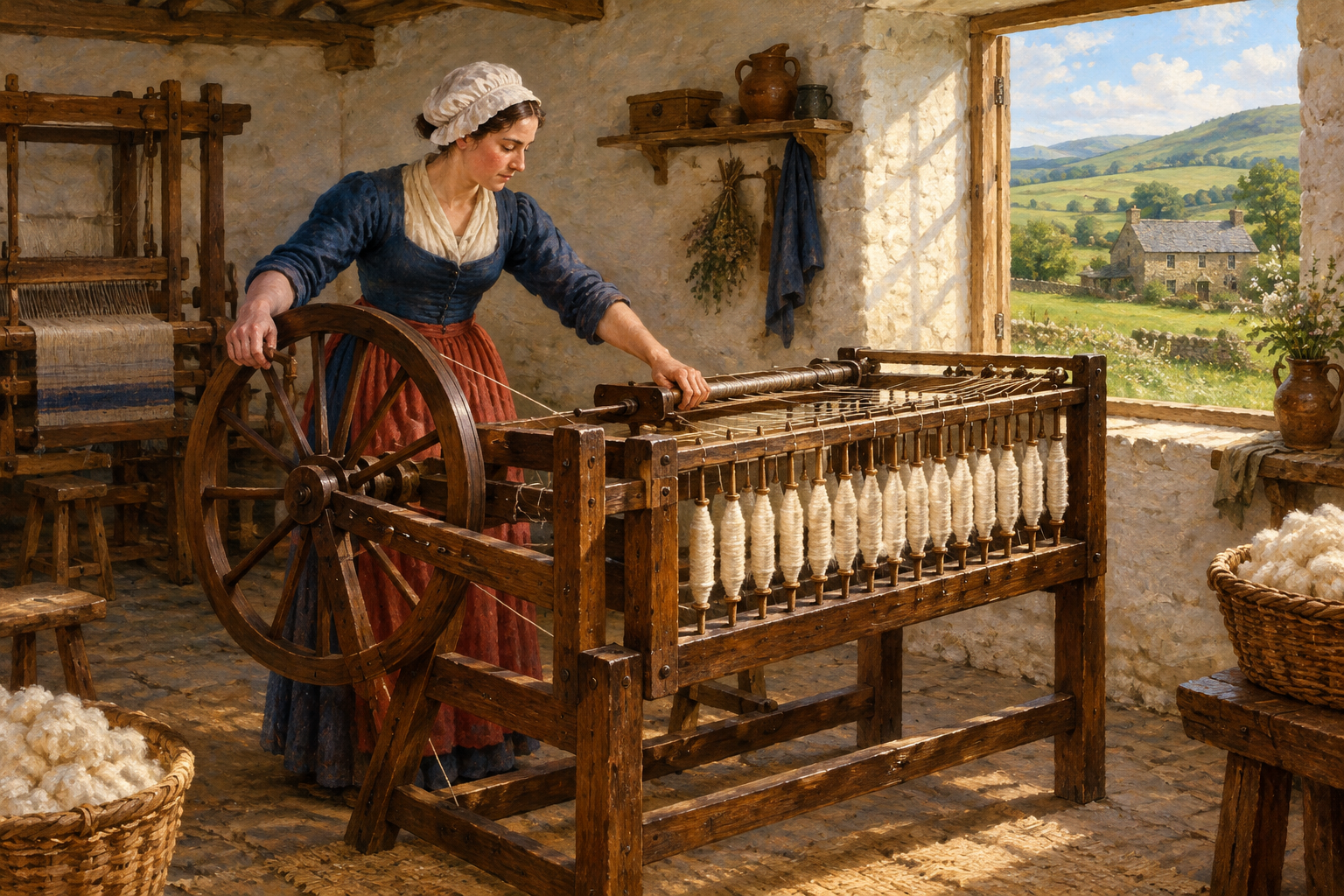
The early jenny was a rectangular wooden frame. At one end stood a row of upright spindles. Loose, soft ropes of cotton fibre, called rovings, were gripped by a wooden clasp on a sliding carriage. The worker turned a hand wheel with one hand and pushed the carriage back and forth with the other.
- As the carriage moved away from the spindles, the rovings were stretched into thin strands.
- The spindles spun, twisting the strands into thread.
- When the carriage came back, the finished thread wound onto the spindles, and the cycle began again.
Because every spindle was fed from the same movement, one person produced as much as several spinners at wheels. The machine needed little space and not much strength, so a family could run one at home.
It had a weakness. Jenny thread was soft and fairly thin. It worked well for weft, the threads that run across the cloth, but it was not strong enough for the warp, the threads that are held under tension on the loom. Making strong warp thread needed a different machine.
Anger, a patent and an unlucky end
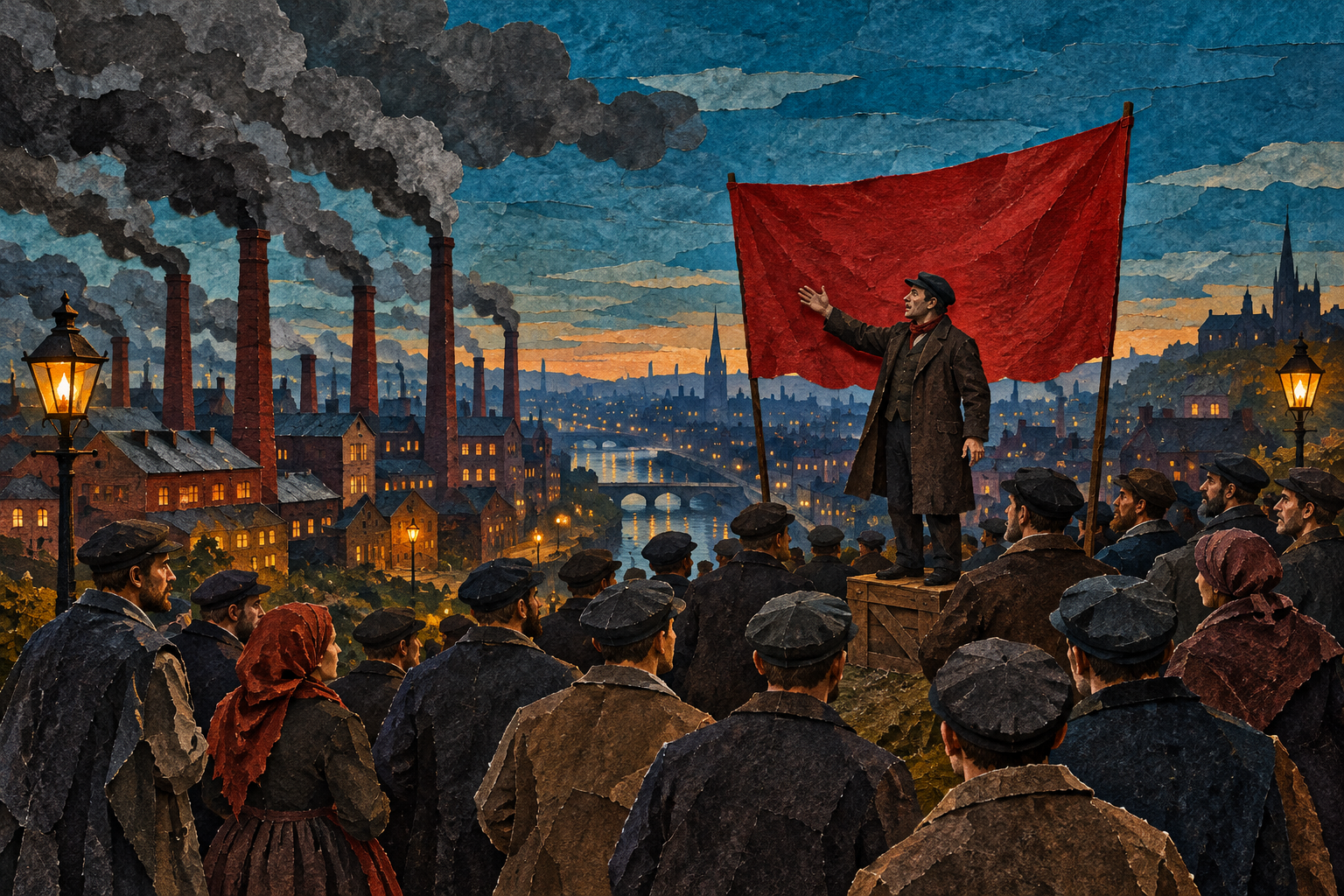
Many hand spinners saw the jenny as a threat to their income. In 1768 a crowd attacked Hargreaves's home area and smashed machines, and he left Lancashire for Nottingham. There he set up a small spinning business with a partner, Thomas James.
In 1770 Hargreaves took out a patent. By then, however, jennies had already been sold and copied, and Lancashire manufacturers were using them. When he tried to claim payment, his patent was ruled invalid, partly because he had sold machines before patenting the design. He died in Nottingham in 1778 and did not grow rich from his invention. Others did.
Jenny, water frame and mule
The jenny was one step in a short chain of spinning inventions:
- Spinning jenny (c. 1764): hand-powered, many spindles, soft thread.
- Water frame (patented 1769): Richard Arkwright's machine used rollers and water power, and made strong thread. It needed a mill beside a river.
- Mule (1779): Samuel Crompton joined the jenny's moving carriage to the water frame's rollers. The result spun strong, fine thread, and larger versions were driven by power.
Jennies spread quickly in the 1770s and 1780s, and an estimated 20,000 were in use by the late 1780s. As the water frame and mule took over, spinning moved out of cottages and into mills. Weaving then lagged behind, until Edmund Cartwright's power loom of 1785 began to close the gap.
What changed
The jenny shows a pattern that repeats across the Industrial Revolution: one improvement creates a new shortage somewhere else, and the next invention fills it. Thread became cheap, so cloth became cheaper, and Lancashire grew into the centre of British cotton.
There were costs too. Hand spinners lost work as machines spread, and the rising demand for raw cotton increased demand for cotton grown by enslaved people in the Americas. Eli Whitney's cotton gin of 1793 belongs to that part of the story (see Eli Whitney's Cotton Gin). In the longer run, the move of spinning from homes to mills prepared the way for factory towns, and for the steam power that came next (see George Stephenson and the First Steam Locomotives).
What exams ask
- Identify it: a multi-spindle hand-powered spinning machine by James Hargreaves, c. 1764, patented 1770.
- Order the inventions: flying shuttle (1733), spinning jenny (c. 1764), water frame (1769), mule (1779), power loom (1785), cotton gin (1793).
- Explain the cause: the flying shuttle sped up weaving, so spinners could not keep up with demand for thread.
- Explain the significance: it raised output per worker, cut the cost of cotton goods and started the shift from home production to mechanised textile making.
- Know the limits: the jenny was hand-powered and its thread was best for weft; the water frame and mule solved those problems.
Read next
- The Industrial Revolution: What It Was and Why It Mattered: the big picture that puts the jenny in context.
- John Kay's Flying Shuttle: the invention that made thread scarce in the first place.
- Eli Whitney's Cotton Gin: how the demand for cotton reached the American South.
- George Stephenson and the First Steam Locomotives: the power source that carried the revolution beyond textiles.