The Belle Époque in five minutes
The Belle Époque, French for “beautiful era,” is the name given to the years from 1871 to 1914 in France, and above all in Paris. After the defeat of the Franco-Prussian War and the bloody end of the Paris Commune, France went more than forty years without a major war on its own soil. Trade grew, cities filled with electric light, and artists, scientists and engineers gave the world the Eiffel Tower, the Paris Métro, the first public film screenings and Art Nouveau.
The name is a looking-back word. People at the time did not call their own years the “beautiful era.” The phrase spread after the First World War, when the years before 1914 began to look calm and golden by comparison. The good times were real, but they were not shared equally: workers, women and colonised peoples stood outside the glitter.
This article follows the story in order: the background, the new technology, the arts, the world's fairs, the dark side, the end, and the points exams ask about. For the wider picture, see the hub page 19th-Century Art and Culture: From Romanticism to the Belle Époque.
When was the Belle Époque? The background
The starting point is defeat. France lost the war of 1870–71 against Prussia and its German allies. By the Treaty of Frankfurt in May 1871 it gave up most of Alsace and part of Lorraine and agreed to pay an indemnity of five billion francs. That same spring, Parisians had set up their own government, the Paris Commune, which the national army crushed in bloody fighting. The “beautiful era” began right after this pain.
The political frame was the Third Republic, declared in September 1870 and settled by the constitutional laws of 1875. In 1881–82 the education reforms of Jules Ferry made public primary school free, compulsory and secular, so more French people could read newspapers, novels and advertisements. In 1884 trade unions were legalised.
Railways, factories and cheap electricity powered growth, and the great powers of Europe avoided a general war for decades, which helped trade and investment. The period ended in 1914: Austria-Hungary declared war on Serbia on 28 July, and Germany declared war on France on 3 August.
France was not alone. Britain had its Edwardian years (1901–1910), the United States its Gilded Age, and Germany and Austria their own confident “fin de siècle” cultures. But the label “Belle Époque” points above all to France and Paris.
Paris: boulevards, cafés and department stores
Much of the stage had been built earlier. Baron Haussmann's rebuilding of Paris, between 1853 and 1870, gave the city wide boulevards that later filled with cafés, theatres and shops. The Opéra Garnier opened in 1875, and by 1900 Paris had about 2.7 million people. Department stores such as Le Bon Marché and Printemps, and Galeries Lafayette from 1893, taught shoppers to browse at fixed prices instead of haggling in small shops.
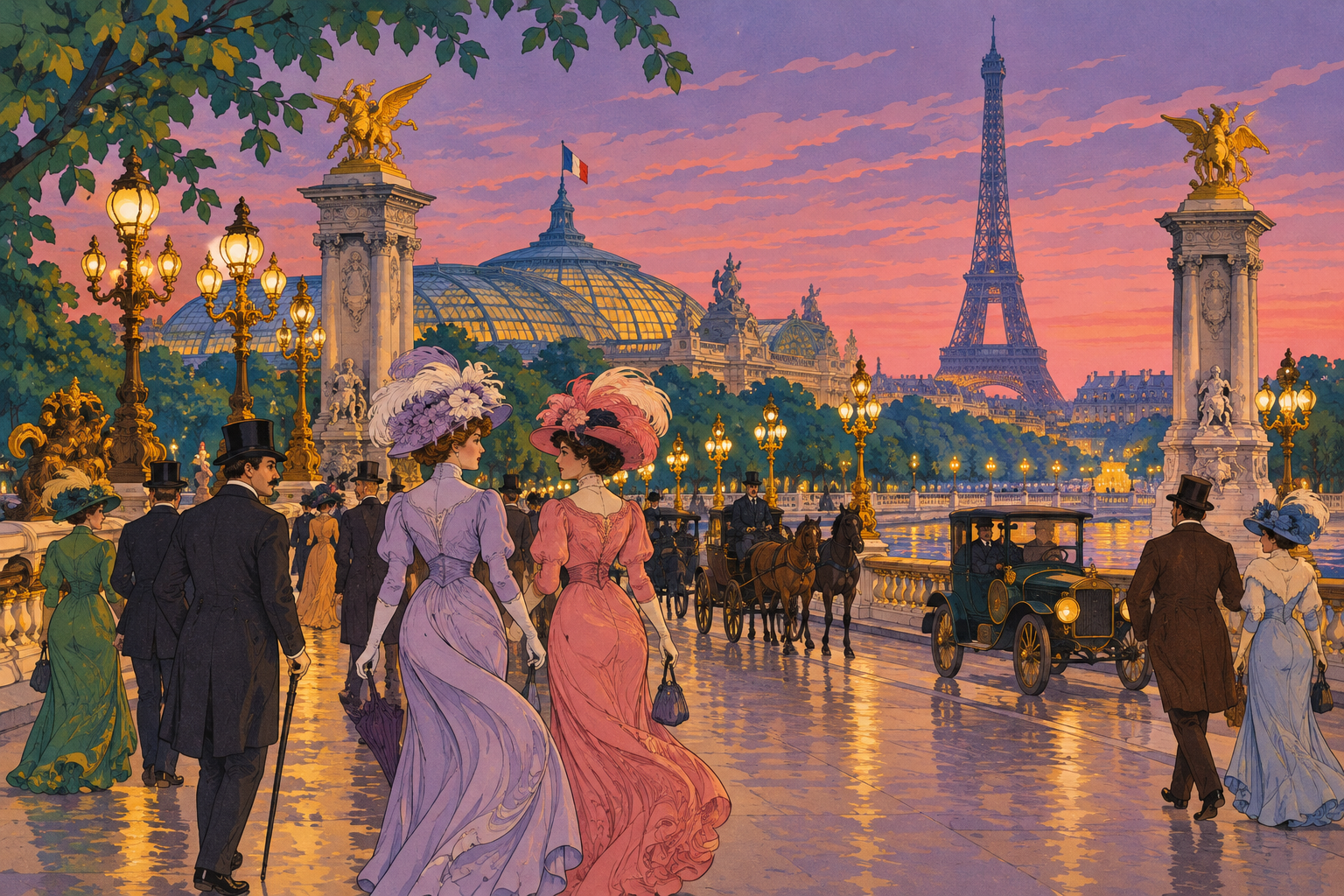
Electric lighting spread through streets and theatres, telephones began to appear, bicycling became a craze and the first motor cars shared the road with horse cabs. On 19 July 1900 the first line of the Paris Métro opened, and its entrances, designed by Hector Guimard, became a symbol of the age. On 28 December 1895 the Lumière brothers held the first paid public film screening at the Grand Café in Paris.
Science moved fast too. The Pasteur Institute was founded in 1887, and in 1903 Pierre and Marie Curie shared the Nobel Prize in Physics with Henri Becquerel. Marie Curie won a second Nobel Prize, in Chemistry, in 1911.
Art and culture: from Impressionism to Art Nouveau
The arts changed as quickly as the streets. Impressionism began with the group exhibition of 1874 and made light, leisure and modern city life its subject; read more in What Is Impressionism?. From the 1890s Art Nouveau (“new art”) spread curving, plant-like lines across posters, furniture, glass and buildings. The Czech artist Alphonse Mucha became famous for his theatre posters for the actress Sarah Bernhardt.
On Montmartre, the Moulin Rouge cabaret opened in 1889, and Henri de Toulouse-Lautrec drew its dancers and posters. In music, Claude Debussy's Prelude to the Afternoon of a Faun appeared in 1894, and the Ballets Russes brought its first Paris season in 1909. In literature, Marcel Proust began In Search of Lost Time around 1909 and published the first volume in 1913, a portrait of the society of these years. For novels that explain the century, see 19th-Century Novels That Explain History.
Outside influence mattered as well. Japanese prints and crafts inspired many painters and designers, a movement explained in Japonisme: How Japanese Art Changed Europe.
The Paris world's fairs: the Eiffel Tower and 1900
The best showcase of Belle Époque confidence was the world's fair. The Exposition Universelle of 1889 marked the hundredth anniversary of the French Revolution. Its entrance was a tower of iron built by the company of Gustave Eiffel, about 300 metres tall and the highest structure in the world at the time. Some artists protested while it was being built, but it soon became the symbol of Paris.
The Exposition Universelle of 1900 celebrated the turn of the century. The Grand Palais, the Petit Palais and the Pont Alexandre III date from this fair. The same year, Paris hosted the second modern Olympic Games, held as part of the exposition over several months.
The fairs also displayed empire. Pavilions and exhibits from French colonies showed visitors a version of the world in which Europe led and others were on show.
The other side: the Dreyfus Affair, inequality and empire
Behind the glitter ran deep conflicts. In 1894 an army captain, Alfred Dreyfus, who was Jewish, was convicted of passing secrets to Germany. Evidence soon pointed to another officer, and on 13 January 1898 the novelist Émile Zola published the open letter “J'accuse” in a newspaper. Dreyfus was pardoned in 1899 and cleared in 1906. The affair split France over the army, the republic, antisemitism and human rights. In 1905 a law separated church and state.
Life for many was hard: low wages, long hours, crowded housing and strikes. Anarchist violence shook the period, and President Sadi Carnot was assassinated in 1894. Women gained schooling and new jobs, but could not vote; French women won the vote only by a decree of 1944 and first voted in 1945.
Overseas, France expanded its empire in Africa and Southeast Asia, and French Indochina was formed in 1887. Part of the era's wealth rested on colonial rule.
How the Belle Époque ended
The end came through alliances. France and Russia agreed an alliance in 1894, Britain and France signed the Entente Cordiale in 1904, and Britain and Russia reached an agreement in 1907. Europe divided into two camps: the Triple Entente and the Triple Alliance of Germany, Austria-Hungary and Italy. When Archduke Franz Ferdinand and his wife were shot in Sarajevo on 28 June 1914, the alliance system pulled one country after another into war.
Many expected a short war. It lasted more than four years, and over a million French soldiers died. Looking back, survivors began to call the years before 1914 the “beautiful era.”
What exams ask
- Dates: 1871 (defeat and the Commune) to 1914 (the First World War).
- Politics: the Third Republic, the Ferry school laws, the Dreyfus Affair (1894–1906) and Zola's “J'accuse.”
- Culture: Impressionism, Art Nouveau, the 1889 and 1900 expositions, the Eiffel Tower.
- Diplomacy: the Franco-Russian alliance, the Entente Cordiale and the Triple Entente.
In essay questions, pair prosperity with its limits: strong answers say that the “beautiful era” was a label applied afterwards, and that its benefits were uneven.
Read next
- 19th-Century Art and Culture: From Romanticism to the Belle Époque: the hub that places this era in the long story of the arts.
- What Is Impressionism?: the painting style that captured Belle Époque light and leisure.
- Japonisme: How Japanese Art Changed Europe: how Japanese prints shaped Paris artists.
- 19th-Century Novels That Explain History: stories that show the society behind the glitter.