In five minutes
Socialism is the idea that a society's main resources, such as factories, land and railways, should be owned or controlled by the community rather than by private owners, so that wealth is shared more fairly. In simple terms, socialists argue that the people who do the work should have a real say in how it is organised and who benefits from it.
The idea took shape in Europe in the early 1800s as a reply to the factory system. Machines made goods cheaper, but profits went mostly to owners, while workers faced low pay, long hours and crowded, unhealthy towns. The word “socialism” was in use by the 1820s and 1830s in Britain and France, and by 1900 it had grown into a mass political movement with parties, trade unions and newspapers. It is one of the big currents covered in Ideas That Shaped the 19th Century, alongside liberalism and nationalism.
One warning: “socialism” has meant very different things, from a small cooperative village to a party that wants public health care to a state that owns nearly everything. This page covers the nineteenth-century roots.
Why socialism appeared
The factory and the “social question”
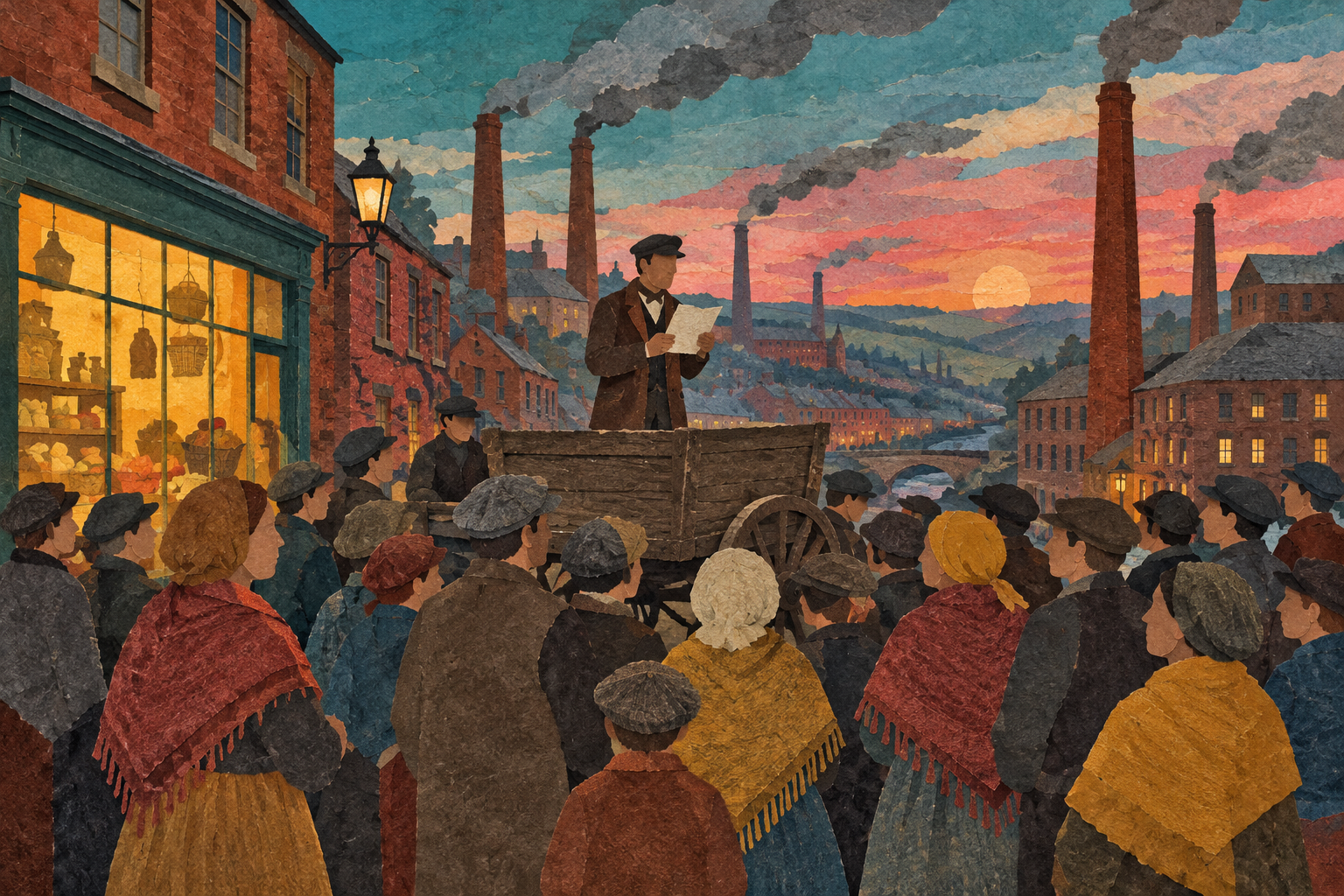
The Industrial Revolution began in Britain in the late 1700s and spread across Europe in the 1800s. Cities filled with people looking for work. Many labourers worked twelve hours or more a day, children worked in mills and mines, and housing and sanitation lagged far behind. People at the time called this the “social question”: what should society do about the poverty that industry was creating beside its wealth?
The promise of the French Revolution
The French Revolution of 1789 promised liberty, equality and fraternity. It ended the legal privileges of birth, but political rights often depended on property, and the daily lives of workers barely changed. Some radicals wanted more. In 1796 Gracchus Babeuf plotted to create a society of shared property; he was caught and executed in 1797. His plot was crushed, but the question he raised, whether equality before the law is enough, did not go away.
The first socialists
Friedrich Engels later called the early socialists “utopian”, because they drew pictures of a better society and hoped to win people over by example and persuasion rather than through a struggle for power. Four names matter most.
- Henri de Saint-Simon (1760–1825) wanted society to be run by producers, engineers and scientists for the benefit of its poorest and most numerous class. His followers spread the idea of planning and organised industry.
- Charles Fourier (1772–1837) imagined self-governing communities called phalansteries, each home to about 1,600 people, where work was chosen to suit each person's talents.
- Robert Owen (1771–1858) ran the cotton mills at New Lanark in Scotland, where he shortened hours, built schools and kept young children out of the mills. In 1825 he started the New Harmony community in Indiana, which failed within a few years. His work fed the cooperative and trade union movements.
- Louis Blanc and Pierre-Joseph Proudhon. Blanc argued in 1839 that the state should help workers set up cooperative workshops. Proudhon, in What Is Property? (1840), declared that “property is theft” and favoured free associations of workers without a strong state, ideas that fed into anarchism.
Their experiments were small and often short-lived, but they put the key question on the table: could work be organised for shared benefit instead of private profit?
Marx and Engels: socialism as a movement
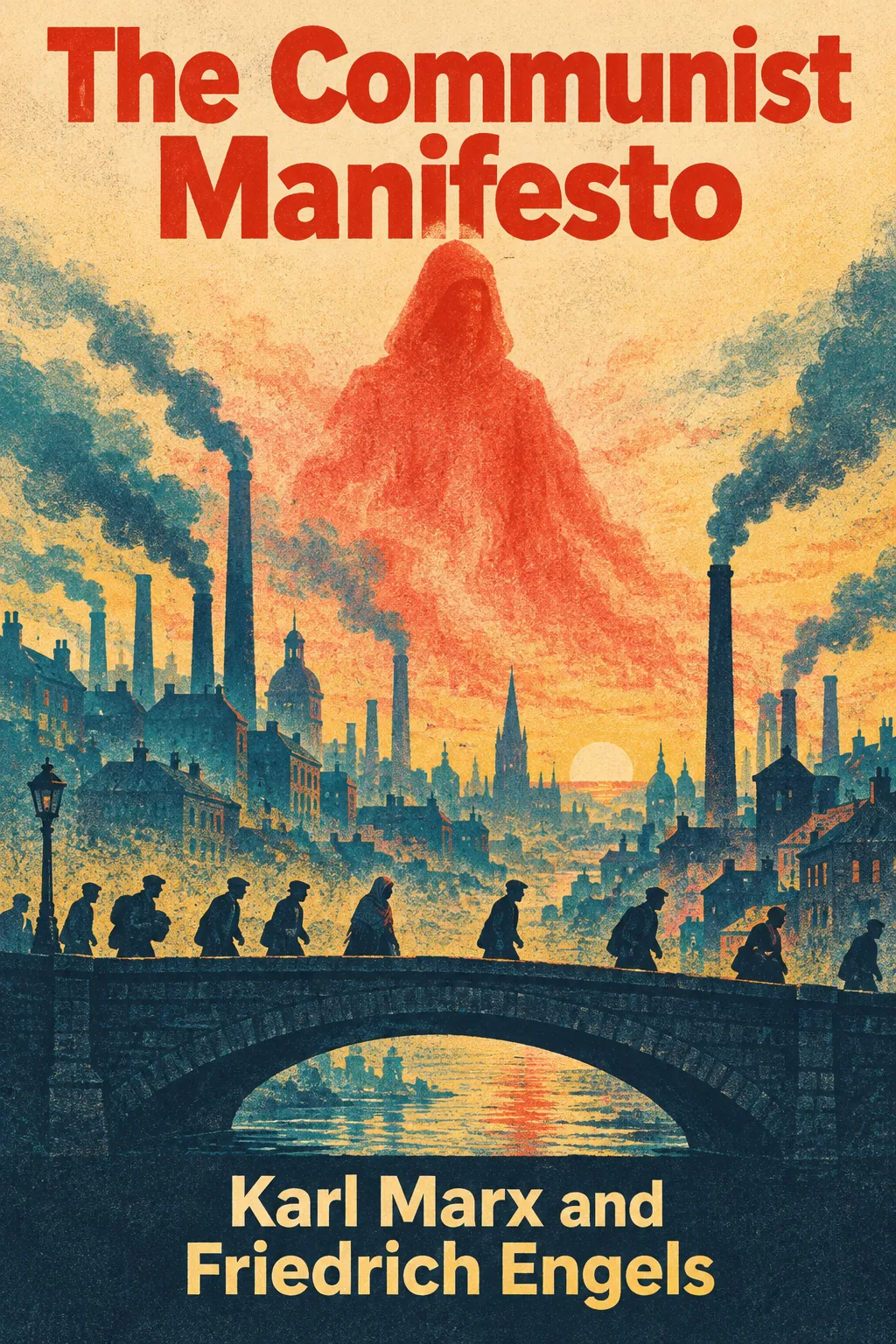
Karl Marx (1818–1883) and Friedrich Engels (1820–1895) gave socialism a new theory. Engels, whose family had a stake in a cotton business in Manchester, described the lives of English workers in The Condition of the Working Class in England (1845). In February 1848, as revolutions began to spread across Europe, the two men published The Communist Manifesto for a small group of workers called the Communist League.
Their argument, which they called scientific socialism, had a few core points:
- History is driven by conflict between classes. In industrial society the main conflict is between the owners of capital (the bourgeoisie) and wage workers (the proletariat).
- Owners make profit by keeping part of the value that workers create, which Marx called surplus value.
- Capitalism produces repeated crises, and workers, organised as a class, would eventually take control of production.
Marx developed the economic side in Capital, whose first volume appeared in 1867. Engels later set out the contrast with the early thinkers in Socialism: Utopian and Scientific (1880). Marxism became the most influential strand of socialism, but it was never the only one.
From ideas to parties
Most of the revolutions of 1848 were defeated, and socialists turned to long-term organising.
- 1864: the International Workingmen's Association, the First International, was founded in London. Marxists and anarchists quarrelled, and it fell apart in the 1870s.
- 1871: the Paris Commune, a radical city government that held Paris for about two months, was crushed by the French army. Socialists everywhere remembered it as a hero's attempt or as a warning, depending on their camp.
- Germany: Ferdinand Lassalle formed a workers' association in 1863, and in 1875 the Gotha congress merged the two main German socialist groups. Chancellor Otto von Bismarck banned socialist organisations from 1878 to 1890, yet he also introduced health, accident and old-age insurance in the 1880s, partly to draw workers away from socialism. After the ban ended, the party took the name Social Democratic Party (SPD) and kept growing until it became the largest party in the Reichstag in 1912.
- 1884: in Britain the Fabian Society began to promote gradual change by reasoned argument, and the Labour Party grew out of unions and socialist groups around 1900.
- 1889: the Second International, a federation of socialist parties, met in Paris.
Reform or revolution?
As socialist parties won seats and unions won better conditions, a debate opened. In 1899 the German socialist Eduard Bernstein argued that capitalism was not collapsing as Marx had predicted and that socialists should aim for gradual reform through elections and laws. Karl Kautsky defended the Marxist expectation of a decisive change, and Rosa Luxemburg replied that reform alone would not be enough. This split between reformers and revolutionaries shaped the twentieth century, including the later divide between social democrats and communists. The story of that divide is in Socialism vs Communism.
Socialism next to other 19th-century ideas
- Liberalism stressed individual freedom, property rights and free markets. Socialists accepted freedom as a goal but said it was empty without economic security.
- Nationalism put the nation first. Socialists said class mattered more than nation and that workers in every country shared interests, yet in 1914 most socialist parties still backed their own governments when war came. See What Is Nationalism?
- Conservatism defended tradition and order, and often feared socialism as a threat to both.
- Anarchism shared socialism's concern for workers but rejected the state altogether.
What exams ask
Typical AP-style and general history questions come back to a few points:
- Explain how industrialisation created the conditions in which socialism grew.
- Contrast the utopian socialists (Owen, Fourier, Saint-Simon) with the scientific socialism of Marx and Engels.
- Know the key dates: 1848 (the Manifesto), 1864 (First International), 1871 (Paris Commune) and 1889 (Second International).
- Describe how governments responded: repression, as in Bismarck's anti-socialist laws, and reforms such as social insurance.
- Compare revolutionary and reformist socialism, for example Bernstein against Marxist orthodoxy.
A strong answer ties socialism to its causes, not only to Marx, and notes that it was a family of ideas rather than a single doctrine.
Read next
- Socialism vs Communism: What's the Difference? shows where Marx's ideas and later movements split.
- What Is Nationalism? covers the rival force that often beat class loyalty.
- Patriotism vs Nationalism helps sort out two terms people often mix up.