In five minutes: who was Mary Wollstonecraft?
Mary Wollstonecraft (1759–1797) was an English writer who argued that women only look less capable than men because they are denied a proper education. Her book A Vindication of the Rights of Woman (1792) set out that case, and it is why she is remembered as a founder of modern feminist thought.
She belonged to the Enlightenment, the eighteenth-century movement that trusted reason over inherited authority. For the wider movement, see The Enlightenment Explained: Ideas, Thinkers and Legacy. Her move was simple and bold: if reason is what makes people worthy of rights, then women, who have reason too, cannot be left out. Her own life was hard and far from conventional, and it shaped everything she wrote.
A girl who learned to protect her mother
Wollstonecraft was born on 27 April 1759 in Spitalfields, London, one of seven children. Her father, Edward John Wollstonecraft, lost the family's money in failed attempts at farming and drank heavily. He was violent at home, and later accounts say Mary would lie outside her mother's door at night to guard her. The family moved often, and the children saw how little protection the law gave a wife. In the 1700s a married woman's property belonged to her husband, and she could do almost nothing without him.
Schooling for girls was thin, so Mary taught herself much of what she knew. As a teenager she became close to Fanny Blood, a slightly older friend who shared her love of books. That friendship showed her that a woman's life could be built around more than pleasing a man.
Teacher, governess, writer
In 1784 Mary, her sisters Eliza and Everina, and Fanny Blood opened a school in Newington Green, north London. The village was home to many religious Dissenters, including the minister Richard Price, who spoke up for liberty and reform. Through his circle she met people who debated politics seriously, and she joined in.
The school struggled. In 1785 she travelled to Lisbon to nurse Fanny, who died after giving birth, and the school soon closed. Short of money, Mary became a governess to the children of Lord and Lady Kingsborough in Ireland in 1786. She disliked the work and was dismissed after about a year, but by then she had published Thoughts on the Education of Daughters (1787) and was starting a novel, Mary: A Fiction (1788).
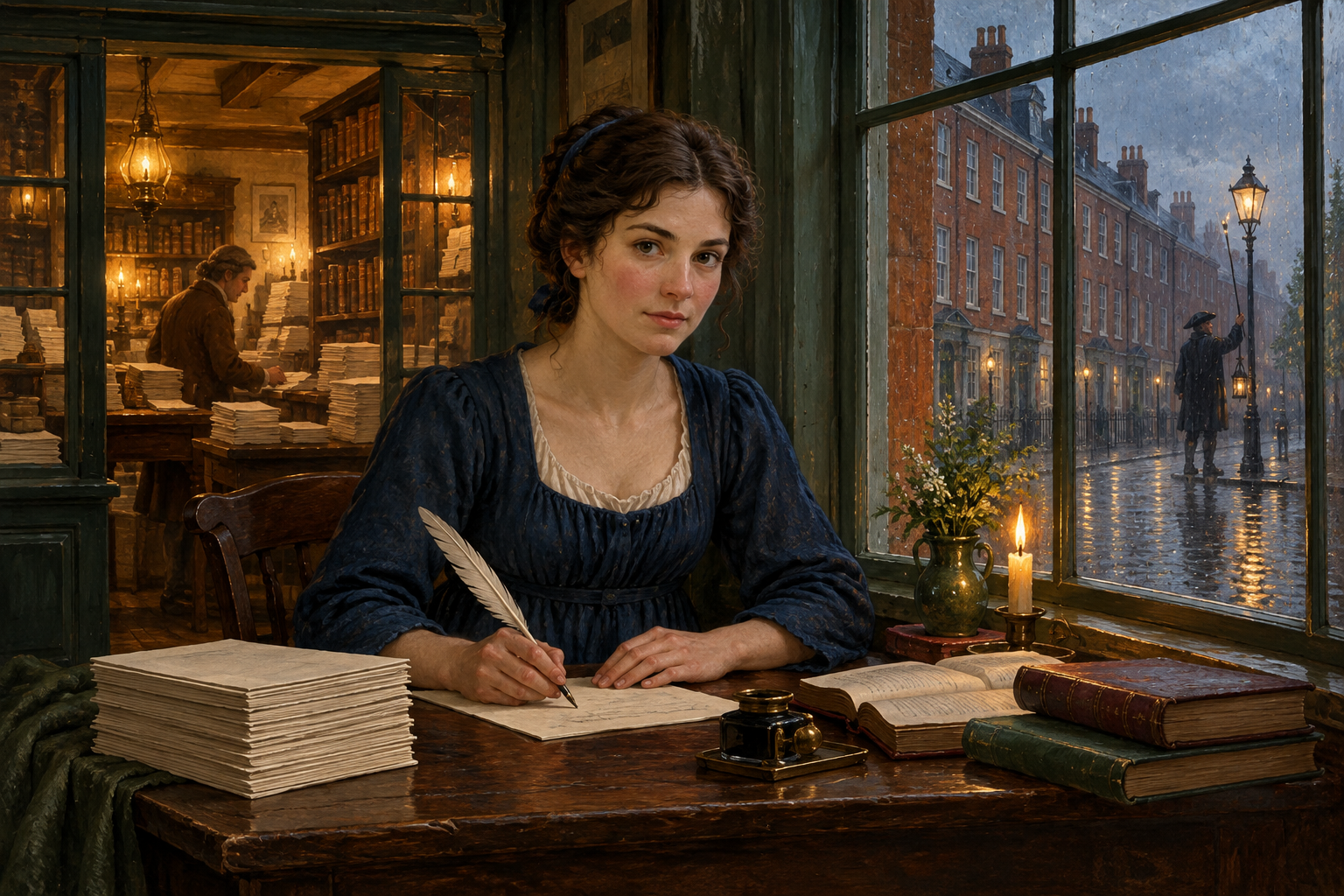
Back in London she chose to live by her pen, which was rare for a woman. The publisher Joseph Johnson gave her translation and reviewing work for his Analytical Review and a place in his circle of radicals, which included Thomas Paine, the painter Henry Fuseli and the philosopher William Godwin.
Revolution and the two Vindications
The French Revolution began in 1789. In November 1790 the statesman Edmund Burke published Reflections on the Revolution in France, defending tradition and inherited rank. Within weeks Wollstonecraft replied with A Vindication of the Rights of Men, a fast, angry pamphlet that made her name. Her point was that rights rest on reason, not on birth or property.
In 1791 the French politician Talleyrand proposed a national education plan that gave girls less schooling than boys. That pushed her to turn her argument toward women. The result, A Vindication of the Rights of Woman, appeared in January 1792 and was written in a matter of weeks. She dedicated it to Talleyrand.
What the Vindication argued
- Education explains the difference. Girls are trained to be charming and to care about their looks, and they are given little chance to think. They then seem shallow, and people take the result for nature.
- Teach boys and girls together. She wanted national day schools open to both sexes, so that children learned side by side.
- Marriage should be friendship. A woman who can reason can be a real companion to her husband and a better parent, which was a typical argument of her day.
- Women should be able to earn a living. She suggested careers in medicine, business and farming, so that a woman did not have to marry for money.
- Rousseau was wrong about girls. In his Émile (1762) the ideal woman, Sophie, is raised to please a man. Wollstonecraft attacked this view directly.
The book says very little about voting. She writes briefly that women ought to have a say in representation, but she did not campaign for the vote. Most of her readers were also middle-class women, a limit that later historians often point out.
Paris, Gilbert Imlay and daughter Fanny
In December 1792 Wollstonecraft moved to Paris to watch the Revolution at close range. When Britain and France went to war in February 1793, British people there were in danger. She had fallen in love with Gilbert Imlay, an American businessman and writer, and she passed as his wife to gain the protection of his citizenship. Their daughter Fanny was born at Le Havre in May 1794.
During these years she wrote An Historical and Moral View of the Origin and Progress of the French Revolution (1794). It backed the Revolution's ideals but was openly critical of its violence.
Imlay drifted away. In 1795 Wollstonecraft twice tried to end her life, first with an overdose of laudanum and then by jumping from Putney Bridge into the Thames. She was rescued both times. She then travelled through Sweden, Norway and Denmark on Imlay's business with Fanny and a maid, and turned the journey into Letters Written in Sweden, Norway and Denmark (1796), a travel book that sold well.
Marriage to Godwin and an early death
Back in London she renewed her friendship with William Godwin. They became lovers, and when she became pregnant they married on 29 March 1797 at St Pancras Old Church, even though both had criticised marriage. Their daughter Mary was born on 30 August 1797. The placenta was not fully delivered, an infection followed, and Wollstonecraft died on 10 September 1797, aged 38.
That baby grew up to be Mary Shelley, who wrote Frankenstein in 1818.
A fall in reputation, then a return
In 1798 a grieving Godwin published Memoirs of the Author of A Vindication of the Rights of Woman. He wanted an honest tribute, so he wrote openly about Imlay and the suicide attempts. Readers were shocked. For decades her opponents used her private life to attack her ideas, and her name became a warning rather than an inspiration. Her unfinished novel The Wrongs of Woman: or, Maria also appeared in 1798.
In the later nineteenth century, campaigners for women's suffrage read her again. Millicent Fawcett wrote the introduction to an 1891 edition of the Vindication. In November 2020 a sculpture by Maggi Hambling honouring Wollstonecraft was unveiled in Newington Green, and it sparked debate about how to represent her.
What exams ask
- Significance: she took Enlightenment ideas of reason and natural rights and extended them to women, challenging the assumption that they stopped at men.
- Context: know the link to the French Revolution, Burke's Reflections and Talleyrand's education report.
- Comparison: set her beside Locke on education and natural rights, Rousseau on the education of girls, and Voltaire's satire of optimism.
- Limits: her main demands were education and economic independence, not the vote, and she wrote mostly for middle-class readers.
Read next
- A Vindication of the Rights of Woman Explained: a closer look at her most famous book, chapter by chapter.
- Who Was John Locke? Life, Ideas and Influence: the thinker whose ideas on education and natural rights she built on.
- Candide by Voltaire: Summary and Meaning: another Enlightenment voice, this time using satire.
- Frankenstein: the novel written by her daughter.