In five minutes
The Napoleon complex is the popular name for a supposed pattern in which a short man makes up for his height with aggression, bossiness or big ambitions. It is named after Napoleon Bonaparte (1769–1821), the Corsican officer who became Emperor of the French. The trouble is that the story behind the name is mostly wrong. Napoleon was not short for a Frenchman of his day, and the label came from caricature and a later psychological idea, not from anything his contemporaries wrote about his character.
Here is the short version. First, Napoleon’s height was recorded after his death as 5 feet 2 inches in French units, which is about 1.68 metres, or roughly 5 ft 6 in in English measures. Second, British cartoonists turned “Little Boney” into a tiny, furious figure to mock him while Britain feared invasion. Third, in the early twentieth century the psychiatrist Alfred Adler wrote about feelings of inferiority and compensation, and popular writers later joined the two ideas together. Fourth, researchers today find only modest and mixed evidence that height shapes behaviour in this way. It is a nickname, not a diagnosis.
This page takes the idea in order: what the phrase means, how tall Napoleon really was, where the myth came from, and what psychology actually says. For the man and his rule, start with the hub page, The Napoleonic Era (1799–1815).
What the Napoleon complex means
People use “Napoleon complex” for a man who seems to act tougher, louder or more domineering than the situation needs, with his small size offered as the explanation. You may also hear “short man syndrome”. The word “complex” is borrowed from psychology, but the Napoleon complex is not a medical condition. It does not appear in the standard diagnostic manuals, and no doctor can diagnose it. It is a figure of speech, closer to a stereotype than to a scientific term.
The idea has two separate parts. One is a claim about Napoleon: that he was unusually short. The other is a claim about people in general: that shorter men feel inferior and push back by chasing power. The first part is false. The second is a loose reading of a real psychological theory, which we reach below. Keeping the two apart makes the whole story much easier to follow.
How tall was Napoleon?
The best evidence comes from his death. After Waterloo, Napoleon was held by the British on Saint Helena, a remote island in the South Atlantic, and he died there on 5 May 1821. The post-mortem the next day recorded his height as 5 pieds 2 pouces. Those are French units. The old French pied (foot) and pouce (inch) were longer than the English ones: a French inch was about 2.7 centimetres, an English inch 2.54. Convert them properly and 5 pieds 2 pouces comes to roughly 1.68 metres, or about 5 ft 6 in.
Now imagine reading “5 feet 2” as English units. That gives a man of about 1.57 metres, who would have been short even then. This misreading, repeated in English-language books for generations, is one of the main reasons the myth stuck. Historians often put the average height of a French man of that period at about 1.65 metres, so Napoleon stood a little above average, not below it.
He could still look small in some settings. The soldiers of his Imperial Guard were chosen partly for their height, and anyone standing among tall grenadiers looks shorter. He also liked to wear the plain green coat of a colonel of the Guard’s mounted chasseurs rather than a showy costume, which did nothing to make him stand out in a crowd of glittering marshals.
Where the myth came from
A soldiers’ nickname: le petit caporal
During the Italian campaigns of 1796–97 his soldiers began calling the young general “le petit caporal”, the little corporal. He was never a corporal, and the word “petit” was a term of affection, the way a family might say “dear little one”. It described how the men felt about him, not how tall he was. English readers later took “little” literally.
British caricature
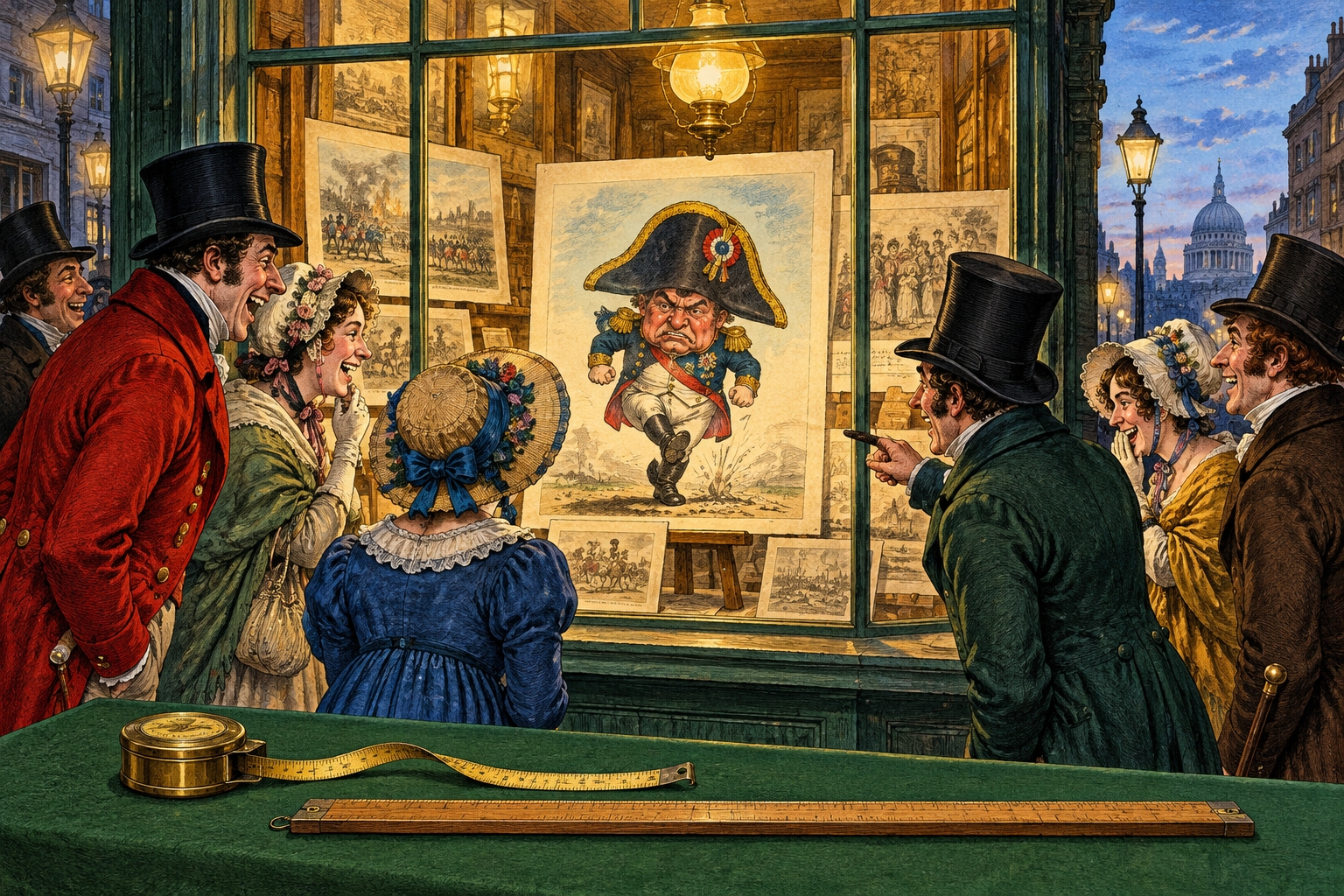
The sharpest source of the myth is satire. Britain and France went back to war in 1803, and fear of a French invasion across the Channel was real. Cartoonists such as James Gillray drew “Little Boney” as a tiny, tantrum-throwing figure in an oversized hat. This is how caricature works: shrink the person you fear and he becomes funny. Napoleon was then First Consul, and he became Emperor on 2 December 1804. For the next decade British prints, songs and newspapers kept the pocket-sized tyrant alive, and the image travelled far beyond Britain.
A unit mix-up and a winner’s story
When Napoleon fell in 1815, the English-speaking world was left with the British version of his story. Books quoted his height as 5 ft 2 without explaining that it was in French measure, and the cartoon seemed to be confirmed by a number. A joke, a misread unit and the account of the winning side together did the rest.
From myth to psychology: Alfred Adler
The second half of the term comes from psychology. Alfred Adler (1870–1937) was a physician from Vienna who left Sigmund Freud’s circle in 1911 and founded his own approach, called individual psychology. As early as 1907 he wrote about how a weakness in the body can push a person to compensate. Later he described the “inferiority complex”: a deep feeling of being less than others, which some people try to cover with exaggerated striving for superiority. By the 1920s “inferiority complex” was a household phrase.
Adler’s work was about feelings of inferiority in general, whatever their cause. It was not about height in particular, and he did not set out to describe Napoleon. The label “Napoleon complex” appears to have come later, when popular writers joined two ready-made images: the cartoon emperor and the compensating man with an inferiority complex. The result sounded like science and was easy to remember, which is why it lasted.
What does research say?
Scientists have tested whether height really affects behaviour. In 2018 a team of Dutch and British researchers (Knapen, Blaker and Van Vugt) published experiments in the journal Psychological Science under the title “The Napoleon Complex: When Shorter Men Take More”. In their games about sharing resources, shorter men took more when they were paired with taller men. The authors read this as a response to a perceived disadvantage, not as a hidden complex.
The result is interesting but modest. It comes from controlled lab tasks, not from real life, and other studies of height and aggression give mixed results. Nothing here shows that short men in general are more aggressive, and nothing shows that Napoleon’s conduct came from his height. A careful summary is that some short men may behave more competitively in some situations, as many people do when they feel at a disadvantage.
Why Napoleon really was so driven
If height does not explain him, what does? Napoleon was born in Ajaccio, Corsica, on 15 August 1769, shortly after France took control of the island from Genoa. His family was minor nobility, and he grew up as an outsider who spoke French with an accent. He trained as an artillery officer, and the French Revolution opened careers to talent in a way the old regime never had. In just a few years he went from a junior officer to commander of the army in Italy, then First Consul, then Emperor. Ambition, timing, skill and an army that believed in him explain far more than a tape measure ever could.
What exams ask
In AP-style history courses the Napoleon complex is a useful case study in how propaganda shapes memory. A typical question gives you a Gillray-style cartoon and asks you to identify the author’s point of view, purpose and audience: a British satirist, writing to ridicule an enemy and to calm a nervous public. Another common angle is historical significance: the myth shows how a wartime image can outlive the war by two centuries. Be ready to explain the unit conversion in one sentence, and to say that the Napoleon complex is a popular label, not a clinical diagnosis. Dates worth knowing are 1803 (war resumes and the caricatures spread), 1804 (coronation), 1815 (Waterloo) and 1821 (death and measurement).
Read next
- How Tall Was Napoleon? Unravelling the Myth: a closer look at the measurements and the evidence behind them.
- Who Was Napoleon Bonaparte?: his life from Corsica to Saint Helena.
- The Battle of Waterloo (1815): the defeat that ended his rule and led to the British version of his story.
- The Napoleonic Era (1799–1815): the hub for the whole period.