In five minutes
The Battle of Austerlitz, also called the Battle of the Three Emperors, took place on 2 December 1805 near the town of Austerlitz (today Slavkov u Brna) in Moravia. Napoleon I of France faced Tsar Alexander I of Russia and Emperor Francis of Austria. The French had roughly 65,000–75,000 men; the allies had about 85,000–90,000.
By the end of the day the allied centre had been broken and the allied army was in retreat. French losses were around 9,000. Allied losses were about 26,000–27,000 killed, wounded and captured, along with many guns. The Austerlitz battle is the one most often used to show Napoleon at his best: he chose the ground, invited the enemy to attack where he wanted, and struck the weak point at the right moment. Within a month Austria had left the war and the Third Coalition had collapsed. This page belongs to the hub The Napoleonic Era (1799–1815).
Why war broke out in 1805
Britain was the one power that kept fighting Napoleon. After the Peace of Amiens broke down in 1803, Britain and France were at war again. Napoleon crowned himself Emperor of the French on 2 December 1804 and gathered an army near Boulogne on the Channel coast to invade England. In May 1805 he also took the crown of Italy, which alarmed Austria.
London, meanwhile, paid for allies. In April 1805 Britain and Russia agreed to work together, and Austria joined in August. With smaller partners such as Sweden and Naples, they formed the Third Coalition. Austria wanted back the influence it had lost in Italy and Germany. Russia feared French power spreading east. Britain wanted France pushed back from the Low Countries and Italy. Napoleon read the situation quickly. Instead of crossing the Channel, he turned the army round and marched east.
From Ulm to Moravia
In late summer and autumn 1805 the French army, now called the Grande Armée, crossed France and the Rhine in several fast-moving corps. The Austrian general Karl Mack had camped at Ulm in Bavaria, expecting the French to arrive through the Black Forest. Napoleon swung around his rear instead. On 20 October Mack surrendered more than 20,000 men at Ulm, and Austria lost much of one army almost without a battle.
The next day, 21 October, Admiral Nelson's fleet destroyed the combined French and Spanish fleet at Trafalgar. That ended any realistic hope of invading Britain, but the war on land went on (see The Battle of Trafalgar). The French entered Vienna on 13 November.
Yet Napoleon's position was not comfortable. His men were far from home, tired from long marches and fewer in number because garrisons had been left behind. A Russian army under Mikhail Kutuzov was retreating north-east to join reinforcements, and Prussia was thinking about joining the allies. Napoleon needed a decisive victory before winter and before the enemy grew stronger.
The ground: the Pratzen Heights
Napoleon picked his battlefield before the allies decided to fight on it. It lay between Brno and the town of Austerlitz. Its key feature was the Pratzen Heights, a broad rise in the middle of the field. Whoever held the Pratzen could strike either flank.
Napoleon pulled his troops back from the heights and thinned his right wing near the villages of Telnitz and Sokolnitz. He also sent messages that hinted he wanted talks, so that he seemed nervous. The aim was to make the allied commanders believe the French were weak and might slip away, and that they should attack at once to cut him off from Vienna.
Kutuzov, the senior Russian general, preferred to wait. Tsar Alexander I, Emperor Francis and the young officers around the tsar wanted a battle. The plan was drawn up by the Austrian staff officer Franz von Weyrother. Several columns would march down off the Pratzen and crush the French right, while a smaller force held the north. It was exactly the move Napoleon hoped for.
The battle, 2 December 1805
Early morning: the French right is attacked
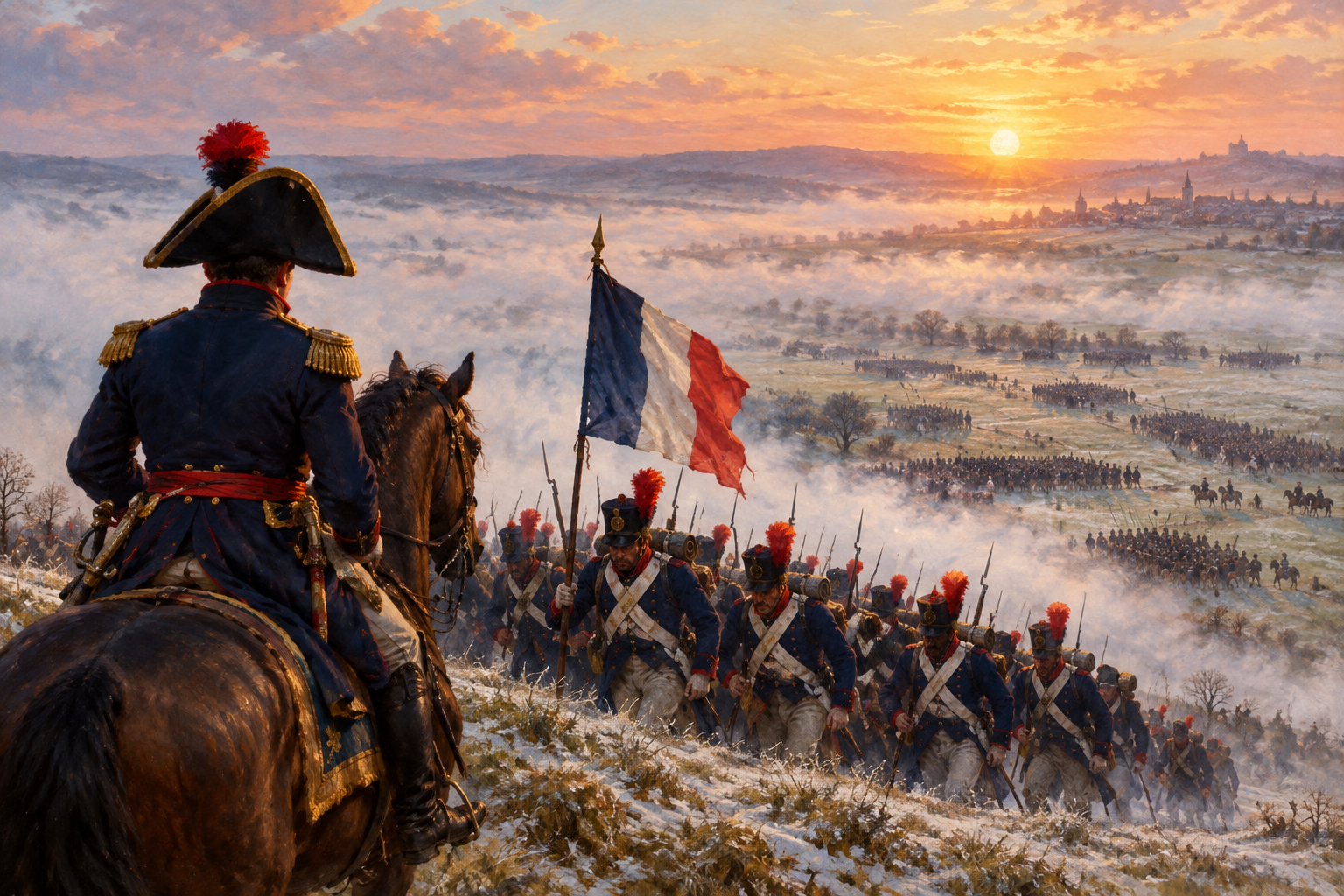
Fog lay in the valleys on the morning of 2 December, and the Pratzen rose above it. Allied columns came down to attack Telnitz and Sokolnitz. The thin French line there held on until the first troops of Marshal Davout's III Corps, who had marched hard from the direction of Vienna, arrived to help.
Mid-morning: Soult takes the Pratzen
As the allied columns went down into the valley, their centre grew weak. Napoleon waited until the Pratzen was largely empty. Then Marshal Soult's IV Corps climbed the slope out of the fog and, after hard fighting, took the heights by mid-morning. Napoleon later liked to recall the “sun of Austerlitz” breaking through the mist.
Afternoon: the allied army is split
With the heights in French hands, the allied army was cut in two. Part of Soult's force turned south and fell on the rear of the allied troops fighting at Sokolnitz, while Davout pressed from the front. In the north, Marshal Lannes and Marshal Murat's cavalry held back the allied right under Prince Bagration.
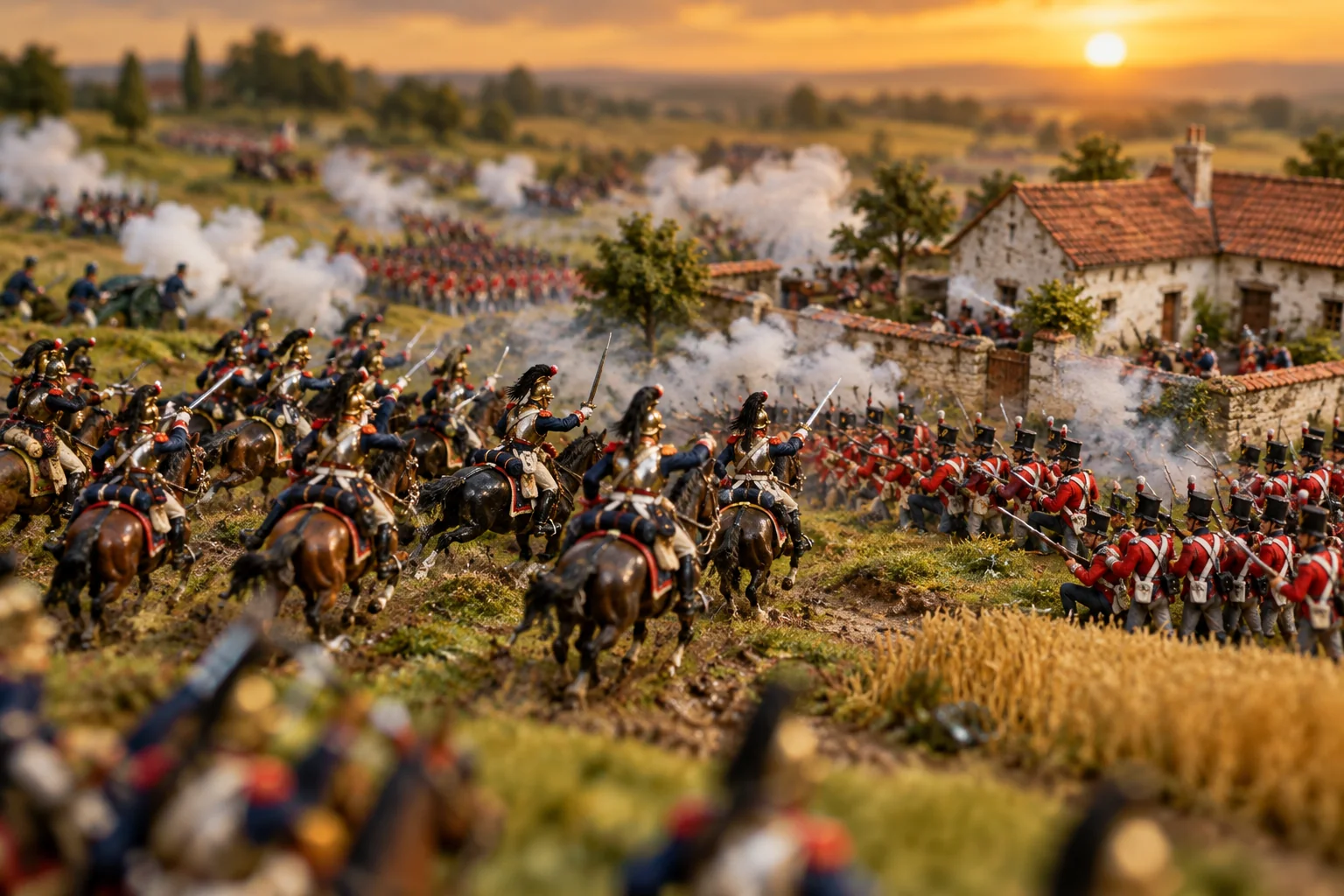
Near the centre the Russian Imperial Guard counterattacked, with Grand Duke Constantine among its leaders, and briefly broke a French battalion. French Guard cavalry, including the horsemen under General Rapp, drove it back. By late afternoon the allied left was surrounded, and many soldiers fled south, caught between French fire and the ponds and marshes behind them. Fighting ended at dusk.
Numbers and losses
Figures differ by source, so they are best given as ranges. The French army numbered about 65,000–75,000, and the allied army about 85,000–90,000. The French lost around 9,000 men. The allies lost about 26,000–27,000 killed, wounded and captured, and left behind many guns and standards.
Aftermath: the end of the Third Coalition
On 4 December Emperor Francis met Napoleon and agreed an armistice. The Russian army withdrew towards Russia. On 26 December 1805 Austria signed the Treaty of Pressburg. It gave Venetia, Istria and Dalmatia to Napoleon's Kingdom of Italy, handed Tyrol and other lands to Bavaria, and required a large payment in francs. Bavaria and Württemberg, Napoleon's allies, became kingdoms.
The deeper changes came in 1806. In July Napoleon set up the Confederation of the Rhine, a group of German states under his protection. On 6 August Francis gave up the title of Holy Roman Emperor, and the Holy Roman Empire came to an end. Britain stayed in the war, with its navy untouched after Trafalgar, and the prime minister William Pitt died in January 1806. Prussia, humiliated and anxious, went to war with France in autumn 1806. Napoleon then turned to economic pressure on Britain, the subject of The Continental System.
Why Napoleon won
- He chose the ground. He studied the field in advance and knew where each corps would stand.
- He baited the trap. A weak-looking right wing and talk of peace drew the allies off the Pratzen.
- He moved fast. The corps system let separate units march apart and fight together, and Davout's march arrived in time.
- The allies were divided. A complicated plan, mixed Russian and Austrian commands and a cautious Kutuzov overruled by the emperors made them slow to react.
What exams ask
Exam questions usually ask about significance. A strong answer says that Austerlitz ended the Third Coalition, forced Austria out of the war and confirmed French dominance on the European continent, while Trafalgar, six weeks earlier, left Britain safe at sea. It also led directly to the Treaty of Pressburg, the Confederation of the Rhine and the end of the Holy Roman Empire. Know the date (2 December 1805), the place (Moravia), the three emperors, and the tactical idea: bait the enemy, then break the centre. Be ready to compare Austerlitz with Trafalgar: one battle decided the land war, the other the sea.
Read next
- The Napoleonic Era (1799–1815): the hub for the whole period, from the consulate to the Congress of Vienna.
- The Battle of Trafalgar (1805): the naval battle that happened six weeks earlier and shaped Britain's role.
- The Continental System (1806): Napoleon's economic answer to a Britain he could not invade.
- Who Was Napoleon Bonaparte?: the life of the man behind the victory.