The American frontier in five minutes
The American frontier was the shifting zone where Euro-American settlement met lands still held and used by Native nations. Between the Louisiana Purchase in 1803 and the 1890 census, that zone moved from the Mississippi River to the Pacific coast. The popular "Wild West" of cowboys and gunfights is only the last chapter, roughly 1865 to 1890.
The word "frontier" describes the story from the settlers' side. For the Lakota, Cheyenne, Comanche, Navajo and dozens of other nations, the same decades were a period of invasion, treaties broken and land lost. Any honest account of the American West has to hold both sides together.
Three forces drove the change: cheap land, the railroad, and the army. This page is part of the larger story told in 19th-Century America: Expansion, Civil War and the Gilded Age.
Why people moved west
The first reason was land. In 1800 most Americans were farmers, and good farmland in the East was expensive or already taken. A family that could not buy a farm at home could look at a map of the West and see millions of acres that were, in the eyes of the government, available. That view ignored the people already living there.
The second reason was a belief in destiny. In 1845 the journalist John O'Sullivan wrote of a "manifest destiny" for the United States to spread across the continent. The phrase gave a noble name to expansion, and politicians used it to justify annexing Texas in 1845 and fighting Mexico in 1846.
The third reason was money. Gold in California in 1848, silver in Nevada, copper in Montana and later cattle all promised fast fortunes. The fourth was escape: Mormons walked to Utah from 1847 to practise their faith in peace, and in 1879 thousands of Black families, called Exodusters, left the post-Reconstruction South for Kansas. Immigrants from Germany, Scandinavia, Ireland and China arrived with their own hopes.
How the West was settled, 1803 to 1890
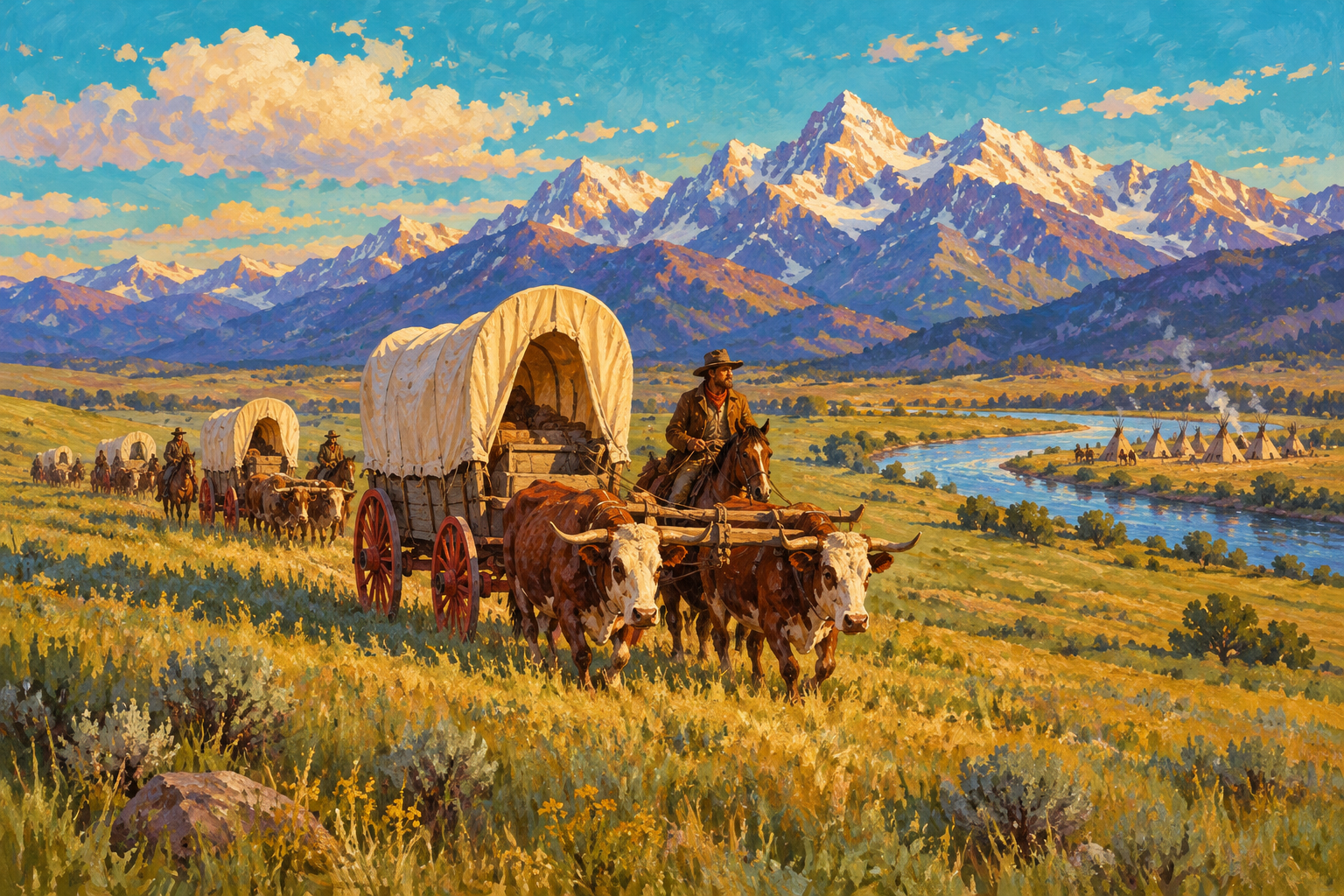
1803 to 1848: the land is claimed. The Louisiana Purchase bought a huge territory from France and roughly doubled the size of the country. Lewis and Clark explored it from 1804 to 1806. Fur traders and missionaries followed, and from the early 1840s wagon trains began to roll along the Oregon Trail, about 2,000 miles from Missouri to the Pacific Northwest. In 1846 the Oregon Treaty with Britain set the northern border at the 49th parallel. In 1848 the Treaty of Guadalupe Hidalgo ended the Mexican-American War, and Mexico handed over California and most of the present-day Southwest.
1848 to 1865: gold and the Civil War. Gold found at Sutter's Mill in January 1848 sent "forty-niners" to California, and San Francisco grew from a village into a city within a few years. Then the Civil War slowed some migration but sped up law-making. In 1862 Congress passed the Homestead Act, which offered up to 160 acres to anyone who lived on and farmed the land for five years. The same year the Pacific Railway Act paid two companies to build a railroad across the continent.
1865 to 1890: rails, ranches and farms. The Union Pacific and Central Pacific lines met at Promontory Summit, Utah, on 10 May 1869. Irish immigrants and Civil War veterans laid much of the Union Pacific track, and thousands of Chinese workers built much of the Central Pacific. A journey that had taken months now took about a week. Railroads sold land to farmers, carried grain east and brought manufactured goods west.
After the war, Texas cattle were driven north to railheads in Kansas such as Abilene and later Dodge City, where they were shipped to eastern slaughterhouses. The long drives peaked from about 1867 to the mid-1880s. Barbed wire, patented in 1874, fenced the open range. The hard winter of 1886 to 1887 killed huge numbers of cattle and ended the era of free grazing. On 22 April 1889 thousands raced across the line for the first Oklahoma land run, which opened former Native lands to settlers in a single afternoon.
What it cost Native nations
The settlers' gain was Native America's loss. The groundwork came earlier: the Indian Removal Act of 1830 forced nations in the Southeast to move west, a process remembered through the Trail of Tears. As settlers crossed the Plains, the government made treaties and then broke or rewrote them when settlers or miners wanted the land.
Violence followed. At Sand Creek, Colorado, in November 1864, a militia attacked a Cheyenne and Arapaho camp and killed more than 150 people, most of them women, children and older people. The Fort Laramie Treaty of 1868 promised the Lakota the Black Hills, but after gold was reported there in 1874, miners flooded in. In June 1876 Lakota, Northern Cheyenne and Arapaho warriors destroyed part of the 7th Cavalry under George Custer at the Little Bighorn. It was the most famous Native victory, yet the army answered with a relentless campaign and the Lakota were forced onto reservations.
The buffalo, central to Plains life, were hunted from tens of millions to fewer than a thousand by the late 1880s. Hide hunters, railroads and the army all played a part, and some officials saw the loss as a way to force Native peoples onto reservations. The Dawes Act of 1887 then split reservation land into individual plots and opened the rest to sale; Native-held land fell from about 138 million acres in 1887 to about 48 million by 1934. The period ended at Wounded Knee, South Dakota, on 29 December 1890, where US soldiers killed about 250 or more Lakota, many of them unarmed.
Cowboys, outlaws and the myth
Real cowboys were mostly young, underpaid workers who spent months herding cattle in dust and rain. Many were Black, Mexican or Native, and the skills and gear of the Mexican vaquero shaped the job. Gunfights were rarer than the movies suggest; cattle towns often had strict gun rules.
The myth grew quickly. Buffalo Bill's Wild West show toured from 1883, and dime novels and later Hollywood westerns turned the frontier into a story of rugged individuals and clear heroes. The myth left out women settlers, Chinese railroad workers, Native nations and the government help (land grants, subsidies, the army) that made settlement possible.
The end of the frontier
The US Census Bureau counted as frontier any area with two to six people per square mile. After the 1890 census it reported that unsettled land was so broken up that a continuous frontier line could no longer be drawn. In 1893 the historian Frederick Jackson Turner argued, in an essay read in Chicago, that the frontier had shaped American democracy and individualism. Later historians criticised him for ignoring Native peoples, women and conquest, and the "New Western history" of the late twentieth century gave those people a place at the centre.
The line on the map disappeared, but the effects did not. Western states joined the Union (Oklahoma in 1907, Arizona and New Mexico in 1912), the United States looked overseas for new frontiers, and the question of Native land and rights remains alive today.
What exams ask
AP US History and similar courses usually test these points:
- Causes: manifest destiny, cheap land, the Homestead Act (1862), gold and silver, the railroads.
- Government role: Pacific Railway Act, land grants, treaties and the army, so the frontier was not simply "self-made."
- Native experience: removal, reservations, the end of the buffalo, the Dawes Act (1887) and assimilation policy.
- Turner's thesis (1893): its claims, and the criticisms of it.
- Dates: 1803, 1848, 1862, 1869, 1876, 1890.
A strong answer shows that the frontier brought opportunity for some and dispossession for others, and that federal policy drove both.
Read next
- The Trail of Tears: how Native nations of the Southeast were forced west in the 1830s, the first stage of removal.
- The Mexican-American War (1846–1848): the war that gave the United States California and the Southwest.
- Who Was Abraham Lincoln?: the president who signed the Homestead Act and the Pacific Railway Act in 1862.