In five minutes: what was the Gilded Age?
The Gilded Age is the name for the years from about the 1870s to around 1900 in the United States. In those decades railroads, steel mills, oil refineries and big-city factories grew faster than anywhere else in the world. A handful of businessmen built some of the largest fortunes ever seen, while millions of workers put in long hours for low pay. The story of this era sits inside our hub on 19th-Century America: Expansion, Civil War and the Gilded Age.
Historians do not agree on exact dates. Some start the clock right after the Civil War ended in 1865, some in 1873, and many in 1877, when Reconstruction came to an end. Most stop around 1896 to 1900, when reformers and a new generation of voters pushed the country toward what is called the Progressive Era. For exams, the safe answer is "roughly 1870 to 1900".
Why is it called the Gilded Age?
The name comes from The Gilded Age: A Tale of Today, a satirical novel that Mark Twain wrote with his neighbour Charles Dudley Warner in 1873. The book made fun of land speculators, bribe-taking politicians and a society obsessed with getting rich quickly.
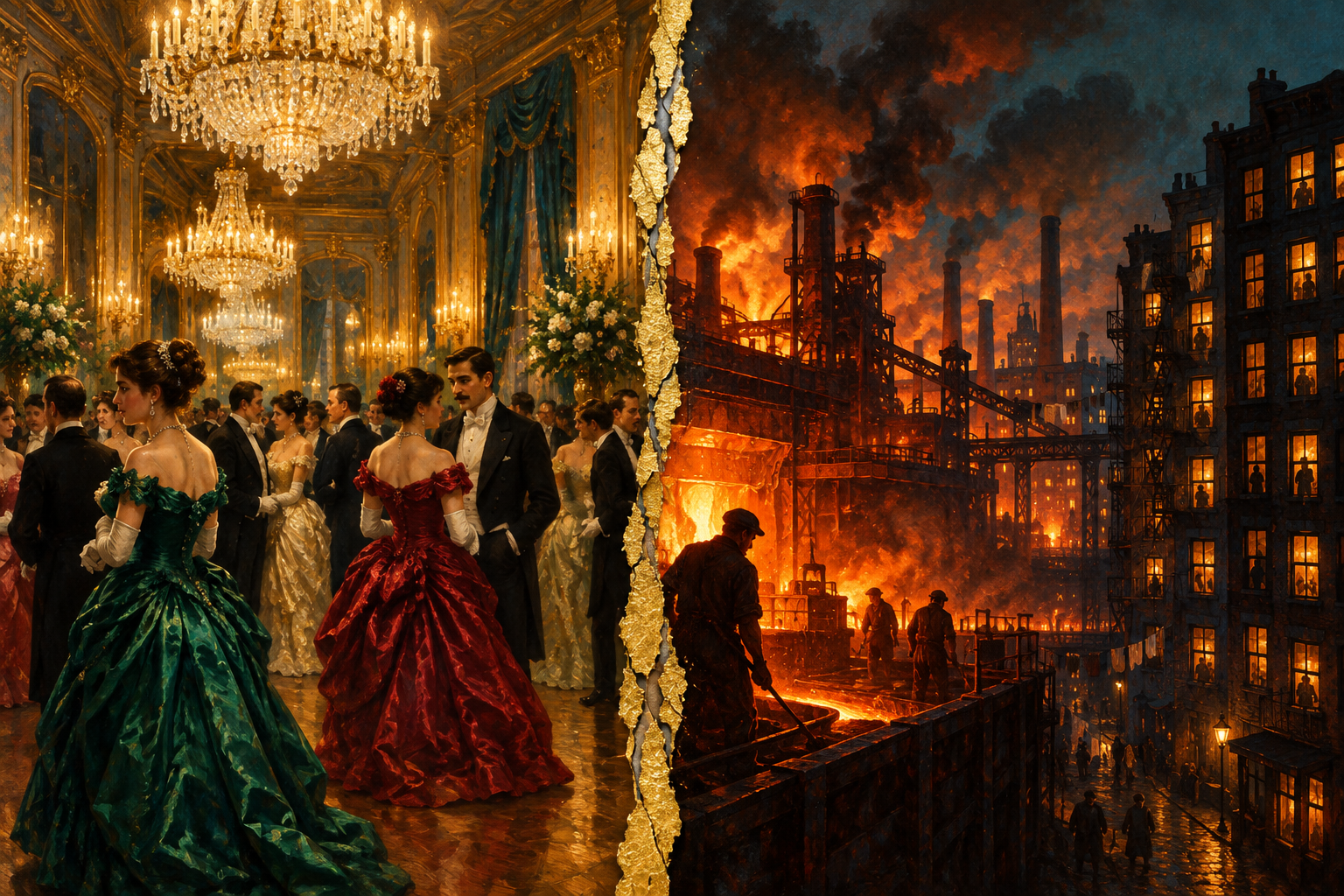
The word "gilded" is the key. Something gilded is not made of gold. It is a cheaper material covered with a thin layer of gold, so it looks valuable from the outside. Twain's point was that the glitter of the new wealth hid serious problems underneath. Historians of the 1920s and 1930s, including Charles and Mary Beard, took up the label for the whole period, and it has stuck, usually with a critical edge. Note that gilded is different from golden: a "Golden Age" would be praise, while "Gilded Age" is a warning.
What made the boom possible?
Several things came together after the Civil War.
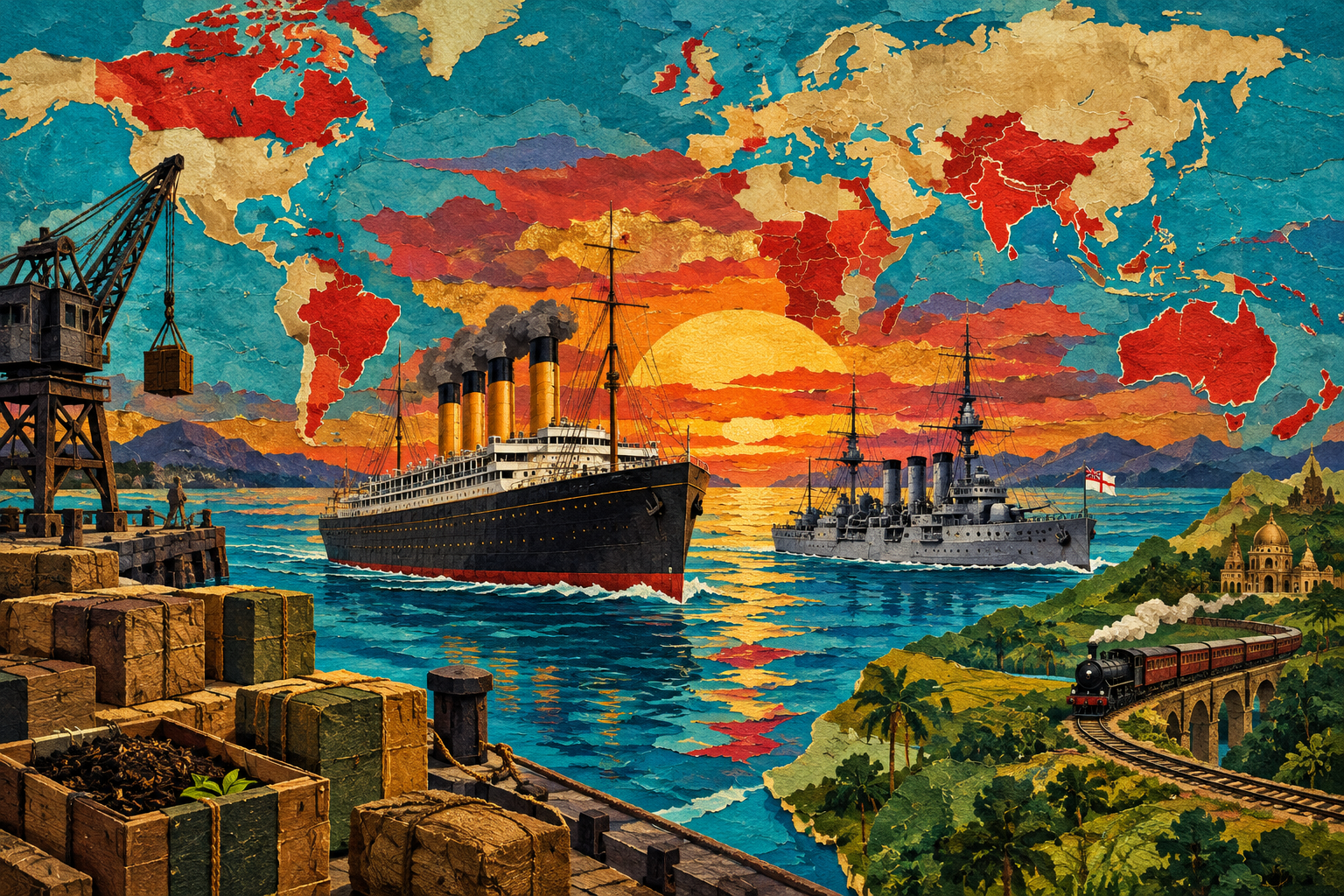
- Railroads. Track in the United States grew from about 35,000 miles in 1865 to roughly 190,000 miles by 1900. Rails tied farms to factories and cities, and the first line across the continent, covered in The Transcontinental Railroad (1869), was only the start. Railroads were also the first truly giant businesses, with thousands of employees and complicated accounts.
- New technology. The Bessemer process made steel cheap enough for rails and bridges. Alexander Graham Bell patented the telephone in 1876. In 1882 Thomas Edison's Pearl Street Station in lower Manhattan began supplying electric power. The Brooklyn Bridge opened in 1883.
- People. The population roughly doubled, from about 39 million in 1870 to about 76 million in 1900. More than 11 million immigrants arrived in those thirty years, many from Ireland, Germany, Italy, Eastern Europe and China, and they filled the mills, mines and construction gangs.
- Government help. High tariffs protected American factories, and land grants and loans helped build the railroads. Courts and legislators usually favoured businesses over regulation, an attitude often called laissez-faire.
- New business forms. Corporations, trusts and holding companies let owners combine many firms into one huge enterprise.
The new rich: captains of industry or robber barons?
A small group of men dominated the economy. Andrew Carnegie, a Scottish immigrant, built the largest steel business in the country. John D. Rockefeller founded Standard Oil in 1870 and came to control most of the nation's oil refining. J. P. Morgan reorganised railroads and, in 1901, helped merge Carnegie's firm into U.S. Steel, the first company valued at more than a billion dollars. The Vanderbilt family held a large share of the railroads.
Admirers called these men "captains of industry", because they cut prices and built things that many people used. Critics called them "robber barons", because they crushed competitors, bribed officials and paid workers as little as they could. Both descriptions have some truth. Carnegie wrote in his 1889 essay "The Gospel of Wealth" that the rich had a duty to give their fortunes away, and he gave away most of his own. Rockefeller also became a major donor.
The rich also showed off. Families built mansions on Fifth Avenue in New York and "cottages" with dozens of rooms in Newport, Rhode Island, and held enormous balls. The HBO series The Gilded Age, set in 1880s New York, is about this world, especially the clash between old families and newly rich ones.
Workers, cities and immigrants
For most people life looked very different. Factory and steel workers commonly worked ten or twelve hours a day, six days a week, with no accident insurance and few safety rules. Children worked in mills and mines. In cities such as New York, Chicago and Pittsburgh, families crowded into tenements with little light, air or clean water. The journalist Jacob Riis exposed these conditions with photographs in How the Other Half Lives (1890), and reformers such as Jane Addams opened settlement houses like Hull House in Chicago in 1889.
Workers organised. The Knights of Labor grew in the 1880s, and the American Federation of Labor, led by Samuel Gompers, was founded in 1886 to represent skilled workers. Big strikes often ended in violence:
- The Great Railroad Strike of 1877 spread across many states, and federal troops were sent in.
- The Haymarket affair (1886) in Chicago began as a rally for the eight-hour day and ended with a bomb thrown at police, followed by gunfire and deaths.
- The Homestead strike (1892) at a Carnegie steel plant near Pittsburgh turned into a battle with Pinkerton guards.
- The Pullman strike (1894), led by Eugene V. Debs's American Railway Union, was broken by a court order and federal troops.
Farmers had their own troubles. Crop prices fell, debts and railroad shipping rates stayed high, and many felt that banks and railroads held them hostage. Their anger produced the Grange, the Farmers' Alliances and, in 1892, the People's Party, known as the Populists.
Politics: close elections, patronage and reform
National politics was tightly balanced. Republicans and Democrats won elections by narrow margins, and presidents of the period, such as Rutherford B. Hayes, James Garfield, Chester Arthur, Grover Cleveland and Benjamin Harrison, mostly had limited power compared with Congress and party bosses. Cleveland was the first president to serve two non-consecutive terms, 1885 to 1889 and 1893 to 1897.
Jobs in government were handed out as rewards for party loyalty, the spoils system. Corruption was common: the Tweed Ring stole millions from New York City, and the Crédit Mobilier scandal of 1872 and 1873 involved railroad money and members of Congress. When a disappointed office-seeker shot President Garfield in 1881, public anger led to the Pendleton Civil Service Reform Act of 1883, which made some federal jobs depend on exams instead of connections.
The federal government began to regulate big business, slowly. The Interstate Commerce Act (1887) created the first federal regulatory commission to oversee railroad rates, and the Sherman Antitrust Act (1890) outlawed trusts that restrained trade. Both were weakly enforced at first. The great money debate of the 1890s was whether the dollar should be backed by gold alone or by silver too. In 1896 William Jennings Bryan electrified the Democratic convention with his "Cross of Gold" speech, but William McKinley won the presidency.
Who was left out?
The Gilded Age's prosperity was not shared equally. After Reconstruction ended in 1877, federal troops left the South and Black Americans lost much of the protection they had gained. Southern states then passed segregation laws, which the Supreme Court accepted in Plessy v. Ferguson (1896).
Chinese workers who had helped build the railroads faced violence and, in 1882, the Chinese Exclusion Act, the first major federal law to ban immigration on the basis of nationality. Native nations lost land as settlers and railroads moved west. The Dawes Act of 1887 broke up tribal lands into individual plots, and the Wounded Knee massacre in December 1890 is usually seen as the end of the major Indian Wars. The 1890 census report noted that the western frontier line no longer existed, and in 1893 the historian Frederick Jackson Turner argued that the frontier had shaped American democracy.
How did the Gilded Age end?
There was no single end date. Two severe depressions, the Panic of 1873 and the Panic of 1893, shook faith in the system, and the second one hit while the country was fighting over silver and strikes. Reformers, journalists known as muckrakers and a new middle class demanded cleaner government, regulation of big business and better working conditions. By the early 1900s, under Theodore Roosevelt, these demands were driving the Progressive Era. The Spanish-American War of 1898 also pointed the country's attention outward.
Many Gilded Age features, such as huge companies and large gaps between rich and poor, did not disappear. That is partly why historians still compare it with later periods.
What exams ask
- Define the term: "gilded" means covered in a thin layer of gold. It comes from the 1873 Twain and Warner novel and suggests surface glitter hiding corruption and poverty.
- Give causes: railroads, new technology, immigration, protective tariffs, and laissez-faire government.
- Compare views: captains of industry versus robber barons; social Darwinism, which used "survival of the fittest" to defend inequality, versus the reformers.
- Link reactions: labour unions, the Populists, the Pendleton Act, the Interstate Commerce Act and the Sherman Act as responses to the problems of the age.
- Know the limits: who benefited and who did not, including immigrants, Black Americans, Native Americans and women.
Read next
- The Transcontinental Railroad (1869): the railway that shows how the Gilded Age economy was built.
- Gilded Age Political Cartoons: how artists mocked bosses, trusts and tycoons at the time.
- Who Was Abraham Lincoln?: the president whose war and policies set up the world the Gilded Age grew from.