The Louisiana Purchase in five minutes
The Louisiana Purchase was the agreement by which the United States bought France's claim to Louisiana, a vast area west of the Mississippi River. The treaty is dated 30 April 1803. The United States agreed to pay 60 million francs for the land and to take on about 20 million francs of American claims against France, a total of roughly $15 million. The deal gave the young republic control of the port of New Orleans and made the country about twice as large as before. It is the first big step in the story told in 19th-Century America: Expansion, Civil War and the Gilded Age.
Here is the surprise. President Thomas Jefferson never planned to buy a huge territory. He wanted New Orleans and a safe way to ship goods down the Mississippi. Napoleon Bonaparte, who needed money and had just lost his plan for an empire in the Caribbean, offered the whole of Louisiana instead.
Key points
- What: a purchase of France's claim to Louisiana, not of land owned by its Native nations.
- When: treaty dated 30 April 1803; Senate approval 20 October 1803; handover in New Orleans on 20 December 1803.
- Who: Jefferson, Robert R. Livingston and James Monroe for the United States; Napoleon, Talleyrand and François Barbé-Marbois for France.
- Price: about $15 million, or about 80 million francs counting the claims.
- Result: the United States roughly doubled in size, and a new question began: would slavery spread into the new lands?
Why Napoleon sold Louisiana
Spain had owned Louisiana since 1762. In the secret Treaty of San Ildefonso of 1800, it agreed to hand the territory back to France. Napoleon hoped to build a French empire in the Americas. Louisiana would feed the sugar islands of the Caribbean, and the richest of those islands was Saint-Domingue, today's Haiti.
That plan fell apart in Saint-Domingue. A French army was sent in 1802 to retake control from the formerly enslaved people who had risen up in the Haitian Revolution. Many thousands of soldiers died, most of them from yellow fever, and the island could not be held. Without Saint-Domingue, Louisiana was much less useful to France.
At the same time Europe was heading back to war. The peace between France and Britain was breaking down, and Napoleon knew that the British navy could seize a distant colony like Louisiana. He also needed cash to fight. Selling the territory to the Americans kept it out of British hands and filled the French treasury.
Why Jefferson wanted New Orleans
In the 1790s and early 1800s, American farmers west of the Appalachian Mountains had no good road to market. Their best route was down the Mississippi River to New Orleans, where goods were moved onto ocean ships. Pinckney's Treaty of 1795 had given Americans the right to store goods in New Orleans, called the right of deposit.
In October 1802, the Spanish official in the city, who was still in charge, suspended that right. Western settlers were furious, and many in Congress called for action. Jefferson wrote privately that whoever held New Orleans was the natural enemy of the United States. He did not want war, so he chose to negotiate.
The negotiation in Paris
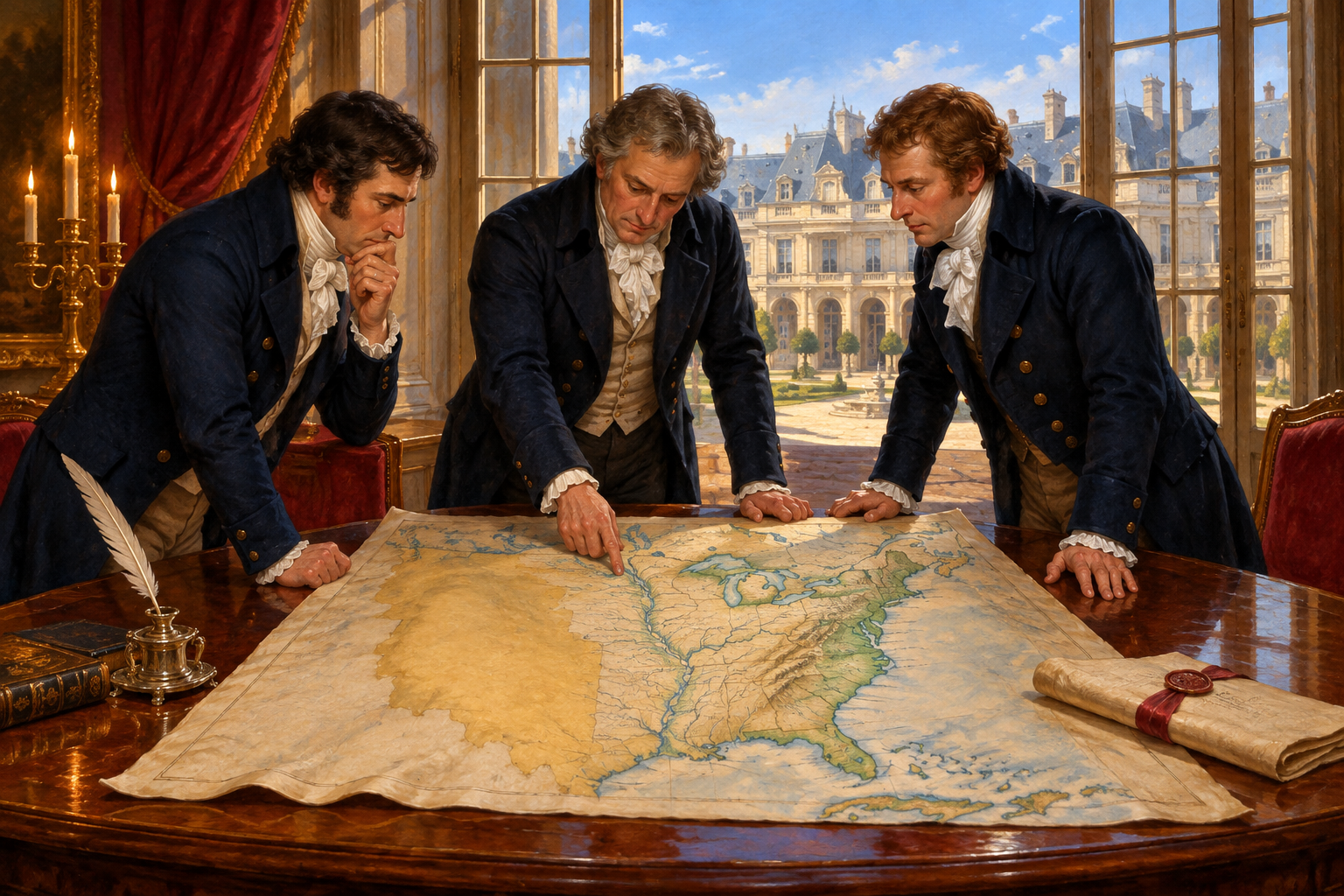
Jefferson sent James Monroe to join Robert R. Livingston, the American minister in Paris. Their instructions were to buy New Orleans and the nearby coast of Florida, and Jefferson was ready to pay up to about $10 million.
Before Monroe arrived, the French side had changed its mind. On 11 April 1803, the French foreign minister, Charles Maurice de Talleyrand, asked Livingston what the United States would pay for all of Louisiana. Monroe reached Paris the next day. Over the following weeks Livingston and Monroe bargained with François Barbé-Marbois, the French treasury minister, and settled on 60 million francs plus the debts for claims. The treaty is dated 30 April 1803. The Americans had no time to ask Jefferson first, so they used their own judgment.
Money was the next problem. The United States did not have $15 million in cash, so the government issued bonds, and the banking houses of Baring in London and Hope in Amsterdam helped move the funds to France. Even Britain's bankers, then at odds with France, had a part in the deal.
What exactly did the United States buy?
The territory covered about 828,000 square miles, or about 2.1 million square kilometres. It stretched from the Mississippi River to the Rocky Mountains and from the Gulf of Mexico north toward Canada. Parts of 15 present-day states were formed from it, among them Louisiana, Missouri, Iowa, Arkansas, Nebraska, Kansas, Oklahoma, the Dakotas and Montana.
Nobody knew the exact borders, and the treaty did not give them. The line with Spanish Texas and the line in the northwest were settled only later, including in the Adams-Onis Treaty of 1819.
One point matters a great deal. The land was not empty. Native nations such as the Osage, the Sioux, the Pawnee and the Mandan lived there, and they had never agreed to sell anything. France sold its claim to deal with other European powers, and the United States took on that claim. The later removal and conflicts with these nations are part of the Louisiana Purchase story too.
Was it constitutional?
Jefferson believed in a strict reading of the Constitution, and the Constitution did not say that the president could buy foreign territory. He thought about proposing an amendment. But he feared that Napoleon might change his mind while Congress debated, so he let the treaty go forward.
Many Federalists, especially in New England, attacked the purchase. They worried that new western states would weaken their region's power in the country. Others said the price was too high for land that nobody had mapped. Supporters argued that the government's treaty-making power covered the deal.
The Senate approved the treaty on 20 October 1803 by a vote of 24 to 7. On 20 December 1803, the flag changed in New Orleans. France had taken formal control from Spain only a few weeks earlier, on 30 November. The transfer in Upper Louisiana was marked in St. Louis in March 1804.
Why it mattered
- Exploration: Jefferson sent Meriwether Lewis and William Clark to explore the new lands and look for a route to the Pacific. Read about it in The Lewis and Clark Expedition.
- Westward growth: The purchase set a pattern. The government could add territory by treaty, and later deals with Spain, Mexico and others followed.
- Slavery: Enslaved people lived in Louisiana, and the question of whether slavery could spread to the new territory led to the Missouri Compromise of 1820 and to bitter fights that continued up to the Civil War.
- Foreign policy: With France out of the mainland, the United States grew more confident, a mood that fed into the Monroe Doctrine of 1823.
- Haiti: Saint-Domingue declared independence on 1 January 1804 as Haiti. The success of its revolution is a direct cause of the sale.
What exams ask
- Date and parties: 1803, United States and France; Jefferson was president.
- Causes: the closing of New Orleans, the failure in Saint-Domingue, and Napoleon's need for money and the war with Britain.
- Constitution: the debate over whether the president could buy territory, and what it shows about Jefferson's strict reading of the Constitution against practical need. In AP-style questions, this is often used to discuss the tension between principle and national interest.
- Effects: doubled size, the Lewis and Clark expedition, the western expansion, and the growing conflict over slavery.
Read next
- The Lewis and Clark Expedition: the trip that explored the new land and shows what Jefferson hoped to find.
- The Monroe Doctrine (1823): how the United States later tried to keep European powers out of the Americas.
- Who Was Abraham Lincoln?: the president who led the country when the fight over slavery in the western lands became a civil war.