The 18th century in five minutes
The 18th century runs from 1701 to 1800. It began with European kings fighting over who should inherit thrones, and it ended with a republic in France, a new country in North America, a free Black-led state taking shape in Haiti, and a young general, Napoleon Bonaparte, ruling Paris. Between those two points, three big changes reshaped the world.
First, the Enlightenment: writers such as Montesquieu, Voltaire and Rousseau argued that governments should rest on reason, law and the consent of the people. Second, the early Industrial Revolution: in Britain, machines, coal and steam power began to change how goods were made. Third, global trade and empire: Britain and France fought for colonies and markets on four continents, and the Atlantic slave trade carried several million Africans to the Americas to grow sugar, tobacco and cotton.
This page is a timeline of the whole century. For the wider course it belongs to, see the Modern World History Study Guide.
Timeline of the 1700s
1701–1748: Kings, wars and the balance of power
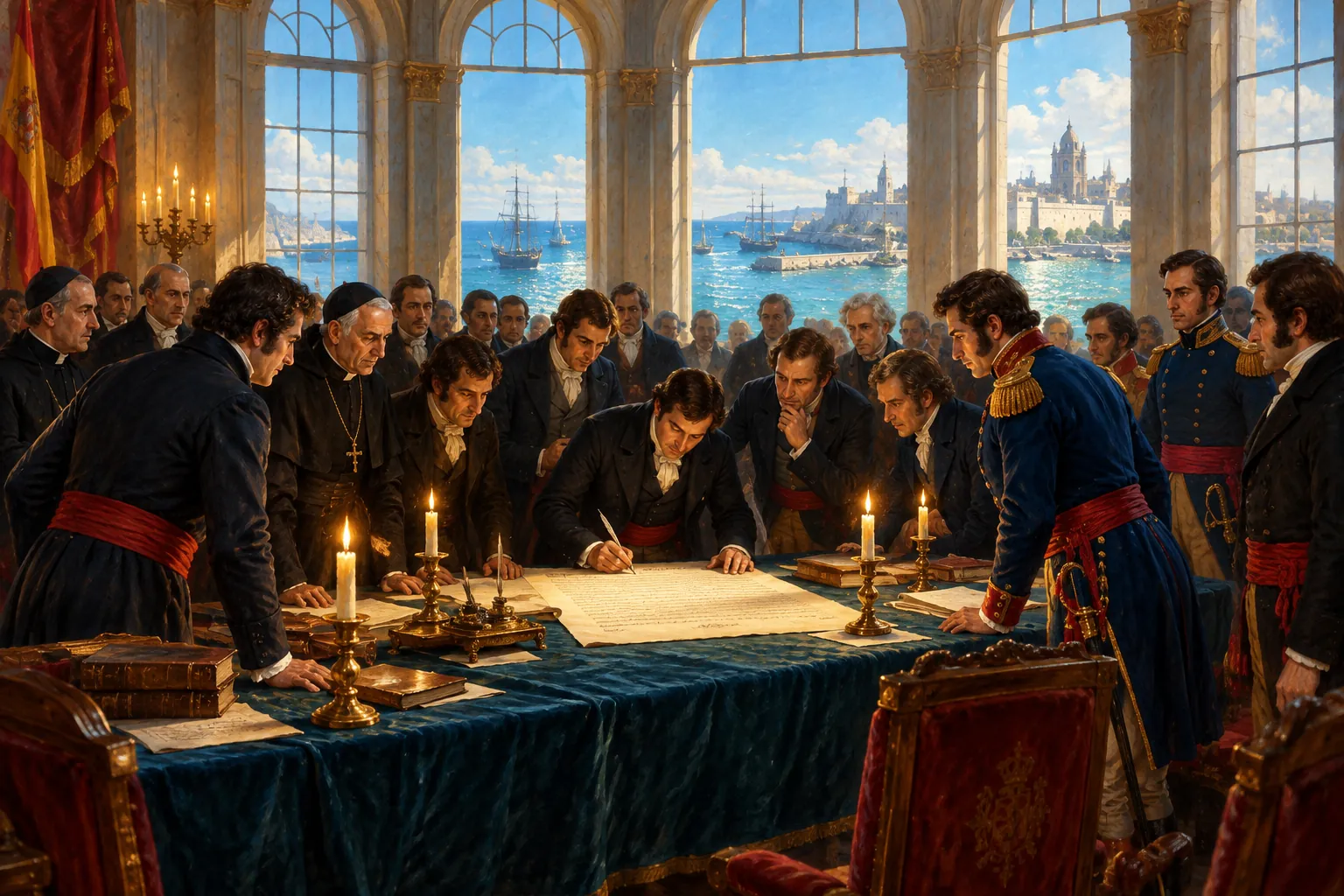
- 1701. The Elector of Brandenburg crowns himself King in Prussia, and the War of the Spanish Succession begins. It is fought over who will rule Spain and its empire.
- 1707. England and Scotland join as the Kingdom of Great Britain under the Acts of Union.
- 1713. The Treaty of Utrecht ends most of the Spanish Succession war. It is a landmark in the idea that no single power should dominate Europe.
- 1716. In Japan, Tokugawa Yoshimune becomes shogun and starts the Kyōhō reforms, which aim to repair the shogunate's finances.
- 1721. The Treaty of Nystad ends the Great Northern War. Russia, under Peter the Great, gains Baltic lands and Peter takes the title of emperor.
- 1740–1748. The War of the Austrian Succession begins when Frederick II of Prussia seizes Silesia from Maria Theresa's Austria.
1748–1775: Ideas, empire and the Seven Years' War
- 1748. Montesquieu publishes The Spirit of the Laws, which argues for separating the powers of government.
- 1751. The first volume of the French Encyclopédie appears, collecting new knowledge in one work.
- 1756–1763. The Seven Years' War is fought in Europe, North America, India and at sea. Britain wins the biggest gains.
- 1757. At Plassey, the British East India Company defeats the Nawab of Bengal, a first step toward its rule in India.
- 1763. The Treaty of Paris ends the war. France gives up Canada to Britain, which now has huge debts and new colonies to govern.
- 1769. James Watt patents his separate condenser, a key improvement to the steam engine.
1776–1800: Revolutions
- 1776. The American colonies declare independence on 4 July. In the same year Adam Smith publishes The Wealth of Nations.
- 1783. The Treaty of Paris recognises the United States.
- 1787–1793. In Japan, Matsudaira Sadanobu leads the Kansei reforms after the Tenmei famine of the 1780s.
- 1789. The French Revolution begins. The Estates-General meets in May, the Bastille falls on 14 July, and the Declaration of the Rights of Man and of the Citizen is adopted in August.
- 1791. Enslaved people in the French colony of Saint-Domingue rise up in August. This starts the Haitian Revolution.
- 1793. Louis XVI is executed on 21 January. The Reign of Terror follows.
- 1795. The third partition of Poland removes it from the map of Europe.
- 1799. Napoleon Bonaparte takes power in France on 9 November (18 Brumaire).
Causes: why the century turned
The century's early wars grew out of dynastic politics. Europe's royal families were tied together by marriage, so the question of who inherited a crown could become a continental war. By 1713, Europeans had started to speak of a balance of power, meaning that no state should become strong enough to dominate the others.
Money and trade drove the next phase. Britain and France competed for colonies, sugar islands, and markets in India and North America. The Seven Years' War left Britain victorious but deep in debt. Its attempts to raise taxes in the American colonies helped set off the protests that led to 1776.
Meanwhile, printing, coffeehouses, salons and academies spread new ideas. Enlightenment thinkers asked why kings should have absolute power and why law should not apply to everyone. Those questions were ready when governments hit financial crises, as France did in the 1780s.
What happened: three arenas of change
Ideas and politics
The American Revolution turned Enlightenment ideas into a written constitution (1787). The French Revolution went further, ending the old privileges of the nobility and Church and claiming that rights belong to all citizens. It also became violent: the monarchy fell in 1792, the king was executed in 1793, and thousands were killed in the Terror before the fall of Robespierre in July 1794.
Economy and technology
In Britain, cotton spinning machines, better iron-making and Watt's steam engine began moving work from homes into factories. This change was gradual and regional, not a single event, and most people in the world in 1800 still worked the land. Even so, it set the direction for the next century.
Empire, slavery and resistance
The 1700s were the peak of the Atlantic slave trade, which carried several million Africans across the ocean. Resistance grew as well. In Saint-Domingue, the richest sugar colony in the world, the 1791 uprising became a revolution that ended slavery there and led to independence in 1804. In Asia, the British East India Company turned trade into rule in parts of India. In China, the Qing dynasty reached its widest extent under the Qianlong emperor, who reigned from 1735 to 1796. In Japan, the shogunate kept its policy of limited foreign contact but met new pressures, such as the Russian envoy Adam Laxman's visit to Nemuro in 1792, while scholars studied Dutch books on medicine and science.
Consequences
By 1800 the political map and political vocabulary had changed. Written constitutions, citizenship, national armies and the idea that people could remove a ruler were now part of the world's toolkit. The French wars that began in 1792 were still going on, and they would shape the next fifteen years. Britain emerged as the leading industrial and naval power. Poland had vanished as a state. Haiti's revolution showed that the rights language of the age could be turned against slavery itself, though most of the world's enslaved people remained unfree for decades.
The story continues in The 19th Century: World Events Timeline (1801–1900).
What exams ask
- Dates and counting. Know that the 18th century is 1701–1800, and that 1789 is the usual start date of the French Revolution.
- Cause and effect. A favourite chain is Seven Years' War, then British debt and taxes, then American protests, then independence. A second chain is financial crisis, then the Estates-General, then revolution.
- Comparison. Compare the American, French and Haitian revolutions by who led them, what they demanded and what they changed.
- Enlightenment. Match thinkers to ideas: Montesquieu with separation of powers, Rousseau with popular sovereignty, Smith with markets.
- Japan. In Japanese exams, be ready to compare the Kyōhō and Kansei reforms and to place the Tenmei famine.
- AP style. AP World and AP Euro questions often ask for continuity and change, so link economic change in Britain to political change in France.
Read next
- The Long 19th Century (1789–1914): it shows how the revolutions of the 1790s shaped the century that followed.
- The 19th Century: World Events Timeline (1801–1900): the next timeline in this series, starting where this one stops.
- World History Timeline 1700–1918 (Printable): a single sheet covering the whole period for revision.