In five minutes: Bloody Sunday and the Russian Revolution
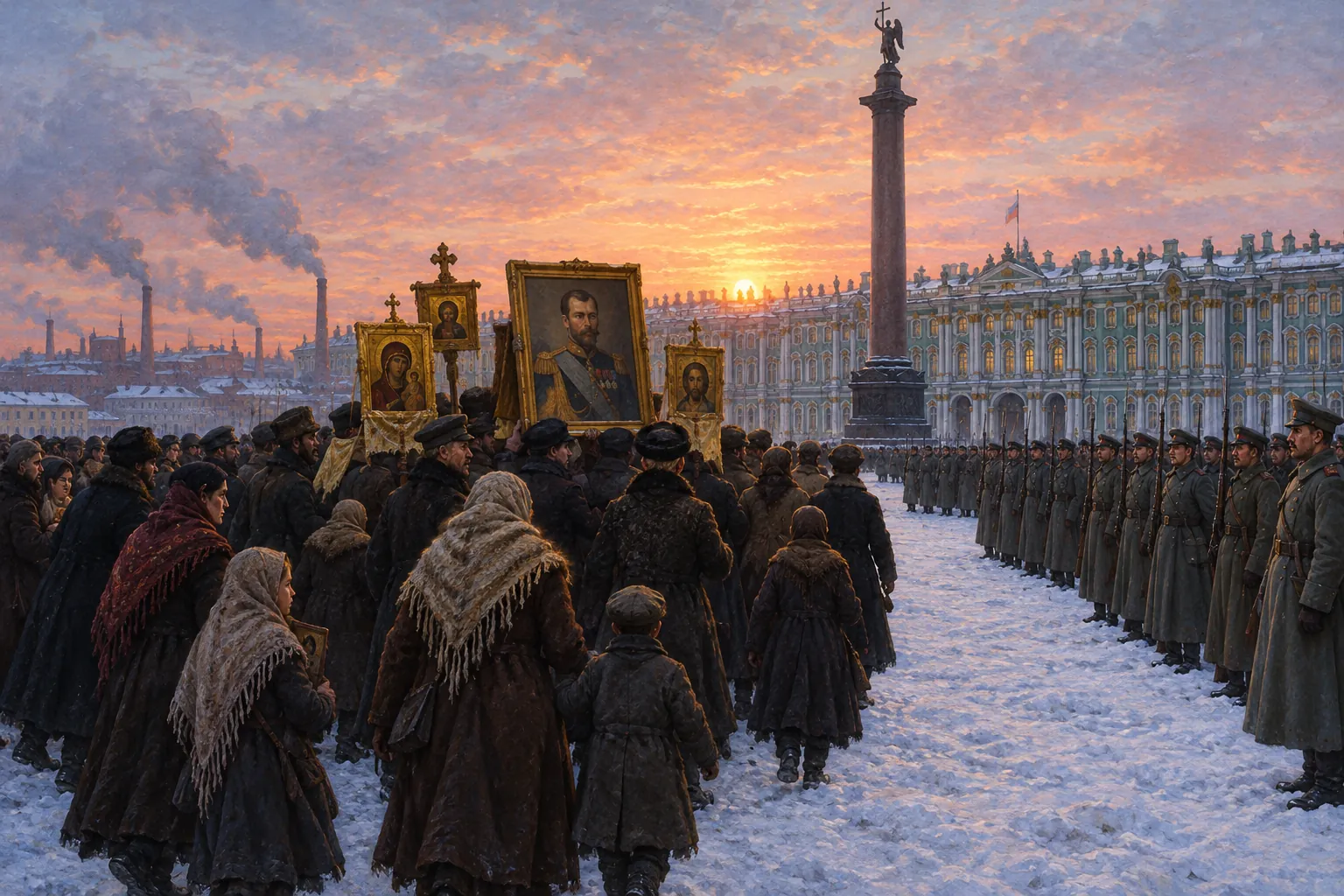
On Sunday 22 January 1905 (9 January in the Julian calendar that Russia still used), tens of thousands of workers and their families walked toward the Winter Palace in St Petersburg to hand Tsar Nicholas II a petition. They carried icons and portraits of the tsar and sang hymns. Soldiers stopped them at several points across the city and opened fire. The government's own count was about a hundred dead and several hundred wounded. Other estimates are much higher, and no exact figure exists.
The shooting is called Bloody Sunday. It matters because the marchers were not rebels. They believed the tsar was their protector, and many lost that belief in a single day. Within days strikes spread across the empire. By the end of the year Russia had been forced to promise civil liberties and its first elected parliament, the State Duma. Historians treat Bloody Sunday as the opening of the Revolution of 1905, a rehearsal for 1917. For the wider story of the dynasty, see the hub article The Russian Empire (1721–1917).
This article uses the modern (Gregorian) calendar. Russian sources of the time give dates 13 days earlier, so you will also see "9 January" for the same day.
Why the workers marched
Factory life in St Petersburg
Russia industrialised quickly from the 1890s, and St Petersburg filled with huge factories. Many workers were peasants who had moved to the city. They often worked ten or eleven hours a day for low pay and lived in crowded, unhealthy housing. Trade unions had no legal standing and strikes were against the law, so workers had almost no lawful way to complain.
Politics offered no outlet either. Russia was an autocracy: the tsar held supreme power, there was no elected parliament and no guaranteed freedom of speech, press or assembly. When economic problems and political powerlessness meet, even a polite request can become a political act.
Father Gapon's assembly
Georgy Gapon was an Orthodox priest who cared about workers' lives. In 1904, with the approval of the police authorities, he founded the Assembly of Russian Factory and Mill Workers of St Petersburg. It offered tea rooms, lectures and mutual aid. Officials hoped such a body would keep workers loyal and away from revolutionary groups. Instead it gave thousands of workers an organisation and a leader who spoke well. Branches spread through the working-class districts of the capital.
The Putilov strike and the war
In December 1904 four members of the Assembly were dismissed from the Putilov Works, one of the capital's biggest engineering plants. The Assembly demanded they be taken back, and management refused. A strike began at Putilov on 16 January 1905 (3 January in the Russian calendar) and spread to other factories. By the eve of the march, about 100,000 workers or more were reported to be out.
The Russo-Japanese War was also going badly. The fortress of Port Arthur surrendered to Japan on 2 January 1905. Rising prices and the shock of defeat deepened the public mood of anger and humiliation.
The petition
Gapon and his colleagues drew up a petition addressed to the tsar. Its tone was humble: it called him "Sire" and spoke of workers seeking justice and protection. Its content, however, went far beyond pay. It asked for an eight-hour day and better wages, freedom of speech, press, assembly and religion, an amnesty for political prisoners, an end to the war, and an elected constituent assembly to decide the country's future. Tens of thousands of people are said to have signed it.
The authorities learned of the plan and banned the march. On the evening of 21 January, large numbers of troops were brought into the city. Gapon wrote that the workers would go anyway. Nicholas II was not at the Winter Palace at all; he was at his residence in Tsarskoye Selo, outside the capital.
What happened on 22 January 1905
On the morning of the march, columns set out from the factory districts, including the Narva Gate area, the Vyborg side and Vasilievsky Island, all aiming for Palace Square. Women, children and older people walked with the men. They carried icons, portraits of the tsar and copies of the petition. Gapon led the column from the Narva Gate side.
Soldiers blocked the routes and fired on the columns at several places, including near the Narva Gate, at Troitsky Bridge, on Vasilievsky Island, along Nevsky Prospect and around Palace Square and the Alexander Garden. In some places cavalry charged the crowd. The authorities feared a mass of that size reaching the palace, but the people they fired on were unarmed.
Gapon was unhurt. Supporters led him away from the scene, and he soon left the country. Nicholas II wrote in his diary that it had been a painful day. He did not accept responsibility for the shooting.
How many died?
The numbers depend on who is counting. Government figures put the dead at about 100 to 130 and the wounded at several hundred. Revolutionaries and foreign journalists gave much higher numbers, from several hundred to over a thousand. Confusion on the day and the lack of independent records mean the exact toll is not known. A safe way to write it in an essay is: "the government reported about a hundred dead, but some estimates are much higher."
After Bloody Sunday: the Revolution of 1905
Strikes spread
News of the shooting reached the rest of the empire within days. Protest strikes broke out in Moscow, Russian Poland, the Baltic provinces and the Caucasus. In January alone, hundreds of thousands of workers took part. Demands moved from wages toward political freedom.
The government's response
The authorities tightened control in the capital and appointed General Dmitri Trepov as governor-general of St Petersburg. In early February the tsar received a hand-picked group of workers and told them they had been misled by agitators. That did little to repair trust. In the summer the government announced an advisory assembly, the so-called Bulygin Duma, but most opponents rejected it as too weak.
The October Manifesto
In June 1905 sailors mutinied on the battleship Potemkin. In October a railway strike grew into a general strike across the empire. On 30 October (17 October in the Russian calendar) Nicholas II issued the October Manifesto, drafted with the minister Sergei Witte. It promised civil liberties and an elected Duma with real legislative power. The first Duma met in spring 1906, though the tsar kept large powers, and many of the freedoms were narrowed again in the following years.
What happened to Gapon
Gapon returned to Russia late in 1905. Because of his old links with the police he was distrusted, and in spring 1906 he was killed by revolutionaries.
Why Bloody Sunday matters
The biggest effect was psychological. Many Russians had seen the tsar as a distant but kind father who would listen if only he knew the truth. After 22 January that image was badly damaged, and ordinary workers who had marched with icons began to turn toward strikes and political parties. Bolsheviks later called 1905 a dress rehearsal for 1917.
Do not overstate the result, though. The tsarist system did not fall in 1905, because the army stayed loyal in the end and the October Manifesto split the opposition. The regime survived, but with its authority weakened. The story continues in The Russian Revolution of 1905.
Also note that "Bloody Sunday" is the name of other events, including a shooting in Dublin in 1920 and one in Derry in 1972. This article is about St Petersburg in 1905.
What exams ask
- Date and calendar: 22 January 1905 (9 January Old Style), during the Russo-Japanese War. Mixing up the two dates is a common error.
- Causes: autocracy with no representation, poor industrial conditions, the failing war, and the Putilov strike.
- People: Father Gapon led the march; Nicholas II was absent from the capital.
- Significance (AP-style): it undermined the myth of the loving tsar, triggered the Revolution of 1905 and led to the October Manifesto and the Duma.
- Compare: 1905 forced reforms without ending the monarchy; in 1917 the army and the capital's garrison turned against the tsar and the monarchy fell.
Timeline to memorise: Russo-Japanese War setbacks, Putilov strike, Bloody Sunday, nationwide strikes, October Manifesto, first Duma.
Read next
- The Russian Revolution of 1905: follow the strikes, mutinies and reforms that came after the shooting.
- The Russian Revolution of 1917: see how the same weaknesses ended in the fall of the tsar twelve years later.
- Anastasia Romanov: Did She Survive?: read about the family of the last tsar and the legend that grew around it.