In five minutes: the Stamp Act of 1765 explained
The Stamp Act was a law passed by the British Parliament on 22 March 1765 and due to take effect on 1 November 1765. It required colonists in British America to pay a tax on printed and official paper, from newspapers and pamphlets to wills, contracts and playing cards. The tax was paid by buying paper that carried an official embossed stamp.
Britain wanted the money to help pay for the army it kept in North America after the Seven Years' War. Colonists did not mainly argue about the size of the tax. They argued about who had the right to impose it. Parliament had no members elected by the colonies, so many colonists said only their own assemblies could tax them. That idea became the slogan “no taxation without representation.”
Protests, riots and a boycott of British goods made the law impossible to enforce. Parliament repealed it on 18 March 1766. The same day it passed the Declaratory Act, which insisted that Parliament could make laws for the colonies “in all cases whatsoever.” The quarrel was paused, not settled. It is one of the first big steps in the story told in The American Revolution: Causes, War and Independence.
What is the Stamp Act?
The Stamp Act (formally an act for granting stamp duties in America) was designed to raise money from the colonies in a way that was simple to collect. Almost everything that mattered in business and law was written on paper, so a tax on paper reached many people.
- What was taxed: newspapers, pamphlets, almanacs, legal documents such as contracts and court papers, licences, playing cards and dice.
- How it worked: the paper had to be bought already stamped, from an official called a stamp distributor appointed in each colony.
- How it was paid: in British coin, not in colonial paper money, and silver and gold were hard to find in the colonies.
- How it was enforced: people accused of breaking the law could be tried in vice-admiralty courts, which sat without a jury.
Earlier laws such as the Sugar Act of 1764 had mostly taxed goods moving through ports, and colonists had grown used to arguing about trade rules. The Stamp Act was different. It reached inside the colonies and fell on everyday paperwork, so almost every lawyer, printer, merchant and tavern keeper met it face to face.
Why did Britain want the tax? Causes
The root cause was debt. Britain won the Seven Years' War in 1763 (see Treaty of Paris 1763), gaining Canada and land east of the Mississippi. But the war had nearly doubled the national debt. Winning also meant new duties: the government decided to keep about 10,000 soldiers in North America to guard the new territory and keep the peace with Native nations.
George Grenville, the prime minister, argued that colonists who had benefited from the victory should help pay for their own defence. British taxpayers already carried heavy burdens, and Grenville saw it as unfair that the colonies paid so little. In 1764 his government passed the Sugar Act and the Currency Act, and in 1765 it added the Stamp Act and the Quartering Act, which dealt with housing troops.
The timing made things worse. After the war ended, the colonial economy slipped into a slump, and the Proclamation of 1763, which limited settlement west of the Appalachians, had already annoyed many colonists. A new tax arrived when people felt least able to bear it.
Why did colonists object?
The central argument was about consent. English political tradition said that free people could be taxed only by representatives they had a say in choosing. The colonies had their own assemblies, such as the Virginia House of Burgesses, and those assemblies had always raised local taxes. Colonists said Parliament, an ocean away, could regulate trade but could not reach into their pockets.
Supporters of the tax answered with “virtual representation.” Their claim was that every member of Parliament spoke for all British subjects, even in towns such as Manchester that sent no member of their own. Colonists rejected this. In their view, a member elected by someone else had no duty to them and no reason to fear their votes.
There were practical complaints too. Lawyers, printers and merchants, the people best able to write pamphlets and organise crowds, were hit first and hardest. Trials without juries looked like an attack on a basic right. And the shortage of coin made payment in silver a real burden.
What happened: protests and the Stamp Act Congress
Resistance began even before the law took effect. In May 1765 the Virginia House of Burgesses debated a set of resolutions, pushed by Patrick Henry, declaring that only Virginia's own assembly could tax Virginians. Newspapers printed them across the colonies, and some printed versions that were even sharper than what the Burgesses had passed.
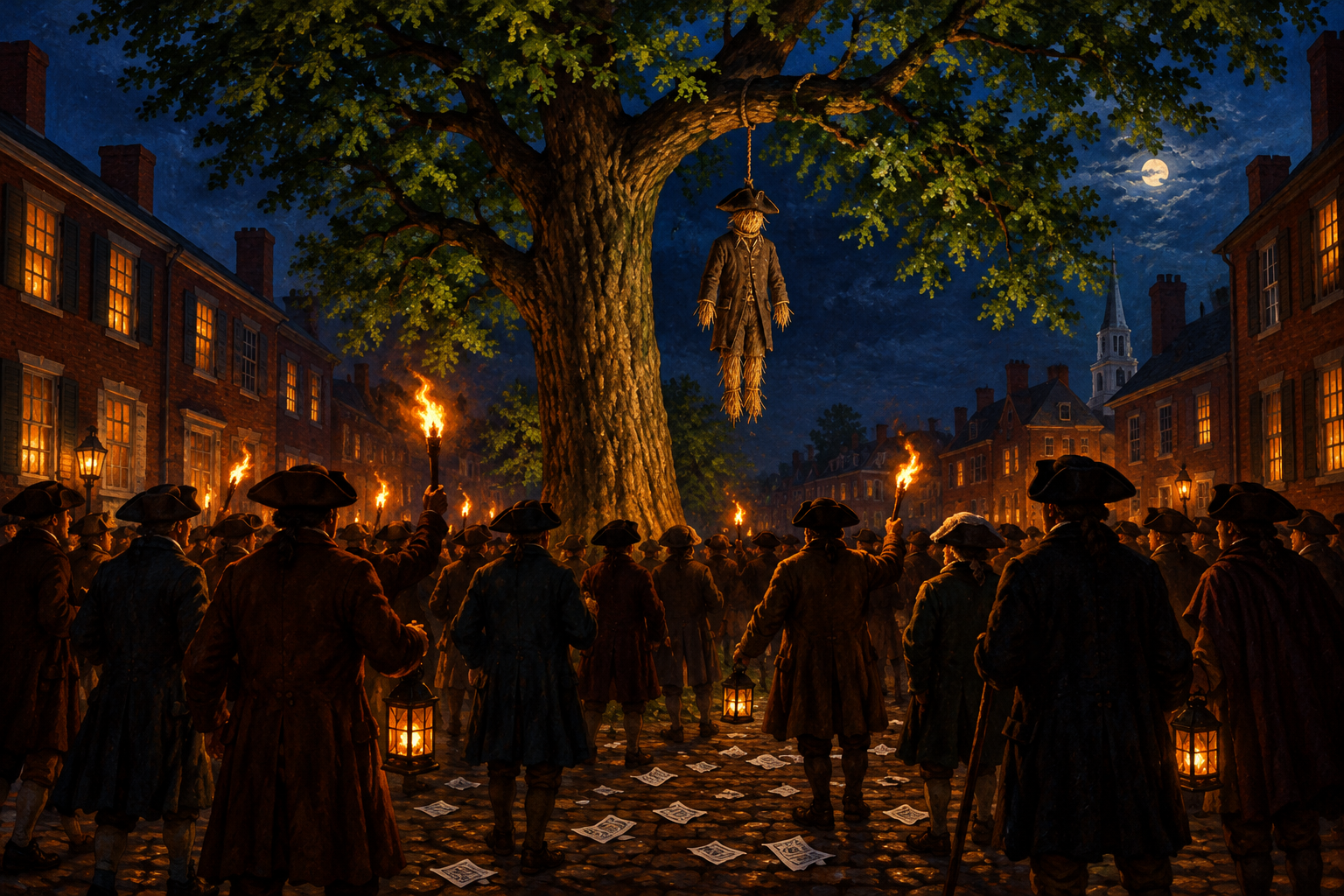
In Boston, on 14 August 1765, a crowd hung an effigy of Andrew Oliver, the man named as stamp distributor for Massachusetts, from an elm that became known as the Liberty Tree. Oliver promised to resign. Twelve days later a mob wrecked the house of Lieutenant Governor Thomas Hutchinson. Groups calling themselves the Sons of Liberty soon appeared in other colonies and pressured stamp distributors to give up their posts. By the time the law took effect, most had resigned or refused to act.
In October 1765, 27 delegates from nine colonies met in New York City for the Stamp Act Congress (7–25 October). It was the first time so many colonies had acted together against a British measure. The delegates approved a Declaration of Rights and Grievances and sent petitions to the king and Parliament. They said colonists owed loyalty to the Crown but could be taxed only by their own representatives.
On 1 November 1765, the day the Act was supposed to begin, some newspapers appeared with black borders and some courts and ports stopped work rather than use stamped paper. Merchants in New York, Philadelphia and Boston agreed to stop importing British goods. British manufacturers lost orders and joined the call for repeal.
Meanwhile the government in London had changed. Grenville was dismissed in July 1765, and the Marquess of Rockingham took over. In February 1766 Benjamin Franklin was questioned in the House of Commons about colonial opinion. Parliament voted to repeal the Stamp Act on 18 March 1766, and George III approved it. News reached the colonies in the spring, and towns celebrated with bells, bonfires and dinners.
Why it matters: consequences
- Colonial unity. Delegates from separate colonies learned they could act together. A decade later this habit grew into the Continental Congress.
- A new tool. The boycott showed that economic pressure on British merchants could change policy without an army.
- Organised resistance. The Sons of Liberty and local committees gave protest a structure that lasted.
- A principle, not a price. The argument moved from “this tax is too high” to “Parliament has no right to tax us.”
- Unfinished business. The Declaratory Act kept Parliament's claim alive, and in 1767 the Townshend Acts taxed imported glass, lead, paint, paper and tea. That led to new boycotts and, in 1773, to the Boston Tea Party.
It would be too simple to say the Stamp Act caused the American Revolution. Most colonists in 1766 still saw themselves as loyal British subjects, and war began nearly ten years later. But the crisis set out the arguments that the Declaration of Independence would later turn into a statement of principle.
What exams ask
In AP-style questions the Stamp Act is usually used to test causation and continuity. Useful points to remember:
- Cause: British war debt and the cost of troops after 1763, not a plan to oppress the colonies.
- Argument: “no taxation without representation” and the dispute over virtual representation.
- Methods of resistance: petitions, the Stamp Act Congress, intimidation of stamp distributors and boycotts.
- Outcome: repealed in 1766, but the Declaratory Act was passed the same day.
- Common mix-ups: the Stamp Act Congress (1765) is not the First Continental Congress (1774), and the Stamp Act taxed paper while the Townshend Acts (1767) taxed imported goods.
A good short answer connects the sequence: Seven Years' War, debt, Sugar Act, Stamp Act, resistance, repeal, Townshend Acts, Tea Act, Boston Tea Party, independence.
Read next
- Treaty of Paris 1763: shows how the war's victory created the debt and the troops that led to the tax.
- The Boston Tea Party (1773): shows how a later tax dispute led to open confrontation.
- The Declaration of Independence Explained: shows where the arguments about consent and rights ended up.