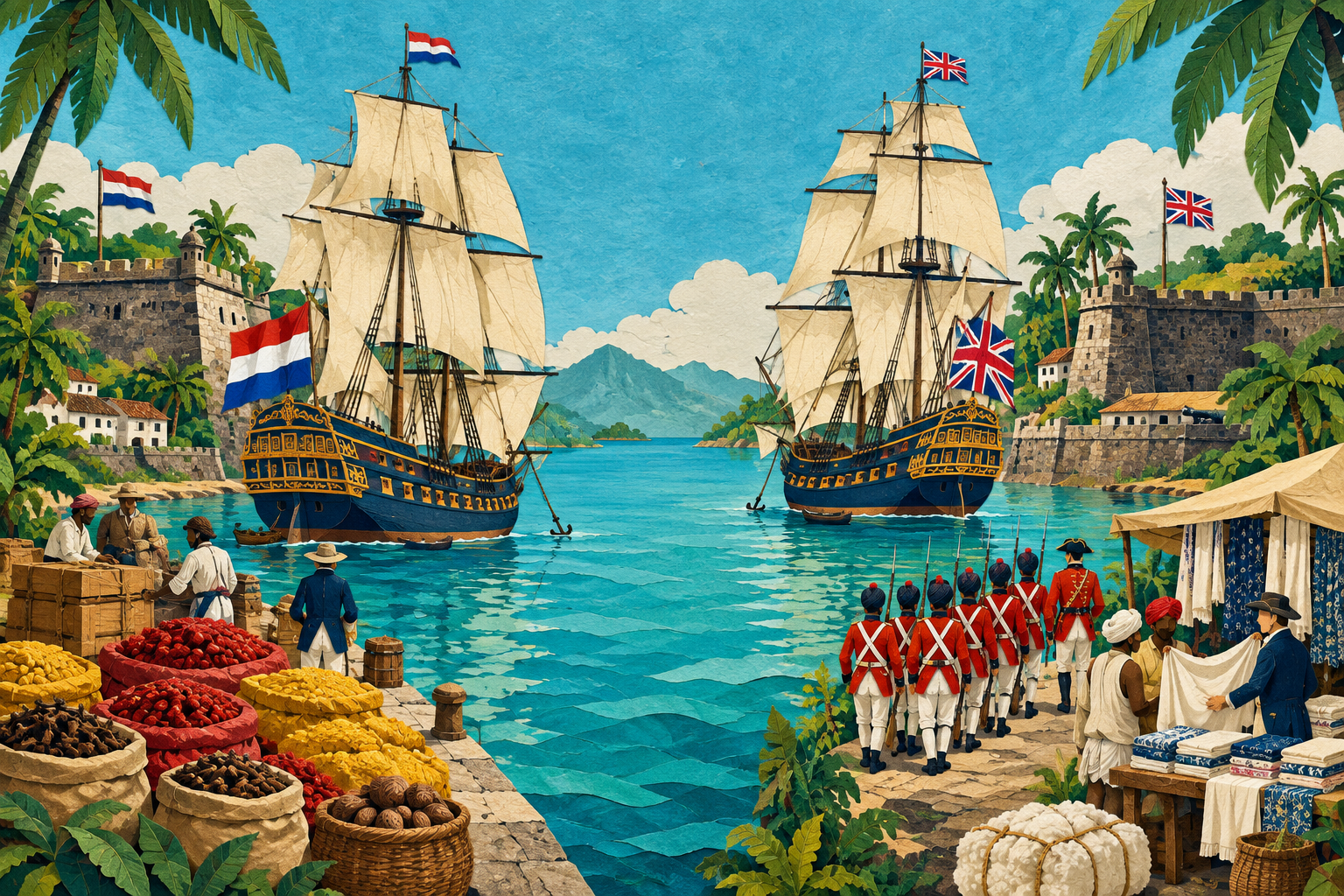
The Dutch East India Company (the VOC, short for Vereenigde Oostindische Compagnie) and the British East India Company (the EIC) were founded two years apart and chased the same prize: Asian spices, cloth and, later, tea. Yet the East India Company and the VOC are mostly a study in contrast. The Dutch built a sea network of fortified ports. The British ended up ruling a large part of India. Both are central to the story of imperialism.
In five minutes
The short version: the VOC (1602–1799) was the bigger and richer company in the 1600s. It controlled the spice trade of what is now Indonesia from its capital, Batavia. The EIC (1600–1874) lost the fight for the spices, turned to Indian cloth and later Chinese tea, and after the Battle of Plassey in 1757 grew into the ruler of Bengal and then much of India.
Three differences explain most of the rest. Money: the VOC started with far more capital. Method: the Dutch controlled ports and supply, while the British came to control land and taxes. Ending: the VOC went bankrupt and its state took it over in 1799; the EIC lost its powers to the Crown in 1858 and was dissolved in 1874.
East India Company and VOC side by side
| Point | British East India Company | Dutch East India Company (VOC) |
|---|---|---|
| Founded | 31 December 1600, royal charter from Elizabeth I | 20 March 1602, charter from the States General |
| Home base | London | Six chambers: Amsterdam, Zeeland, Delft, Rotterdam, Hoorn, Enkhuizen |
| Governing body | Court of Directors, chosen by shareholders | The Lords Seventeen (Heeren XVII) |
| Asian bases | Surat, then Madras, Bombay, Calcutta | Batavia (1619), Malacca, coastal Ceylon, the Cape |
| Main goods | Pepper at first, then cotton cloth, saltpetre, indigo, tea | Pepper, cloves, nutmeg, mace, cinnamon; later textiles, coffee, tea |
| Territory | Ruled Bengal from 1765, later much of India | Mostly ports and islands |
| In Japan | Hirado post, 1613–1623 | Hirado from 1609, Dejima from 1641 |
| End | Dissolved 1874 | Charter expired 31 December 1799 |
How they began: 1600 and 1602
Elizabeth I's charter of 31 December 1600 gave a group of London merchants a monopoly on English trade east of the Cape of Good Hope. The first voyages were separate ventures: investors paid for one trip, took their share of the profit and were paid out. Only around 1657 did the Company settle on a permanent joint stock.
The Dutch took a different route. By the late 1590s several small Dutch companies were competing in Asia and pushing up prices against each other. In 1602 the States General, the national assembly of the Dutch Republic, merged them into one company with a 21-year monopoly on Dutch trade between the Cape and the Strait of Magellan. Almost anyone could buy shares, and the shares could be traded on the Amsterdam exchange. That is why the VOC is often called the first joint-stock company. It also began with much more money than the English company, which helps explain its early lead.
Spice islands first, then India
Both companies wanted pepper and the fine spices of the Moluccas: cloves, nutmeg and mace. The Dutch had the stronger fleet. Under Jan Pieterszoon Coen, the VOC built Batavia on the north coast of Java in 1619, on the site of Jayakarta. In 1621 it conquered the Banda Islands, the only source of nutmeg, in a campaign that killed, enslaved or drove out most of the islanders. The aim was to let the Company, not the growers, decide how much spice reached the market.
The English tried to share this trade. In 1623, on the island of Ambon (Amboyna), Dutch officials arrested about twenty men, among them ten English company servants plus Japanese and Portuguese men, on a charge of plotting to seize the Dutch fort. They were tortured and executed. In England the "Amboyna massacre" was remembered for decades. Afterwards the English company pulled back from the Spice Islands and put more effort into India.
There it had already won a foothold at Surat in 1613 with the permission of the Mughal emperor. Madras followed around 1639, Bombay in 1668 (an island that had come to Charles II as part of his queen's dowry and was leased to the Company) and Calcutta around 1690. Indian cotton cloth sold well in Europe and across Asia. The VOC also traded in India, but its centre of gravity stayed in Southeast Asia.
Two kinds of empire: ports and land
The VOC's strength was a chain of ports linked by ships. It took Malacca from the Portuguese in 1641 and the coast of Ceylon in the 1650s, and founded Cape Town in 1652 as a supply station on the way to Asia. In Java it slowly widened its reach through the 1700s by stepping into the quarrels of local rulers in return for land and deliveries of crops. Throughout, the goal remained trade profit.
The British company changed in 1757. At Plassey, forces led by Robert Clive defeated the ruler of Bengal, and the Company gained real power there. After the Battle of Buxar in 1764, the Mughal emperor granted it in 1765 the diwani, the right to collect the revenue of Bengal, Bihar and Orissa. A trading firm now collected taxes and kept its own army of Indian soldiers, the sepoys. Read more in The Battle of Plassey (1757).
Shares, directors and the state
Both were private companies that a state had licensed to hold a monopoly, sign treaties and fight wars. The VOC's six chambers sent delegates to the Lords Seventeen, which set overall policy; having several centres could slow decisions. The EIC's shareholders elected a Court of Directors in London.
The British state became more involved as the Company ran into debt. The Regulating Act of 1773 and Pitt's India Act of 1784 put government oversight over its Indian rule. The Charter Act of 1813 ended its monopoly on India trade, and the Act of 1833 ended its China monopoly and its commercial role. The VOC stayed a trading company to the end.
Japan: Hirado and Dejima
The comparison is concrete in Japan. The English pilot Will Adams reached Japan in 1600 aboard the Dutch ship Liefde. The Dutch opened a trading post at Hirado in 1609, and the English followed in 1613 under John Saris. The English post never made money and closed in 1623. The Dutch moved to Dejima in Nagasaki in 1641 and, through the Edo period, were the only European traders allowed in Japan. Through them came "Dutch learning" (rangaku), Japan's window on European science.
The French company
France's company was set up in 1664 by the finance minister Jean-Baptiste Colbert, with strong royal backing, and it settled at Pondicherry in 1674. In the 1740s to 1760s France and Britain fought each other in southern India. After the Seven Years' War, the Treaty of Paris (1763) left France only a few small trading posts in India.
Why they ended differently
The VOC earned its greatest profits in the 1600s. In the 1700s the cost of forts and soldiers rose, employees traded privately and cheated the Company, and Britain pulled ahead in Indian cloth and tea. It kept paying dividends by borrowing. The Fourth Anglo-Dutch War (1780–84) wrecked its shipping. Its charter ran out on 31 December 1799, and the Dutch state took over its assets and debts.
The EIC lasted longer because it held land and tax revenue. It still ran into debt and needed a government loan in 1772. After the uprising of 1857, the Government of India Act of 1858 moved its rule to the Crown, and the Company was dissolved in 1874.
Both companies rested on violence, forced labour and, in the VOC's case, the slave trade within the Indian Ocean. A famine in Bengal in 1769–70 killed a very large number of people; estimates differ widely but run into the millions. The wider story is told in The Abolition of the Slave Trade and Slavery.
What exams ask
- The order and dates: EIC 1600, VOC 1602; the VOC as the early joint-stock company.
- Dutch bases: Batavia, Malacca, Ceylon, the Cape Colony.
- Amboyna (1623) and the English shift from the Spice Islands to India.
- The Navigation Act of 1651 and the Anglo-Dutch Wars (1652–54, 1665–67, 1672–74, 1780–84). In the Treaty of Breda (1667) the Dutch gave up New Amsterdam, which became New York.
- Plassey (1757) and the diwani (1765) as the moment a company became a state.
- Endings: VOC 1799; EIC 1858 (rule to the Crown) and 1874 (dissolved).
A good significance line: the VOC showed how shares could fund global trade, while the EIC showed how a trading company could become a government.
Read next
- The East India Company: the full story of the British company, from 1600 to 1874.
- The Battle of Plassey (1757): the battle that began the Company's rule in Bengal.
- The Abolition of the Slave Trade and Slavery: the human cost behind the trade.
- Imperialism: What It Was, Why It Happened, What It Left Behind: the big picture.