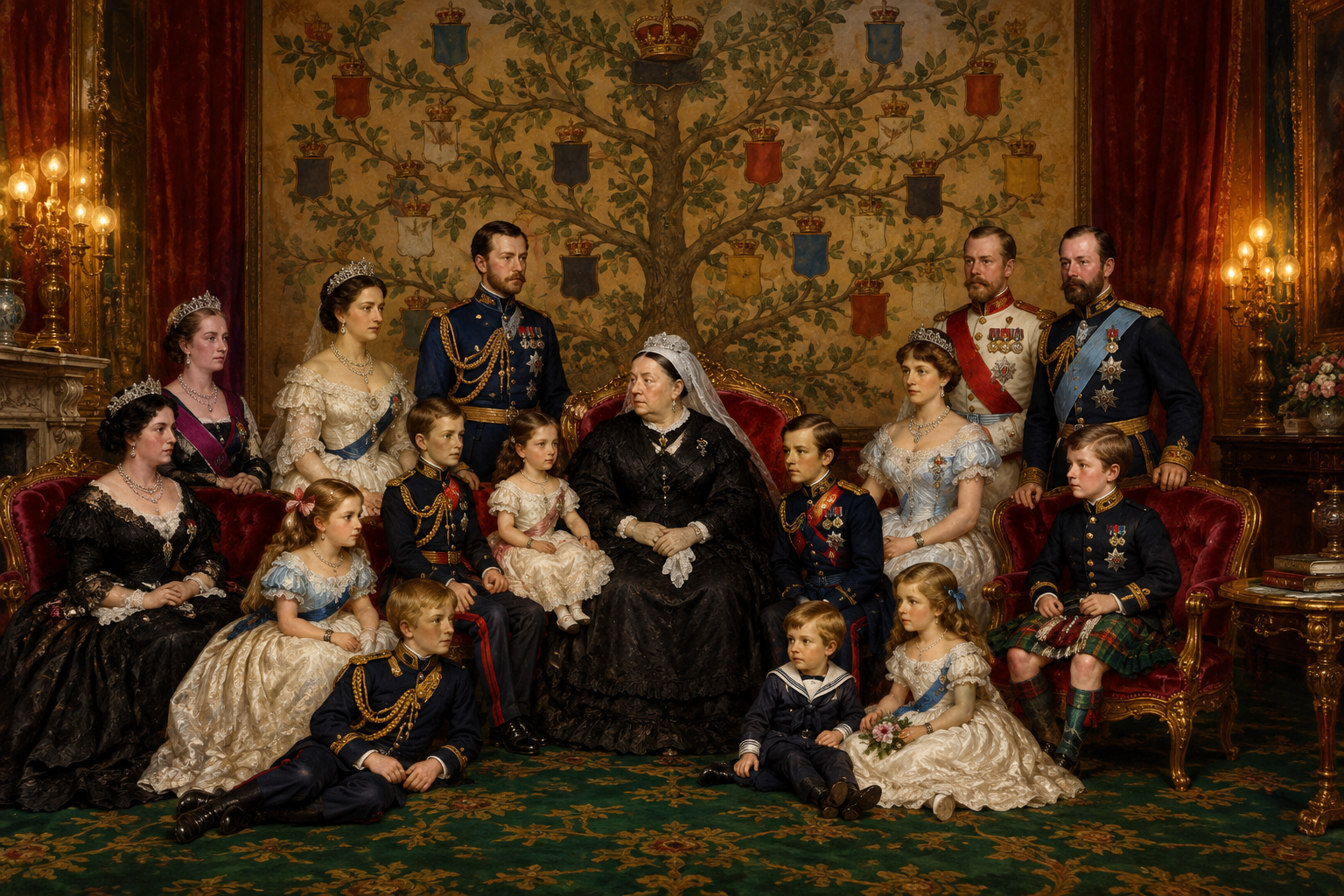
Queen Victoria's family tree in five minutes
Here is the Queen Victoria family tree in one line: she married her cousin Prince Albert of Saxe-Coburg and Gotha in 1840, had nine children, and by the early 1900s her descendants sat on, or had married into, the thrones of Britain, Germany, Russia, Spain, Greece, Romania, Norway and Sweden. She had more than 40 grandchildren, and that is why people call her the "grandmother of Europe".
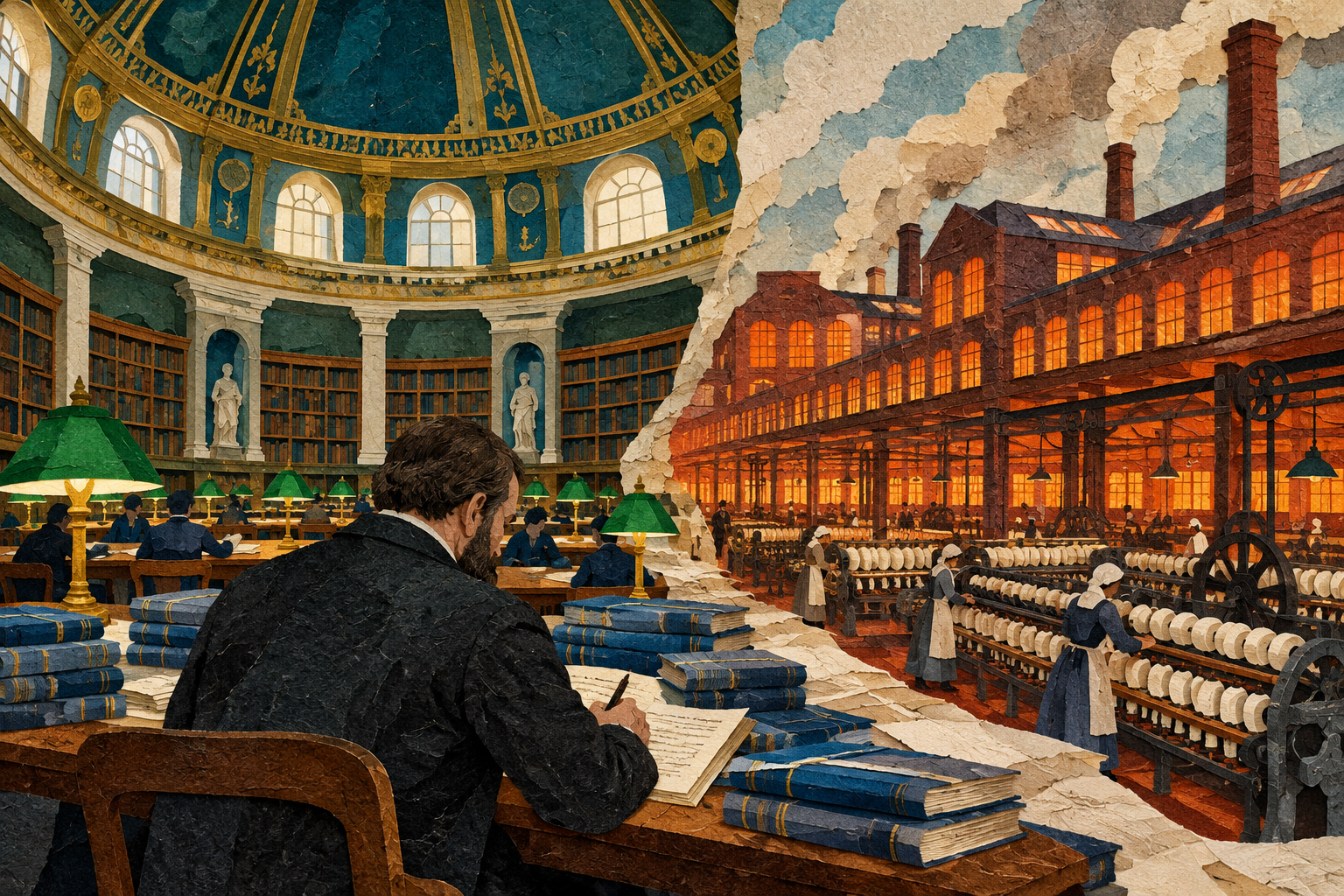
She reigned for 63 years, from 1837 to 1901, the period known as The Victorian Era (1837–1901). This article follows what happened inside her family during those years: who her children were, why they married where they did, how a rare blood disorder travelled down the tree, and why so many royal cousins still ended up on opposite sides in 1914.
Who were Victoria's nine children?
Victoria and Albert had four sons and five daughters, born between 1840 and 1857. In order of birth:
- Victoria, the Princess Royal (1840–1901): married Frederick of Prussia, who briefly reigned as German emperor Frederick III in 1888. Their eldest son became Kaiser Wilhelm II.
- Albert Edward, "Bertie" (1841–1910): married Princess Alexandra of Denmark and became King Edward VII in 1901. His second son became George V.
- Alice (1843–1878): married Louis, later Grand Duke of Hesse. Her daughter Alix became the last Russian empress. Alice died of diphtheria aged 35.
- Alfred (1844–1900): Duke of Edinburgh, a naval officer. He married Grand Duchess Maria of Russia and later inherited the duchy of Saxe-Coburg and Gotha.
- Helena (1846–1923): married Prince Christian of Schleswig-Holstein and stayed in England, close to her mother.
- Louise (1848–1939): an artist who married a British nobleman, the Marquess of Lorne, rather than a foreign prince. They had no children.
- Arthur (1850–1942): Duke of Connaught, an army officer. His daughter Margaret married into the Swedish royal family.
- Leopold (1853–1884): had haemophilia and died aged 30 after a fall. His daughter passed the condition on to the next generation.
- Beatrice (1857–1944): the youngest, who lived with her mother for years. Her daughter Victoria Eugenie ("Ena") became queen of Spain.
Among the grandchildren, the best known are Wilhelm II of Germany, George V of Britain, Empress Alexandra of Russia, Queen Maud of Norway, Queen Marie of Romania, Queen Sophie of Greece and Queen Victoria Eugenie of Spain.
Why did her children marry across Europe?
In the nineteenth century, royals were expected to marry royals. For a Protestant British family, the pool of suitable partners was small, and many came from German states. Victoria herself had married a German cousin, and Albert, who came from the Coburg family, had relatives in many courts.
Marriage was also diplomacy. When Albert and Victoria arranged the Princess Royal's wedding to Frederick of Prussia in 1858, they hoped it would nudge Prussia toward a more liberal, constitutional government, and that Britain would gain a friend in Berlin. Albert died in December 1861, but Victoria kept guiding her children's matches for decades. Later marriages linked Britain with Denmark, Hesse, Russia, Spain and Romania.
The plan had limits. Most of the monarchs involved ruled under their own ministers, parliaments and military advisers. A grandmother could arrange a wedding, but she could not decide a country's foreign policy.
The royal disease: haemophilia in the family tree
Haemophilia is a condition in which blood does not clot properly, so even small injuries can bleed for a long time. It is passed on through the X chromosome. Women usually carry the gene without having the disease, while their sons have a 50 per cent chance of being affected.
No earlier case is known in Victoria's family, and a new mutation is the most likely explanation: her father was 51 when she was born. She was clearly a carrier. Her son Leopold had haemophilia and was seriously ill throughout his short life. Two of her daughters, Alice and Beatrice, were carriers. In 1873 Alice's son Frederick, aged two, died after a fall from a window.
Through Alice the gene reached the Russian court. Her daughter Alix married Nicholas II in 1894, and their only son, Alexei, born in 1904, had haemophilia. The family's private worry about his health shaped the final years of the Romanov monarchy. Through Beatrice it reached Spain, where Victoria Eugenie's sons Alfonso and Gonzalo were affected. A 2009 DNA study of the Romanov remains identified the mutation as a form of haemophilia B.
Edward VII's line did not carry it. A man without haemophilia cannot pass it on, so the British line descending from Bertie stayed clear of the condition.
Cousins on thrones, and at war
By 1914 Wilhelm II of Germany and George V of Britain were first cousins, both grandsons of Victoria. Nicholas II's wife, Alexandra, was another granddaughter. The three rulers wrote friendly letters to each other in the years before the First World War.
Family ties did not prevent the war. Alliances, army timetables and public opinion mattered more than the letters, and the rulers were bound by their governments. Once the fighting began, Britain and Germany were enemies. In 1917 George V dropped the German name Saxe-Coburg and Gotha and made the royal house the House of Windsor.
The war ended badly for most of the cousins. Nicholas II abdicated in 1917 and was shot with his family, including Alexandra and Alexei, in July 1918. Wilhelm II abdicated in November 1918 and lived the rest of his life in exile in the Netherlands. Of the three, only George V kept his throne.
Victoria's family today
The tree is still alive. Elizabeth II was Victoria's great-great-granddaughter through the line of Edward VII, and her husband, Prince Philip, was also a great-great-grandson, through Alice. King Charles III therefore descends from Victoria on both sides. The royal families of Norway and Spain also trace their ancestry back to her, through Maud and Victoria Eugenie.
What exams ask
- Significance: Victoria's family shows dynastic diplomacy at work, and it also shows its limits against nationalism, industry and alliances.
- Haemophilia: be ready to explain why it passed through daughters to sons, and why it mattered in Russia and Spain.
- Key names: Albert, Edward VII, Wilhelm II, George V, Alexandra and Nicholas II, and the 1917 name change to Windsor.
- Typical question: "To what extent did family ties between the monarchs shape European politics before 1914?" A strong answer says: some, in tone and contact, but little in decisions.
Read next
- Who Was Queen Victoria?: her life and reign in five minutes, the right starting point before the family tree.
- Prince Albert and Queen Victoria: the marriage that created the family, and the plans Albert had for his children.
- Queen Victoria's Childhood and the Kensington System: how a lonely, closely controlled childhood shaped the mother she became.