In five minutes: Grant and Lee
Robert E. Lee and Ulysses S. Grant are the two best-known generals of the American Civil War (1861–1865). Lee, a Virginian, commanded the Confederate Army of Northern Virginia and beat larger Union armies again and again in the first three years of the war. Grant, an Ohio-born officer, rose through the western theatre and became the Union's general-in-chief in March 1864. He kept the pressure on Lee's army until it ran out of room, food and men, and he accepted its surrender at Appomattox Court House, Virginia, on April 9, 1865.
Their story is about two styles of generalship and about how the war was remembered afterwards. It is one chapter of the larger story in 19th-Century America: Expansion, Civil War and the Gilded Age, and the dates fit into the 19th-Century America Timeline.
Two very different starting points
Lee was born in 1807 into one of Virginia's best-known families. His father, Henry “Light-Horse Harry” Lee, had commanded cavalry in the Revolutionary War. Robert finished second in his class at West Point in 1829 and became an engineer. He married Mary Custis, whose family was close to George Washington's, and served under General Winfield Scott in the Mexican–American War. He ran West Point as superintendent from 1852 to 1855, and in 1859 he led the force that captured John Brown at Harpers Ferry.
Grant was born in 1822 in Ohio, the son of a tanner. He graduated from West Point in 1843 in the middle of his class; what people noticed was his skill with horses. He fought in Mexico, mostly in supply work, and learned how armies are fed and moved. After he resigned in 1854, farming and business went badly. When the war began in 1861, he was working in his family's leather shop in Galena, Illinois.
In short, Lee had the career of an elite officer. Grant came back to the army from failure. Both facts shaped how they fought.
Lee's choice in 1861
In April 1861 Lee had to choose a side. Accounts say that Lincoln's government informally offered him command of the Union army, and he refused. When Virginia left the Union on April 17, he resigned from the US Army on April 20. Lee had not wanted secession, but he would not fight against his home state.
It is important to remember what the Confederacy was. It was created to protect slavery, so Lee's personal loyalty to Virginia led him to fight for a government built on that system.
Lee's war, 1862–1863
On June 1, 1862, Lee took over the main Confederate army in Virginia and renamed it the Army of Northern Virginia. In the Seven Days battles he pushed the Union general George McClellan back from Richmond. He won again at Second Bull Run in August, then invaded Maryland.
That advance was stopped at Antietam on September 17, 1862, the bloodiest single day in American military history, with more than 20,000 casualties on both sides. Lee still won at Fredericksburg in December and at Chancellorsville in May 1863, where he divided a much smaller army to hit the Union flank. He lost his trusted lieutenant Stonewall Jackson there.
The turning point was Gettysburg, July 1–3, 1863. On the third day Lee ordered a frontal assault on the Union centre, known as Pickett's Charge, and it failed with terrible losses. He withdrew to Virginia and never again led a large invasion of the North.
Lee's strength was boldness and a feel for what the enemy would do. His weakness was that the South had fewer men and supplies, and costly attacks used up what it could not replace.
Grant's war, 1862–1864
Grant made his name in the West. In February 1862 he captured Fort Henry and Fort Donelson in Tennessee, and at Donelson he told the Confederate commander that nothing but “unconditional and immediate surrender” would do. Northern newspapers turned his initials into “Unconditional Surrender” Grant. At Shiloh in April 1862 he was surprised, then recovered and counterattacked the next day. The heavy casualties shook public opinion.
His greatest success was Vicksburg. After a long campaign he besieged the Mississippi River fortress, and it surrendered on July 4, 1863, one day after the fighting at Gettysburg ended. The Union now controlled the whole river and the Confederacy was cut in two. That is why July 1863 is seen as the war's turning point. Grant also won at Chattanooga in November.
In March 1864 Lincoln made him lieutenant general and general-in-chief of all Union armies. Grant's plan was simple: move the Union armies at the same time so the Confederates could not shift forces to help each other, and never let Lee's army rest.
Face to face, 1864–1865
The two men met in battle for the first time in May 1864, in the Overland Campaign. The fighting in the Wilderness was inconclusive, but unlike earlier Union commanders, Grant did not retreat. He turned south and kept moving. At Spotsylvania and then Cold Harbor in early June, Union losses were heavy, and Grant later regretted the Cold Harbor attack. Even so, the Union could replace its losses and the Confederacy could not.
In June Grant crossed the James River and attacked Petersburg, the rail hub that fed Richmond. A siege of about nine months began, with both armies in long lines of trenches. Lee became general-in-chief of all Confederate armies in January 1865, but by then his men were short of food and numbers.
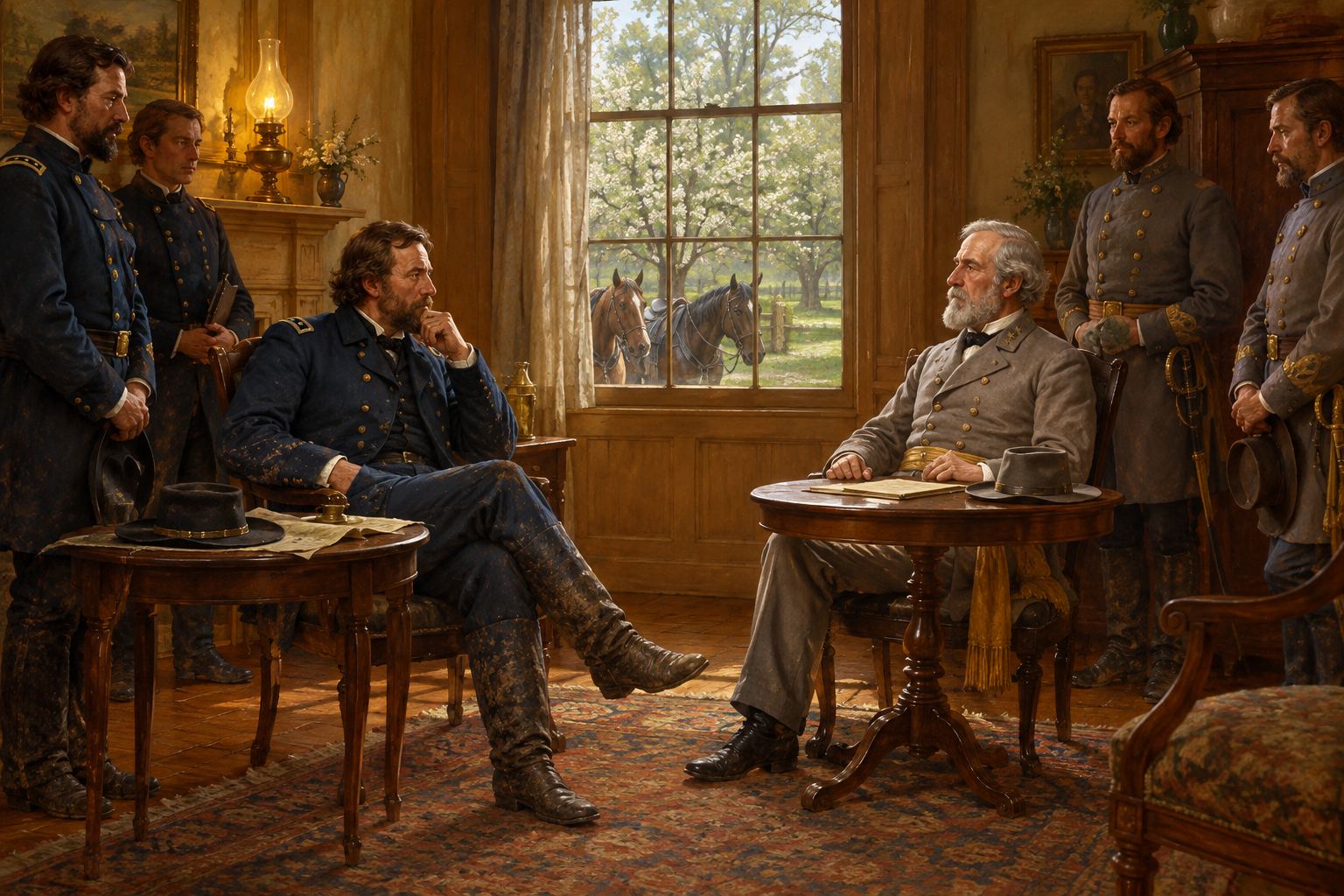
On April 2 the Union broke through at Petersburg and the Confederate government left Richmond. Lee marched west hoping to find supplies, but Union forces got ahead of him and blocked the road. On April 9 he met Grant in a private house at Appomattox Court House and surrendered.
Grant's terms were generous. Confederate soldiers were paroled and could go home, and men who owned horses or mules could take them for spring planting. Grant also arranged food for the hungry Confederate army. Other Confederate forces surrendered over the following weeks, so Appomattox ended the main fighting rather than the whole war on one day.
After the war
Lee became president of Washington College in Lexington, Virginia, now Washington and Lee University, and died on October 12, 1870. He never recovered his US citizenship in his lifetime; Congress restored it in 1975.
Grant served as the 18th president from 1869 to 1877. During Reconstruction he supported the rights of freed Black Americans: his administration backed the Fifteenth Amendment (ratified 1870), which barred racial limits on voting, and used the Enforcement Acts to prosecute the Ku Klux Klan. His reputation suffered from scandals among his appointees and from the Panic of 1873. In 1884 a firm he had invested in collapsed and he lost his savings. Dying of throat cancer, he wrote his Personal Memoirs to provide for his family, and finished them days before he died on July 23, 1885. They are still regarded as one of the best military memoirs ever written.
The way the two were remembered also mattered. In the South, the “Lost Cause” view portrayed Lee as a noble leader and placed the cause of the war in states' rights rather than slavery. Most historians today stress that the Confederate leaders themselves named the defence of slavery as their reason for leaving the Union.
Comparing the two generals
- Background: Lee came from a Virginia elite family; Grant from an Ohio tanner's household.
- West Point: Lee second in his class; Grant in the middle.
- Strength: Lee, bold movement and surprise; Grant, relentless advance and coordinated armies.
- Weakness: Lee, attacks that cost men the South could not replace; Grant, frontal assaults such as Cold Harbor.
- Outcome: Lee surrendered to Grant on April 9, 1865.
What exams ask
In AP-style questions the significance points are usually these:
- Gettysburg and Vicksburg in July 1863 together marked the war's turning point: Lee's invasion of the North failed and the Union took the Mississippi River.
- Grant became general-in-chief in March 1864 and used a strategy of coordinated, continuous pressure that wore down a smaller Confederacy.
- The surrender at Appomattox on April 9, 1865, ended the main Confederate army in Virginia. Lincoln was shot five days later.
- As president, Grant supported Reconstruction measures, including the Fifteenth Amendment and action against the Klan.
- The “Lost Cause” is a postwar memory, not the war's cause.
Read next
- Who Was Abraham Lincoln? The president who chose Grant to lead the Union armies.
- 19th-Century America Timeline Place the battles and the surrender in the full sequence of the century.
- The Monroe Doctrine (1823) A look at the country's earlier foreign policy, before the crisis that led to civil war.