In five minutes: “Let them eat cake”
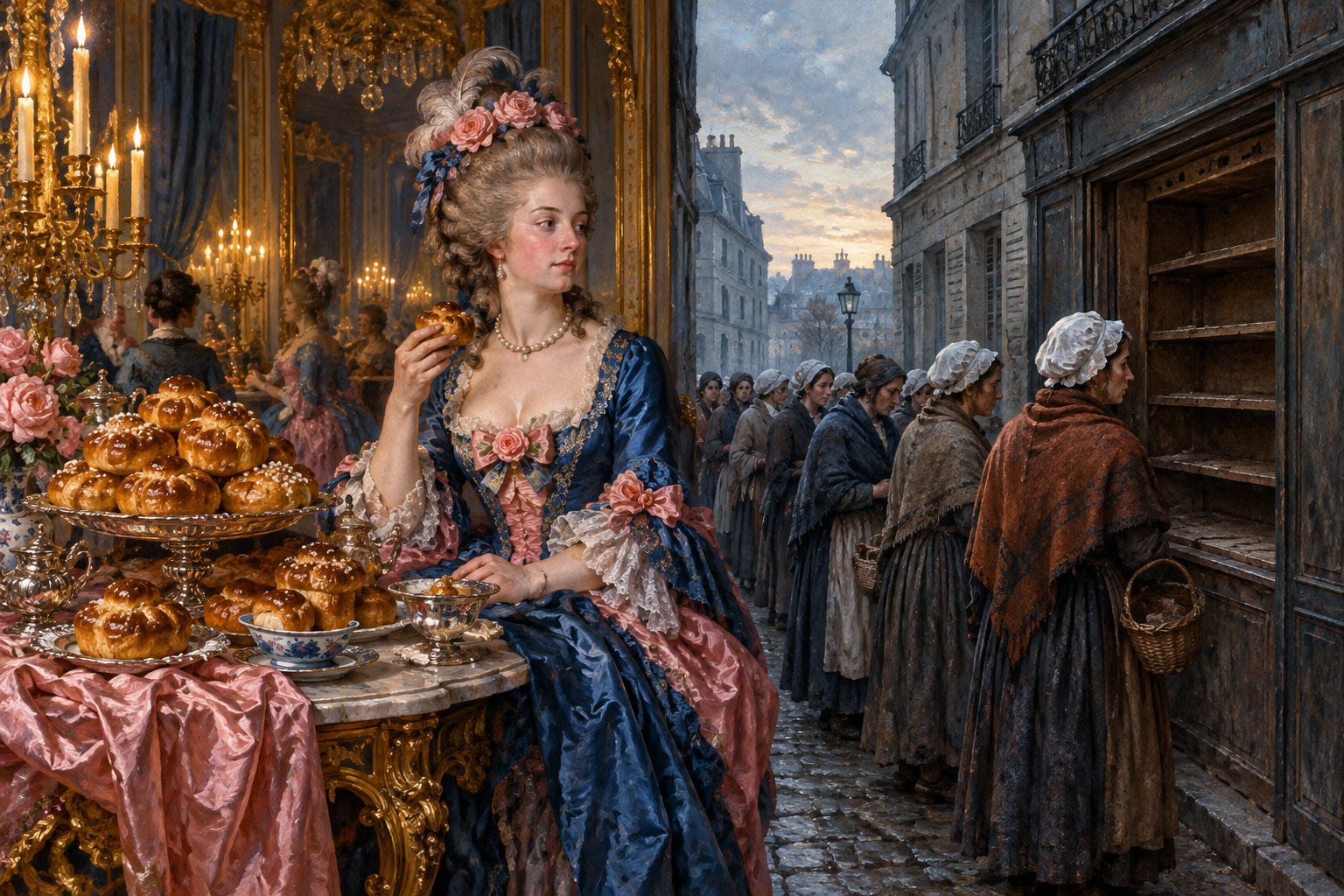
“Let them eat cake” is the most famous thing Marie Antoinette never said. No letter, diary, newspaper or official record from her lifetime shows her saying it. The French line is “Qu’ils mangent de la brioche,” and it first appears in print in the Confessions of Jean-Jacques Rousseau, who credits it to “a great princess” and never gives her name.
The story matters because of what it was used for. As the French Revolution turned against the monarchy, the line became a handy way to say three things at once: the queen is rich, she is a foreigner, and she has no idea that ordinary people are hungry. Whether she said it is a small question. Why people were ready to believe it is the bigger one, and the answer leads straight back to bread.
This article is part of our hub, The French Revolution Explained (1789–1799). Read that page first if you want the full sequence of events.
Where the line really comes from
Rousseau wrote the Confessions in the 1760s, and the first part was published in 1782, four years after his death. In the sixth book he remembers a moment from his youth. He wants something to eat with his wine, but he is too shy to walk into a fine shop. Then he recalls an old anecdote about a great princess who, told that the peasants had no bread, said they should eat brioche. He tells it as a story already going around, not as a recent event.
The dates settle the question of who he meant. Marie Antoinette was born in Vienna in 1755. When Rousseau was writing, she was a child of about ten in Austria. She did not arrive in France until 1770, when she was fourteen, to marry the future Louis XVI. Rousseau cannot have been writing about her.
Two details are worth noticing. First, brioche is not cake. It is a soft bread enriched with eggs and butter, so “cake” is a loose English rendering. Second, the joke works because the princess is clueless rather than cruel. She cannot imagine a world where bread itself is scarce, so she offers a richer version of it. Stories of out-of-touch royal women were told around Europe, and the tale was in circulation before Marie Antoinette ever lived in France.
Why it was pinned on Marie Antoinette
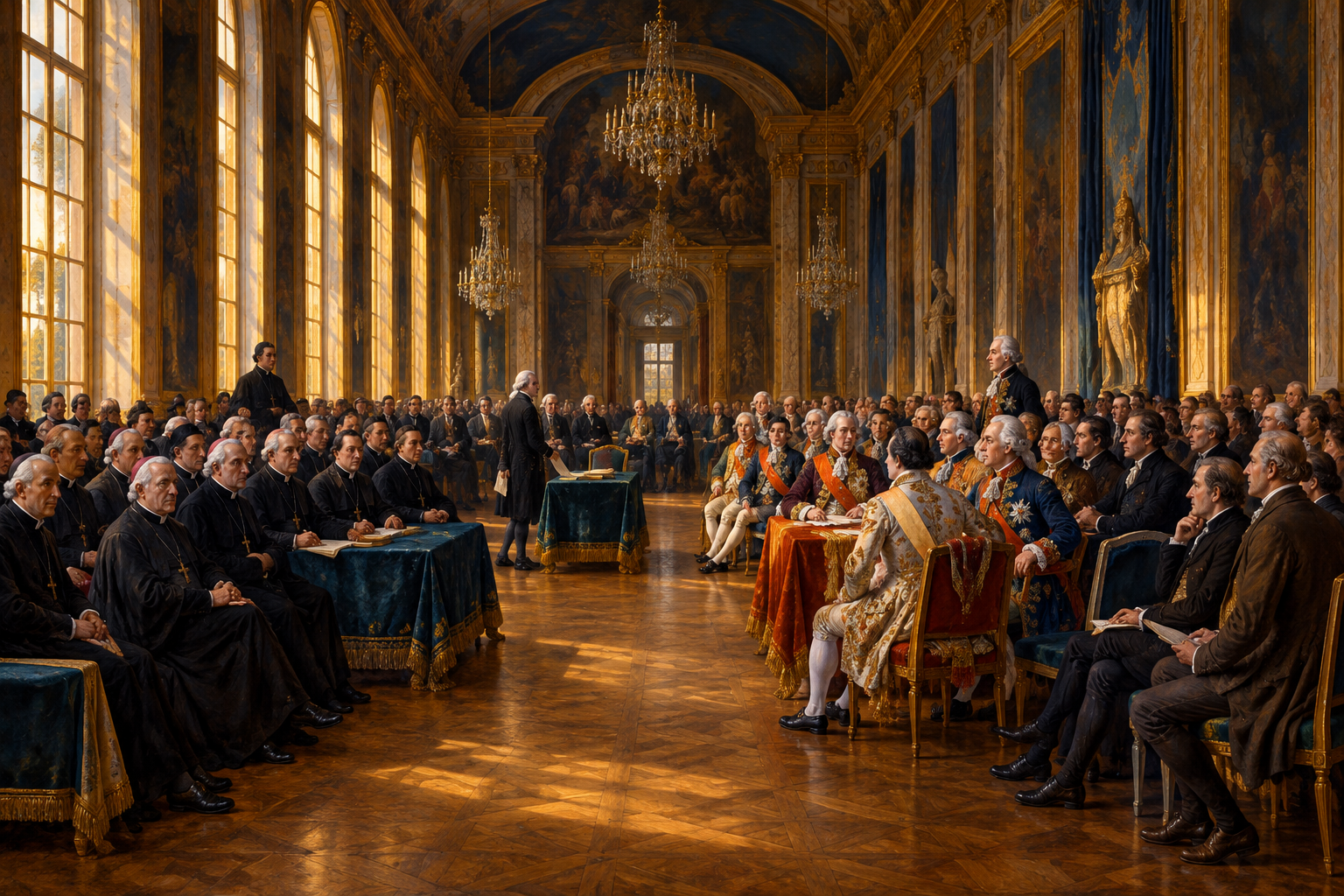
She was an easy target. She was Austrian, and many French people still distrusted the Habsburgs, France’s old rival, even after the alliance of 1756. She was queen of a court known for display. For the first years of her marriage she had no children, which fed gossip, and in 1778 her first child was born.
Printed attacks, called libelles, spread through Paris and made her the villain of every scandal. In the Affair of the Diamond Necklace in 1785 she was a victim of a fraud, yet much of the public believed she was guilty. You can read the details in The Affair of the Diamond Necklace. By about 1787 she had a nickname, “Madame Déficit,” as the royal debt became the main political problem of the day.
Once the public had a picture of a queen who spent freely while the country struggled, a line like “let them eat brioche” fitted it perfectly. It did not need to be true. It needed to sound like her.
The real bread crisis
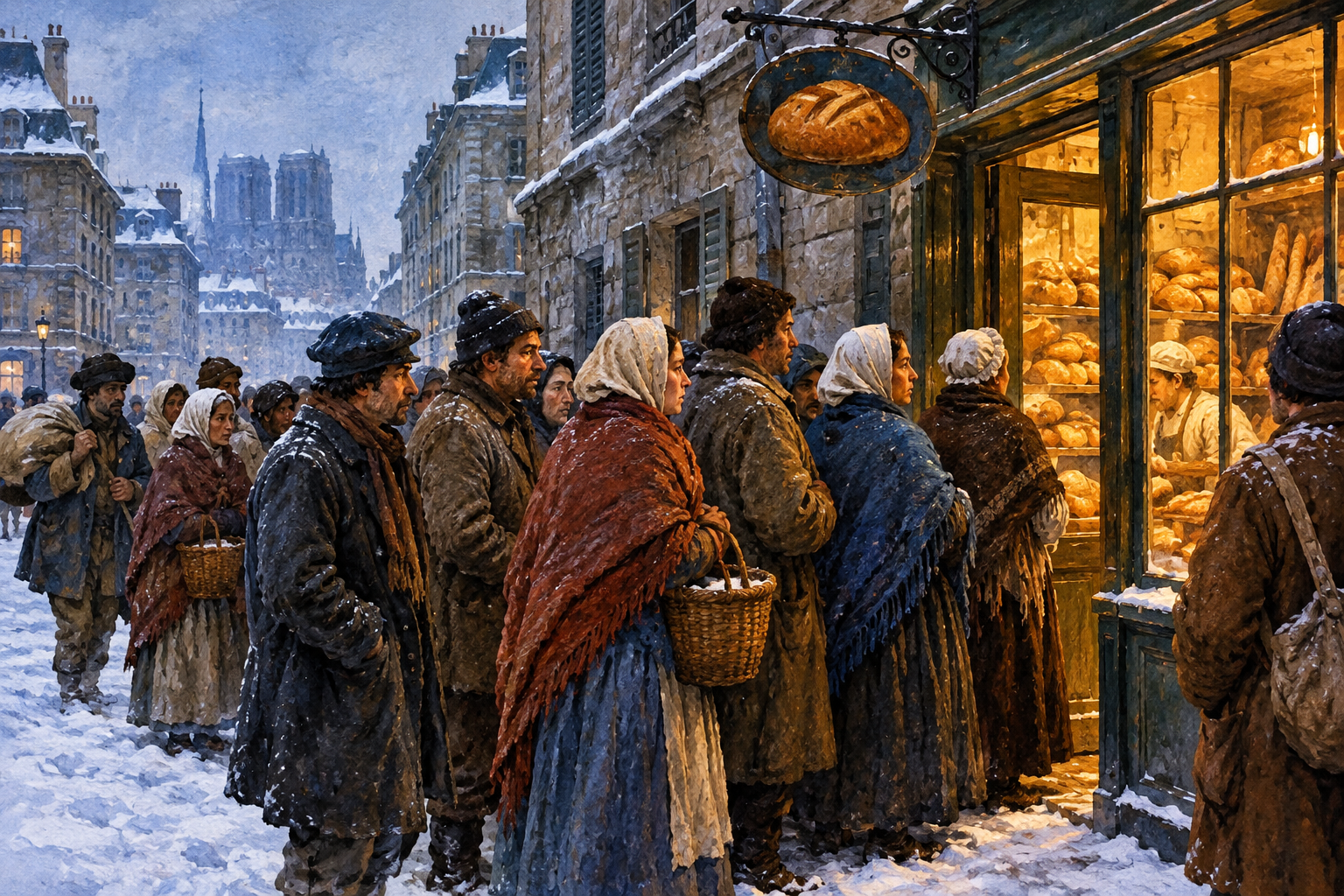
In the eighteenth century, bread was the centre of an ordinary family’s diet, and in bad years a labourer could spend a large share of his wages on it. When the price of grain rose, trouble followed. In the spring of 1775, just after Louis XVI became king, riots over grain and flour prices broke out across the Paris region. They are known as the Flour War.
The crisis of 1788–1789 was worse. A violent hailstorm in the summer of 1788 damaged harvests, a hard winter followed, and bread prices climbed to a peak in the summer of 1789. This is the background to the fall of the Bastille in July 1789 and to everything after it.
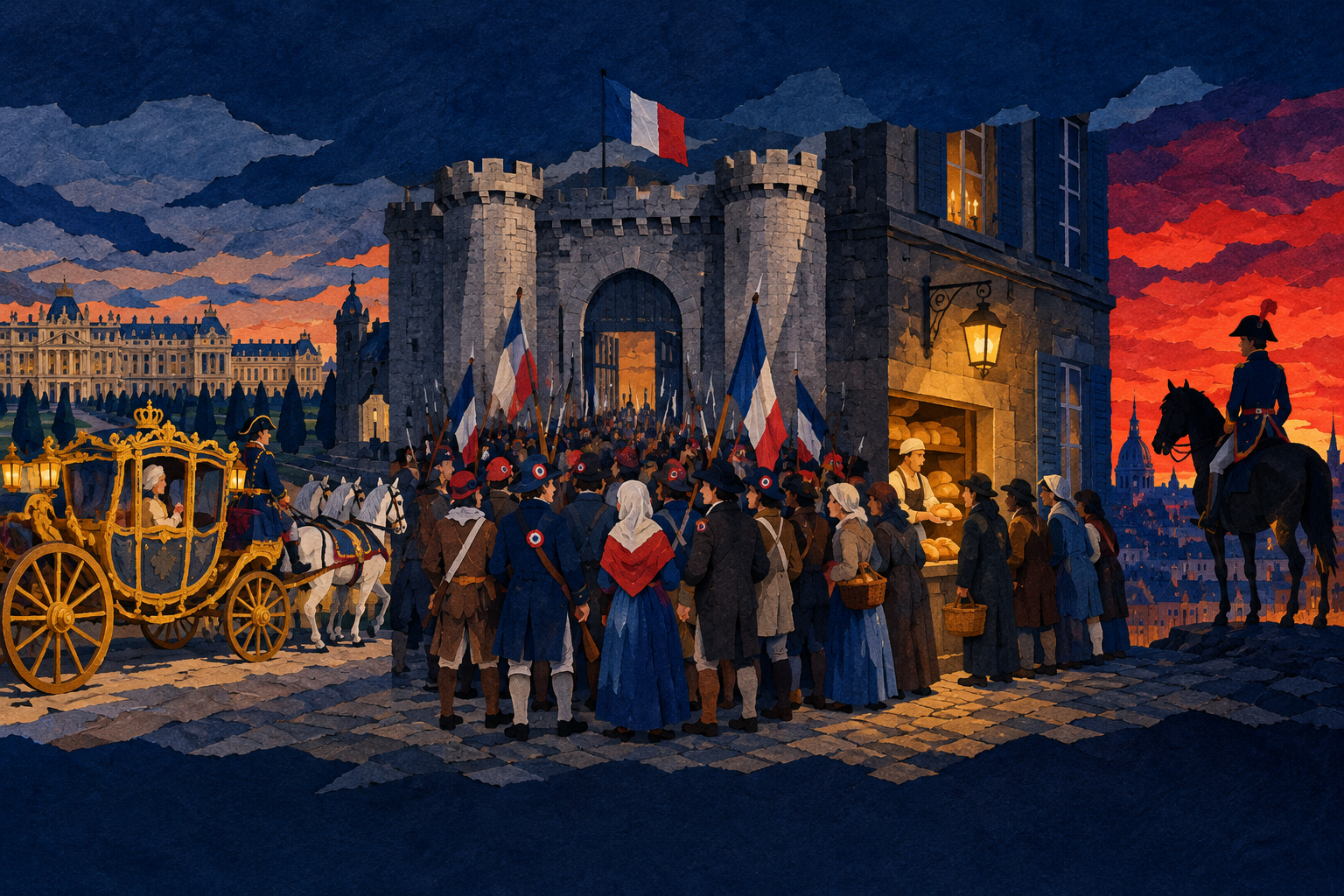
On 5 October 1789, thousands of Parisian women marched to Versailles, many of them demanding bread. They returned to Paris with the royal family in their midst. Some in the crowd joked that they were bringing back “the baker, the baker’s wife and the baker’s boy,” meaning the king, the queen and the heir. A phrase about bread being taken lightly, attached to a queen, was bound to travel in such a mood.
The real queen, and what she was blamed for
Marie Antoinette did spend a lot. She loved fashion, gambling, music and her private retreat at the Petit Trianon, and her tastes were a gift to her critics. But the state’s deficit came mostly from long-term debt and war costs, including the expense of supporting the American Revolution, and the court’s personal spending was only a small share of the total. She was a symbol of the problem more than the cause of it.
She was also not a simple villain in private. Her surviving letters show a woman who was often sheltered, sometimes careless and later frightened and determined as the monarchy collapsed. Her husband’s story is told in Who Was Louis XVI?. After the monarchy fell, she was tried in October 1793 and guillotined on 16 October. The “cake” line plays no part in the charges against her. For the aftermath, see What Happened to Marie Antoinette’s Head?.
Why the myth lasted
The line has three strengths. It is short, so it is easy to repeat. It gives a vague complaint, “the elite do not understand us,” a single vivid image. And it was repeated by writers in the nineteenth century who liked a dramatic story about the old regime. Modern biographers, such as Antonia Fraser, point out that there is no evidence she said it.
The story is a good lesson in how propaganda works. A false quotation can tell us nothing about what a person said but a great deal about what people wanted to believe about her.
What exams ask
- Source: the earliest known version is in Rousseau’s Confessions, and it does not name Marie Antoinette.
- Dates: she arrived in France in 1770, became queen in 1774, and was executed in 1793.
- Causes of the Revolution: the fiscal crisis, the 1788 harvest failure and high bread prices all fed popular anger.
- Significance (AP style): explain how hostile pamphlets and rumours weakened the monarchy’s legitimacy before and during the Revolution.
- Key event: the Women’s March on Versailles, 5–6 October 1789, moved the royal family to Paris.
Read next
- The French Revolution Explained (1789–1799): the full timeline this story belongs to.
- The Affair of the Diamond Necklace: how a fraud damaged the queen’s image just before the Revolution.
- Who Was Louis XVI?: the king who shared her fate.
- What Happened to Marie Antoinette’s Head?: her execution and what followed.