In five minutes
Catherine the Great was empress of Russia from 1762 to 1796. She was born a minor German princess, married into the Russian royal family, and took the throne from her own husband, Peter III, with the help of the guards regiments. Over the next 34 years she pushed Russia's border south to the Black Sea, took the largest share of Poland's land, and made St Petersburg a centre of European art and ideas. She also strengthened the power of the nobles over their serfs. She is the best-known ruler of the Russian Empire after Peter the Great, whose work she wanted to finish.
From a German princess to a Russian grand duchess
She was born Sophie of Anhalt-Zerbst on 2 May 1729 in Stettin, then part of Prussian Pomerania. Her father was a minor prince and an officer in the Prussian army. The family had a grand name but little money. She was educated at home by tutors and a French governess, learned French well, and read widely.
In 1744 Empress Elizabeth, a daughter of Peter the Great, invited the fourteen-year-old Sophie to Russia as a possible bride for her nephew and heir, the future Peter III. Sophie learned Russian, converted to the Orthodox faith and took the name Ekaterina (Catherine) Alekseyevna. She married Peter in August 1745.
The marriage was unhappy. Peter was immature, openly admired Prussia and cared little for Russian ways. Catherine spent these years reading Voltaire, Montesquieu and the Roman historian Tacitus, and quietly building friendships at court. Her son Paul was born in 1754. The ideas she read gave her the vocabulary she would later use as a ruler.
The coup of 1762
Elizabeth died in January 1762 and Peter III took the throne. (Russia then used the Julian calendar, eleven days behind western Europe; dates here follow the western calendar.) He made enemies quickly. He admired the Prussian king Frederick the Great, so he pulled Russia out of the Seven Years' War and gave back the land its army had won. He alarmed the Church by moving to take over its estates. He annoyed the guards regiments by favouring troops from his home duchy of Holstein.
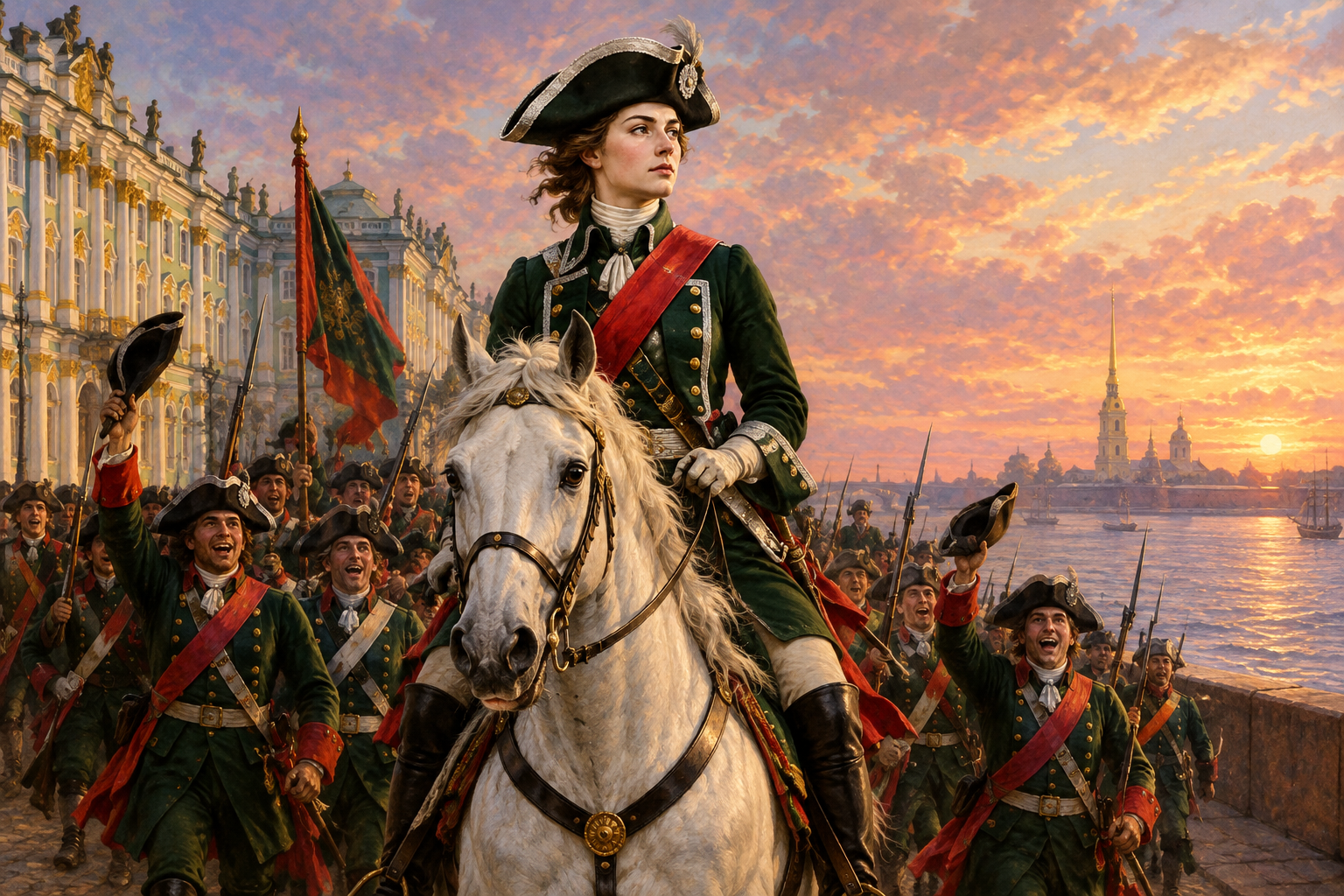
On 9 July 1762 (28 June in the Russian calendar) Catherine acted. With the help of the guards officer Grigory Orlov and his brothers, she won over the guards regiments in St Petersburg. Alexei Orlov brought her from the palace at Peterhof to the barracks, the soldiers swore loyalty, and the Senate and the Holy Synod accepted her as empress. Peter III gave up the throne without a fight.
On 17 July, Peter died in custody at Ropsha. The official cause was illness, but historians generally believe he was killed by guards under Alexei Orlov. Catherine always denied ordering it, but his death made her position safe. She was crowned in Moscow in September.
Her claim to the throne was weak. She was a German with no Romanov blood, and her son Paul was the more legitimate heir. For her whole reign she had to keep the nobles and the guards satisfied. That need explains many of her policies.
An enlightened ruler on paper
Catherine wrote to Voltaire and Diderot and presented herself as a ruler guided by reason. When Diderot needed money in 1765 she bought his library and left it with him, paying him as its librarian. In 1767 she wrote the Nakaz, or Instruction, a long document drawing on Montesquieu and the Italian jurist Beccaria, which argued for law, order and milder punishments. She called a Legislative Commission with delegates from several social groups to Moscow. When war with the Ottoman Empire began in 1768 the commission faded away, and Russia never got its new law code.
Several practical reforms did take effect:
- 1764: church and monastery lands were taken over by the state, easing the treasury.
- 1764: the Smolny Institute opened in St Petersburg as a school for noble girls.
- 1768: the English doctor Thomas Dimsdale inoculated Catherine against smallpox, and she let the public know, to encourage others.
- 1775: a provincial reform split the empire into smaller provinces with more officials and a role for local nobles.
- 1785: the Charter to the Nobility confirmed that nobles need not serve the state, protected their property and rank, and gave them local assemblies. A charter for towns followed the same year.
Historians call this style enlightened absolutism: ideas of reason and law used to run a state, while the ruler's own power stays unlimited. Frederick II of Prussia and Joseph II of Austria are the other textbook examples.
War, Crimea and Poland
Catherine's most lasting results came from war and diplomacy. Her first goal was access to the Black Sea.
In the Russo-Turkish War of 1768–1774, Russian armies under Rumyantsev won on land. A fleet that sailed from the Baltic to the Mediterranean destroyed the Ottoman fleet at Chesme in 1770. The Treaty of Küçük Kaynarca (1774) gave Russia ports on the Black Sea coast, made the Crimean Khanate independent of the Ottomans, and gave Russia a recognised interest in the sultan's Orthodox subjects.
In 1783 Russia annexed Crimea. Her close partner Grigory Potemkin governed the new southern lands, founded the naval base of Sevastopol and built up the Black Sea Fleet. A second war (1787–1792) ended with the Treaty of Jassy, which confirmed Russia's hold on Crimea and moved the border to the Dniester river. The grasslands north of the Black Sea were settled and called New Russia.
In the west she turned to Poland. In 1764 she placed her former lover Stanisław Poniatowski on the Polish throne, and from then on Russia held great influence there. Russia, Prussia and Austria divided Polish land in three partitions, in 1772, 1793 and 1795 (the second involved only Russia and Prussia). In 1795 Poland vanished from the map. Russia took most of Lithuania, Belarus and western Ukraine.
In 1780 she also backed the League of Armed Neutrality, a group of neutral states that defended their ships against British searches during the American Revolutionary War.
She even touched Japan. The castaway Daikokuya Kodayu met her in 1791 and was allowed to go home, and in 1792 Adam Laxman brought him and others to Nemuro in Hokkaido, asking Japan for trade.
Pugachev and the weight of serfdom
The greatest danger at home came in 1773. Yemelyan Pugachev, a Don Cossack, claimed to be the dead Peter III and raised the Yaik Cossacks in the Urals. Serfs, factory workers and peoples such as the Bashkirs joined him. The revolt spread across the Volga region, and in 1774 his forces burned part of Kazan. The army defeated him, his own followers handed him over, and he was executed in Moscow in January 1775.
The shock pushed Catherine closer to the nobility, who now ran local government under the reforms of 1775 and 1785. She did not move toward ending serfdom. She gave state land and peasants to favourites and officials, and in 1783 she tied peasants to the land in left-bank Ukraine. In 1790 the writer Alexander Radishchev published a book attacking serfdom. Catherine had him sentenced to death, then reduced the sentence to exile in Siberia. This gap between fine words and harsh practice is the main reason historians argue about her.
Court, art and favourites
Catherine was a serious collector. In 1764 she bought a collection of paintings from the Berlin merchant Johann Gotzkowsky, and it became the start of the Hermitage Museum. In 1782 the statue of Peter the Great known as the Bronze Horseman, by the French sculptor Falconet, was unveiled in St Petersburg. Its base reads, in Latin and Russian, that it was set up by Catherine II to Peter I. She also wrote plays, memoirs and stories for children.
Her private life was always gossip. Men such as Grigory Orlov, Grigory Potemkin and, near the end, Platon Zubov held the position of favourite, and several of them had real political power. Rumours and hostile pamphlets later produced tales that have no evidence behind them, including the famous story about a horse.
Death and legacy
Catherine suffered a stroke and died on 17 November 1796, aged 67. Her son Paul I, who disliked his mother's policies, took the throne and in 1797 changed the succession law so that the crown passed through the male line.
The empire she left was larger, richer and more respected in Europe than the one she took over. The name “the Great” was never an official title. Some people remember her as the ruler who made Russia a great power. Others remember a monarch who ruled through the nobility and made life harder for the serfs. Both views have facts behind them.
What exams ask
- Enlightened absolutism: explain how she used Enlightenment ideas while keeping unlimited power. Compare her with Frederick II and Joseph II.
- Cause and effect: the Pugachev revolt (1773–1775) led to stronger noble control of the provinces and no relief for serfs.
- Expansion: the Treaty of Küçük Kaynarca (1774), the annexation of Crimea (1783) and the Treaty of Jassy (1792) show Russia's drive for warm-water ports on the Black Sea.
- Poland: know the three partitions of 1772, 1793 and 1795, and that Poland disappeared as a state in 1795.
- Japan link: Adam Laxman's visit to Nemuro in 1792.
Read next
- Peter the Great: the ruler who built St Petersburg and whose reforms Catherine claimed to continue.
- Serfdom in Russia: how the system worked and why her reign deepened it.
- The Russian Revolution of 1917: how the problems she left unsolved came back more than a century later.
- The Russian Empire (1721–1917): the full story of the state she ruled.