In five minutes
George Washington (1732–1799) was the commander of the Continental Army in the American Revolutionary War and the first president of the United States. He is remembered as much for what he did with power as for how he won it. He led a poorly paid, often hungry army to victory over Britain, then handed his command back to Congress in 1783. As president from 1789 to 1797, he shaped the office for everyone who followed, and then he stepped down after two terms.
That is the short answer to “what did George Washington do?” He held the revolution together in the field, lent his reputation to the new Constitution, and set habits of civilian rule that the young republic needed. He did not write the Declaration of Independence (Thomas Jefferson drafted it), and he was not a brilliant tactician. His strengths were patience, judgment and a stubborn sense of duty. This page belongs to our hub on the American Revolution. It also covers a hard fact: Washington enslaved people for most of his life.
Early life: surveyor, soldier, planter
Washington was born on 22 February 1732 into a Virginia planter family (11 February 1731 in the calendar then used in British lands). His father, Augustine, died when George was eleven, and he never had a formal higher education. As a teenager he trained as a surveyor, and in 1748 he joined a trip to survey land in the Shenandoah Valley. The work taught him how to read terrain and how to travel through rough country.
In 1753 Virginia’s governor sent him with a warning to French forces in the Ohio country. In 1754 he led Virginia militia in a skirmish at Jumonville Glen and then surrendered at Fort Necessity on 3 July. These clashes helped start the French and Indian War, the North American part of the Seven Years’ War. In 1755 he survived General Braddock’s disastrous defeat near the Monongahela River, and he later commanded the Virginia Regiment. The war taught him how badly supplied armies fail, a lesson he would need again.
In 1759 he married Martha Dandridge Custis, a wealthy widow, and settled into life as a planter at Mount Vernon, which he took over in 1761. He sat in Virginia’s House of Burgesses and, like many colonists, grew angry at British taxes and rules passed without colonial votes. In 1774 Virginia sent him to the First Continental Congress.
Commander of the Continental Army
In June 1775, after fighting had begun at Lexington and Concord, the Second Continental Congress named Washington commander in chief. Choosing a Virginian also helped bind the southern colonies to a war that had started in New England. He took command outside Boston in early July 1775. In March 1776 cannons dragged from Fort Ticonderoga by Henry Knox were set up on Dorchester Heights, and the British left Boston.
Defeat and survival, 1776
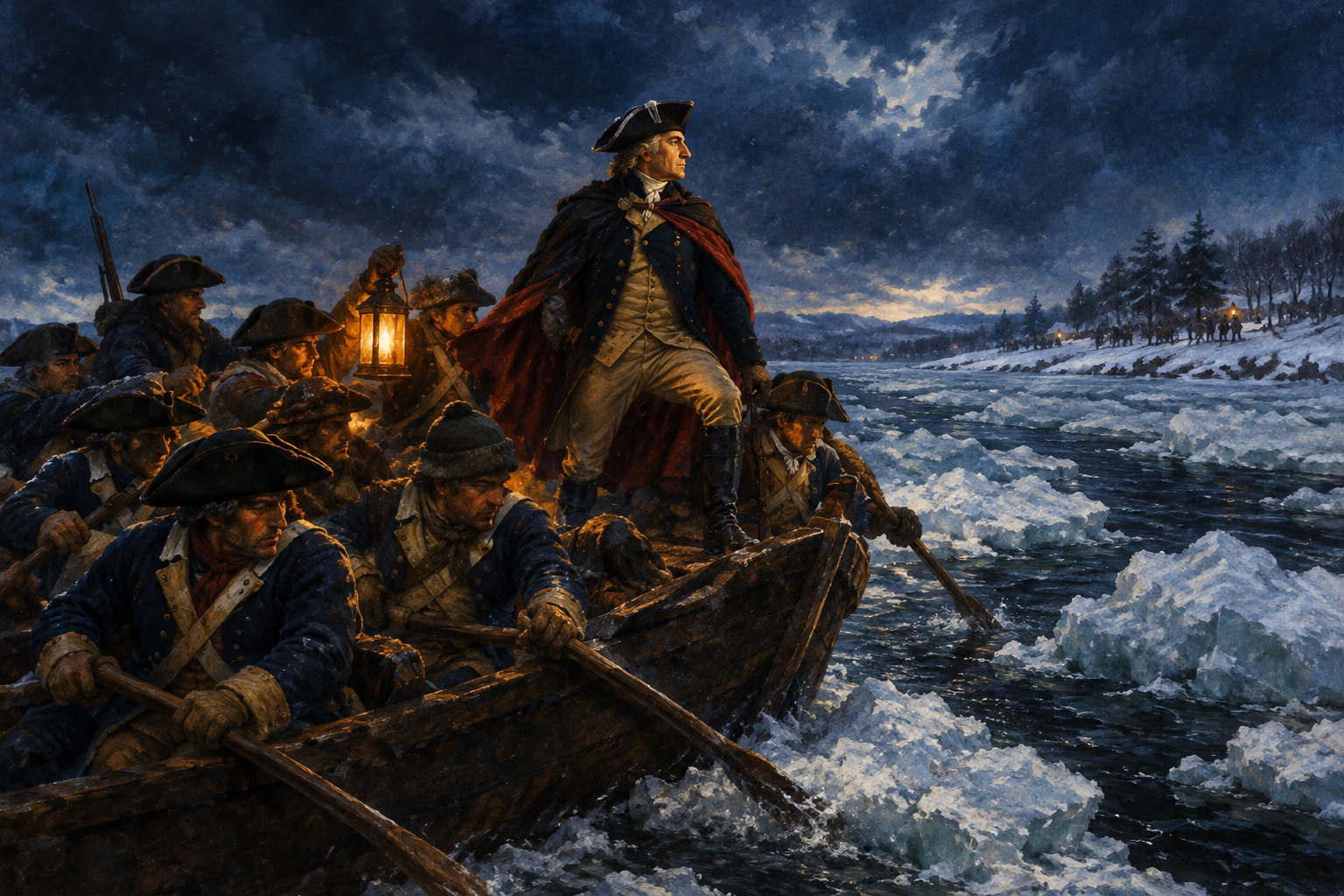
The summer brought disaster. The British landed a huge force at New York, and Washington lost the Battle of Long Island in August. He saved his army by ferrying it across the East River at night. By winter, enlistments were ending and the army was shrinking. On the night after Christmas 1776 he crossed the icy Delaware River and surprised a Hessian garrison at Trenton on 26 December. A week later, at Princeton on 3 January 1777, he won again. These were small battles, but they proved the rebellion was still alive.
Valley Forge and the French alliance
In the winter of 1777–78 the army camped at Valley Forge, Pennsylvania, with shortages of food, clothing and shoes. Many men fell ill. Under Baron von Steuben, a Prussian-born officer, the troops were drilled into a more disciplined force. In February 1778 France signed an alliance with the United States, after the American victory at Saratoga, and the war became a wider contest between Britain and France.
Yorktown and letting go
In 1781 Washington and the French commander Rochambeau marched an army from the north to Virginia. With the French fleet of Admiral de Grasse blocking the sea, they trapped General Cornwallis at Yorktown, and he surrendered on 19 October 1781. The Treaty of Paris of 3 September 1783 recognised American independence.
Then came the moment many historians consider his greatest. Some officers, angry about unpaid wages, had talked of using the army to pressure Congress. In March 1783 Washington calmed them at Newburgh, New York. On 23 December 1783, at Annapolis, he resigned his commission and went home to Mount Vernon. Giving up military power by choice was rare for a victorious general, and it set a pattern of civilian control of the military.
Making a government: the Constitution and the presidency
The Articles of Confederation left the national government weak. In 1787 Washington came out of retirement to preside over the Constitutional Convention in Philadelphia. He rarely spoke in debate, but his presence gave the meeting credibility, and many Americans trusted the new office of president partly because they expected him to hold it.
In early 1789 the electors chose him unanimously, and he took the oath in New York on 30 April 1789. He built the executive branch from almost nothing. His first cabinet included Thomas Jefferson as secretary of state, Alexander Hamilton at the Treasury and Henry Knox at War, and their disputes over a national bank, debt and foreign policy helped form the first political parties. He insisted on the simple title “Mr. President”.
Two tests mattered. In 1793, as Britain and France went to war, he proclaimed American neutrality. In 1794 he led federal forces toward western Pennsylvania during the Whiskey Rebellion, showing that the new government could enforce its tax laws. The Jay Treaty with Britain, which settled disputes without war, was bitterly debated.
Slavery at Mount Vernon
Washington inherited enslaved people as a young man and bought more later. When he died, 317 enslaved people lived at Mount Vernon, about 123 of whom he owned. He privately came to oppose selling enslaved families, and his will freed those he owned after Martha’s death, which was a rare step among large Virginia planters. Martha freed them in 1801. Yet he never publicly led a campaign against slavery, and in office he signed the Fugitive Slave Act of 1793. The leader of a revolution about liberty lived off the labour of people who had none, and that contradiction is part of his story.
Farewell and death
Washington declined a third term. His Farewell Address, published on 19 September 1796, warned against bitter party rivalry and against deep, permanent alliances with foreign powers. He left office in March 1797 and returned to Mount Vernon. He died there on 14 December 1799, aged 67, after a sudden throat infection. Two myths are worth dropping: he never chopped down a cherry tree (that tale came from a biographer, Parson Weems), and his false teeth were not wooden.
What exams ask
In AP-style questions, Washington’s significance usually rests on four points. He gave the Continental Army unity and survived its defeats. He accepted civilian authority by resigning in 1783. He presided over the Constitutional Convention. As the first president he set precedents: a cabinet, a two-term tradition, and neutrality in European wars. Be ready to explain the Farewell Address and to separate him from the Declaration of Independence, which Jefferson wrote and Congress adopted on 4 July 1776. Washington had it read to his troops in New York on 9 July.
Read next
Continue with Thomas Jefferson: Author of the Declaration, who served in Washington’s cabinet and clashed with Hamilton. For the document that gave the war its purpose, see The Declaration of Independence Explained. To compare it with its French cousin, read Declaration of Independence vs the Declaration of the Rights of Man. The whole story is at The American Revolution: Causes, War and Independence.