In five minutes: who was Toussaint Louverture?
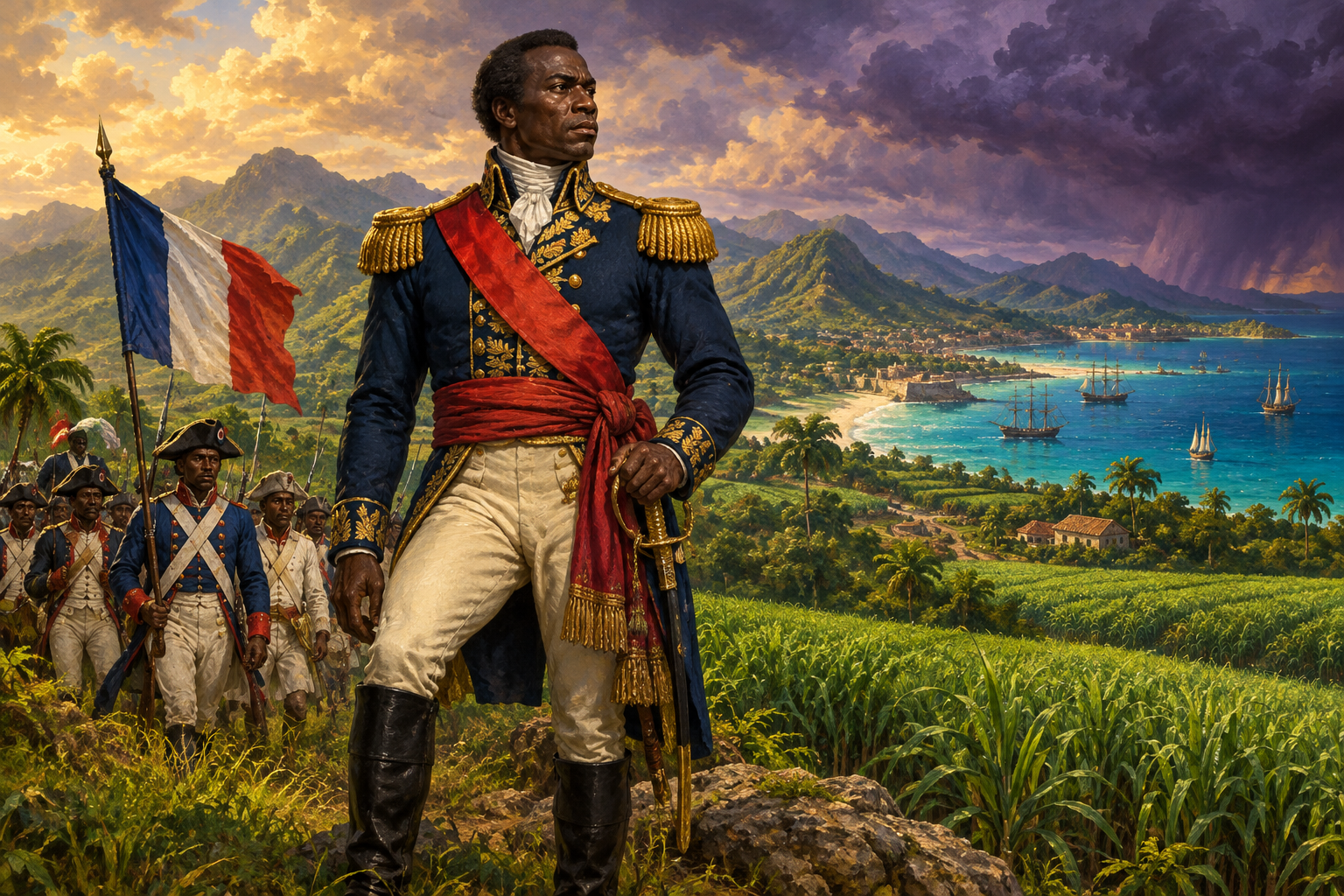
Toussaint Louverture was born into slavery in the French colony of Saint-Domingue, today's Haiti, and rose to become its most powerful leader. He is the central figure of the Haitian Revolution (1791–1804), the only slave uprising in history that produced a lasting independent state. He did not live to see that state. He died in a French prison in April 1803, nine months before Haiti declared independence.
His story is the opening chapter of the Latin American Independence (1791–1826) hub. Haiti's revolution came first, and rulers across the Atlantic world watched it with fear or hope.
The short version: Toussaint joined the 1791 slave uprising, became a skilled general and politician, played Spain, Britain and France against one another, and built a nearly self-governing Black-led colony. Napoleon decided to take it back. Toussaint was tricked, arrested and deported, and his generals finished the war without him.
Early life: from the Bréda plantation to freedom
Toussaint was probably born around 1743 on the Bréda plantation near Cap-Français, the colony's main northern port. The exact year is uncertain. He was known at first as Toussaint Bréda, after the estate. He learned to read and gained skills with animals and herbal medicine, and he rose to a trusted position among the plantation's workers. He was freed by the 1770s, long before the revolution, and later he managed land of his own.
The world he lived in was brutal. Saint-Domingue was the richest colony in the Caribbean, producing a huge share of the world's sugar and coffee. Around 1789 roughly half a million enslaved people worked there, far outnumbering the white colonists and the free people of colour. Many of the enslaved had been born in Africa, and a high death rate meant the colony kept importing more. That imbalance made the colony tense even before news of the French Revolution arrived.
1791: the uprising begins
When the French Revolution declared the "rights of man" in 1789, colonists, free people of colour and the enslaved all read the words in different ways. White planters wanted self-rule. Free men of colour demanded equal rights. In late August 1791, enslaved workers in the northern plain rose up, burning plantations and fighting colonial militias. Within weeks the revolt was too large to crush.
Toussaint did not start the uprising, but he joined it within its first months. He first served as a doctor and adviser to rebel leaders, and then as a commander. His strength was organisation. He turned scattered bands into a disciplined army, with officers, supplies and drill, and he won loyalty by refusing to throw away his men's lives.
Choosing sides, 1793–1798
The revolution on the island soon became part of a European war. France declared war on Britain and Spain in 1793, and Spain held the eastern half of the island. Toussaint and other rebel leaders took commissions from the Spanish, who offered arms and recognition. Around this time he began calling himself Louverture, a name usually understood as "the opening".
Then the situation changed. French commissioners in the colony, desperate for soldiers, proclaimed freedom for the enslaved in the north in 1793. In February 1794 the National Convention in Paris abolished slavery in all French territories. In spring 1794 Toussaint switched to the French side. Spain had not promised to end slavery; France now had. The move paid off for him and for the people who followed him.
Over the next four years he drove the Spanish back and fought the British, who had invaded in hopes of seizing the colony and keeping slavery. Yellow fever wore down the British troops as much as battle did. By 1798 Britain agreed to withdraw. Toussaint was now the commander of the colony's army and the real power on the island.
Governing Saint-Domingue, 1798–1801
Toussaint did not rule from a distance. He rebuilt a shattered economy, insisting that freed people return to the plantations as paid workers, with a share of the crop. Many resented this. They had fought to leave plantation labour, and the new rules felt like a harsh half-freedom. Toussaint believed that without sugar and coffee exports the colony would collapse and that France would have a reason to return. Historians still debate how far these rules were necessary.
He also fought a civil war. André Rigaud, a general of mixed race who controlled the south, disputed his authority in the War of the Knives (1799–1800). Toussaint won, with Jean-Jacques Dessalines as one of his harshest commanders, and the fighting was bloody on both sides. In early 1801 he occupied Spanish Santo Domingo, the eastern part of the island, and ended slavery there too.
In July 1801 a constitution written under his direction named him governor for life, with the right to choose his successor. It declared slavery abolished forever and said every person in the colony, whatever their colour, could hold any job. It still described Saint-Domingue as a French colony. But a colony that wrote its own constitution and chose its own ruler looked very much like a state. Napoleon Bonaparte, who had taken power in France in 1799, read it as defiance.
Napoleon's expedition and the arrest
Napoleon wanted the colony's wealth back, and his government was moving to restore control and, in places, slavery. In 1802 it kept or restored slavery in colonies such as Martinique and Guadeloupe. That year he sent his brother-in-law, General Charles Leclerc, to Saint-Domingue with more than 20,000 soldiers, and tens of thousands more followed. Leclerc claimed that he came to protect freedom. Toussaint's officers suspected the truth.
The war that began in early 1802 was savage. Toussaint's generals, including Dessalines and Henri Christophe, burned towns as they retreated, and French troops answered with massacres. But yellow fever, which swept through the newly arrived army, helped the defenders more than any battle. After several months, with Christophe and others already making terms, Toussaint agreed to end the fighting in May 1802 and retired to one of his estates.
It did not protect him. On 7 June 1802 French officers invited him to a meeting, then seized him. He was put on a ship with part of his family and sent to France. In July he reached Brest, was separated from his family and was taken to the Fort de Joux, a cold mountain prison in the Jura near the Swiss border.
Death at Fort de Joux and legacy
Toussaint spent the winter of 1802–1803 in a cell with little heat or light. He wrote letters and memoirs defending his conduct, and none of his appeals to Napoleon had any effect. He died on 7 April 1803, probably from pneumonia and the effects of cold and poor treatment. He was about 60.
Back in Saint-Domingue the war was already turning. Leclerc died of yellow fever in November 1802, and the news that France was restoring slavery elsewhere convinced former rivals to unite. Dessalines took command of the army, defeated the French at the Battle of Vertières in November 1803, and on 1 January 1804 declared the independent state of Haiti. His own story continues in our page on Jean-Jacques Dessalines.
Toussaint's legacy is still argued over. To many he is the great symbol of Black freedom and a model for later anti-colonial movements; the poet William Wordsworth even wrote a sonnet to him in 1802. Others point to his forced-labour policies and his harshness toward rivals. Both things are part of the record. What is not in doubt is the scale of what he did: he led the largest successful slave revolt in modern history.
What exams ask
In AP World History and AP European History, Toussaint appears as the example of how the French Revolution's ideals spread to the colonies, and how enslaved people claimed those ideals for themselves. Be ready to explain:
- Causes: the colony's slave-based economy, racial hierarchy, and the 1789 French Revolution.
- Turning points: the 1791 uprising, the 1794 abolition of slavery, the 1801 constitution, and Napoleon's 1802 expedition.
- Outcome: Haiti became independent in 1804, the first Black-led republic in the Americas.
- Significance: it frightened slaveholders in the Americas and shaped debates on abolition, empire and race.
Read next
- Jean-Jacques Dessalines: the general who finished the war and declared Haiti independent in 1804.
- Effects of the Haitian Revolution: how it changed slavery, the Louisiana Purchase and the politics of empire.
- Mexican Independence Day (16 September): a later independence movement in Spanish America, from 1810.