In five minutes
Nationalism is the belief that a nation, a group of people who feel they belong together, should rule itself, and that loyalty to the nation comes first. The feeling usually rests on a shared language, history, religion or citizenship. Nationalism became a major political force after the French Revolution of 1789, and it has been building and breaking states ever since.
In the nineteenth century it helped create Greece, Italy and Germany as nation-states, and it shook multi-ethnic empires such as Austria-Hungary and the Ottoman Empire. In the twentieth century it drove the collapse of those empires and the end of European colonial rule in Asia and Africa. It also fed wars and persecution. This page belongs to our guide to the ideas that shaped the 19th century, which sets nationalism beside liberalism, socialism and Darwin's theory of evolution.
What nationalism means
Three words are easy to mix up. A nation is a community of people who see themselves as one people. A state is the machinery of rule: a government, laws, an army and borders. A nation-state is a state that claims to speak for one nation. Nationalism is the idea that the first two should line up: each nation deserves its own state, and each state should express its nation.
Nationalism is often compared with patriotism. Patriotism is usually described as affection for your country and the people in it. Nationalism is more of a political programme: it says who belongs to the nation, what the nation is owed, and how the state should act for it. Scholars admit that the line between the two is blurry, and in everyday speech people use the words in different ways.
Nationalism also comes in different forms. Civic nationalism defines the nation by shared citizenship, laws and institutions. Ethnic nationalism defines it by descent, language or inherited culture. Real movements often mix the two. We compare them in Civic vs Ethnic Nationalism.
Where it began: the French Revolution
For most of history, people owed loyalty to a king, a church, a local lord or a city, not to an abstract nation. The French Revolution changed that. The Declaration of the Rights of Man and of the Citizen (1789) stated that sovereignty rests essentially in the nation. Power no longer came from the king by right of birth; it came from the people as a whole.
War made the idea real. In 1792 French volunteers and soldiers faced the armies of Prussia and Austria at Valmy and are remembered for shouting “Vive la nation!” In 1793 the government decreed a levée en masse, which called on the whole population to serve the war effort. Ordinary men were now fighting for a nation they were told was theirs. Napoleon later carried French laws and armies across Europe, and the occupied peoples learned two lessons: that a nation could be a powerful political unit, and that foreign rule was an insult to it.
Language and culture: Herder and Fichte
Another strand came from German thinkers. Johann Gottfried Herder (1744–1803) argued that each people has its own language and way of seeing the world, and that these cultural differences deserve respect. Herder was a cultural thinker rather than a plotter of states, but his emphasis on language became a building block for later movements.
After Prussia's defeat by Napoleon at Jena in 1806, the philosopher Johann Gottlieb Fichte gave his Addresses to the German Nation in Berlin in 1807–08. He urged Germans to renew themselves through education and a shared national spirit. The speeches were later read as a founding text of German nationalism, although Germany did not yet exist as a single state: it was a patchwork of dozens of kingdoms, duchies and free cities.
Making nation-states: Greece, Italy and Germany
The first great success came on the edge of Europe. In 1821 Greeks rose against Ottoman rule. After a long war and the intervention of Britain, France and Russia, Greek independence was recognised in 1830. Many Europeans supported the cause, partly because they saw ancient Greece as the root of their own culture.
Italy was divided into several states, some ruled or influenced by Austria. Giuseppe Mazzini founded the secret society Young Italy in 1831 to promote a united republic. In the end unification came through the kingdom of Piedmont-Sardinia under the statesman Cavour and the volunteers of Giuseppe Garibaldi. The Kingdom of Italy was proclaimed in 1861, and Rome joined it in 1870–71.
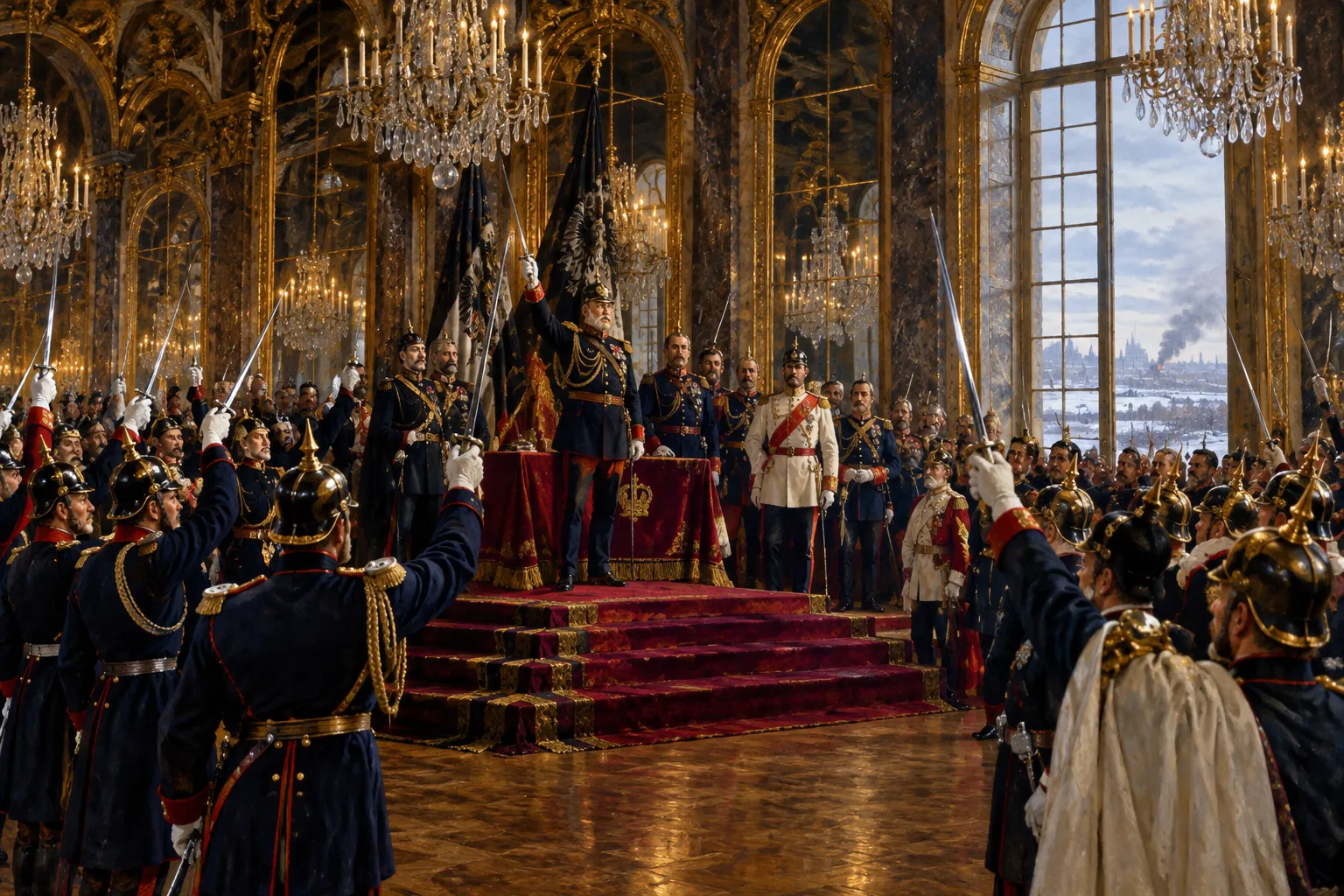
Germany was united from above. A customs union, the Zollverein (1834), tied many German states together economically. Then Prussia under Otto von Bismarck won wars against Denmark (1864), Austria (1866) and France (1870–71). The German Empire was proclaimed on 18 January 1871 at Versailles. Italy and Germany show that nation-states were made as much by diplomacy and war as by feeling.
1848: the Springtime of Peoples
In 1848 revolutions broke out across Europe, and historians call this the “Springtime of Peoples”. In German lands, an elected assembly met in Frankfurt to draft a constitution for a united Germany, but it failed to secure the support of the larger powers. In the Habsburg lands, Hungarians under Lajos Kossuth demanded self-rule. The revolution was crushed in 1849 with Russian help.
The Habsburg monarchy shows why nationalism was dangerous for empires. It ruled Germans, Hungarians, Czechs, Poles, Croats, Italians and many others. If every nation demanded its own state, there would be nothing left of the empire. The same problem faced the Ottoman Empire in the Balkans and the Russian Empire in its western borderlands.
Twentieth century: self-determination and decolonisation
The pressure built until the First World War. The war began in 1914 in Sarajevo, with the assassination of the Austrian heir by a young Bosnian Serb nationalist, and rivalries among the powers and the fear of rising nationalist movements both played a part. In 1918 US President Woodrow Wilson made national self-determination a leading principle of the peace. Austria-Hungary broke apart in the autumn of 1918, and new or restored states such as Czechoslovakia, Poland and the Kingdom of Serbs, Croats and Slovenes (later Yugoslavia) appeared.
The same idea turned against European empires overseas. After 1945 nationalist movements in Asia and Africa demanded independence in the name of their own peoples. Indonesia declared independence on 17 August 1945, and Vietnam on 2 September 1945. India and Pakistan became independent in 1947, and Ghana in 1957. In many of these cases, nationalism meant uniting people of many languages and religions against a colonial ruler, and the new borders often followed the colonial map.
Is nationalism good or bad?
History does not give a one-word answer. Nationalism has given people a sense of belonging, a reason to build schools, roads and welfare systems for strangers, and a language for resisting foreign rule. It has also been used to justify expelling or killing minorities, as in racial nationalism under Nazi Germany and in the wars that followed the breakup of Yugoslavia in the 1990s.
Karl Marx expected class to matter more than nation, and the Communist Manifesto (1848) ended with a call for workers of all countries to unite. Later history showed how strong national loyalty could be. You can read more in Who Was Karl Marx?. Many historians therefore treat nationalism less as a single doctrine and more as a force whose effects depend on who defines the nation and how.
How historians explain it
Scholars disagree about whether nations are ancient or modern, but the most influential accounts of the 1980s stress that they are modern. Ernest Gellner, in Nations and Nationalism (1983), argued that industrial societies need a shared language and schooling, and that nationalism grows from this need. Benedict Anderson, in Imagined Communities (1983), described a nation as an imagined political community: you will never meet most of your fellow citizens, yet you feel connected to them, helped by print, newspapers and novels in a common language. Earlier, in 1882, the French thinker Ernest Renan described a nation as a “daily plebiscite”, a community that continues because its members choose to keep it going.
None of this means nations are fake. “Imagined” means that they are made by shared stories, laws and institutions, and that people live and die by them.
What exams ask
- Definition: be able to explain nationalism, nation and nation-state in your own words, and separate nationalism from patriotism.
- Origins: link the French Revolution (1789), the levée en masse (1793) and Napoleonic occupation to the rise of national feeling.
- Case studies: compare Italian unification (1861) with German unification (1871), including the roles of Cavour, Garibaldi and Bismarck.
- Empires: explain why nationalism threatened multi-ethnic empires, using the Habsburg monarchy and the revolutions of 1848.
- Twentieth century: connect self-determination in 1918 with decolonisation after 1945.
- Evaluation: give one way nationalism unified and one way it divided or harmed, with an example for each.
Read next
- Ideas That Shaped the 19th Century: the hub for this topic, placing nationalism beside liberalism, socialism and Darwin.
- Civic vs Ethnic Nationalism: how a nation can be defined by citizenship or by descent, and why that matters.
- Who Was Karl Marx?: the thinker who bet on class over nation.
- Malthus and the Population Debate: another idea from the same age of big theories.