In five minutes
Giuseppe Garibaldi was a sailor turned guerrilla commander who became the best-known fighter of Italian unification. His most famous act came in 1860, when about a thousand volunteers in red shirts landed in Sicily and, within months, brought down the Kingdom of the Two Sicilies, which covered the whole southern half of the peninsula.
At the time, Italy was not one country. It was a patchwork: the Kingdom of Sardinia (also called Piedmont-Sardinia) in the northwest, Austrian-ruled lands in the northeast, the Papal States around Rome, and the Bourbon-ruled Two Sicilies in the south. Garibaldi helped erase those borders on the battlefield. Yet he never made himself king. He gave what he had won to Victor Emmanuel II of Sardinia and went home to a farm on the island of Caprera.
Historians often set him beside Count Cavour. Cavour was the diplomat who united Italy through alliances and politics; Garibaldi was the volunteer general who did it through popular enthusiasm and surprise attacks. They distrusted each other, but Italy needed both. This page is part of the hub 19th-Century Europe: Revolutions, Nationalism and Unification.
From Nice to South America
Garibaldi was born on 4 July 1807 in Nice, which was then under French rule and later returned to the Kingdom of Sardinia. He came from a family of coastal sailors and went to sea young.
Around 1833 he joined Young Italy, the secret society of Giuseppe Mazzini, who argued that Italy should be a single republic. After a failed uprising in 1834, Garibaldi was sentenced to death in his absence and fled in 1835 to South America.
He spent more than a decade there. He fought in the war of the breakaway Rio Grande do Sul in Brazil, and later led an Italian Legion in Montevideo, Uruguay. The legion wore red shirts, and the colour stuck to his followers for life. In Brazil he met Anita, who rode and fought beside him. The war taught him how a small, fast, motivated force could beat a larger and slower one, and how to win local people over.
Rome, 1849
When revolutions broke out across Europe in 1848, Garibaldi returned to Italy. He fought Austria in the north, but the Sardinian army was beaten and the war ended for the time being.
In 1849 the Pope fled Rome and a Roman Republic was declared under Mazzini and others. Garibaldi commanded its defenders against a French expedition sent by Louis-Napoléon, who wanted Catholic support at home. The republic held out for weeks but surrendered in July 1849.
Garibaldi led thousands of men out of Rome, with armies chasing them. During the retreat, Anita died of illness. He went into exile again, worked as a ship captain, returned in 1854, and by 1856 was farming on Caprera. The lesson he drew was practical: ideals alone could not unite Italy. It would also need a state with a real army.
The Expedition of the Thousand, 1860
In 1859 Sardinia, with French help, fought Austria in the Second Italian War of Independence and gained Lombardy. Garibaldi led volunteers called the Hunters of the Alps and won several small victories. Then, in March 1860, Sardinia gave Savoy and Nice to France as payment for French support. Garibaldi, a native of Nice, was furious.
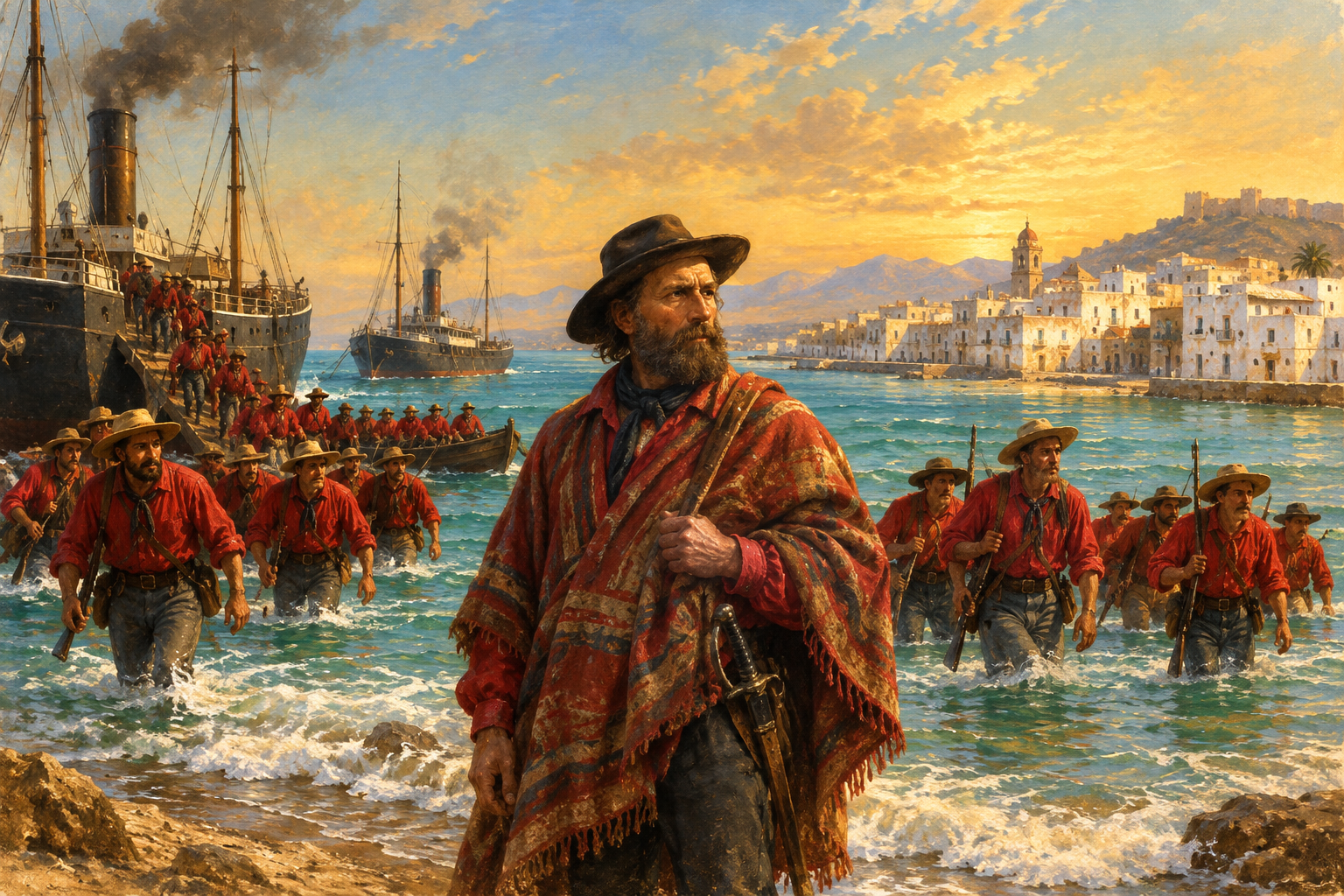
That spring a revolt against the Bourbon king broke out in Sicily. On 5–6 May 1860, Garibaldi sailed from Quarto near Genoa on two steamers, the Piemonte and the Lombardo, with just over a thousand volunteers: students, craftsmen, lawyers, doctors. The government of Sardinia did not stop him, though it did not openly back him either.
On 11 May the force landed at Marsala. On 15 May, at Calatafimi, it defeated a larger Bourbon force, and Sicilians began to join in. Garibaldi declared himself dictator of Sicily in the name of Victor Emmanuel II. He attacked Palermo in late May; after several days of street fighting an armistice was agreed in early June, and the Bourbon troops left the city. A victory at Milazzo in July secured most of the island.
On 19 August Garibaldi crossed to the mainland. Bourbon resistance crumbled, and on 7 September he entered Naples by train, after King Francis II had withdrawn to the fortress of Gaeta. On 1 October he beat a Bourbon counterattack at the Volturno River. Meanwhile, the regular Sardinian army had marched south through the Papal States.
Handing over the south, then more campaigns
On 26 October 1860, near Teano, Garibaldi met Victor Emmanuel II and passed the conquered south to him. Plebiscites in the south voted overwhelmingly for union. On 17 March 1861 the Kingdom of Italy was proclaimed. Garibaldi accepted almost none of the honours offered and returned to Caprera.
He was not finished, because Rome and Venice were still outside Italy. In 1862 he marched toward Rome but was stopped at Aspromonte, where Italian royal troops shot him in the foot. In the 1866 war against Austria he fought in the Trentino; when ordered to halt after an armistice, he answered with one telegram word, "Obbedisco" ("I obey"). In 1867 he tried Rome again and was beaten at Mentana by French and papal forces.
His last campaign was for France. In 1870, as France lost the war with Prussia, he led a volunteer Army of the Vosges. Ironically it was the same state that had defeated him three years earlier. On 20 September 1870 Italian troops entered Rome once French soldiers had left, completing unification. Garibaldi sat in parliament in later years and died on Caprera on 2 June 1882, aged 74.
Why he matters
Garibaldi showed that a nation could be created from below, by volunteers and popular support, not only by kings and ministers. He also became an international symbol of liberal nationalism, admired well beyond Italy.
The story has a less comfortable side. Garibaldi was a republican at heart who handed power to a monarchy, and many in the south later felt that unification was imposed from Piedmont, leading to unrest and long-standing regional resentment. Compare him with Cavour, the careful statesman, and with Bismarck, who made the German Empire through army and diplomacy, not volunteers.
What exams ask
- Order of events: Young Italy (1831) → 1848 revolutions → Second War of Independence (1859) → Thousand (1860) → Kingdom of Italy (1861) → Venice (1866) → Rome (1870).
- Contrast: Cavour (diplomacy, monarchy, Piedmont) versus Garibaldi (volunteers, popular nationalism) versus Mazzini (republican idealism).
- Significance: unification through both diplomacy and popular action; the north-south divide that remained; the Roman Question between Italy and the Papacy.
- Key terms: Red Shirts, Expedition of the Thousand, Teano, Risorgimento.
Read next
- Count Cavour: Architect of Italian Unity: the statesman who worked with and against Garibaldi.
- Otto von Bismarck: The Iron Chancellor: Germany's very different path to unification.
- The German Empire (1871–1918): what the other great unification built.