In five minutes: who was Karl Marx?
Karl Marx (1818–1883) was a German philosopher, journalist and economist. He argued that in a capitalist society the people who own factories and the people who work in them are locked in a struggle, and that this struggle pushes history forward. With his friend Friedrich Engels he wrote The Communist Manifesto in 1848. He then spent most of his life on Capital (Das Kapital), whose first volume appeared in 1867.
Marx never ran a country or led an army. His influence came through his writing. In the late nineteenth century it shaped labour unions and socialist parties across Europe. In the twentieth century, governments such as the Soviet Union claimed to follow him. How closely those states matched his own ideas is still debated.
This page follows his life, explains his main ideas in plain words and ends with what exams ask. Marx is one part of a bigger story told in Ideas That Shaped the 19th Century.
Early life and education
Marx was born on 5 May 1818 in Trier, a town in the Rhineland that belonged to the Kingdom of Prussia. The region had been ruled by France in Napoleon's time, so ideas about equality and legal rights were more familiar there than in much of Germany.
His father, Heinrich, was a lawyer from a Jewish family. Prussia limited what Jews could do in public life, so Heinrich became a Lutheran Protestant, and Karl was baptised at the age of six. As an adult Marx held no religious faith and wrote sharply about religion.
He began studying law at the University of Bonn in 1835 and moved to Berlin a year later. There he drifted toward philosophy and joined the Young Hegelians. They took the philosopher Hegel's idea that history moves forward through conflict and used it to criticise religion and politics. Marx earned a doctorate at the University of Jena in 1841 with a thesis on two ancient Greek thinkers, Democritus and Epicurus. A radical had little chance of a university post in Prussia, so he turned to journalism.
From journalist to exile
In 1842 Marx began writing for the Rheinische Zeitung, a newspaper in Cologne, and soon became its editor. He wrote about poor wine growers on the Moselle river and about laws that punished peasants for gathering fallen wood. The Prussian government banned the paper in 1843.
That June he married Jenny von Westphalen, a friend from his Trier childhood, and the couple moved to Paris. The city was full of socialists and craftsmen from across Europe. In August 1844 Marx met Friedrich Engels, the son of a German textile-manufacturing family who had seen factory life first-hand in Manchester. They became lifelong partners in work and friendship.
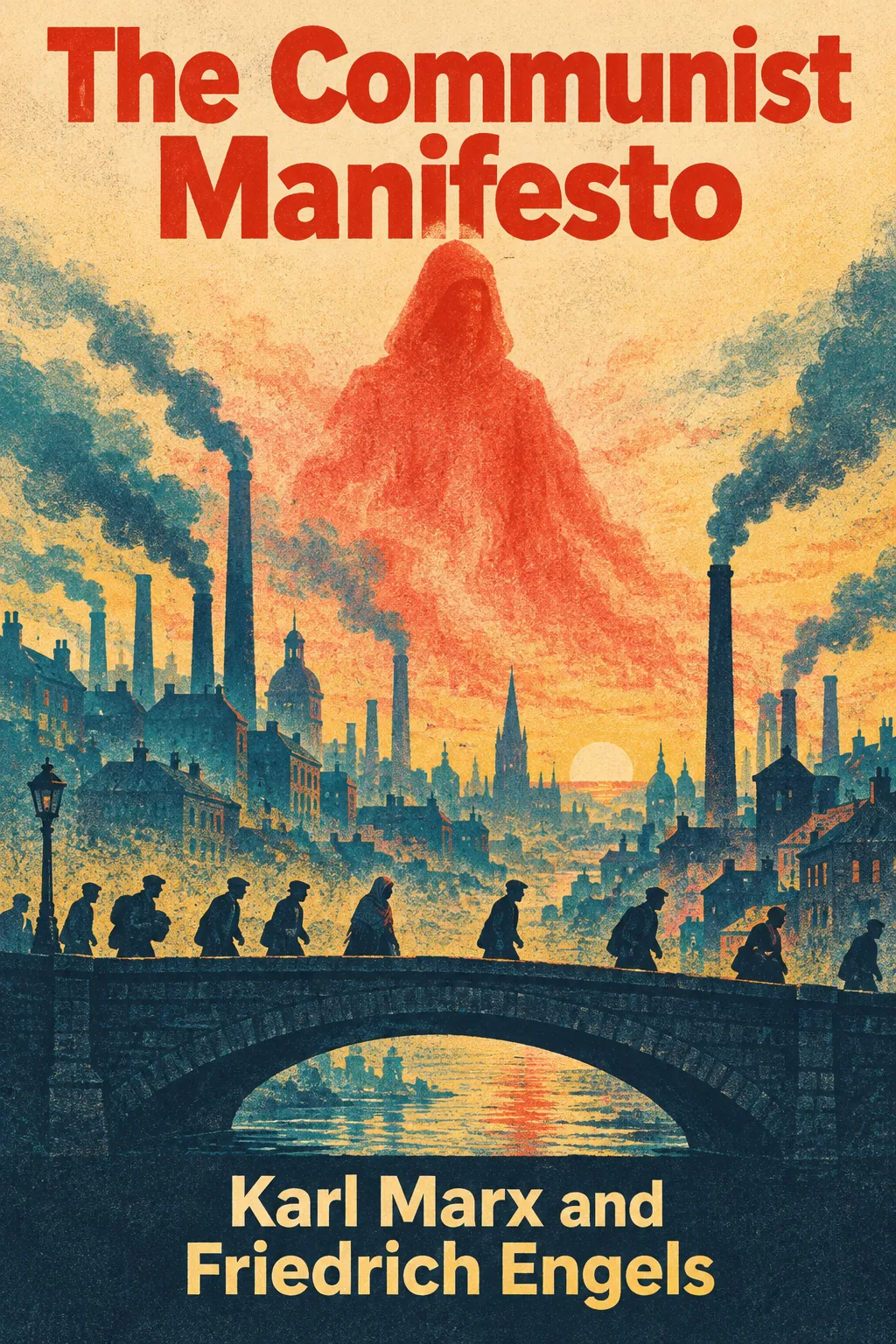
France expelled Marx in 1845, and he moved to Brussels. There he and Engels wrote The German Ideology, which was not published in his lifetime. He also joined the Communist League, which asked him and Engels to write its programme. The result, The Communist Manifesto, was published in London in February 1848. It is a short pamphlet that presents history as a story of class struggle.
Revolutions broke out across Europe soon afterwards. Marx returned to Cologne and ran a new paper, the Neue Rheinische Zeitung. When the revolutions failed he was expelled again, and in 1849 he settled in London, where he lived for the rest of his life.
The London years and Capital
Life in London was hard. The family lived in cramped rooms in Soho, and several of their children died young. They survived mainly on money from Engels, who worked in his family's business in Manchester, and on Marx's articles for the New-York Daily Tribune, which he wrote from the early 1850s to the early 1860s.
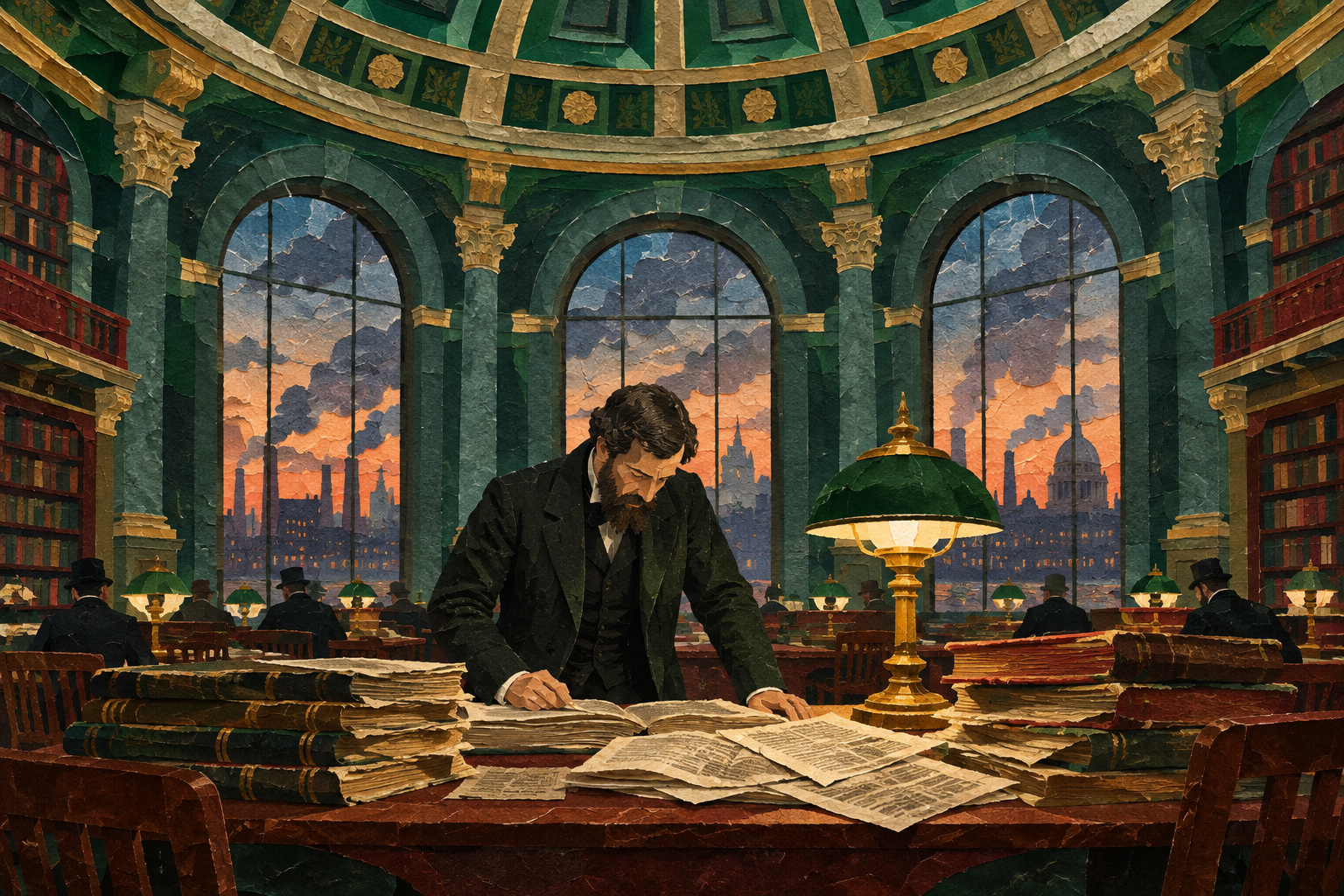
Marx spent long days in the British Museum Reading Room, studying economics books and government statistics. In 1859 he published A Contribution to the Critique of Political Economy, an early step toward Capital.
In 1864 workers' leaders founded the International Working Men's Association in London, later called the First International. Marx helped write its founding address and rules. It tried to unite workers across borders but split over disputes with anarchists such as Mikhail Bakunin, and it ended in 1876.
Capital, Volume 1, appeared in Hamburg in 1867. When the Paris Commune, a short-lived city government run by ordinary Parisians, was crushed in 1871, Marx defended it in The Civil War in France.
His wife Jenny died in December 1881 and their eldest daughter, also named Jenny, in January 1883. Marx himself died in London on 14 March 1883, aged 64, and was buried in Highgate Cemetery. Engels edited Marx's notes into Volume 2 (1885) and Volume 3 (1894) of Capital.
Marx's main ideas in plain words
Historical materialism. People must produce food and tools to live. Marx argued that the way a society produces them, by farming, in workshops or in factories, shapes its laws, politics and ideas. Economics comes first, and ideas follow.
Class struggle. Each era, such as ancient slavery, feudalism or capitalism, has a ruling class and a ruled class. Under capitalism these are the bourgeoisie, who own factories and machines, and the proletariat, who sell their labour for wages. Their interests clash, and Marx believed that clash drives change.
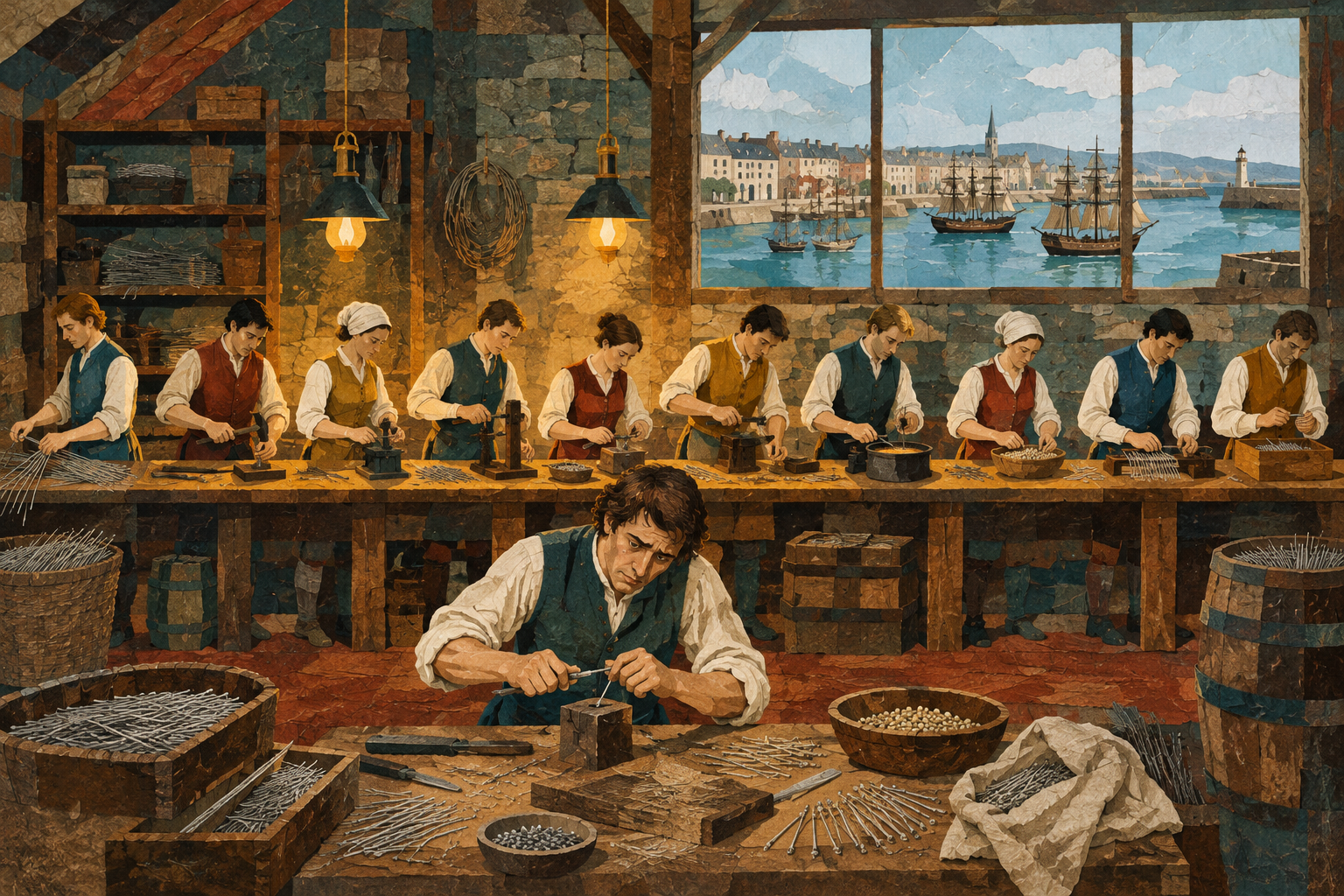
Surplus value. This is the core of Capital. A worker creates more value in a day than the wage they receive. The difference, which Marx called surplus value, is the source of the owner's profit.
Alienation. In his early writings Marx described workers as cut off from what they make, from the work itself and from other people. Repeating one motion on an assembly line is the classic picture.
Crisis and communism. Marx expected capitalism to suffer repeated economic crises and to concentrate wealth in fewer hands. He predicted that workers would eventually take over the means of production and create a communist society. He left very little detail on how such a society would run.
Marx and Engels called their approach “scientific socialism”, in contrast to the “utopian” plans of Robert Owen and Saint-Simon. The difference is explained in Utopian vs Scientific Socialism.
After Marx: legacy and criticism
After his death, socialist parties such as the German Social Democratic Party made his ideas the base of their programmes. The body of thought that grew from his work is covered in Marxism Explained.
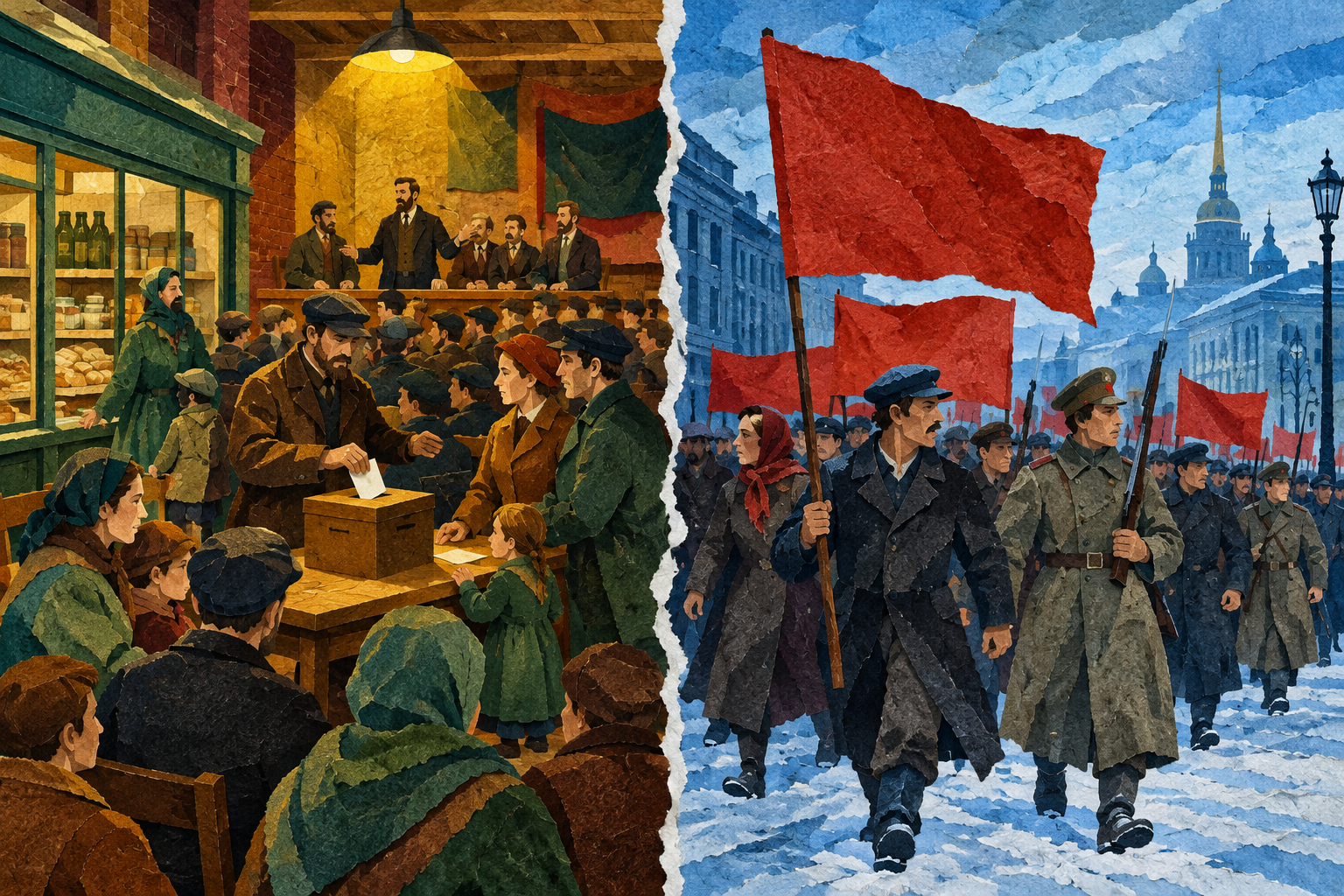
In 1917 Lenin and the Bolsheviks took power in Russia, claiming to put Marx's theory into practice, and later the Soviet Union and other states, including China, ruled in his name. Marx's own arguments were aimed mainly at industrial Western Europe, so many historians ask how far these states followed him.
Critics point out that wages and living standards rose in capitalist countries, so the revolutions Marx expected did not arrive as predicted. They also point to shortages and political repression in planned economies. Even so, his analysis of business cycles, inequality and work is still used in economics, sociology and history.
What exams ask
- The Communist Manifesto (1848) was written by Marx and Engels. It describes a struggle between the bourgeoisie and the proletariat.
- Capital, Volume 1 (1867) analyses capitalism through the idea of surplus value.
- Historical materialism says that how a society produces goods shapes its politics and ideas.
- Marx's “scientific socialism” is contrasted with the utopian socialism of Owen, Saint-Simon and Fourier.
- The First International (1864) and the Paris Commune (1871) are the usual links to workers' movements.
Typical essay prompts ask why industrialisation produced socialist thought, how Marx's view of society differs from liberal ideas about individual rights and free markets, and how Lenin's practice differed from Marx's theory. Support your answer with the 1848 Manifesto and one concrete example, such as factory conditions in Britain.
Read next
- Marxism Explained: how Marx's ideas grew into a school of thought and a political movement.
- Utopian vs Scientific Socialism: how Marx and Engels set themselves apart from earlier socialists.
- What Is Nationalism?: the other great force of the nineteenth century, which often competed with class politics.