In five minutes: what the cotton gin was
The cotton gin is a machine that pulls cotton fibre away from the seeds. Eli Whitney, a young Yale graduate working in Georgia, built one in 1793 and received a US patent on 14 March 1794. Before the gin, a worker cleaning the sticky-seeded cotton that grew inland could prepare only about a pound a day by hand. A small hand-cranked gin could clean something like fifty pounds a day, and larger gins driven by horses or water cleaned far more.
The result was a boom. Cotton planters spread west from the Carolinas and Georgia into Alabama, Mississippi, Louisiana and beyond. The number of enslaved people in the United States rose from roughly 700,000 in 1790 to nearly four million by 1860. The gin did not start the Industrial Revolution, but it supplied the raw material that mills in Lancashire and New England were hungry for. Its story fits inside the larger picture in The Industrial Revolution: What It Was and Why It Mattered, where new machines, factories and power sources changed how goods were made.
How does a cotton gin work?
Cotton grows in a boll, a soft capsule in which white fibres, called lint, wrap around seeds. A gin (short for “engine”) has one job: to separate the two.
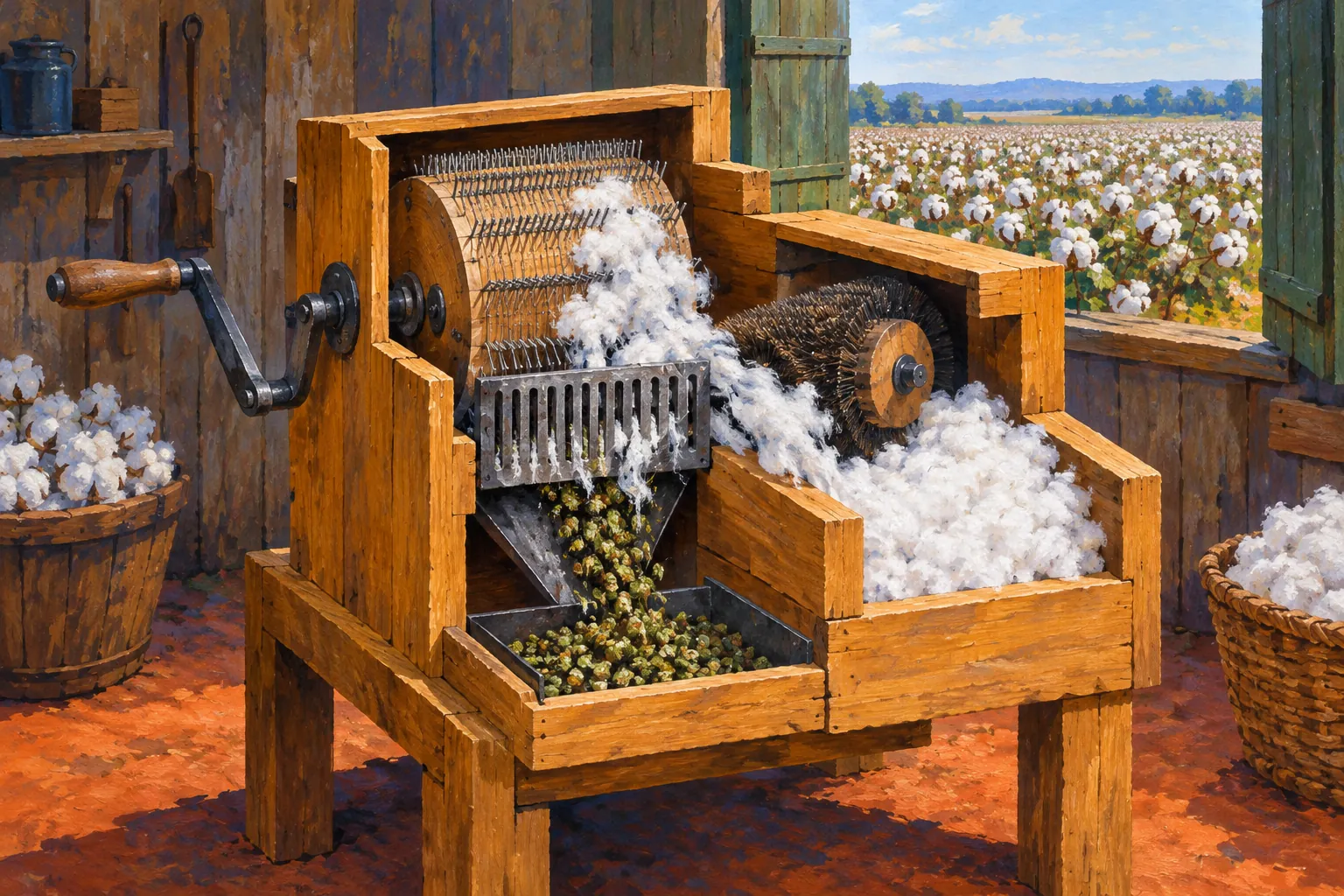
Whitney's design used a wooden drum with rows of thin metal teeth set into it. As the drum turned, the teeth passed through narrow slots in a metal grate and caught the fibres. The slots were too narrow for seeds, so the seeds stayed behind while the lint was dragged through. A second drum covered in brushes spun against the first and swept the lint off the teeth, which stopped the machine clogging. A hand crank turned the drums. Bigger gins were run by horses, then by water, and later by steam.
Gins were not new in themselves. Roller gins, which squeeze the fibre away between rollers, had been used for centuries in India and elsewhere. They worked well on long-staple cotton, whose seeds come away easily. They failed on short-staple “upland” cotton, whose green seeds cling stubbornly to the fibre. Whitney's toothed drum solved exactly that problem.
Why cotton needed a new machine
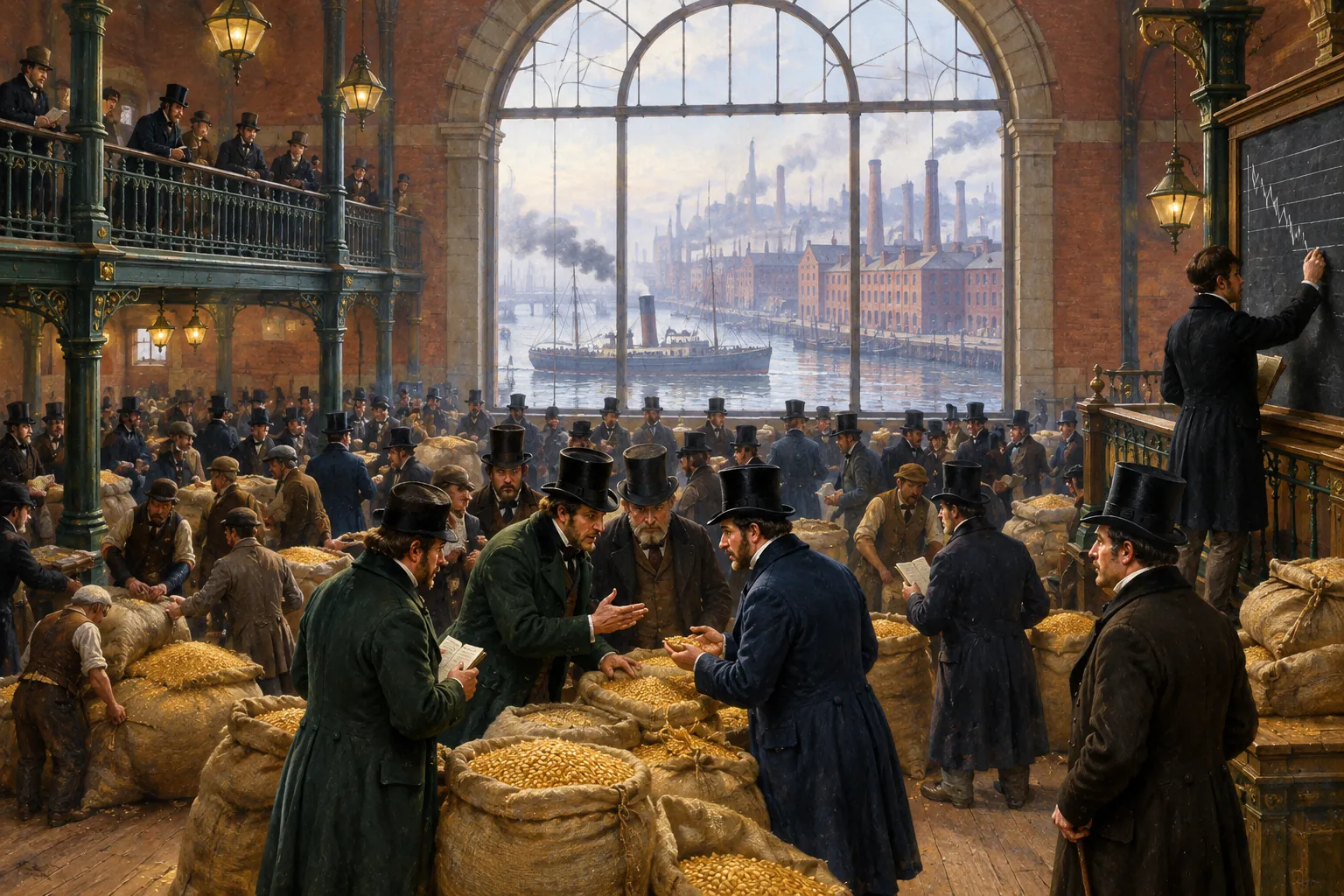
By the 1780s, British inventions such as the spinning jenny and the water frame let mills spin cotton thread faster than ever. That story is told in Factories and the Cotton Industry. The mills wanted far more raw cotton than the old supply could give them.
In the American South, fine long-staple sea island cotton grew only along the coast and islands of Georgia and South Carolina. Short-staple cotton could grow across a much wider area of inland country, but cleaning it by hand was so slow that few planters found it worth the effort. Meanwhile the tobacco soils of the Chesapeake region were wearing out, and slavery there was becoming less profitable. Cleaning was the bottleneck. Remove it, and a huge inland region could be turned over to cotton.
Eli Whitney and the invention
Eli Whitney was born in 1765 in Westborough, Massachusetts, the son of a farmer, and graduated from Yale in 1792. He travelled south to work as a private tutor, but the job fell through. He stayed instead at Mulberry Grove, a plantation near Savannah, Georgia, owned by Catharine Greene, the widow of Revolutionary War general Nathanael Greene.
Local planters described the trouble with cleaning upland cotton, and in 1793 Whitney built a working machine. He joined forces with Phineas Miller, who managed the Greene plantation, and received his patent on 14 March 1794.
Their business plan went badly. Rather than selling gins, Whitney and Miller meant to build them and keep a share of each planter's cotton, a third, as payment. Planters resented that. The machine was also made of wood and wire and was easy to copy, so unlicensed gins appeared across the South. Lawsuits dragged on, and a federal court in Georgia upheld the patent only in 1807, shortly before it expired. In 1812 Congress refused to extend it. Whitney earned little from the invention that made him famous.
He turned next to making muskets for the US government in Connecticut, signing a contract for 10,000 guns in 1798. He is often linked to interchangeable parts, although fully standardised production came later. Whitney died in New Haven in 1825.
What happened after the cotton gin
Cotton production exploded. US output grew from a few thousand bales a year around 1790 to about four million bales in 1860. Cotton fields moved west into Alabama, Mississippi, Louisiana and later Texas. By the 1850s cotton was the country's largest export, more than half of the value of everything the United States sold abroad, and the South was Britain's main supplier of raw cotton.
The heaviest consequence was the growth of slavery. The gin made cleaning easier, but picking was still done by hand. More land under cotton meant a need for many more pickers. The United States banned the import of enslaved people from abroad in 1808, yet the domestic slave trade grew to fill the demand. Historians estimate that around a million people were forced from the Upper South to the cotton lands of the Deep South between 1790 and 1860, and families were torn apart. The gin did not create slavery, which existed long before 1793, but it made slavery far more profitable and gave planters a strong reason to defend it.
Southern leaders came to talk of “King Cotton”. When the Civil War began in 1861, many expected that cutting off cotton exports would force Britain to side with the Confederacy. It did not.
The gin also shows a pattern that runs through the period: a machine that saves labour at one step can raise demand for labour at another. Workers' anger at being replaced by machines is the subject of The Luddites: Machine Breakers. The power that later drove gins and mills is covered in The Steam Engine: Who Invented It and How It Worked.
Common mistakes
- The gin did not pick cotton. It removed seeds from cotton that had already been picked.
- Whitney did not invent the first cotton-cleaning device. He designed a toothed-drum machine that worked on upland cotton.
- Whitney did not invent slavery. The gin made it more profitable and helped it spread west.
- The gin cleaned cotton, but it did not spin thread or weave cloth. Those jobs belonged to spinning machines and looms.
What exams ask
In AP-style questions, expect to explain how the cotton gin changed the American South. A strong short answer has three links: the gin made upland cotton cheap to process, cotton farming and the demand for enslaved labour expanded into the Deep South, and British and Northern mills depended on that cotton. Note the paradox that an industrial invention strengthened an agricultural slave economy.
Know the dates: invention 1793, patent 1794, end of legal slave imports 1808, Civil War from 1861. Be ready to compare the gin with textile machines in Britain, since the two together explain why cotton was a leading industry of the age. Questions may also ask about continuity and change: mechanisation spread through manufacturing, while planters in the South kept to hand labour in the fields.
Read next
- The Industrial Revolution: What It Was and Why It Mattered: the big picture of machines, factories and energy that this invention belongs to.
- Factories and the Cotton Industry: shows who wanted the cotton the gin helped to supply.
- The Luddites: Machine Breakers: explains how workers reacted when machines threatened their jobs.
- The Steam Engine: Who Invented It and How It Worked: tells how new power later drove mills and many gins.