In five minutes: Commodore Perry and the opening of Japan
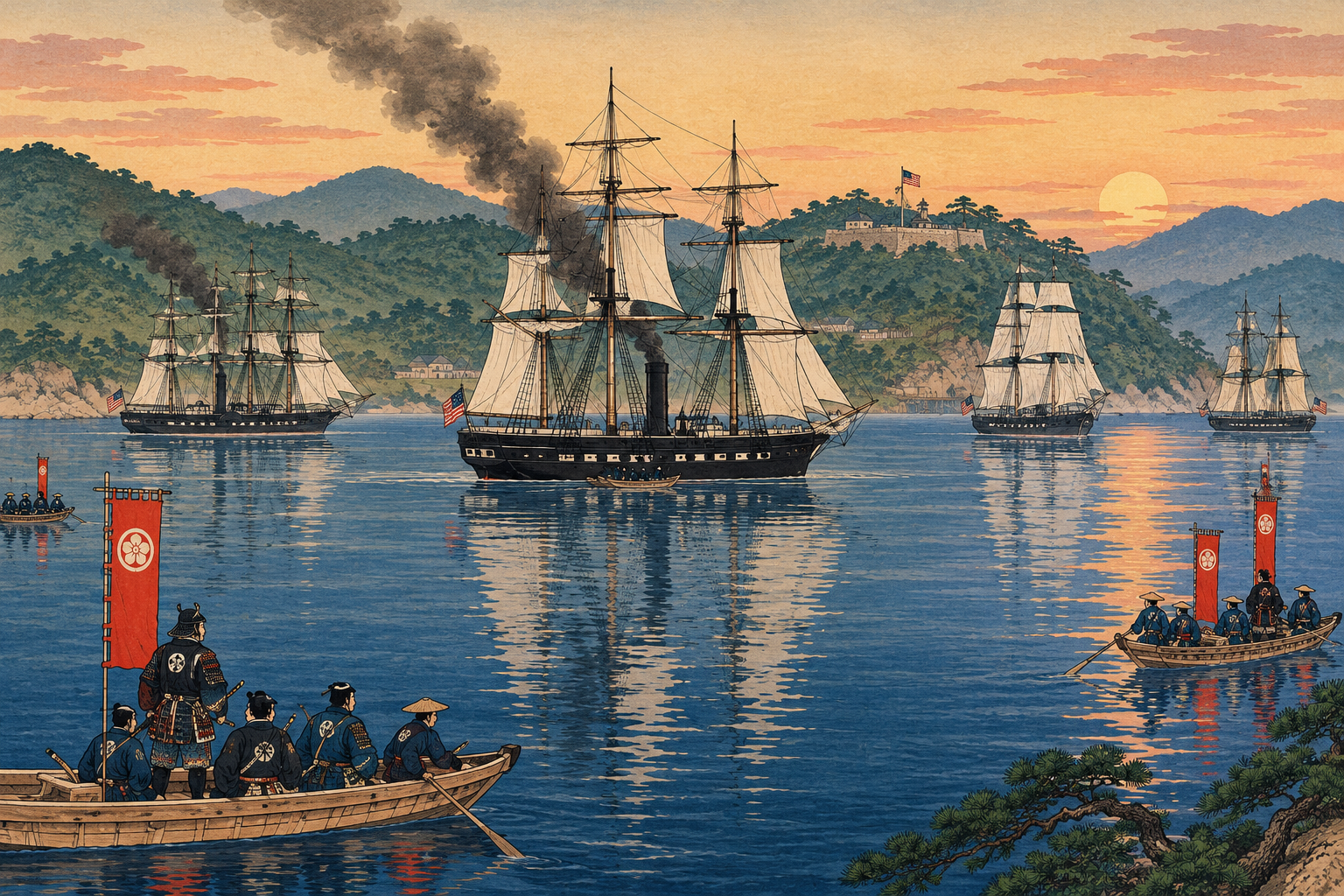
On 8 July 1853, Commodore Matthew C. Perry of the US Navy sailed to the mouth of Edo Bay with four warships. Two of them were steam-powered frigates with hulls blackened by tar, and Japanese people soon called the whole squadron the “black ships” (kurofune). Perry carried a letter from President Millard Fillmore. It asked the shogunate to let American ships take on supplies in Japanese ports, to protect shipwrecked sailors, and to consider trade.
The shogunate asked for time, and Perry left with a promise to return. He came back in February 1854 with a larger squadron, and on 31 March the two sides signed the Convention of Kanagawa. Two ports, Shimoda and Hakodate, opened to American ships, but trade did not begin. That came after the Harris Treaty of 1858. Together these agreements ended the old policy of keeping foreign ships away and drew Japan into the same world of treaties that had already reached Qing China. The wider story is told in our hub article Qing China, Japan and the West (1793–1912).
Why Japan was closed
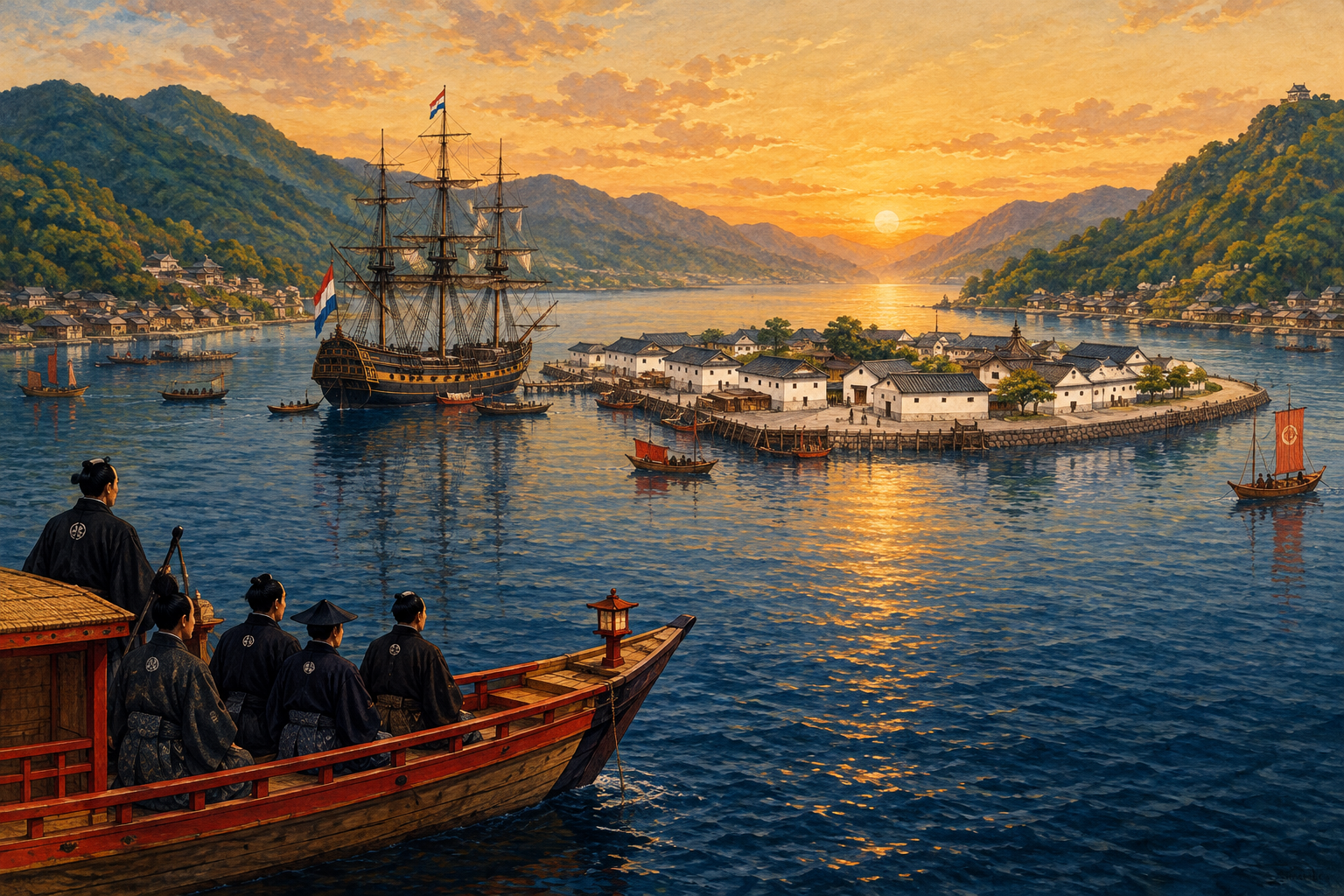
By the 1630s the Tokugawa shogunate had banned Christianity, forbidden Japanese people to travel abroad and sharply limited contact with Europeans. Historians often call this policy sakoku, “closed country”, but Japan was never sealed off. Dutch traders worked on the small island of Dejima in Nagasaki, and Chinese merchants used the same port. Korea dealt with Japan through Tsushima, the Ryukyu Kingdom through the Satsuma domain, and the Ainu trade ran through the Matsumae domain in the north. The shogunate controlled every doorway. For the wider system, read The Tokugawa Shogunate for World History Students.
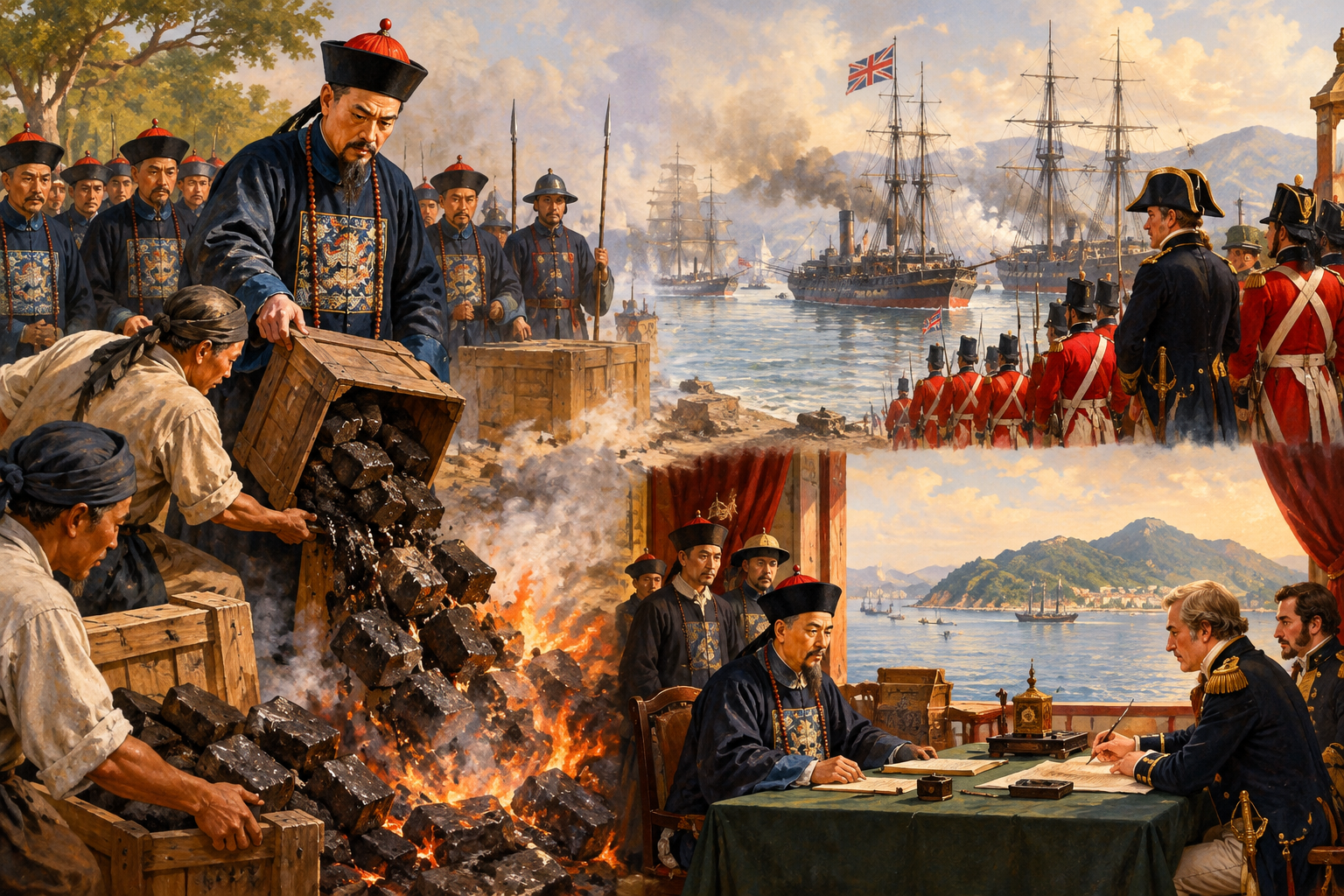
The arrangement lasted more than two hundred years, but pressure grew in the early nineteenth century as Russian, British and American ships appeared off the coast. In 1825 the shogunate ordered coastal officials to drive foreign ships away. Then news arrived from China: Britain had defeated the Qing empire in the First Opium War. In 1842 the shogunate softened its order and allowed ships in trouble to receive firewood and water. In 1846 the American Commodore James Biddle anchored at Uraga and asked for trade. He was refused and sailed home with nothing. Perry went out seven years later determined not to repeat that result.
Why the United States came
Perry’s mission is easiest to understand as three practical goals plus one big hope.
- Supplies for whalers. In the mid-1800s American whaling ships hunted across the North Pacific. They needed fresh water, food and firewood, and storms sometimes drove them onto Japan’s coast. A friendly port would make the trade safer and cheaper.
- Coal for steamships. After the United States reached the Pacific coast in 1848, merchants and politicians dreamed of steamship lines from California to China. Steamers burned huge amounts of coal, so they needed fuel stops along the way. Japan lay almost exactly on that route.
- Protection for sailors. Americans believed that castaways in Japan were treated harshly and held for long periods. Washington wanted a firm promise of rescue and fair treatment.
Trade was the big hope. Fillmore’s letter mentioned it, and merchants saw Japan as a future market. But the thing Perry most needed to bring home from a first round of talks was a guarantee of supplies and safety. There was also a matter of national mood. Britain had won treaty ports in China in 1842, and many Americans did not want to be left behind in Asia.
July 1853: the black ships at Uraga
Perry left Norfolk, Virginia, on 24 November 1852. His route took him around Africa and through Singapore, Hong Kong, Shanghai and Okinawa. The squadron that anchored off Uraga on 8 July 1853 had four ships: the steam frigates Susquehanna and Mississippi, and the sailing sloops Plymouth and Saratoga.
Perry played a deliberate game of status and pressure. When local officials rowed out, he refused to meet them and said he would deal only with a high-ranking official. He then sent survey boats deeper into Edo Bay, a move that put the shogun’s capital within reach of his guns. The shogunate knew its coastal batteries were no match for steam-powered warships, and it chose not to fight. On 14 July officials received Fillmore’s letter at Kurihama, a beach near Uraga. They gave no answer there. Perry sailed on 17 July and said he would be back the next year with more ships.
The crisis changed how decisions were made. The senior councillor Abe Masahiro did something unusual: he asked daimyo and shogunate officials for their opinions. It was sensible, but it also opened a door. Domains outside the shogun’s inner circle began to see foreign policy as their business too. The shogun Tokugawa Ieyoshi died on 27 July 1853, in the middle of the crisis, and his successor Iesada was in poor health.
1854: the return and the Convention of Kanagawa
Perry returned on 13 February 1854, earlier than expected and with a bigger fleet. This time the ships moved close to the site of present-day Yokohama, and talks took place on shore. The shogunate’s main negotiator was Hayashi Akira (Hayashi Fukusai). Perry asked for trade, but the Japanese side refused, and a limited agreement followed. The convention, signed on 31 March 1854, said:
- Shimoda and Hakodate would open to American ships, which could buy coal, wood, water and food.
- Shipwrecked Americans would be protected and treated kindly.
- An American consul could live at Shimoda after a set period if both governments agreed it was needed.
- Japan would give the United States any privileges it later gave to other countries (“most-favoured-nation” treatment).
The last point mattered most in the long run, because every new concession to another country now reached the United States automatically. Britain signed a similar agreement in 1854, Russia followed in 1855 with the Treaty of Shimoda, and the Dutch agreed new terms in 1855–56. Perry also brought gifts, including a model steam locomotive and a telegraph. Japanese hosts answered with a display by sumo wrestlers carrying rice bales.
What happened next: from Harris to Meiji
The 1854 treaty did not allow trade. In 1856 Townsend Harris arrived at Shimoda as the first American consul general and pushed the shogunate to sign a commercial treaty. He pointed to the Arrow War in China, where Britain and France were using force again, and argued that Japan would get better terms from the United States than from them. In 1858 the chief minister Ii Naosuke signed the Treaty of Amity and Commerce without waiting for the emperor’s approval. It opened Kanagawa (Yokohama), Nagasaki, Niigata and Hyogo (Kobe) to trade alongside Hakodate. It also gave foreign residents extraterritoriality, meaning they were tried by their own consuls, and it set tariffs that Japan could not change on its own. Later Japanese leaders called such agreements the “unequal treaties”.
Opening ports caused real strains. Gold left the country because of differences in the gold-to-silver ratio, and prices rose. Critics said the shogunate had given in to foreigners and ignored the court. The slogan sonno joi (“revere the emperor, expel the barbarians”) spread. Ii Naosuke punished opponents in the Ansei Purge and was assassinated outside the Sakuradamon gate of Edo Castle in 1860. The shogunate’s authority fell quickly, and the Meiji Restoration of 1868 ended its rule. The new government made revising the unequal treaties a central goal: Britain gave up extraterritoriality in 1894, and Japan regained full tariff autonomy in 1911. Read how it all ended in The Meiji Restoration in World History.
It is too simple to say Japan was just pushed around. The shogunate consulted widely, negotiated for months and refused trade in 1854. But the gap in naval power left it with few choices.
What exams ask
AP-style questions usually ask about significance and comparison. Useful points:
- Causes: American whaling, steamship coal needs, rescue of castaways and trade ambitions, combined with Japan’s restrictive foreign policy.
- Method: “gunboat diplomacy”: Perry used the threat of force while formally asking for talks.
- Compare with China: China’s opening followed war in 1839–42, while Japan’s opening in 1853–54 came without fighting, though under a clear threat.
- Consequences: unequal treaties, political crisis in the shogunate, rise of imperial loyalism, and the modernising reforms of the Meiji state.
- Do not confuse: the 1854 convention opened ports for supplies; the 1858 treaty opened trade.
Read next
- Qing China, Japan and the West (1793–1912): the hub that places Perry’s mission beside China’s encounters with Britain and France.
- The Tokugawa Shogunate for World History Students: how the regime Perry met governed Japan.
- The First Opium War (1839–1842): the news from China that frightened Japan’s leaders.
- The Meiji Restoration in World History: what came after the shogunate fell.