The Treaty of Portsmouth in five minutes
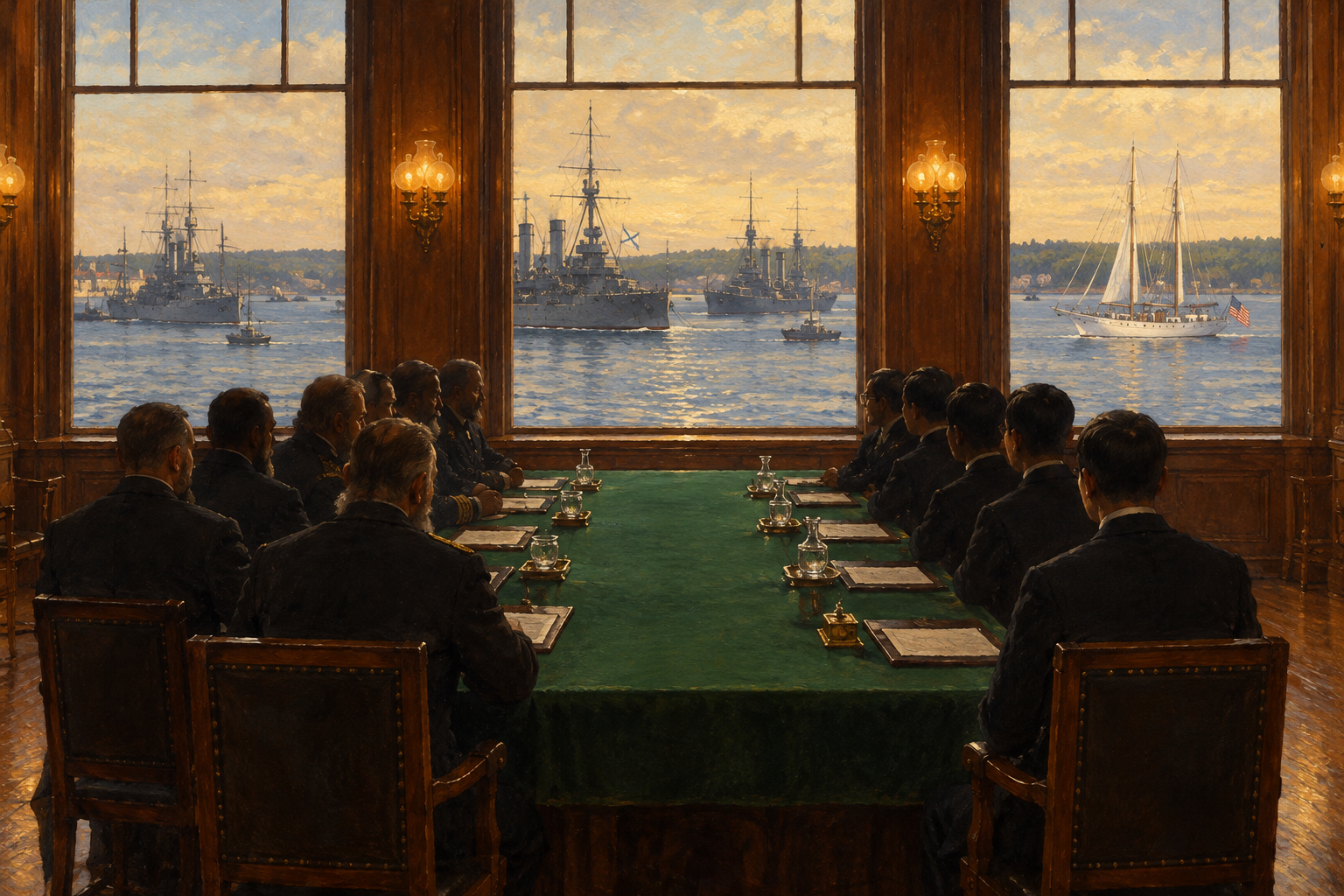
The Treaty of Portsmouth ended the Russo-Japanese War. It was signed on 5 September 1905 at the Portsmouth Naval Shipyard, on the Maine side of the river that separates Maine from the port town of Portsmouth, New Hampshire. Japan's foreign minister, Komura Jutaro, and Russia's Sergei Witte did the bargaining. The American president, Theodore Roosevelt, did not draft the terms, but he invited both sides, kept them talking and pushed each to give way at the worst moments.
The result was a split decision. Japan won recognition of its dominant position in Korea, Russia's leases on the southern tip of the Liaodong Peninsula, the southern part of the Manchurian railway and the southern half of Sakhalin. It did not win a cash indemnity, which many Japanese had been told to expect. That gap between hope and result matters as much as the terms themselves. This page is part of our series on Qing China, Japan and the West (1793–1912).
Why both sides wanted peace
The war had begun in February 1904 over rival ambitions in Korea and Manchuria. For more than a year Japan kept winning. Port Arthur fell in January 1905, Japanese armies took Mukden in the biggest land battle of the war that March, and in late May Admiral Togo destroyed most of Russia's Baltic Fleet at Tsushima.
Yet Japan was close to the end of its strength. It had borrowed heavily abroad, raised taxes at home and lost a very large number of men. Russia had lost its battles but not its size. Its army in Manchuria was still intact, and time seemed to favour the bigger country. Tokyo wanted to turn military success into a treaty while it still held the upper hand.
Russia had its own reasons. After Bloody Sunday in January 1905, strikes and unrest spread across the empire in what is called the Revolution of 1905. Tsar Nicholas II could not easily keep sending armies to the far east while his government faced trouble at home. Both capitals, for different reasons, could accept talks.
Why Roosevelt stepped in
Japan quietly asked Roosevelt to bring the two sides together soon after Tsushima. He agreed for reasons of balance. He admired Japan's performance but did not want it to crush Russia, and he did not want Russia to keep its position in Manchuria either. A rough balance of power in East Asia suited American trade and the American hold on the Philippines. In June 1905 he proposed direct talks, and both governments accepted.
In July 1905, while this was under way, US Secretary of War William Howard Taft met Japan's prime minister, Katsura Taro, in Tokyo. The record of their talk, known as the Taft–Katsura memorandum, shows the two men agreeing that Japan would not threaten the Philippines and that the United States would not object to Japanese influence in Korea. It was a private memorandum and not a treaty, but it shows how the great powers were arranging East Asia without asking the Koreans.
The negotiations
Roosevelt first received the delegations on 5 August 1905 aboard the presidential yacht Mayflower off Oyster Bay, New York, and then sent them to the navy yard at Portsmouth. Formal talks opened on 9 August. The two teams were well matched in character: Komura was a precise, quiet lawyer-diplomat with orders from a government that had little room to retreat; Witte was a large, confident statesman who understood that the American press mattered. He was friendly to reporters and local residents and presented Russia as a country that had not really been beaten.
Japan came with a long list of demands. Most were accepted fairly quickly: Russian withdrawal from Manchuria, Japanese primacy in Korea, the transfer of the Liaodong leases and of the railway running south from Changchun. Two points nearly broke the talks. Japan wanted all of Sakhalin and a large indemnity, and the Tsar had told Witte to give neither land nor money.
By late August the conference was close to collapse. In Tokyo, Japanese leaders faced the truth that they could not afford another year of war. They decided that peace mattered more than the indemnity, and they were ready to drop it. Roosevelt also leaned on both sides. On 29 August a compromise emerged: Russia would hand over the southern half of Sakhalin, and Japan would give up its claim to payment. The treaty was signed on 5 September.
What the treaty said
- Korea: Russia recognised Japan's paramount political, military and economic interests in Korea and promised not to interfere.
- Manchuria: both armies were to withdraw, and the territory was to go back to Chinese administration.
- Liaodong: Russia transferred its lease of Port Arthur, Dalian and the surrounding waters to Japan, with Chinese consent to be obtained.
- Railway: Russia gave Japan the southern branch of the Manchurian railway, from Changchun down to Port Arthur, with its mining and other rights.
- Sakhalin: the island was divided at 50 degrees north, and Japan received the southern half, which it called Karafuto.
- Fisheries: Japanese subjects gained fishing rights along Russia's Pacific coast.
- Money: Japan received no war indemnity.
China was not at the table, even though much of the fighting took place on its soil. In December 1905 Japan and China signed a separate agreement in Beijing in which China accepted the transfers of the leases and the railway.
Anger in Tokyo: the Hibiya riots
Japanese newspapers had reported victory after victory, and ordinary people had paid with high taxes and with the lives of sons and husbands. Many expected a large indemnity and all of Sakhalin. When the terms became known, there was a sense of betrayal. A protest meeting at Hibiya Park in Tokyo on 5 September, the very day of the signing, had been banned by the police, and it turned into riot. Crowds attacked police boxes, the home of the interior minister and pro-government newspaper offices, and burned many Christian churches. Martial law was declared the next day. Order returned within days, but the government of Prime Minister Katsura resigned in January 1906.
The riots show a question that kept returning in Japanese politics: what had the sacrifices of the war been for, and who had the right to decide?
Consequences
For Japan, the treaty marked its arrival as a major power. A non-European country had beaten a European great power, and observers from Asia to Europe noticed. Japan used its new position quickly. In November 1905 it forced Korea to accept the status of a Japanese protectorate, and in 1910 it annexed the country. In 1906 it founded the South Manchurian Railway Company, which became the base of its economic and later military influence in Manchuria.
For Russia, defeat and revolution pushed the government toward reform at home and caution abroad. It turned back toward Europe, and in 1907 it signed an agreement with Japan that divided their interests in Manchuria and Mongolia.
For the United States, Roosevelt won the 1906 Nobel Peace Prize for his work at Portsmouth, the first American to receive any Nobel Prize. The longer-term result was cooler. Many Japanese felt that the United States had pressed Japan for a settlement, and relations between the two Pacific powers slowly became more guarded. The treaty also turned Japan into a competitor for influence in China, where the older powers had already met earlier through the First Opium War.
What exams ask
- Who and where: Komura Jutaro and Sergei Witte negotiated; Roosevelt mediated; the treaty was signed in 1905 at Portsmouth, USA.
- Terms: Japanese interests in Korea, the Liaodong lease, the southern Manchurian railway, southern Sakhalin, fishing rights, and no indemnity. A typical question asks why the absence of indemnity mattered.
- Consequences: the Hibiya riots, the Korean protectorate (1905) and annexation (1910), the South Manchurian Railway (1906), Roosevelt's Nobel Prize.
- Significance (AP-style): the first modern victory of an Asian state over a European great power; a model of great-power mediation; the start of Japan's expansion on the Asian mainland.
Read next
- The Russo-Japanese War (1904–1905): the battles from Port Arthur to Tsushima that led to the peace table.
- How Southeast Asia Was Colonised: how the European powers, and later Japan, divided up the region that this war reshaped.
- The First Opium War (1839–1842): the earlier clash that opened China to Western powers, and the background to Manchuria's later fate.