In five minutes: what manifest destiny means
Manifest destiny was the belief, popular in the United States in the 1840s, that the country was meant to spread across North America from the Atlantic to the Pacific. It was not a law, a treaty or an official policy. It was a slogan, first used in print in 1845, that made the hunger for land sound like a duty. This page is part of our hub on 19th-Century America: Expansion, Civil War and the Gilded Age.
Within about three years of the phrase appearing, the United States annexed Texas, agreed the Oregon boundary with Britain and won a war against Mexico. The country added more than a million square miles, and its border reached the Pacific coast. Behind that success sat a long list of costs: Native nations pushed off their land, Mexico stripped of about half its territory, and a bitter argument over whether slavery would spread into the new West. That argument helped lead to the Civil War.
Where the phrase came from
The words came from John L. O'Sullivan, a New York editor and a loyal Democrat who ran the United States Magazine and Democratic Review. As early as 1839 he had written about America as a "great nation of futurity", a country defined by what it would become rather than by its past. In the July–August 1845 issue, he wrote about the push to annex Texas. He claimed that foreign powers, above all Britain, were trying to block "our manifest destiny" to fill the continent. A few months later he used the phrase again in a newspaper piece about the Oregon dispute.
O'Sullivan did not invent the idea. Americans had talked for decades about a republic of farmers growing westward. What he did was give the mood a name that fitted in a headline. Politicians, editors and speakers picked it up quickly, and it stuck.
Why Americans felt pushed and pulled west
Several things came together in the 1830s and 1840s.
- Land and money. The population was growing fast, farms in the East were wearing out, and the Panic of 1837 left many families in debt. Cheap western land looked like a fresh start. Cotton growers also wanted new soil.
- An old political idea. Thomas Jefferson had argued that a republic stays healthy when ordinary people own farms. The Louisiana Purchase of 1803, which roughly doubled the country, showed that this kind of growth was possible.
- Fear of rivals. The Monroe Doctrine of 1823 had warned European powers away from the Americas. In the 1840s, many Americans worried that Britain might gain Texas, Oregon or California before they did.
- Religion and race. Many speakers said that Providence had chosen the United States to spread liberty and Protestant Christianity. This often went hand in hand with the belief that Anglo-Saxon Americans were superior to Native peoples and to Mexicans. Those ideas were wrong, and they were used to excuse taking land.
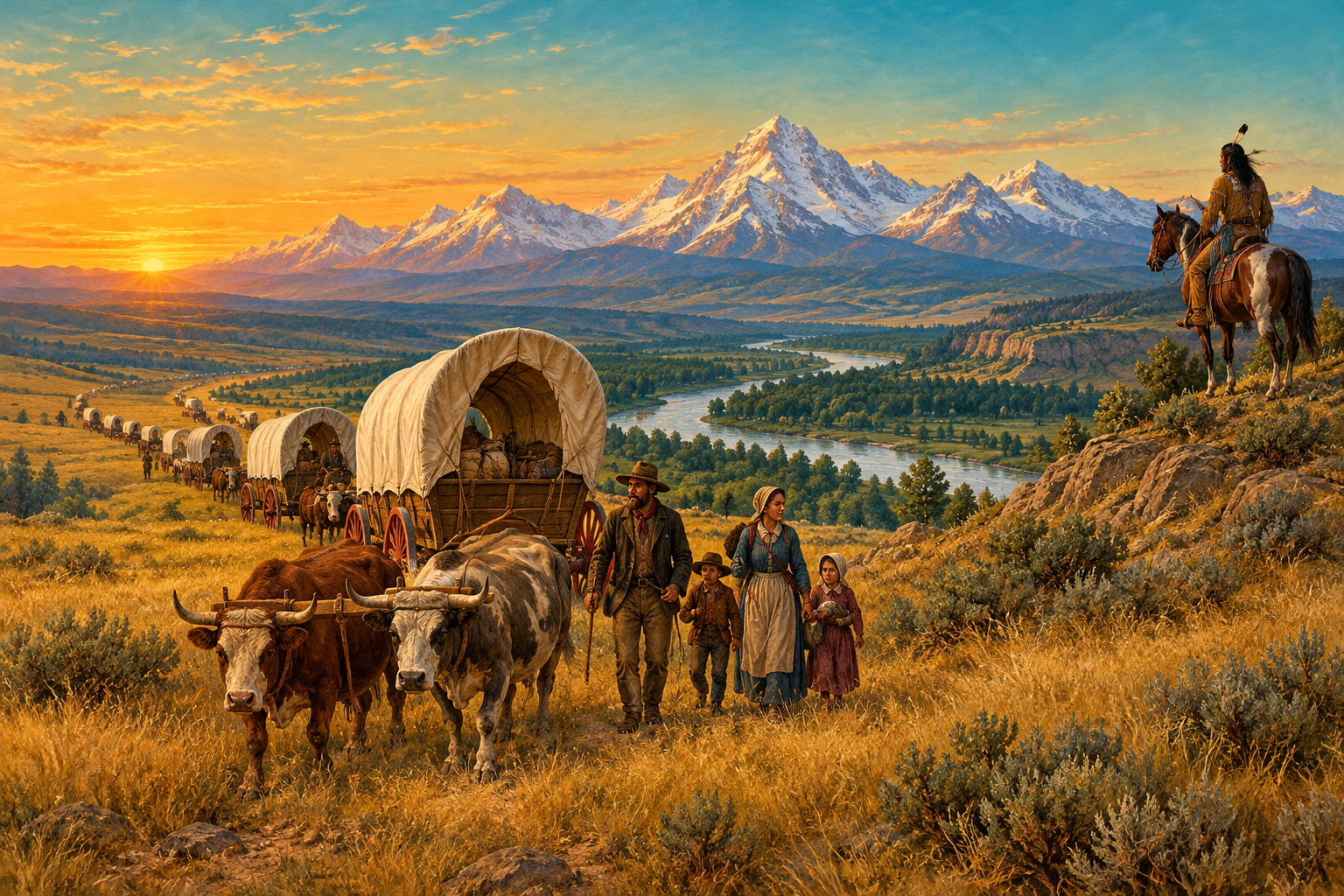
- Travel and news. Wagon trains on the Oregon Trail began in the early 1840s, and hundreds of thousands of people used the overland trails over the next decades. The telegraph and cheap newspapers spread the excitement quickly.
What happened: Texas, Oregon and the Mexican War
Texas. Texas was part of Mexico until American settlers there, many of them enslavers, rebelled. Texas won independence in 1836 and asked to join the United States, but Washington hesitated because annexation meant more slave territory and a likely war with Mexico. In 1844 James K. Polk, an openly expansionist Democrat, won the presidency. Congress passed a joint resolution to annex Texas in March 1845, and Texas became a state that December.
Oregon. The United States and Britain had shared the Oregon Country for years. Some Democrats demanded the whole region, up to the line 54°40′ north. Polk chose to settle. The Oregon Treaty of June 1846 set the border at the 49th parallel, and the United States gained what is now Washington, Oregon and Idaho, with parts of neighbouring states.
War with Mexico. Mexico had never accepted the loss of Texas, and the two countries disagreed about where Texas ended. Polk sent troops into the disputed land between the Nueces and Rio Grande rivers. After a clash in April 1846, Congress declared war on 13 May. American armies took northern Mexico, New Mexico and California, and in September 1847 entered Mexico City. In the Treaty of Guadalupe Hidalgo, signed on 2 February 1848, Mexico gave up California, New Mexico and the lands between, over 500,000 square miles in all. The United States paid $15 million and took on some claims of its citizens against Mexico. Gold was found in California in January 1848, just before the treaty, and the Gold Rush that followed sent settlers pouring in. In 1853 the Gadsden Purchase added a strip of southern Arizona and New Mexico for a possible railroad route.
Who paid, and who objected
The idea was never universally popular, even at the time. Many Whigs saw the Mexican War as a land grab started by a president. In 1847 a young congressman from Illinois, Abraham Lincoln, challenged Polk to show the exact spot where American blood had supposedly been shed on American soil. Henry David Thoreau went to jail in 1846 for refusing to pay a tax he linked to the war and to slavery. Ulysses S. Grant, who fought in it as a young officer, later called it deeply unjust. Many abolitionists believed the war was designed to add slave states.
The costs fell hardest on people who had little say. Native nations had already been pushed west by the Indian Removal Act of 1830 and events like the Trail of Tears. As settlers crossed the Plains and reached California, they lost more land, food sources and lives through treaties broken, disease and violence. Mexican families who lived in the ceded lands were promised citizenship and property rights, but many lost their land through courts, costs and pressure. Mexico lost about half of its pre-war territory, and the war still shapes how the two countries remember each other.
Why it mattered: slavery and the road to civil war
Each new piece of territory raised a question: would slavery be allowed there? In August 1846, Congressman David Wilmot proposed banning slavery in any land won from Mexico. The Wilmot Proviso passed the House but never the Senate, yet it split parties along North–South lines. The Compromise of 1850 patched the problem for a few years. The Kansas–Nebraska Act of 1854 reopened it, and the dispute ended in the Civil War in 1861.
After the war, expansion continued in new forms. The Homestead Act of 1862 offered western farmland to settlers, and the transcontinental railroad was finished in 1869. The United States bought Alaska in 1867 and took control of Hawaii and several island territories around 1898. Historians still argue about how much the idea drove events and how much it was an excuse added afterwards. Most agree that it shaped how Americans explained their own growth.
What exams ask
- Define it: a 19th-century belief that the United States was destined, even divinely, to expand across the continent. Be ready to say it was an ideology and a slogan, not a law.
- Name the key people and dates: John L. O'Sullivan (1845 phrase), James K. Polk (president 1845–1849), Texas annexation (1845), Oregon Treaty (1846), Treaty of Guadalupe Hidalgo (1848).
- Link cause and effect: expansion led to a fight over slavery in the territories, which pushed the country toward the Civil War. In AP US History this fits the period from 1844 to 1877.
- Give more than one view: supporters saw progress and opportunity, while critics pointed to injustice toward Native peoples, Mexicans and enslaved people.
- Common mistake: the phrase appeared in 1845, so the Louisiana Purchase of 1803 is part of the same story of expansion but came before the term existed.
Read next
- The Monroe Doctrine Political Cartoon Explained: the 1823 warning to Europe that shaped later claims on the continent.
- The Trail of Tears: the forced removal of Native nations that came before the Western push.
- Who Was Abraham Lincoln?: the young congressman who questioned the Mexican War, and the president who faced its consequences.