In five minutes: what were Jim Crow laws?
Jim Crow laws were state and local rules that forced Black and white Americans apart in public life and, in much of the South, shut Black citizens out of voting. They were not one law passed by Congress. They were hundreds of separate statutes, city ordinances and customs that grew up between the 1870s and the early 1900s and lasted until the mid-1960s.
The system rested on three supports. Public places, from railway cars to schools, were divided by race. Voting rules were written so that Black citizens could rarely register. And violence, or the threat of it, backed up both. The Supreme Court allowed the arrangement in 1896 under the phrase “separate but equal”, although the facilities set aside for Black people were almost never equal.
This page is part of our guide to 19th-Century America: Expansion, Civil War and the Gilded Age, and it picks up where the story of Reconstruction leaves off.
Where the name came from
“Jim Crow” began as a stage character. In the early 1830s the white entertainer Thomas D. Rice performed a song-and-dance act called “Jump Jim Crow” in blackface, mocking Black people with a crude caricature. The act was a hit in the United States and Britain.
Over the following decades “Jim Crow” turned into an insulting word for Black Americans. By the 1890s newspapers and politicians were using it for the new segregation statutes. Historians now use it as the standard name for the whole system, while remembering where the word came from.
Causes: why the laws appeared after Reconstruction
The Civil War ended slavery. Congress then passed the 13th, 14th and 15th Amendments to abolish slavery, guarantee citizenship and equal protection of the laws, and protect the right of Black men to vote (see The 13th, 14th and 15th Amendments). During Reconstruction (1865–1877), Black men voted, held office and helped write new state constitutions across the South.
White Southern leaders pushed back at once. In 1865 and 1866 former Confederate states passed Black Codes that limited where Black people could work, own land or travel. Groups such as the Ku Klux Klan used terror against Black voters and their white allies. Meanwhile, Northern support for enforcing Reconstruction faded. After the disputed presidential election of 1876, federal troops withdrew from the last Southern states in 1877, and white Democrats, who called themselves Redeemers, took back control of state governments.
Without federal enforcement, Southern legislatures could write racial rules with little fear of an answer from Washington. The Supreme Court helped. In the Civil Rights Cases of 1883 it ruled that the Civil Rights Act of 1875, which had banned discrimination in hotels, theaters and trains, could not be applied to private businesses. Black citizens were left without national protection against that kind of exclusion.
How the system worked
Segregation in daily life
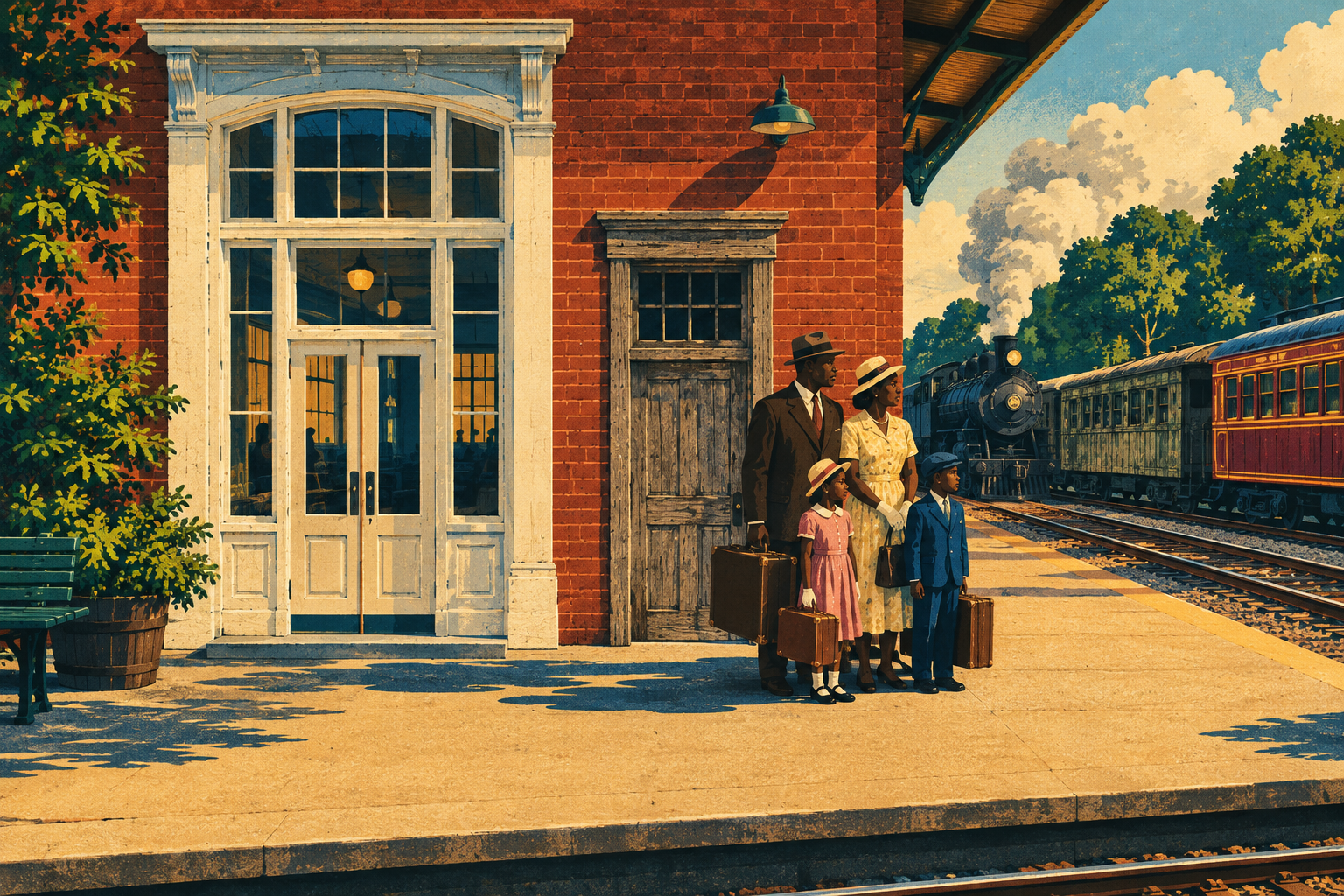
Tennessee passed one of the first railroad segregation laws in 1881, and in 1890 Louisiana’s Separate Car Act required separate train cars. Other states followed with rules for streetcars, waiting rooms, schools, hospitals, parks, restaurants, theaters, prisons and even cemeteries. Signs reading “White” and “Colored” hung over entrances and drinking fountains. Black Americans were expected to use side doors, rear seats and poorer facilities, and to show deference to white people in everyday contact. Black schools received far less money than white schools.
Taking away the vote
The 15th Amendment banned denying the vote because of race, so Southern states used rules that looked neutral. Mississippi’s 1890 constitution set the pattern with a poll tax and a literacy test, and other states copied it. Registrars decided whether an applicant had “understood” a passage of the constitution, which let them fail Black applicants and pass white ones. Grandfather clauses, adopted by Louisiana in 1898, excused men whose ancestors could vote in the 1860s from the tests, which in practice meant white men only. White-only Democratic primaries closed the last gaps. In Louisiana, about 130,000 Black voters were registered in 1896; by 1904 the number was about 1,300.
Work and money
Most Black Southerners were poor farmers. Sharecropping and debt tied many of them to the land. States also used vagrancy laws and convict leasing to send Black prisoners to work for private companies and landowners in brutal conditions.
Violence
Law was backed by terror. Records kept by Tuskegee Institute count nearly 4,700 lynchings in the United States between 1882 and 1968, and most of the victims were Black. Few attackers were punished. In 1898, in Wilmington, North Carolina, white supremacists overthrew the elected city government and killed Black residents. Police, judges and juries were almost entirely white, so Black citizens had little chance of protection in court.
Plessy v. Ferguson (1896)
In 1892 Homer Plessy, a Louisiana man of mixed ancestry, bought a first-class ticket in New Orleans and sat in a whites-only car of the East Louisiana Railroad. A group of Black New Orleans citizens had planned the protest to challenge the Separate Car Act, and Plessy was arrested.
The case reached the Supreme Court. In 1896 it ruled 7 to 1 that separate facilities were constitutional as long as they were “equal”. Justice Henry Billings Brown wrote for the majority that the 14th Amendment could not abolish distinctions based on color. Justice John Marshall Harlan dissented alone. He wrote that the Constitution is “color-blind” and warned that the decision would do as much harm as the Dred Scott ruling.
The decision did not create Jim Crow, but it gave segregation legal cover for nearly sixty years. In practice “equal” was a fiction: Black schools got far less money, and in many places Black travelers and patients had no equivalent facility at all.
Resistance and the Great Migration
Black Americans resisted from the start. The journalist Ida B. Wells investigated and campaigned against lynching. Booker T. Washington urged economic progress, while W. E. B. Du Bois demanded full political rights. The NAACP was founded in 1909. From about 1916, Black Southerners moved north and west in what became the Great Migration, roughly six million people by 1970, in search of better jobs and fewer legal barriers. The North had its own segregation in housing, schools and work, though it was less often written into state law.
How Jim Crow ended
The system came apart in steps. In 1944 Smith v. Allwright struck down white-only primaries. In 1954 Brown v. Board of Education ruled unanimously that separate public schools are inherently unequal, overturning Plessy for education. Many Southern officials delayed integration for years.
The Montgomery bus boycott (1955–1956), sparked by the arrest of Rosa Parks, brought Martin Luther King Jr. to national attention. Sit-ins, the Freedom Rides and the 1963 March on Washington followed. Then Congress acted. The Civil Rights Act of 1964 banned segregation in public accommodations and discrimination in employment. The Voting Rights Act of 1965 suspended literacy tests in places with a history of discrimination and let federal officials oversee voter registration. Many historians treat 1965 as the end of Jim Crow as a legal system.
What Jim Crow left behind
The effects lasted much longer than the laws. Banks and real-estate agents kept steering Black families into separate neighborhoods, and because schools followed neighborhoods, unequal schooling continued. Many Black families were shut out of chances to build wealth for generations, which researchers link to gaps that remain today. The civil rights movement also became a model for rights campaigns around the world.
What exams ask
Typical questions and short answers:
- What gave segregation its legal basis? Plessy v. Ferguson (1896) and the doctrine of “separate but equal”.
- How did Southern states get around the 15th Amendment? Poll taxes, literacy tests and grandfather clauses.
- Which ruling struck down school segregation? Brown v. Board of Education (1954).
- Which laws ended the system? The Civil Rights Act of 1964 and the Voting Rights Act of 1965.
For AP-style significance, Jim Crow shows how the gains of Reconstruction were reversed, how federalism let states set racial rules, and how the meaning of the 14th Amendment depends on how courts read it. A chain to remember: end of Reconstruction (1877), segregation and disfranchisement laws (1880s–1900s), Plessy (1896), Great Migration, Brown (1954), Civil Rights Act (1964), Voting Rights Act (1965).
Read next
The 13th, 14th and 15th Amendments: the constitutional rights that Jim Crow laws were built to get around.
Who Was Abraham Lincoln?: the wartime president whose leadership led to emancipation and the amendments.
The Transcontinental Railroad (1869): the railroad age that also produced the first segregation statutes for train cars.