This article is part of the story of 19th-century Europe: revolutions, nationalism and unification. While Germany and Italy were being built out of many small states, the Habsburg lands went the other way: they stayed together by redesigning the state.
In five minutes: what was Austria-Hungary?
Austria-Hungary was a state with one ruler and two governments. From 1867 to 1918, Franz Joseph was Emperor of Austria and, at the same time, King of Hungary. Austria and Hungary each had their own parliament, laws and prime minister. They shared only foreign policy, the army and the finances needed to pay for both. People call this arrangement the Dual Monarchy.
The deal is known as the Compromise of 1867 (in German, the Ausgleich). It rescued the Habsburg state after a military defeat. It also created a lasting problem: Hungarians won an equal partnership, but Czechs, Slovaks, Croats, Serbs, Romanians, Poles and many others did not.
Why the Habsburgs needed a deal
The Habsburg monarchy was a patchwork of lands gathered over centuries: Austria, Bohemia, Hungary, Galicia, Croatia, Transylvania and northern Italy. Its people spoke German, Hungarian, Czech, Polish, Romanian, Croatian, Serbian, Italian and more. In the age of nationalism, that mix was a weakness.
In 1848 revolutions broke out across the empire. Hungarian nationalists under Lajos Kossuth demanded self-government, and in 1849 they declared Hungary independent. The young Emperor Franz Joseph, who had come to the throne in 1848, put the uprising down only with the help of Russian troops. For the next decade Hungary was ruled harshly from Vienna, and Hungarian leaders never forgot it.
Foreign defeats then weakened Vienna. Austria lost most of Lombardy after the war of 1859 and then lost the leadership of the German lands. The October Diploma of 1860 and the February Patent of 1861 tried to give the provinces some say without giving up central control. Hungary refused both. A moderate Hungarian lawmaker, Ferenc Deák, argued in 1865 that Hungary would accept a shared monarch and common defence, but only if its old constitution was restored.
1866: the defeat that forced the issue
The decisive push came from Prussia. In June 1866 Austria and Prussia went to war over who would lead the German states. On 3 July 1866 the Prussian army won a large victory at Königgrätz (also called Sadowa) in Bohemia. Austria was pushed out of German affairs, and the German Confederation ended. You can read how Prussia built that power in Prussia: From Kingdom to Germany's Core, and how Otto von Bismarck chose a quick, mild peace so that Austria would not become a lasting enemy.
For Franz Joseph the lesson was clear. A monarchy that was weak at home and beaten abroad could not afford to keep fighting its most powerful province. Talks with Hungary, already under way, became urgent.
What the Compromise of 1867 actually did
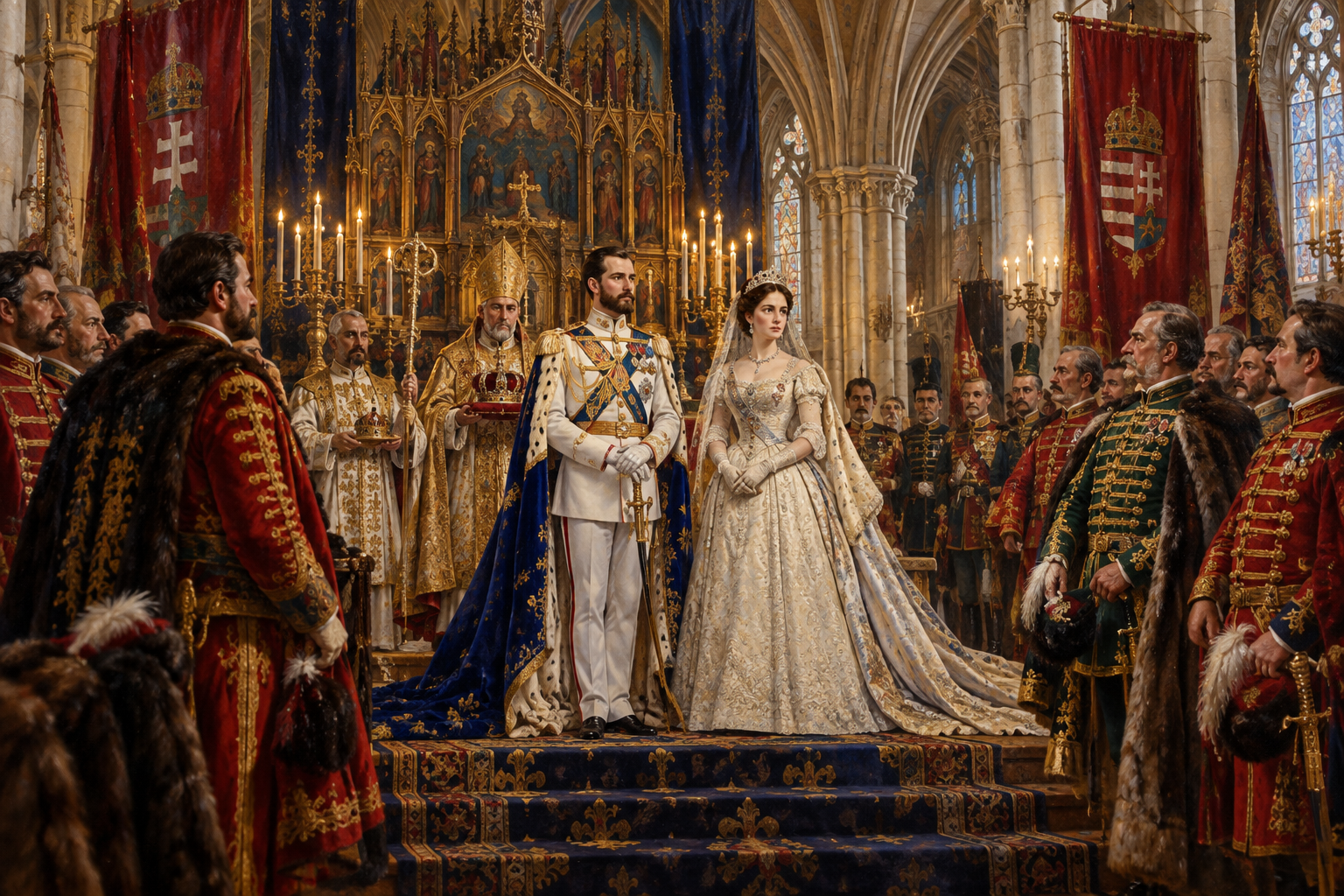
Hungarian leaders led by Deák and Count Gyula Andrássy negotiated with the court. In February 1867 Franz Joseph restored the Hungarian constitution and named Andrássy prime minister. The Hungarian parliament approved the agreement in the spring, and on 8 June 1867 Franz Joseph and his wife Elisabeth were crowned King and Queen of Hungary in Buda. In December the Austrian side adopted its own set of constitutional laws.
The result had these main features:
- One monarch. The Habsburg ruler was Emperor of Austria and King of Hungary, so the two halves shared a dynasty.
- Two governments. Each half had its own parliament in Vienna and Budapest, its own prime minister, courts, schools and police. Historians call the Austrian half Cisleithania and the Hungarian half the Lands of the Crown of St Stephen.
- Three common ministries. Foreign affairs, war and the finances for those two were run jointly. Delegations of 60 members from each parliament met to oversee them, and they met separately, in different cities, so that neither side would dominate.
- Money by negotiation. Customs and the share each half paid toward common costs, called the quota, were renegotiated about every ten years. At first Austria paid roughly 70 per cent and Hungary roughly 30 per cent. Each renewal became a bargaining crisis.
Croatia received its own limited self-rule inside Hungary through the Croatian-Hungarian Settlement of 1868. The monarchy's other peoples were left inside the Austrian or Hungarian halves without a deal of their own.
How the Dual Monarchy worked day to day
The state had awkward names. Imperial institutions carried the letters k.u.k. (imperial and royal), the army was joint, and the emperor stood at the top of both systems. Franz Joseph, who reigned until 1916, became the symbol that held the structure together.
The economy grew quickly. Railways, mines and factories spread in Bohemia and around Vienna, and Budapest grew into a major city. The empire's total population reached about 51 million by 1910, making it one of Europe's larger states by population, although it was poorer than Germany or Britain.
Its foreign policy turned toward the Balkans, since German unification had closed the door to the west. Andrássy, who served as joint foreign minister in the 1870s, represented the monarchy at the Congress of Berlin in 1878, where the great powers allowed Austria-Hungary to occupy Bosnia and Herzegovina. In 1879 it signed the Dual Alliance with Germany, and in 1882 it joined Germany and Italy in the Triple Alliance. The monarchy formally annexed Bosnia in 1908.
The weakness inside the compromise
The Compromise gave real power to two groups: the Germans in Austria and the Magyars (ethnic Hungarians) in Hungary. Neither was a majority of the whole. Germans were about a quarter of the population and Hungarians about a fifth. In the Hungarian half, Magyars made up roughly half of the people, and Hungarian governments pushed the Hungarian language in schools and offices. Slovaks, Romanians, Serbs and Croats complained of this.
In the Austrian half, Czech leaders wanted the kind of status Hungary had. A plan to grant it in 1871 collapsed. In 1897 a language decree for Bohemia led to riots in the parliament and the fall of the government. Parliamentary life in Vienna was often stuck, and the emperor ruled through emergency decrees.
Nationalism abroad added pressure. Serbia attracted South Slavs inside the monarchy who wanted to join a larger state, and Vienna came to see Serbia as an enemy. Hungary also blocked reforms such as giving Slavs a third partner in the state, because that would reduce its own position.
From compromise to collapse, 1914-1918
On 28 June 1914 a Bosnian Serb, Gavrilo Princip, shot Archduke Franz Ferdinand, the heir to the throne, in Sarajevo. Austria-Hungary, backed by Germany, sent an ultimatum to Serbia, and on 28 July declared war. Within days the great powers were at war.
The Dual Monarchy fought for four years but was strained by defeats, shortages and national movements. Franz Joseph died in November 1916 and was followed by Charles I. In October 1918 the peoples of the empire began to declare their own states. Hungary ended the union at the end of the month, Czechoslovakia and a South Slav state were proclaimed, and Austria-Hungary signed an armistice in early November 1918. Charles gave up his role in government on 11 November.
The peace treaties of Saint-Germain (1919) and Trianon (1920) set the borders of the new states. Hungary lost about two thirds of its former territory.
Why Austria-Hungary matters
Austria-Hungary shows another route through the era of nationalism. Germany and Italy joined together; the Habsburg monarchy tried to hold many nations in one frame, and it did so for 51 years. Its end left a belt of new, small states in Central Europe, many with minorities of their own, which shaped the politics of the interwar years.
What exams ask
- Explain how the defeat at Königgrätz in 1866 led to the Compromise of 1867.
- List what Austria and Hungary shared (foreign affairs, defence, joint finance) and what each ran alone.
- Explain why the settlement favoured Germans and Magyars and caused unrest among Slavs and Romanians.
- Link Austria-Hungary's Balkan policy to the outbreak of the First World War.
- For AP-style questions, compare it with German unification: a multinational empire that accommodated one national movement but not the others.
Read next
- The Congress of Berlin (1878): how the great powers let Austria-Hungary occupy Bosnia and Herzegovina.
- Otto von Bismarck: The Iron Chancellor: the statesman who beat Austria in 1866 and then allied with it in 1879.
- Prussia: From Kingdom to Germany's Core: the rival state whose victory pushed Vienna into the Compromise.