In five minutes: socialism vs communism
Socialism is the broad idea that a society's main economic resources, such as factories, land and banks, should be owned or controlled by the public rather than by private owners. Communism is a narrower idea inside the same tradition: a future society with no social classes, no private ownership of those resources and, in the end, no state. In everyday speech the word also names the one-party states that communist parties ran in the twentieth century. That is why every communist is a socialist, but most socialists are not communists.
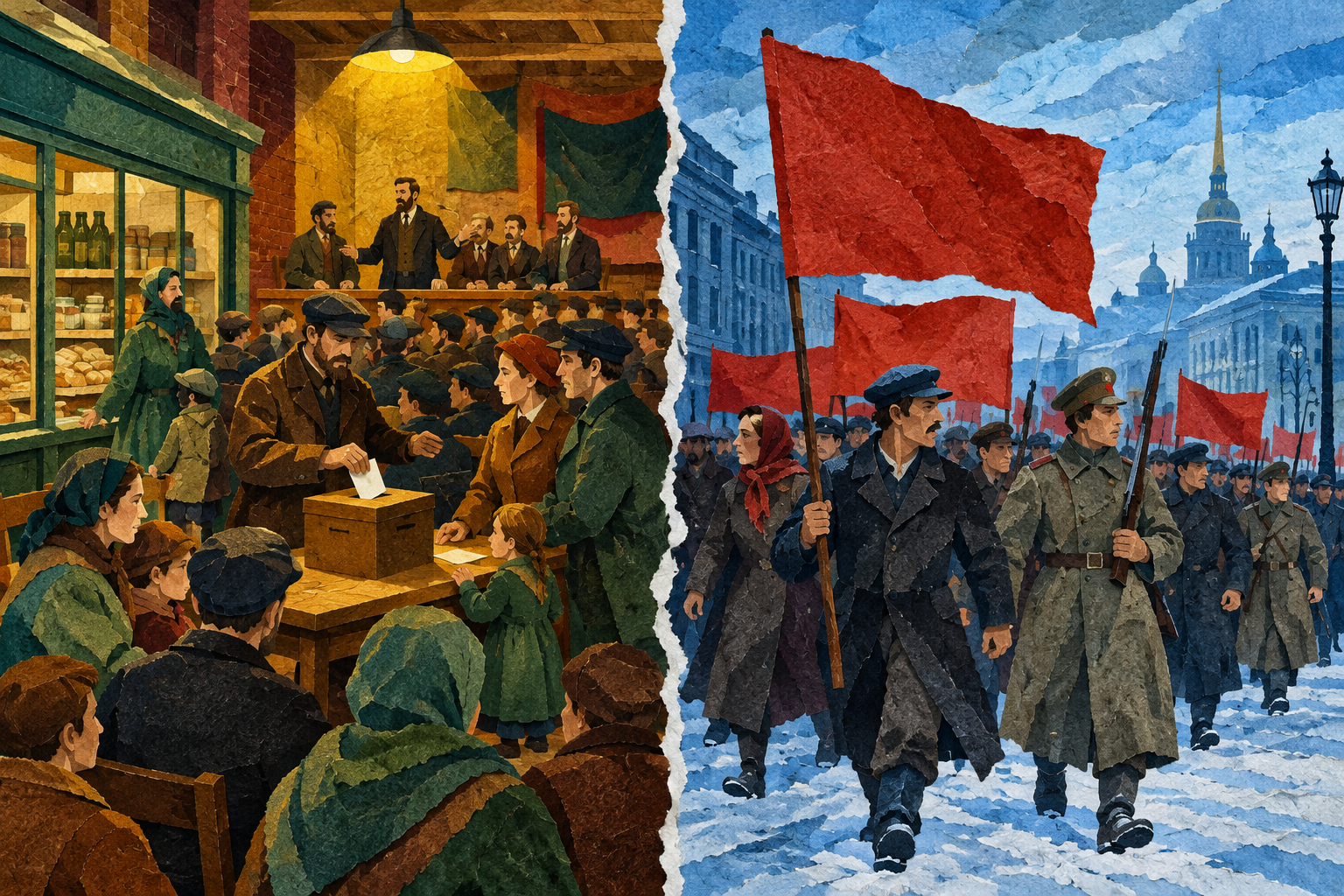
Two questions keep the words apart. How far should the change go? And how do you get there: by votes and reforms, or by revolution? Socialists disagree about both. Communists, following Karl Marx, answer: all the way, and through the struggle of the working class. This page belongs to our topic Ideas That Shaped the 19th Century, where liberalism, nationalism and Darwin's ideas sit next to it.
Where the words come from
Both words are products of the early industrial age. Factories pulled people into crowded towns, wages were low and workdays were long, and thinkers began to ask whether private ownership of machines was the cause. The word socialism appeared in Britain and France in the 1820s and 1830s, used by followers of Robert Owen and Henri de Saint-Simon. Owen, a mill owner turned reformer, tried to build a cooperative village at New Harmony, Indiana, in 1825. It did not last, but it showed the dream: a community that shares its work and its wealth.
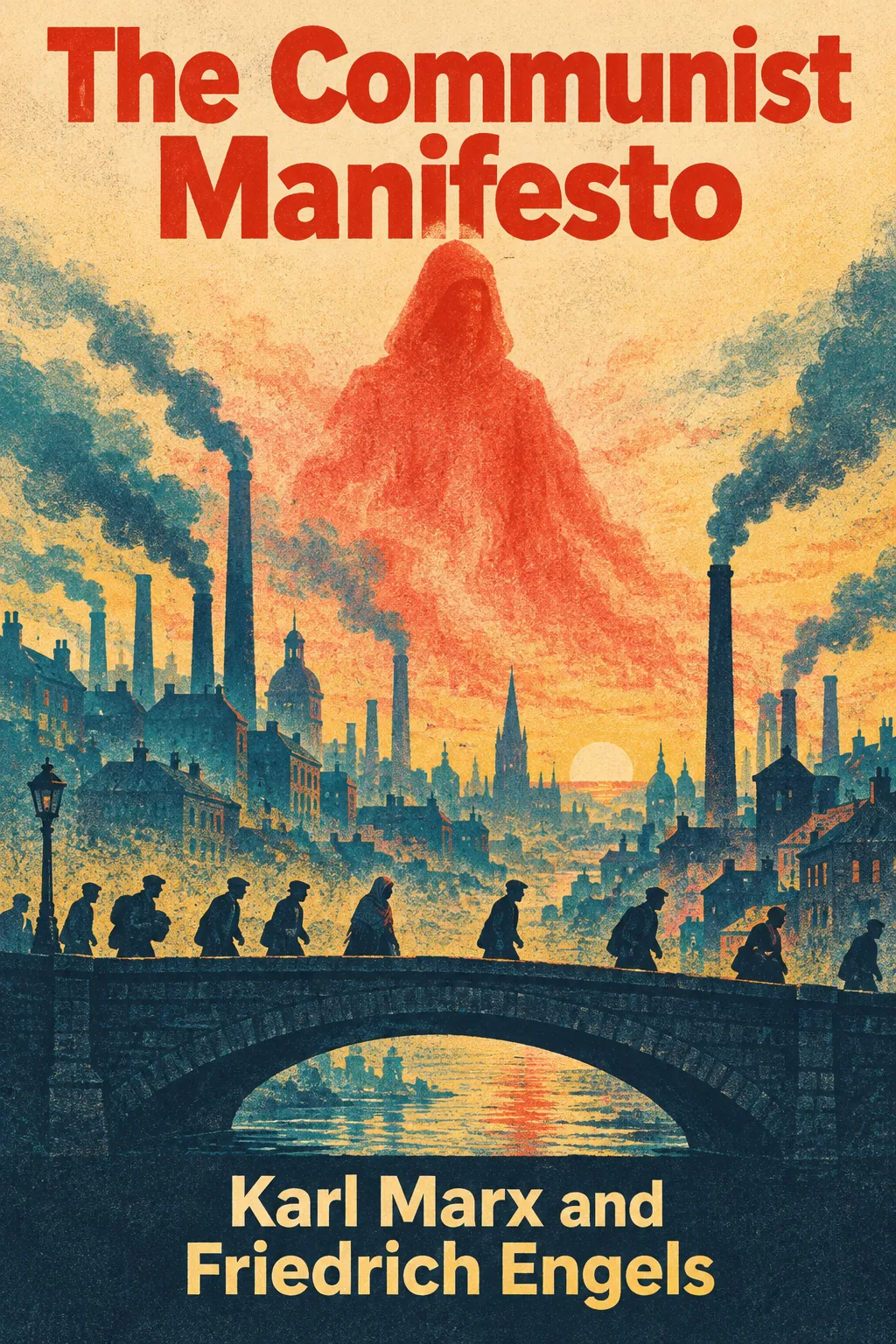
Communism was the sharper word. It was used in the 1840s by small groups of workers and exiles who wanted to abolish private property in the means of production altogether. In 1847 a group called the Communist League asked Karl Marx and Friedrich Engels to write its programme. The result, The Communist Manifesto, appeared in London in February 1848. It argued that history is a story of class struggle and that the industrial workers would one day overthrow the owners of capital.
What socialism means
Socialism is a family of ideas rather than one blueprint. What they share is a belief that the means of production should serve the community. After that, they split. Some socialists want the state to own major industries. Others prefer cooperatives, local councils or worker-run firms. Some want to replace markets with planning, and some want to keep markets but tame them with taxes, unions and public services.
The most important division is between reform and revolution. In the late nineteenth century, large socialist parties grew up in Germany and elsewhere, took part in elections and won laws on working hours and insurance. In 1899 the German thinker Eduard Bernstein argued in Evolutionary Socialism that change could come step by step through democracy. This tradition became social democracy. Today's welfare states in Northern Europe borrow from it, although they are mixed economies with private companies, not fully socialist systems.
What communism means
Communism, in Marx's sense, is both a theory and a goal. The theory says that under capitalism a small class owns the factories while a large class sells its labour, and that this conflict will eventually push workers to take power. The goal is a society without classes, where goods are shared and, as the old slogan puts it, each gives according to ability and receives according to need.
Marx did not describe the future in detail. In a note written in 1875, now called the Critique of the Gotha Programme, he spoke of a lower stage after the revolution and a higher stage later, when scarcity had faded. Later Marxists, especially Vladimir Lenin (for example in The State and Revolution, 1917), used the word socialism for the lower stage and communism for the higher one. This is the source of much confusion: in Marxist language, socialism is the road and communism is the destination.
Lenin added a second idea. In 1902, in his pamphlet What Is to Be Done?, he argued that a disciplined party of professional revolutionaries should lead the workers, and later run the state during the transition. That party-led model, not Marx's distant vision, is what most people picture when they hear the word communism.
Four questions that separate them
- What is the end goal? Socialism: a fairer economy under public or shared control. Communism: a classless and stateless society.
- How do you get there? Socialism: elections, reforms or revolution, depending on the group. Communism: revolution led by the working class and, in Lenin's version, a party.
- What happens to markets and property? Socialism: ranges from mixed economy to full planning. Communism: private ownership of the means of production is abolished. Personal belongings such as a home or a phone were never the target.
- What about the state? Socialism: often uses the state. Communism: in theory the state fades away, in practice the ruling parties kept it strong.
What happened in the twentieth century
The First World War broke the movement in two. In August 1914 the largest socialist party in Germany voted for war credits, which angered those who believed workers should not fight each other. In October 1917 the Bolsheviks seized power in Russia. In March 1918 they renamed their party the Russian Communist Party, and in March 1919 they founded the Communist International, or Comintern, in Moscow. Its conditions for membership forced a choice, and socialist parties around the world split into communist parties and social democratic parties that rejected the Russian path.
The Soviet Union, created in 1922, called itself socialist, and its 1936 constitution declared that socialism had been built. The ruling party said communism was still ahead. China followed in 1949 when the People's Republic was founded, and it still describes its system as socialism with Chinese characteristics. These states had state-owned industry and one-party rule. Many historians and critics point to censorship, repression and famine in them, and this record shaped how the word communism is heard today. The Soviet Union ended in December 1991.
Meanwhile, democratic socialist and social democratic parties governed in Britain, Sweden and many other countries, building public health services and pensions without abolishing private enterprise. The same word, socialism, therefore covers very different politics.
Common mix-ups
- Socialism is not always communism. A party that wants a public health service or higher taxes on the rich is not calling for the abolition of the state.
- Communism is not the same as the Soviet Union. The Soviet system was one attempt, led by a party, and Marx's stateless society was never reached.
- Socialism is not the same as welfare. A welfare state redistributes money inside a market economy; socialism in the classic sense changes who owns the means of production.
- Personal property is not abolished. The target was the ownership of factories, land and capital, not toothbrushes.
What exams ask
AP-style questions usually ask you to compare the two ideas and place them in context. A strong answer names Marx and Engels and the 1848 Manifesto, explains class struggle, separates Marx's theory from Lenin's party-led practice, and notes the 1914 to 1919 split between communists and social democrats. Remember the shorthand: socialism is the broader family and the transition, communism is the final stateless goal and, in common speech, the Soviet-style systems.
Read next
- What Is Socialism? Origins in the 19th Century: the full story of Owen, Saint-Simon and the early movement.
- Capitalism vs Socialism: the other half of the comparison, about markets and ownership.
- What Is Nationalism?: the rival idea that often beat both in 1914.