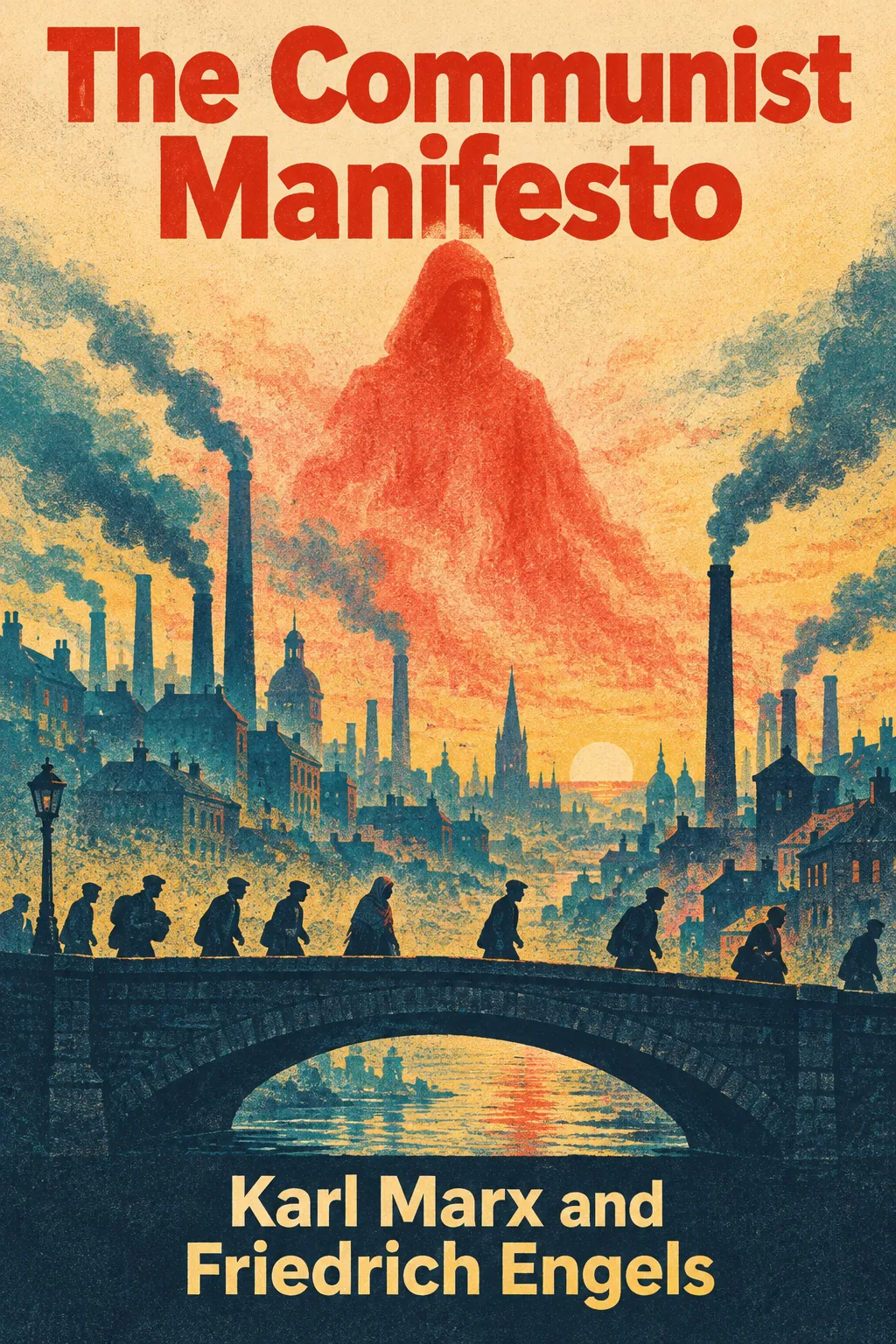
The Communist Manifesto
by Karl Marx and Friedrich Engels
The Communist Manifesto is a short pamphlet, published in London in February 1848, in which Karl Marx and Friedrich Engels set out a theory of history and a political programme. It claims that every society so far has been shaped by struggles between classes, that modern capitalism has split society into owners (the bourgeoisie) and wage workers (the proletariat), and that workers should organise across borders to end private ownership of the means of production.
The Big Idea
"The Manifesto argues that history is driven by conflict between social classes, that capitalism has created a working class strong enough to challenge it, and that the aim is a society without class divisions."
Key Insights
History as class struggle
The Manifesto explains social change through conflict between groups in different economic positions, not through great men or ideas alone. Slavery, feudalism and capitalism differ in form, it says, but each divides a ruling group from a ruled one.
Section I lists freeman and slave, lord and serf, guild master and journeyman, then says modern society has simplified these into two camps: owners and wage workers. Many later historians adopted the habit of reading history through economics, even when they rejected the conclusions.
Capitalism as creative and unstable
The text does not simply condemn capitalism. It admits that the bourgeoisie built wonders greater than pyramids and cathedrals and created a world market. It then argues that the system lurches into crises of overproduction and turns every relationship into a money transaction.
The line “all that is solid melts into air” captures how fast old customs and ranks are swept away. The image is still widely quoted in discussions of rapid technological and social change.
Workers' unity across borders
The authors say working people share interests by class, not by nation, so national movements should support one another. They answer the charge of disloyalty by arguing that workers must first win political power and become the leading class of their own nation.
The closing call, “Working Men of All Countries, Unite!”, became the pamphlet's best-known slogan. Section IV lists allies in England, America, France, Switzerland and Poland to show what such cooperation could look like.
Abolishing private ownership of production
The authors sum up their theory in one phrase: abolition of private property. They explain that this means ownership of factories, land and capital used to profit from others' labour, not people's personal possessions.
Section II lists ten measures, among them a heavy progressive income tax, the end of inheritance rights and free public education. Debate over these ideas continues, and the policies of later states that claimed Marx's name are a separate question from the text itself.
Chapter Breakdown
Chapter-by-chapter summary
This section walks through the whole pamphlet in order: a short preamble and four numbered sections.
Preamble: A Spectre Haunting Europe
The text opens with the image of communism as a “spectre” that Europe's rulers, from the Pope to the Tsar, are trying to chase away. Marx and Engels point out that “communist” has become an insult everyone throws at their rivals, even though no one has stated what communists actually want. They say it is time to set out their views openly, in a manifesto addressed to the world. Why it matters: it presents the pamphlet as the public statement of an organised group, the Communist League, and not as one thinker's essay.
Section I: Bourgeois and Proletarians
This is the longest section and the base of the whole argument. It begins by claiming that all history so far is the history of class struggle: freeman and slave, lord and serf, guild master and journeyman. Modern society, it says, has simplified this into two camps. The bourgeoisie, who own factories and capital, swept away feudal ties, opened a world market and made the cities dominate the countryside. But they also created the proletariat, workers who live only by selling their labour. The authors predict repeated economic crises and a growing workers' movement. Why it matters: every later claim rests on this view of history.
Section II: Proletarians and Communists
Here the authors explain how communists relate to the wider working-class movement. They say communists have no interests apart from the working class as a whole, but stress common aims across nations and look to the movement's future. The central demand is the abolition of bourgeois private property, meaning ownership of the means of production that lets some people live off the work of others. The authors then answer common objections about family, education, nationality, religion and freedom. The section ends with ten measures for advanced countries, including a progressive income tax, free public education and state control of credit and transport. Why it matters: this is the clearest statement of what the programme would change.
Section III: Socialist and Communist Literature
This part reviews rival schools of socialism and explains why the authors reject them. Feudal socialism, they say, is the lament of a declining aristocracy. Petty-bourgeois socialism wants to protect small craftsmen and farmers. “German” or “true” socialism turns French ideas into abstract philosophy. Conservative socialism wants to fix abuses without changing the system. Finally, the “critical-utopian” thinkers Saint-Simon, Fourier and Owen are credited with sharp insights but criticised for ignoring class struggle. Why it matters: Marx and Engels position their view as a historical analysis tied to a real movement, not a blueprint for an ideal community.
Section IV: Position of the Communists in Relation to the Various Existing Opposition Parties
The shortest section says communists should support every movement against the existing social and political order. It names the Chartists in England, agrarian reformers in the United States, Social-Democrats in France and radicals in Switzerland and Poland. In Germany, communists are to back the bourgeoisie against the monarchy whenever it acts in a revolutionary way, while preparing the workers' own fight. It closes by saying communists do not hide their aims, and with the call “Working Men of All Countries, Unite!” Why it matters: it turns analysis into a call to act.
Key people and terms
Karl Marx (1818–1883)
German philosopher, journalist and economist, aged 29 when the pamphlet appeared. He is regarded as its main drafter. He later wrote the multi-volume Capital, and his ideas became known as Marxism.
Friedrich Engels (1820–1895)
German social thinker from a textile-manufacturing family who had studied factory conditions in Manchester. He wrote an earlier draft, Principles of Communism, and edited later editions, including the authorised 1888 English translation.
The bourgeoisie
The class that owns capital and the means of production and hires wage labour for profit. The text credits it with enormous productive achievements, and also says it turns every human relationship into a cash payment.
The proletariat
The class of wage workers who own no means of production and must sell their labour to live. The authors present it as growing in numbers and organisation, and as the class that could end class society.
The Communist League
An international workers' association, mostly German exiles and craftsmen, formed in London in 1847. Its second congress, held in London in late 1847, asked Marx and Engels to write its public programme.
Class struggle
The conflict between ruling and ruled classes over wealth, labour and power. The Manifesto treats it as the main driver of historical change, from ancient slavery through feudalism to industrial capitalism.
Means of production
The factories, machines, land and tools used to make goods. The Manifesto targets their private ownership by a minority, not personal belongings, and calls for them to be held in common.
Utopian socialists
Early thinkers such as Saint-Simon, Fourier and Owen, who imagined ideal communities before 1848. The authors praise their insight but say they overlooked class struggle and the workers' own political action.
Writing about this book
You don't have to agree or disagree with the Manifesto to write well about it. A strong paper separates what the text says, what was happening in 1848, and what you think. Pick one passage and build from it.
- How does Section I describe the factory and the city, and what is different or similar today?
- Can the idea that history is class struggle explain another event you have studied? Where does it fail?
- The authors describe a world market reshaping every country. How does that compare with globalisation now?
- Which of the Manifesto's predictions came true, which did not, and what evidence would you use to decide?
Keep quotations short and put the rest in your own words. Treat the pamphlet and the later governments that used Marx's name as separate subjects, and say clearly which one you are discussing.
Take Action
Practical steps you can implement today:
-
Try explaining an event by asking which groups gained and lost economically; it is one useful lens among several.
-
Read an old political text twice: once for what it says, once for the 1848 world it came from.
-
Separate predictions from analysis, then check each prediction against what actually happened.
-
Read how a text answers its critics before judging it; Section II shows how the argument is built.
Notable Quotes
"“A spectre is haunting Europe — the spectre of Communism.” (Preamble)"
— Karl Marx and Friedrich Engels
"“The history of all hitherto existing society is the history of class struggles.” (Section I)"
— Karl Marx and Friedrich Engels
"“All that is solid melts into air.” (Section I)"
— Karl Marx and Friedrich Engels
"“The proletarians have nothing to lose but their chains. They have a world to win.” (Section IV)"
— Karl Marx and Friedrich Engels
"“Working Men of All Countries, Unite!” (Section IV)"
— Karl Marx and Friedrich Engels
Who Should Read This
Suited to high school and university students in history, politics, economics or philosophy, and to adults who want to read the source behind so many references. The pamphlet is short, but its terms are unfamiliar, so this guide works well as a first pass before the text itself.
Frequently Asked Questions
What is The Communist Manifesto about?
It is a short pamphlet by Karl Marx and Friedrich Engels, published in 1848. It argues that history is a series of class struggles, that capitalism divided modern society into owners and wage workers, and that workers should unite internationally and replace private ownership of production with common ownership.
When and why was the Manifesto written?
It was published in London in February 1848 in German. The Communist League, a small international workers' group, asked Marx and Engels to write its public programme at a congress in late 1847. Revolutions broke out across Europe that same year.
What are the ten measures in Section II?
They are steps proposed for advanced countries, including a heavy progressive income tax, abolishing inheritance, centralising credit and transport in the state, expanding state-owned factories, equal liability to work, and free public education for all children. The authors say they would vary by country.
Was the Manifesto widely read at first?
Not very. It had little circulation in 1848. It became far better known from the 1870s onward, was translated into many languages, and the authorised English version by Samuel Moore, edited by Engels, appeared in 1888. Today it is among the most printed political texts.
How is it different from Capital?
The Manifesto is a short political document from 1848 meant to state a movement's aims to a wide audience. Capital, whose first volume appeared in 1867, is Marx's long, detailed economic analysis of how capitalism works. Many readers start with the Manifesto for the overall picture.
Check Your Understanding
Pick an answer for each question to see if you were right.
-
In which year was The Communist Manifesto first published?
1848 — It appeared in London in February 1848, shortly before the revolutions of that year.
-
Which group asked Marx and Engels to write the Manifesto?
The Communist League — The Communist League, formed in London in 1847, commissioned a public statement of its programme.
-
According to Section I, which two classes dominate modern society?
Bourgeoisie and proletariat — The authors say capitalism has simplified older class divisions into owners of capital and wage workers.
-
How does Section III treat the “critical-utopian” socialists such as Fourier and Owen?
It praises their insight but says they overlooked class struggle — The authors credit their critiques of society but argue they lacked a view of the working class as an active force.
-
Which slogan closes the Manifesto?
Working Men of All Countries, Unite! — The final line of Section IV is the call to unite across borders.
About Karl Marx and Friedrich Engels
Karl Marx (1818–1883) was a German philosopher, journalist and economist. Friedrich Engels (1820–1895) was a German social thinker from a textile-manufacturing family. They met in the 1840s and worked together for the rest of their lives. Their ideas, later called Marxism, shaped debates in economics, politics and history.
Summary Written By

Software Engineer & Writer
Software engineer with a passion for distilling complex ideas into actionable insights. Writes about finance, investment, entrepreneurship, and technology.
View all summaries →Reviews
No reviews yet. Be the first to share your thoughts!
Write a Review
Keep reading
Explore the topic: Science & IdeasSummaries

Educated by Tara Westover
Tara Westover
A memoir about a young woman born to survivalists in Idaho who, despite having no formal schooling, teaches herself to…

Atomic Habits: An Easy & Proven Way to Build Good Habits & Break Bad Ones
James Clear
No matter your goals, Atomic Habits offers a proven framework for improving–every day. James Clear, one of the world’s leading…
Think and Grow Rich
Napoleon Hill
What if the secrets to wealth and success weren’t hidden in complex financial strategies, but within the power of your…

Melbourne
Alex Ng
Sophie Cunningham's Melbourne is a deeply personal exploration of Australia's cultural capital, weaving together history, architecture, weather patterns, and personal…
Articles
Das Kapital (Capital) Explained
Das Kapital is Karl Marx's analysis of how capitalism works. Volume 1 appeared in 1867 and argued that profit comes…
Capitalism vs Socialism
Capitalism leaves most property and production in private hands and lets markets and profit steer the economy. Socialism puts key…
Marxism Explained
Marxism is a set of ideas developed by Karl Marx and Friedrich Engels in the mid-1800s. It argues that economic…