Capitalism vs socialism in five minutes
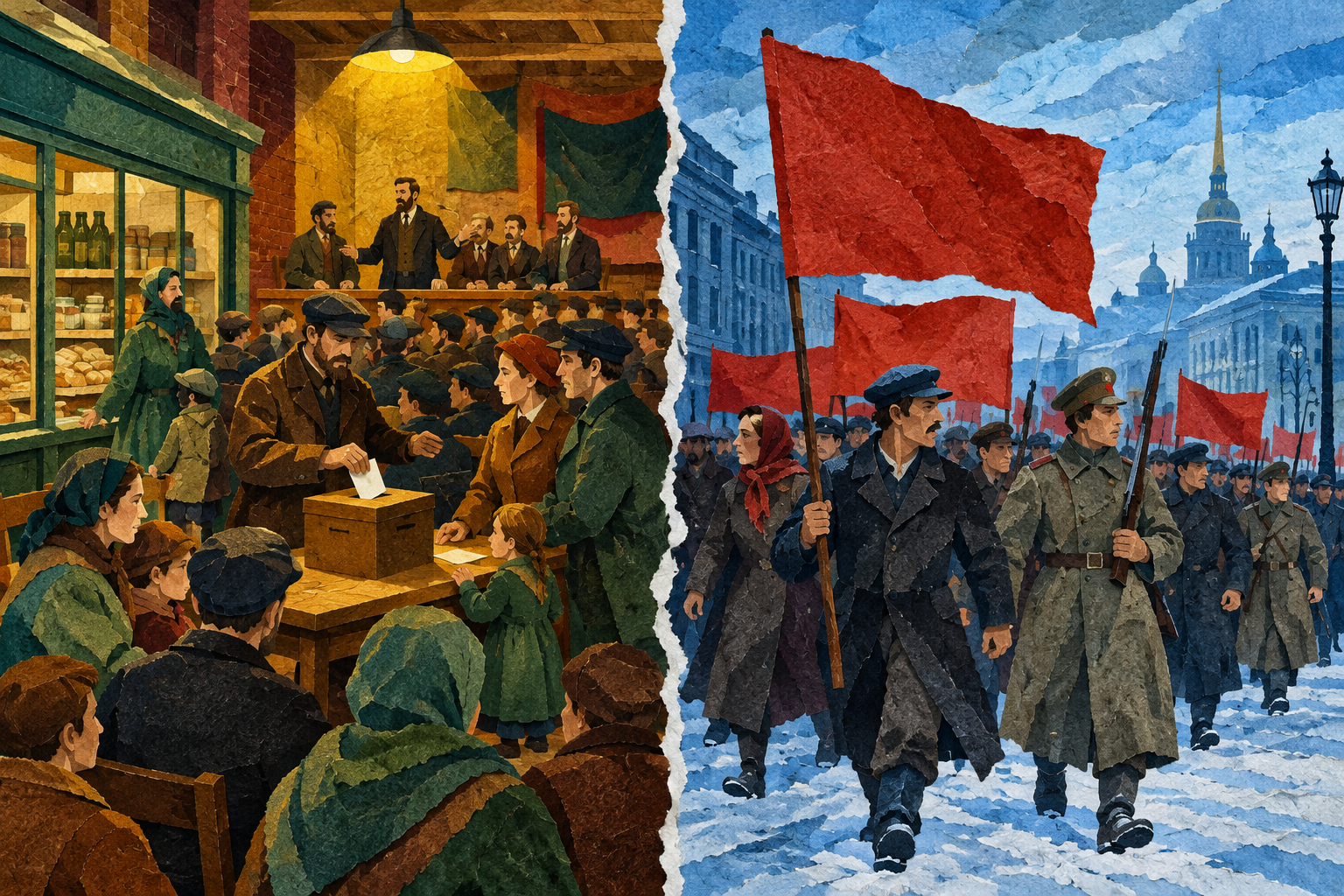
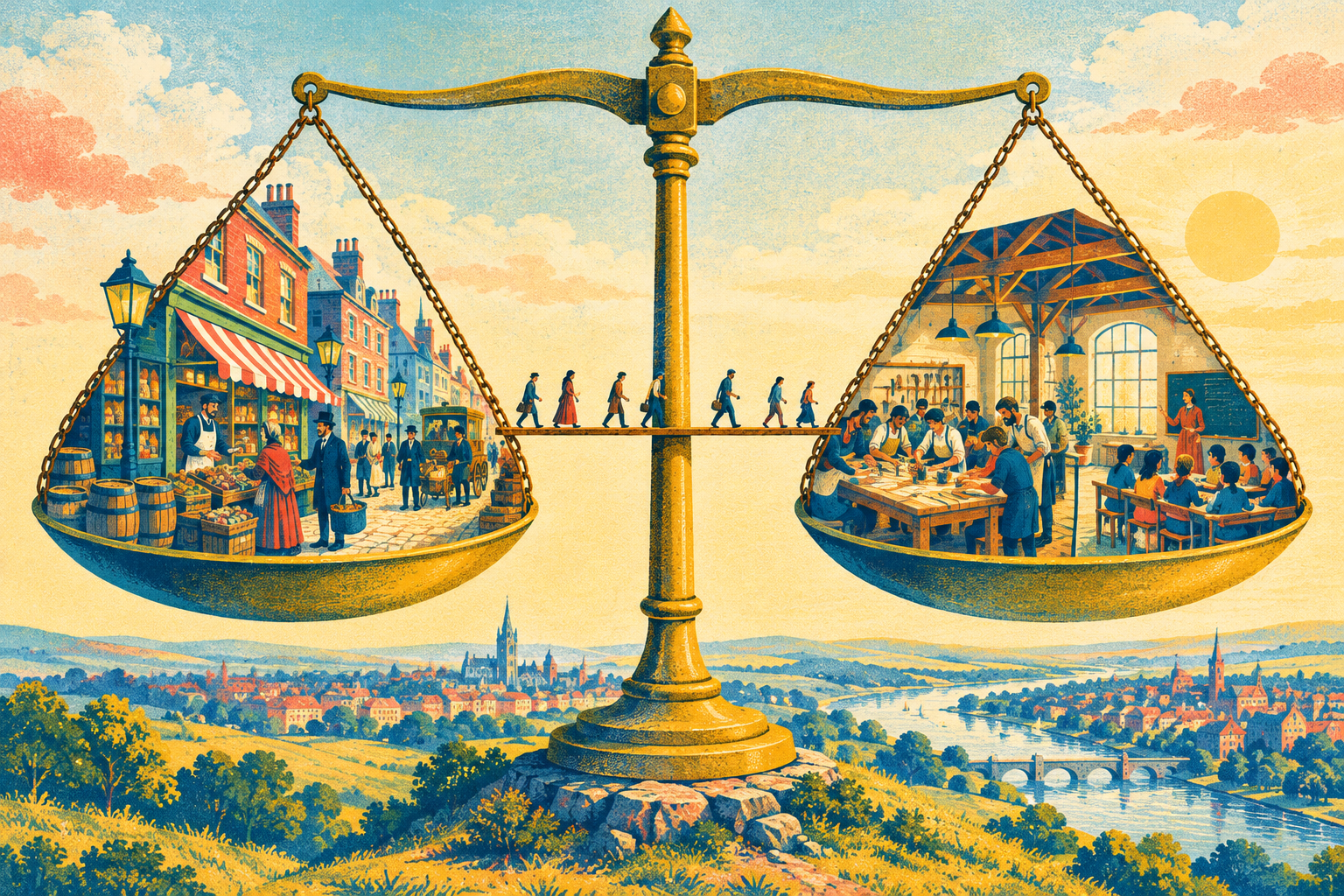
Capitalism and socialism are two answers to one question: who should own the farms, factories and shops, and who decides what gets made? Under capitalism, private owners and companies hold most of them, and prices set in markets guide production. Under socialism, the community, the state or workers' groups own the main ones, and the goal is to share the results more evenly.
Both ideas took shape in the 1800s, as factories changed how people lived. This page belongs to Ideas That Shaped the 19th Century, where you can see how they sit beside liberalism and nationalism. The most useful thing to know early is that no country runs on either idea alone. Almost every economy today is a mix, so the real debates are about how much market, how much state, and who benefits.
The main differences
- Ownership: capitalism relies on private ownership of land, factories and companies. Socialism puts key industries under public, state or cooperative ownership.
- Who decides: in a capitalist economy, millions of buyers and sellers decide through prices. In a fully planned socialist economy, a central authority sets output targets and often prices as well.
- Motive: capitalism runs on profit and competition. Socialism aims at meeting needs and narrowing the gap between rich and poor.
- Work: under capitalism most people sell their labour for wages. Socialists argue that this leaves workers with less power than owners, and they want workers to share control or ownership.
- Strengths claimed: supporters of capitalism point to innovation, choice and growth. Supporters of socialism point to security, fairness and shared services.
- Weaknesses claimed: critics of capitalism point to inequality and boom-and-bust cycles. Critics of socialism point to weak incentives, shortages under central planning and concentrated political power.
Where the two ideas came from
Capitalism grew over centuries of trade and enterprise, but it received its most famous explanation in 1776, when the Scottish thinker Adam Smith published The Wealth of Nations. Smith argued that people pursuing their own interest in competitive markets could, as if guided by an “invisible hand,” end up providing what society needs. He also backed public works and rules against abuse, so he was no champion of a free-for-all.
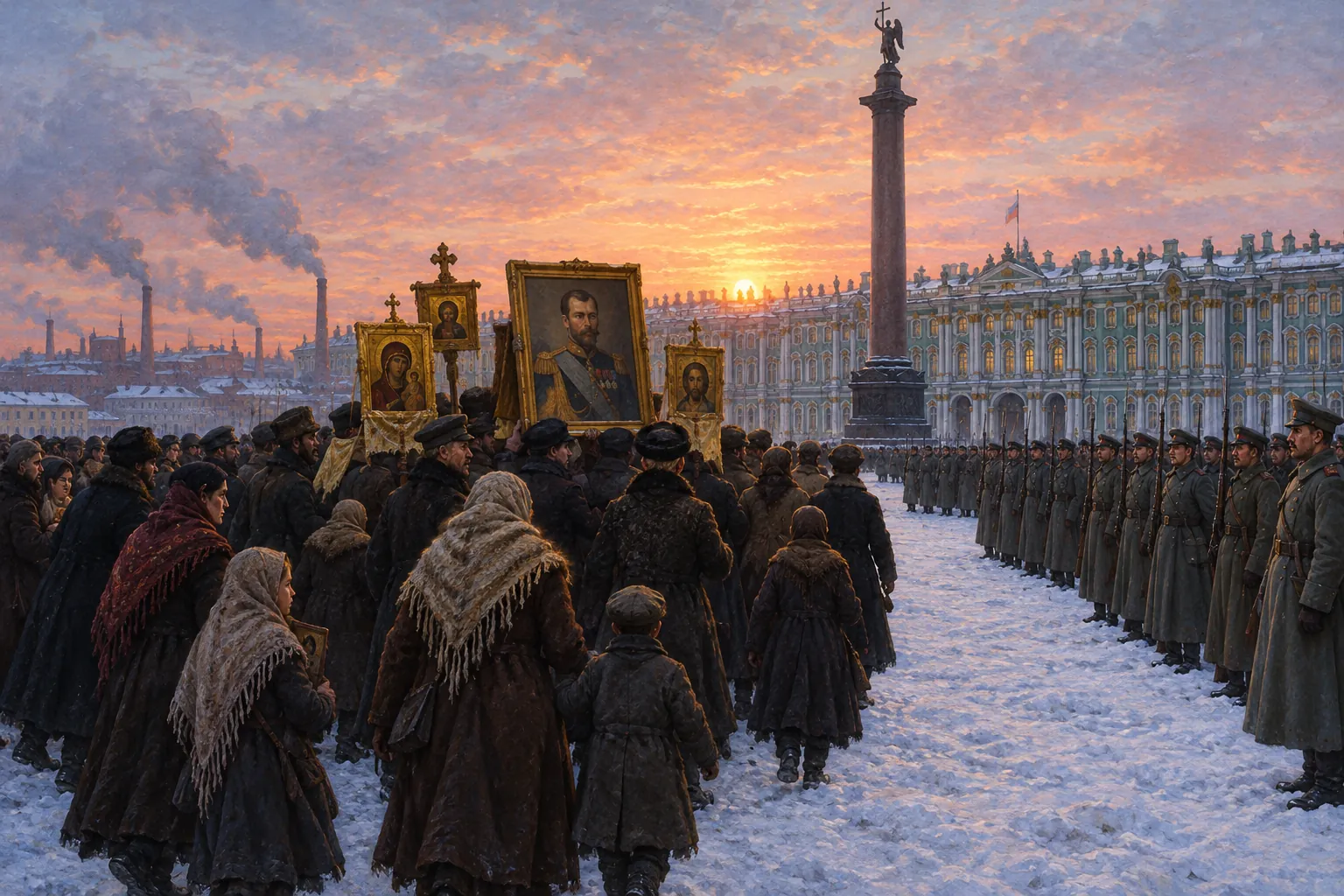
Industrialisation then brought crowded cities, long hours and child labour to Britain. Some reformers responded by trying to build fairer communities. The Welsh-born mill manager Robert Owen took charge of the New Lanark mills in Scotland in 1800 and tried shorter hours and schooling for children. The word “socialism” spread in the 1820s and 1830s among followers of Owen in Britain and of Saint-Simon in France.
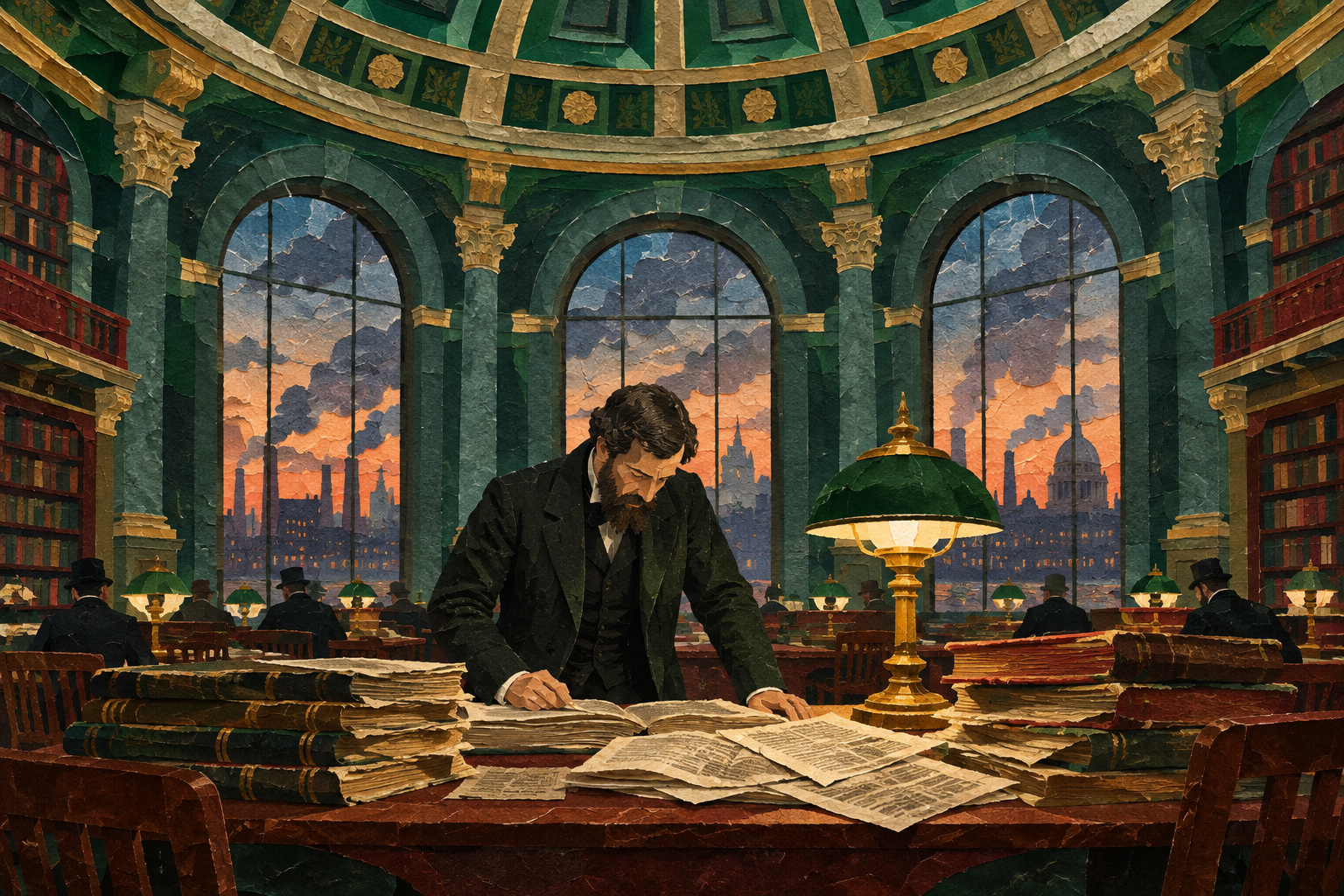
Karl Marx and Friedrich Engels gave the idea its hardest edge. In The Communist Manifesto (1848) they described history as a struggle between classes, and in Capital (volume one, 1867) Marx analysed how owners profit from the labour of workers. They argued that workers should one day take over the means of production. Marx called his approach “scientific” and the earlier reformers “utopian.” The article Utopian vs Scientific Socialism explains that split.
Two big experiments in the 20th century
After the Russian Revolution of 1917, the Soviet Union built the best-known socialist planned economy. From 1928, five-year plans set output targets for heavy industry and farming. The system industrialised quickly, but it also meant shortages of consumer goods, forced collectivisation of farms with terrible famine in the early 1930s, and a one-party state that allowed little dissent. The Soviet Union dissolved in December 1991.
Capitalist countries had their own crisis. After the 1929 stock market crash, the Great Depression left millions unemployed in the United States and Europe. Governments took on new roles: the American New Deal began in 1933, and the economist John Maynard Keynes argued in The General Theory (1936) that governments should spend to support demand in downturns. Many historians describe the result as regulated, or reformed, capitalism.
The Cold War then presented the two systems as rival camps, yet each side borrowed from the other. Western Europe built welfare states, such as Britain's National Health Service in 1948, while Soviet-bloc countries tolerated small private plots and black markets. The Berlin Wall opened in November 1989, and by 1991 the Soviet system was gone.
Mixed economies: what most countries do
Today, nearly every country combines private firms with public services. In the 1880s Germany's chancellor Otto von Bismarck, no socialist, introduced health, accident and old-age insurance partly to weaken the socialist movement. Britain expanded public health care after 1948, and Japan brought in universal health insurance in 1961.
The Nordic countries (Denmark, Sweden, Norway and Finland) are often called socialist in debates, but they are market economies with private companies, open trade and high taxes that pay for generous public services. Denmark's prime minister said so directly in 2015. China is the reverse case: since reforms began in 1978 it has allowed markets and private business under one-party rule, and it describes the result as a “socialist market economy,” a goal formally set out in 1992.
So the practical question is rarely “capitalism or socialism?” It is how large the public share should be, what it should cover and how to design it well.
Common mix-ups
- Socialism is not the same as communism. Communism, in Marx's sense, is a later stage with no classes or state, and in the 20th century the word came to mean one-party rule by a Communist party. See Socialism vs Communism.
- Public spending is not socialism by itself. Roads, schools and pensions exist in capitalist countries too. Socialism in the stricter sense is about ownership of the means of production.
- Capitalism is not “no rules.” Every capitalist economy depends on courts, contracts, property law and, in modern times, regulation of safety, competition and labour.
What exams ask
AP-style questions usually want you to compare the two systems on ownership, decision-making, incentives and a real example, then judge how well each handled a crisis. Be ready for these points:
- Adam Smith, 1776, markets and the “invisible hand.”
- Marx and Engels, the 1848 Manifesto, class struggle.
- Planned economy (Soviet five-year plans from 1928) versus market economy.
- The Great Depression, the New Deal and Keynes as a turning point for capitalism.
- Mixed economies and welfare states as the common outcome.
Read next
- Socialism vs Communism: What's the Difference? clears up the two words people confuse most.
- Utopian vs Scientific Socialism shows how Owen and Saint-Simon differ from Marx.
- What Is Nationalism? covers the other great idea that was reshaping Europe at the same time.