In five minutes: Italian unification
Italian unification (the Risorgimento, meaning "resurgence") was the process, from about 1815 to 1871, in which the separate states of the Italian peninsula became one country. The Kingdom of Italy was proclaimed on 17 March 1861, and the capture of Rome on 20 September 1870 finished the main work. This page is part of our hub on 19th-century Europe: revolutions, nationalism and unification.
The short version has four steps. First, the Congress of Vienna in 1815 put the old rulers back and kept Italy divided. Second, nationalist revolts in 1820, 1831 and 1848–49 failed. Third, Piedmont-Sardinia, led by Count Cavour, allied with France and won Lombardy in 1859, and Garibaldi's volunteers then conquered the south in 1860. Fourth, Venetia joined in 1866 and Rome in 1870.
Why Italy was divided in 1815
After Napoleon's fall, the Congress of Vienna (1814–15) restored the old order. The peninsula was split into the Kingdom of Sardinia (Piedmont, Savoy and Sardinia), ruled by the House of Savoy; Lombardy and Venetia, which belonged directly to Austria; the duchies of Parma and Modena and the Grand Duchy of Tuscany, ruled by relatives of the Habsburgs; the Papal States in the centre; and the Kingdom of the Two Sicilies in the south, under the Bourbons. The Austrian chancellor Metternich is famous for calling Italy a "geographical expression": a name on a map, not a nation.
Yet Napoleon's rule had left something behind: shared law codes, modern administration and the idea that Italians might form one state. Secret societies such as the Carbonari tried to force constitutions in Naples and Piedmont in 1820–21 and in central Italy in 1831. Austrian troops or local rulers crushed them. Daily life also divided Italy. Each state had its own customs duties, coins and weights, railways were few, and most people spoke local dialects. Standard Italian was used by only a small educated minority.
Three visions of a united Italy
Giuseppe Mazzini, a republican from Genoa, founded Young Italy in 1831. He wanted one democratic republic, made by the people's own efforts. His writing inspired a generation, though his uprisings failed. You can read more in Giuseppe Mazzini and Young Italy.
The priest Vincenzo Gioberti proposed in 1843 a loose federation of Italian states with the pope as its president. Many Catholics liked this idea, and it gained strength when Pius IX, elected in 1846, seemed liberal. The third path was a union led by the kingdom of Piedmont-Sardinia, the only Italian state ruled by an Italian dynasty with a real army. In the end this path won, partly because the other two lost their chance in 1848–49.
1848–49: the revolutions fail
In March 1848 Milan rose against Austria in the "Five Days", and King Charles Albert of Piedmont-Sardinia declared war to help. In April, Pius IX refused to fight a Catholic power, and many patriots lost faith in a papal-led Italy. The Austrians, under Marshal Radetzky, won at Custoza in July 1848 and again at Novara on 23 March 1849. Charles Albert abdicated in favour of his son, Victor Emmanuel II.
Elsewhere, republics rose and fell. Venice held out under Daniele Manin until August 1849. The Roman Republic, led by Mazzini with Garibaldi as its military defender, ended in July 1849 when French troops restored the pope. Almost everything was undone, with one exception: Victor Emmanuel kept the liberal constitution, the Statuto, that his father had granted. That made Piedmont-Sardinia the hope of Italian liberals.
Cavour and the war of 1859
Camillo Benso, Count of Cavour, became prime minister of Piedmont-Sardinia in 1852. He was a practical liberal who built railways, cut tariffs and reformed finance. He knew Piedmont could not beat Austria alone. In 1855 he sent about 15,000 soldiers to the Crimean War on the side of Britain and France. That earned Piedmont a seat at the 1856 Paris peace conference, where he raised the Italian question.
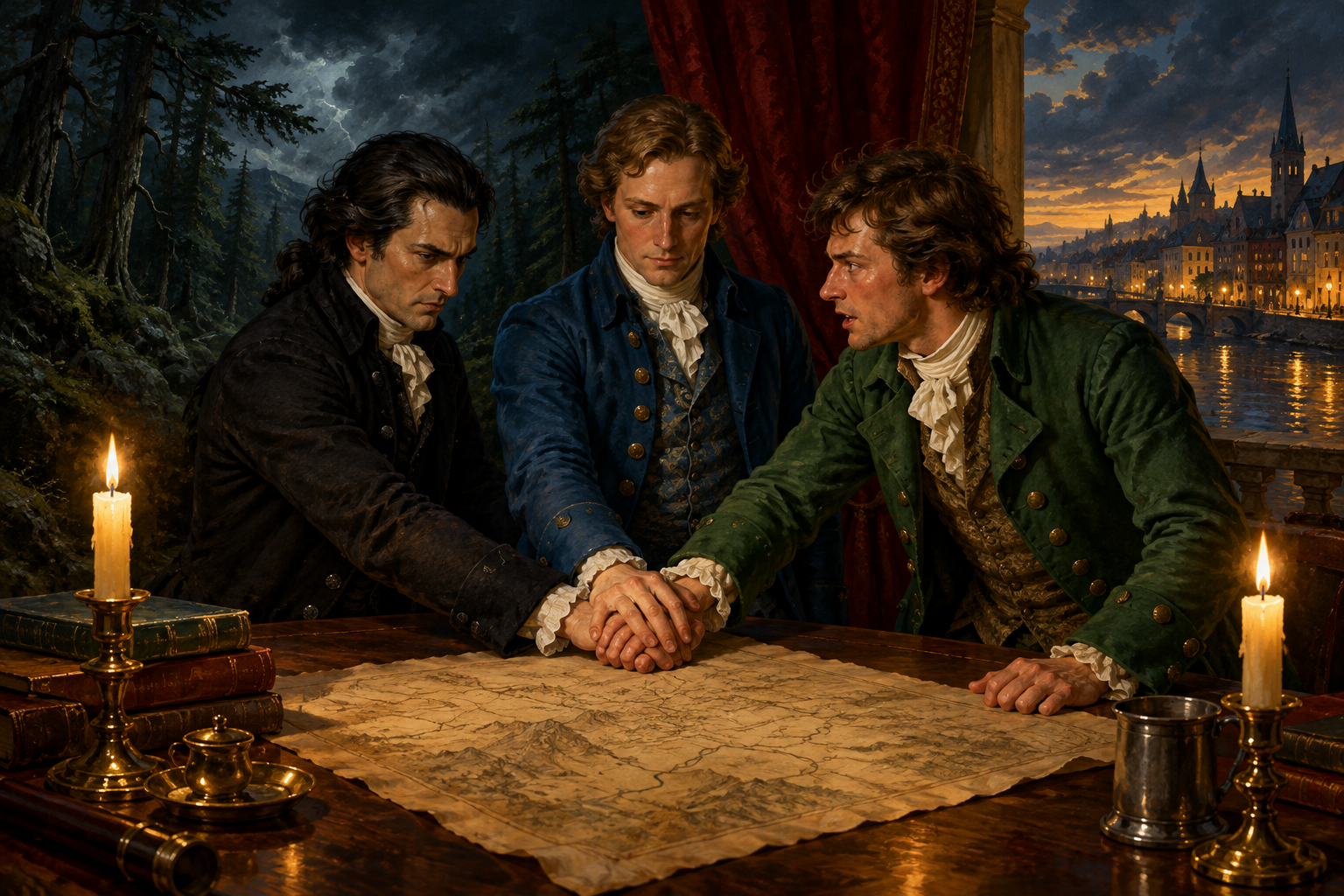
In July 1858 Cavour met Napoleon III of France at Plombières and agreed a plan: France would fight if Austria attacked Piedmont, and in return France would receive Savoy and Nice. Cavour's manoeuvres led Austria to send an ultimatum, and war began in April 1859. French and Piedmontese forces won at Magenta (4 June) and Solferino (24 June). Shocked by the casualties and worried about Prussia, Napoleon III agreed an armistice at Villafranca on 11 July. Piedmont gained Lombardy but not Venetia, and Cavour resigned in anger before returning in January 1860. In 1860 Tuscany, Parma, Modena and Romagna voted by plebiscite to join Piedmont, and France received Savoy and Nice.
1860: Garibaldi and the Thousand
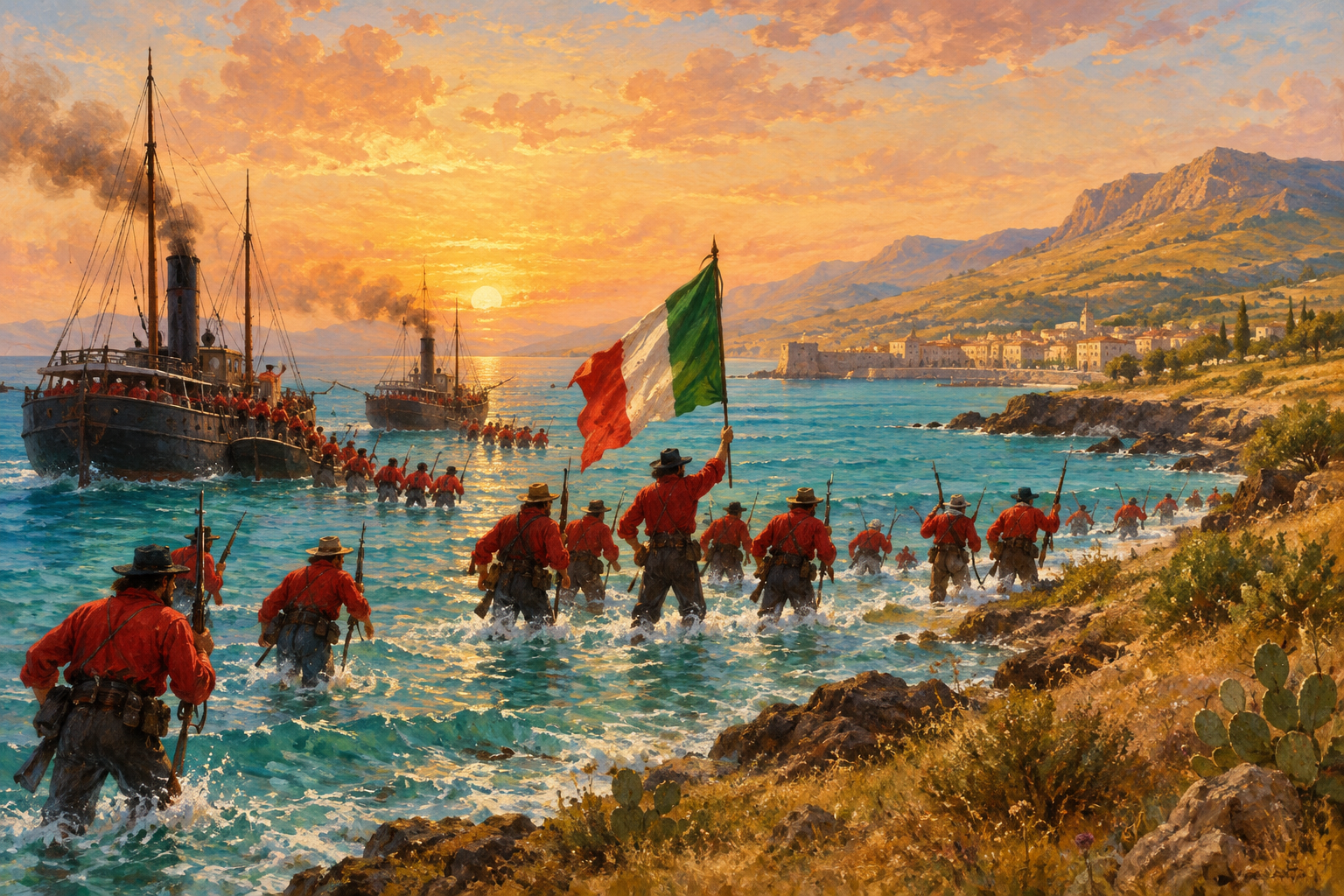
Giuseppe Garibaldi, a veteran of the Roman Republic of 1849, was the movement's most famous soldier. In May 1860, after a revolt began in Sicily against the Bourbon king, he sailed from near Genoa with about 1,000 volunteers, known as the Red Shirts. Cavour stayed officially out of it but did not stop it. The volunteers landed at Marsala on 11 May, won at Calatafimi on 15 May and took Palermo at the end of the month. In August Garibaldi crossed to the mainland, and on 7 September he entered Naples as the Bourbon king Francis II withdrew to Gaeta.
Garibaldi now wanted to march on Rome, which would have meant a clash with the French troops who protected the pope. Cavour acted first. In September Piedmontese troops entered the Papal States and beat the papal army at Castelfidardo (18 September), leaving Rome itself alone. On 26 October at Teano, Garibaldi greeted Victor Emmanuel II as King of Italy and handed over the south, then retired to the island of Caprera. After plebiscites in the south and centre, the first Italian parliament met in Turin, and the Kingdom of Italy was proclaimed on 17 March 1861. Cavour died on 6 June 1861, less than three months later.
Venice and Rome, 1866–1870
Two regions were still missing. In 1866 Italy allied with Prussia against Austria. The Italian army and navy did badly, losing at Custoza and at sea at Lissa, but Prussia crushed Austria at Königgrätz. Austria gave up Venetia (through France), and a plebiscite in October confirmed the union.
Rome was harder. Under the September Convention of 1864, France promised to withdraw its troops, and Italy moved its capital from Turin to Florence in 1865. Garibaldi's attempts to seize Rome failed at Aspromonte (1862) and Mentana (1867), where French and papal troops beat him. Then in 1870 the Franco-Prussian War forced France to bring its garrison home. Italian troops breached the walls at Porta Pia on 20 September 1870 and entered Rome. A plebiscite followed, and Rome became the capital in 1871.
Consequences: a state without a nation yet
The pope, Pius IX, refused to accept the loss of Rome and treated himself as a prisoner in the Vatican. Italy passed the Law of Guarantees in 1871 to protect the pope's position, but he rejected it. The "Roman Question" lasted until the Lateran Treaty of 1929, which created Vatican City.
The new state spread Piedmont's constitution and laws across the peninsula. At first only a small fraction of the population, around two in every hundred people, could vote. The south, poorer and often hostile to the new rulers, saw years of rural revolt in the 1860s, put down by a large military campaign. Trentino and Trieste stayed Austrian until after the First World War, which gave rise to the nationalist cause of "unredeemed Italy". The unification of Italy also changed the balance of power in Europe. Together with Prussia's victories it showed that borders could be redrawn by diplomacy and war; compare it in German vs Italian Unification.
What exams ask
- The four key people: Mazzini (ideas and republicanism), Cavour (diplomacy), Garibaldi (volunteer force) and Victor Emmanuel II (the crown). Be ready to compare their methods.
- Foreign powers: France helped in 1859, Prussia in 1866, and the Franco-Prussian War opened the way to Rome in 1870. Italy did not unify by its own strength alone.
- Dates: 1815, 1831, 1848–49, 1859, 1860, 17 March 1861, 1866 and 20 September 1870.
- Significance (AP style): unification came "from above" through a monarchy and diplomacy, not through Mazzini's popular revolution, and it left regional gaps and the Roman Question.
- Typical essay: why did Piedmont-Sardinia, not a republic, lead unification? The answer: it had an army, a constitution, a capable minister and powerful allies.
Read next
- Giuseppe Mazzini and Young Italy: the republican thinker who made unity a mass idea.
- German vs Italian Unification: how two nations were made in the same decades in very different ways.
- Otto von Bismarck: The Iron Chancellor: the Prussian statesman whose wars helped Italy win Venice and Rome.